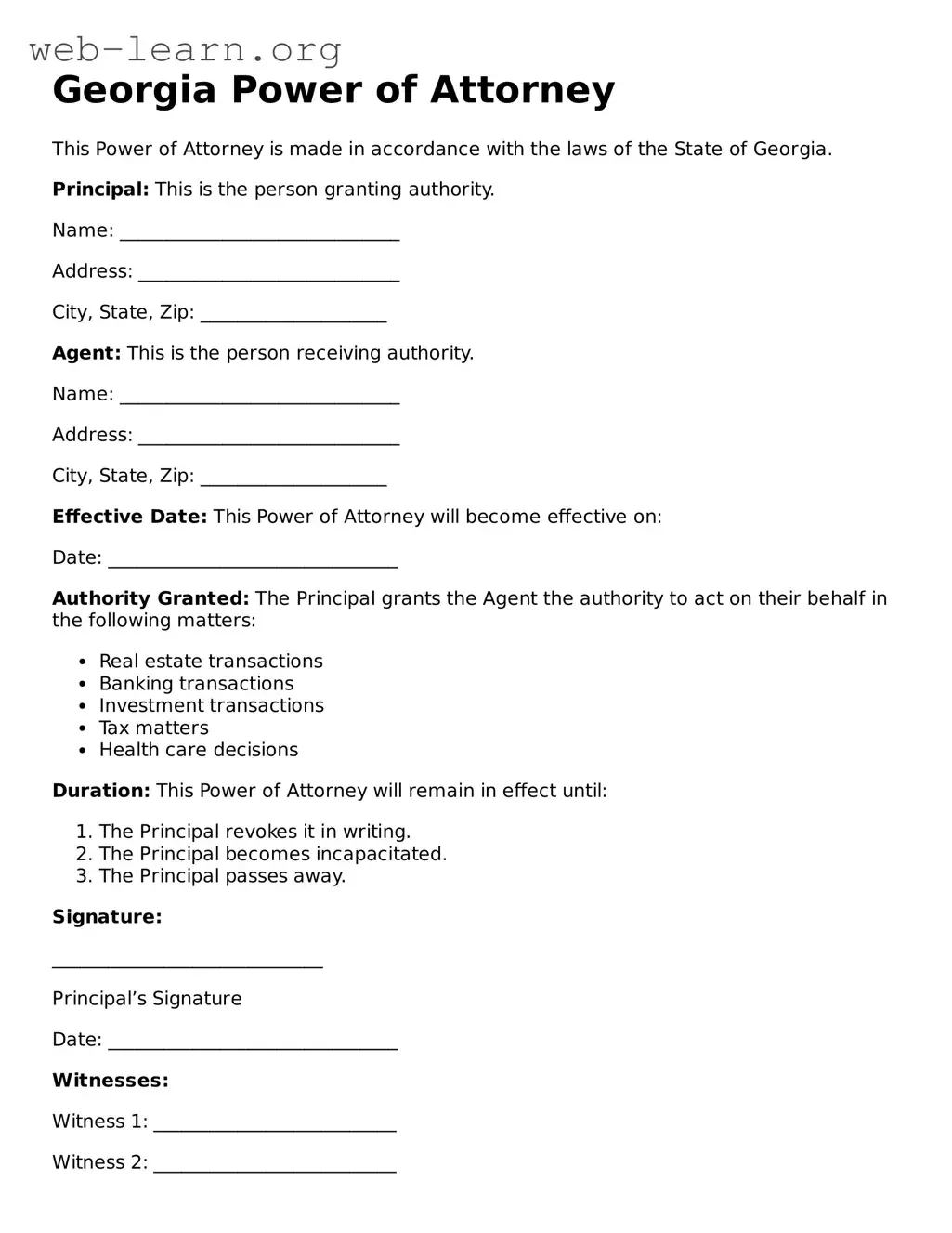
In the state of Georgia, the Power of Attorney form serves as a vital legal document that allows individuals to appoint someone else to make decisions on their behalf. This form can be especially important in situations where a person may be unable to handle their own affairs due to illness, absence, or incapacity. The appointed individual, known as the agent or attorney-in-fact, can be granted broad authority or limited powers, depending on the specific needs of the person creating the document. Key aspects of the Georgia Power of Attorney include the ability to manage financial matters, make healthcare decisions, and handle real estate transactions. Furthermore, the form must be signed and notarized to ensure its validity, providing peace of mind that the appointed agent can act in the best interest of the individual. Understanding the nuances of this form is essential for anyone considering its use, as it plays a crucial role in ensuring that personal and financial affairs are managed according to one's wishes.
Georgia Power of Attorney
This Power of Attorney is made in accordance with the laws of the State of Georgia.
Principal: This is the person granting authority.
Name: ______________________________
Address: ____________________________
City, State, Zip: ____________________
Agent: This is the person receiving authority.
Name: ______________________________
Address: ____________________________
City, State, Zip: ____________________
Effective Date: This Power of Attorney will become effective on:
Date: _______________________________
Authority Granted: The Principal grants the Agent the authority to act on their behalf in the following matters:
Duration: This Power of Attorney will remain in effect until:
Signature:
_____________________________
Principal’s Signature
Date: _______________________________
Witnesses:
Witness 1: __________________________
Witness 2: __________________________
Notarization:
State of Georgia
County of ____________________________
Subscribed and sworn to before me on this _____ day of __________, 20__.
_______________________________
Notary Public
My commission expires: _______________
| Fact Name | Description |
|---|---|
| Definition | The Georgia Power of Attorney form allows an individual (the principal) to designate another person (the agent) to act on their behalf in legal and financial matters. |
| Governing Law | This form is governed by the Official Code of Georgia Annotated (O.C.G.A.) § 10-6-140 et seq., which outlines the requirements and powers granted through a power of attorney. |
| Durability | A Georgia Power of Attorney can be durable, meaning it remains effective even if the principal becomes incapacitated, unless explicitly stated otherwise. |
| Revocation | The principal can revoke the power of attorney at any time, as long as they are mentally competent, by providing a written notice to the agent and any relevant third parties. |
Filling out the Georgia Power of Attorney form is an important step in designating someone to act on your behalf. This process requires careful attention to detail to ensure that the document accurately reflects your wishes. Once completed, the form should be signed, dated, and potentially notarized, depending on your specific needs and circumstances.
Once you have filled out the form, ensure that you keep it in a safe place and provide a copy to your agent. This will help facilitate any actions they may need to take on your behalf.
What is a Power of Attorney in Georgia?
A Power of Attorney (POA) is a legal document that allows one person to act on behalf of another. In Georgia, this document can grant broad or limited powers. It can be used for various purposes, such as managing finances, making medical decisions, or handling real estate transactions. The person granting the authority is called the "principal," while the person receiving the authority is known as the "agent" or "attorney-in-fact."
How do I create a Power of Attorney in Georgia?
To create a valid Power of Attorney in Georgia, follow these steps:
Once completed, keep a copy for yourself and provide copies to your agent and any relevant institutions.
Can I revoke a Power of Attorney in Georgia?
Yes, you can revoke a Power of Attorney at any time, as long as you are mentally competent. To revoke it, you need to create a written document stating that you are revoking the previous POA. Make sure to sign it and have it notarized. After revocation, inform your agent and any institutions that were using the original POA. This helps prevent any confusion.
What happens if I become incapacitated?
If you become incapacitated and have a valid Power of Attorney in place, your agent can step in to make decisions on your behalf. This can include financial matters or healthcare decisions, depending on the powers you granted. If you did not create a POA before becoming incapacitated, your loved ones may need to go through a court process to obtain guardianship, which can be time-consuming and complicated.
Filling out a Power of Attorney form can be a straightforward process, but many people make common mistakes that can lead to complications. One significant error is not clearly identifying the principal and the agent. The principal is the person granting authority, while the agent is the one receiving it. If their names are misspelled or not clearly stated, it can create confusion about who is involved.
Another frequent mistake is failing to specify the powers being granted. The form should clearly outline what decisions the agent can make on behalf of the principal. If these powers are vague or not included, the agent may not have the authority to act when needed.
People often overlook the importance of signing the document in the appropriate places. The principal must sign the form, and in some cases, witnesses or a notary public may also need to sign. Missing any required signatures can render the document invalid.
Additionally, individuals may forget to date the Power of Attorney. Without a date, it can be unclear when the authority was granted, which may lead to questions about its validity in the future.
Another common mistake is not considering the type of Power of Attorney being created. There are different types, such as durable, medical, or limited Power of Attorney. Choosing the wrong type can limit the agent's ability to act effectively when necessary.
People sometimes fail to communicate their intentions clearly with their agent. It’s essential for the principal to discuss their wishes and expectations with the agent to ensure that the agent understands their role and responsibilities.
In some cases, individuals may neglect to keep copies of the completed form. Having multiple copies is crucial for both the principal and the agent, as well as for any institutions that may need to verify the authority granted.
Another mistake involves not reviewing the form for accuracy after filling it out. Simple typos or errors can lead to misunderstandings. A thorough review can help catch mistakes before the form is submitted.
Some people may also fail to inform relevant parties about the Power of Attorney. It is important to notify banks, healthcare providers, and other institutions that may need to recognize the agent’s authority.
Lastly, individuals might underestimate the importance of revoking previous Powers of Attorney. If a new form is created without revoking the old one, confusion may arise regarding which document is currently valid. Ensuring that only one Power of Attorney is active at a time is crucial for clarity and effectiveness.
When creating a Power of Attorney (POA) in Georgia, several other forms and documents may also be necessary to ensure that your wishes are clearly outlined and legally recognized. Below is a list of commonly used documents that often accompany a Georgia Power of Attorney form. Each document plays a specific role in the process, helping to clarify intentions and provide additional legal protections.
Understanding these accompanying documents can help ensure that all aspects of legal authority and personal wishes are addressed. It is always advisable to consult with a legal professional to ensure that all documents are completed correctly and in accordance with Georgia law.
The Power of Attorney (POA) form is a crucial legal document that grants one person the authority to act on behalf of another. Several other documents share similarities with the POA, each serving specific purposes while empowering individuals to make decisions for others. Below are nine documents that are comparable to the Power of Attorney form:
Understanding these documents can help individuals make informed decisions about who they trust to act on their behalf in various situations. Each serves a unique purpose but shares the underlying principle of delegation of authority.
When filling out a Georgia Power of Attorney form, it's essential to approach the task with care. Here are some important dos and don'ts to keep in mind:
By following these guidelines, you can ensure that your Power of Attorney form is filled out correctly and serves your needs effectively.
Many individuals have misconceptions about the Georgia Power of Attorney form. Understanding these misconceptions can help clarify the role and function of this important legal document.
While many people associate Power of Attorney with financial transactions, it can also cover healthcare decisions. A durable Power of Attorney for healthcare allows someone to make medical decisions on your behalf if you are unable to do so.
This is not true. A Power of Attorney can be revoked at any time, as long as the principal is mentally competent. It is essential to provide written notice to the agent and any relevant institutions.
While it is advisable to consult a lawyer to ensure that the document meets all legal requirements, individuals can create a Power of Attorney on their own using state-approved forms.
Agents must act in the best interest of the principal and follow their wishes as outlined in the document. Any actions taken outside of this scope can be challenged legally.
Anyone, regardless of age or health status, can benefit from having a Power of Attorney. Life can be unpredictable, and having this document in place can provide peace of mind.
The powers granted to an agent depend on what is specified in the document. It does not automatically provide access to all personal information unless explicitly stated.
A durable Power of Attorney remains effective even if the principal becomes incapacitated. This is one of its key features, ensuring that someone can act on your behalf when you cannot.
By addressing these misconceptions, individuals can make informed decisions regarding the use of a Power of Attorney in Georgia.
When filling out and using the Georgia Power of Attorney form, it's essential to keep several key points in mind. Understanding these aspects can help ensure that the document serves its intended purpose effectively.
By keeping these takeaways in mind, individuals can navigate the process of creating and utilizing a Power of Attorney in Georgia with greater confidence and clarity.
Alabama Power of Attorney Form - This document can ensure that your financial matters are handled efficiently.
Florida Power of Attorney - Power of Attorney can simplify transactions like selling property or managing investments.