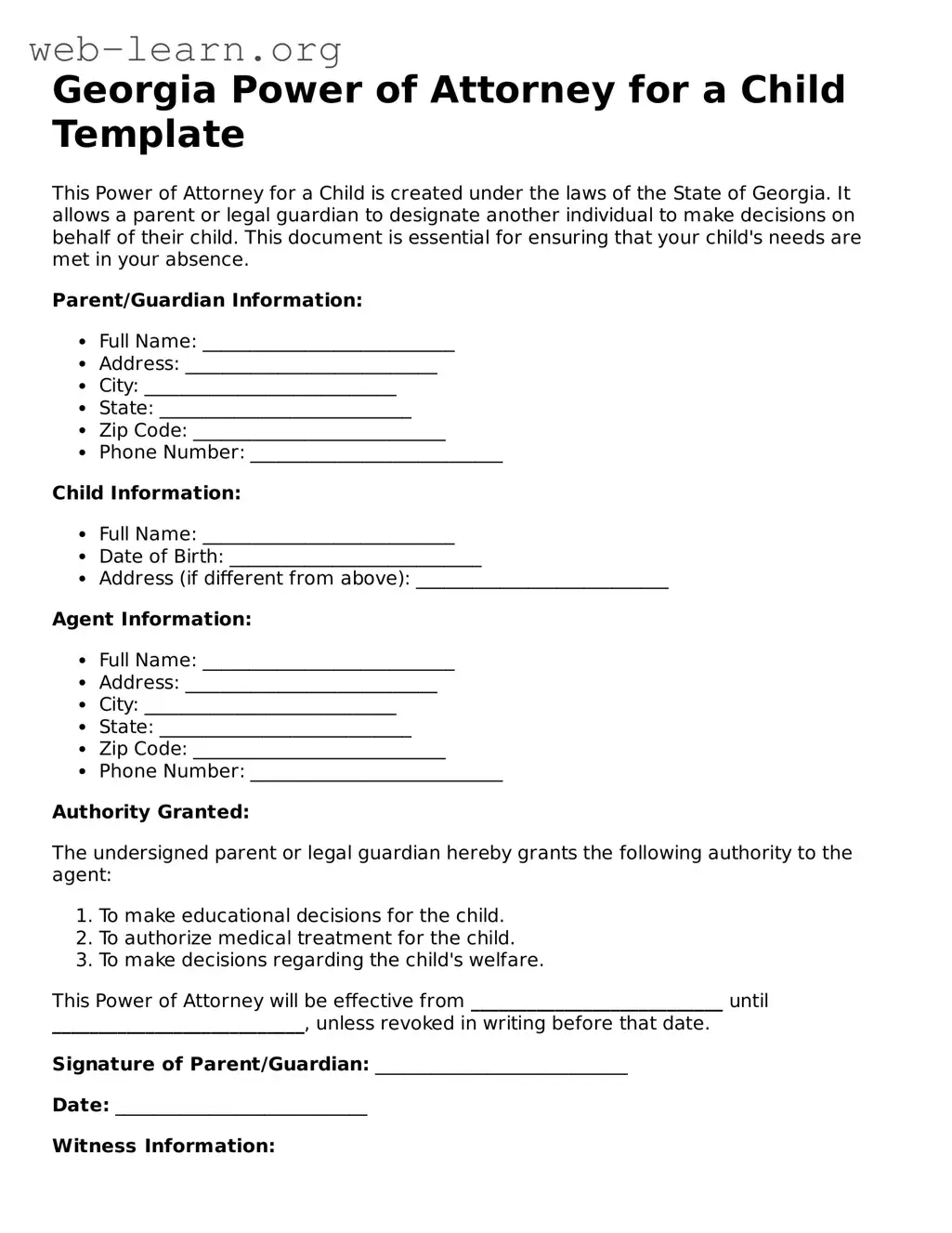
The Georgia Power of Attorney for a Child form serves as a vital legal document that enables parents or guardians to designate another adult to make decisions on behalf of their child. This form is particularly useful in situations where parents are temporarily unavailable, such as during travel or military deployment. By granting this authority, the designated individual, often referred to as the agent, can manage essential aspects of the child's welfare, including medical care, education, and day-to-day activities. The form requires specific information about both the child and the appointed agent, ensuring clarity and legality in the delegation of responsibilities. Importantly, it is designed to be straightforward, allowing parents to easily navigate the process while ensuring that their child's best interests remain the priority. Understanding the nuances of this form is crucial, as it not only provides peace of mind but also safeguards the child's well-being in the absence of their primary caregivers.
Georgia Power of Attorney for a Child Template
This Power of Attorney for a Child is created under the laws of the State of Georgia. It allows a parent or legal guardian to designate another individual to make decisions on behalf of their child. This document is essential for ensuring that your child's needs are met in your absence.
Parent/Guardian Information:
Child Information:
Agent Information:
Authority Granted:
The undersigned parent or legal guardian hereby grants the following authority to the agent:
This Power of Attorney will be effective from ___________________________ until ___________________________, unless revoked in writing before that date.
Signature of Parent/Guardian: ___________________________
Date: ___________________________
Witness Information:
Signature of Witness: ___________________________
Date: ___________________________
| Fact Name | Details |
|---|---|
| Purpose | The Georgia Power of Attorney for a Child form allows a parent or guardian to grant temporary authority to another adult to care for their child. |
| Duration | This power of attorney is typically valid for a specific period, often up to one year, unless revoked earlier. |
| Governing Law | The form is governed by the Official Code of Georgia Annotated (O.C.G.A.) § 19-9-120 et seq. |
| Signatures Required | The form must be signed by the parent or guardian and may need to be notarized for validity. |
| Limitations | The agent cannot make decisions regarding the child's education or medical treatment unless specifically authorized. |
| Revocation | The parent or guardian can revoke the power of attorney at any time, provided they notify the agent in writing. |
After obtaining the Georgia Power of Attorney for a Child form, it is essential to complete it accurately to ensure that the designated individual can act on behalf of the child. Follow these steps carefully to fill out the form correctly.
Once the form is completed and notarized, it should be kept in a safe place. The designated individual can then use it as needed to make decisions regarding the child's welfare.
A Power of Attorney for a Child in Georgia is a legal document that allows a parent or guardian to designate another adult to make decisions on behalf of their child. This can include decisions related to education, healthcare, and general welfare. The form is particularly useful when parents are unable to care for their child temporarily due to travel, illness, or other circumstances.
The agent, often referred to as the attorney-in-fact, can be any responsible adult that the parent or guardian trusts. This could be a family member, friend, or neighbor. However, it is essential to choose someone who is willing and able to take on the responsibilities outlined in the document.
The agent can make a variety of decisions, including:
It is important to specify the extent of the authority granted in the Power of Attorney form to ensure that the agent understands their role.
The Power of Attorney for a Child remains in effect until the specified expiration date, if one is provided, or until it is revoked by the parent or guardian. Parents should be aware that this document does not typically last beyond the child reaching the age of majority, which is 18 in Georgia.
Revoking a Power of Attorney for a Child can be done by providing a written notice to the agent and any relevant parties, such as schools or healthcare providers. This notice should clearly state the intention to revoke the authority granted in the original document. It is advisable to keep a copy of the revocation for personal records.
Filling out the Georgia Power of Attorney for a Child form can be straightforward, but many people make mistakes that can lead to complications. One common error is not providing complete information. It’s crucial to fill in all required fields, including the names and addresses of both the child and the agent. Omitting even one detail can render the document invalid.
Another frequent mistake is failing to specify the duration of the power of attorney. Without a clear start and end date, the authority granted may be questioned. This can lead to confusion about when the agent can act on behalf of the child. Always include the specific time frame to avoid any potential issues.
People often overlook the need for signatures. Both the parent or guardian and the agent must sign the document. Not having these signatures can invalidate the power of attorney. It’s essential to double-check that all necessary parties have signed before submitting the form.
Lastly, many individuals neglect to have the document notarized. In Georgia, notarization is typically required for the power of attorney to be legally binding. Without a notary’s seal, the document may not be recognized by schools, medical facilities, or other institutions. Ensure that you follow this step to protect your child’s interests.
The Georgia Power of Attorney for a Child form is often accompanied by several other documents that facilitate the legal authority and responsibilities concerning a child. Below is a list of commonly used forms and documents that may be relevant in conjunction with this power of attorney.
These documents collectively help ensure that the child’s welfare is prioritized and that legal authority is clearly established. It is important to review each form carefully to ensure compliance with state regulations and to address the specific needs of the child.
When filling out the Georgia Power of Attorney for a Child form, it's essential to navigate the process carefully. Here’s a list of ten important dos and don’ts to keep in mind.
By following these guidelines, you can ensure that the process goes smoothly and that the best interests of the child are prioritized. Taking the time to fill out this form correctly can make a significant difference in ensuring their well-being.
Many people have misunderstandings about the Georgia Power of Attorney for a Child form. Here are some common misconceptions:
Understanding these misconceptions can help ensure that the Power of Attorney for a Child is used effectively and appropriately.
When filling out and using the Georgia Power of Attorney for a Child form, there are several important considerations to keep in mind. Here are key takeaways to guide you through the process:
By following these guidelines, you can ensure that the Power of Attorney for a Child form is filled out correctly and used effectively. This will help provide peace of mind for both you and your child.
Does a Power of Attorney Need to Be Notarized in Connecticut - This form is particularly useful for families with multiple caregivers or guardians.
Idaho Power of Attorney Requirements - This form is used to grant temporary authority to someone else for specific responsibilities regarding a child.
Does a Power of Attorney Need to Be Notarized in Arizona - It provides peace of mind for parents during times of separation.