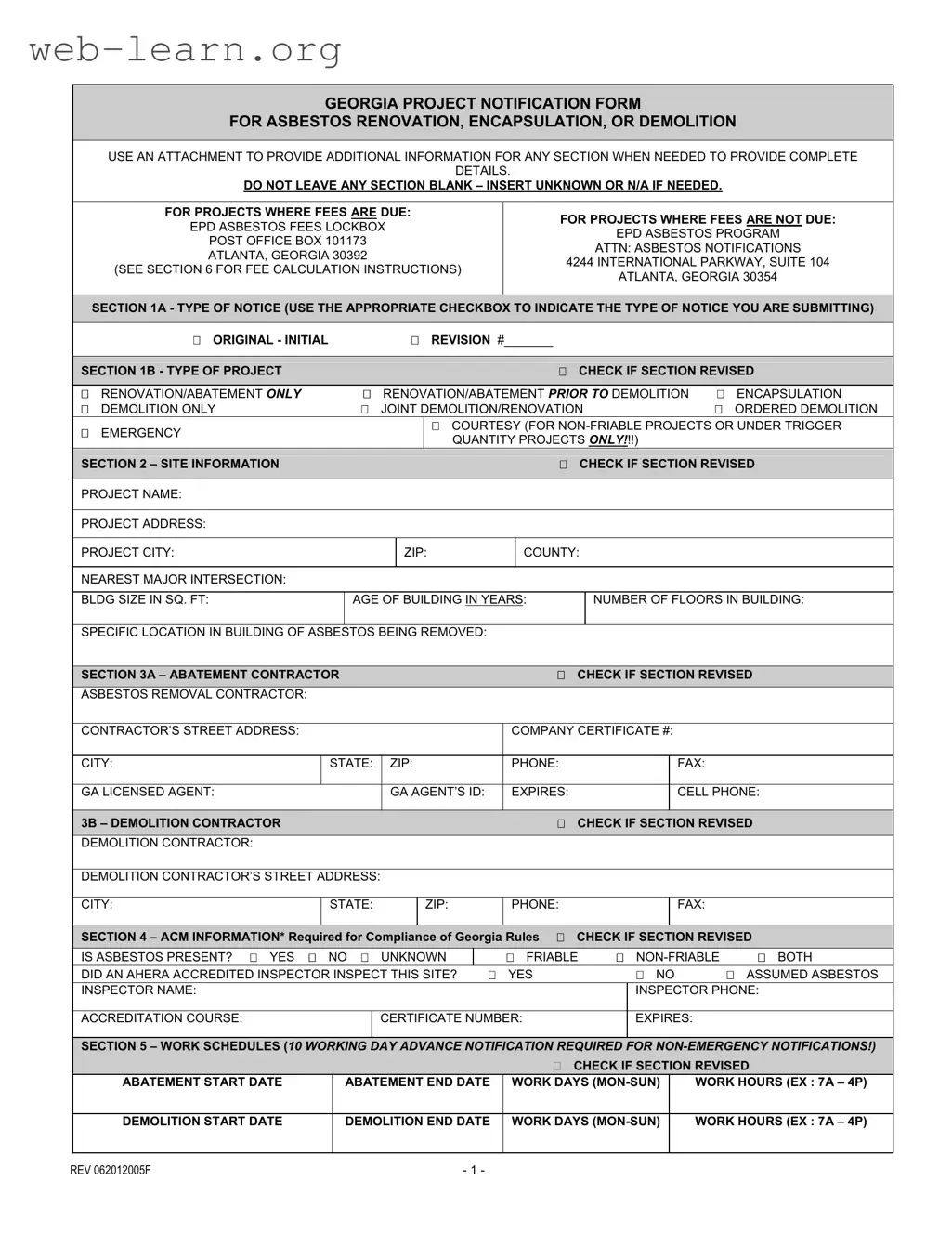
The Georgia Notification Form for Asbestos Renovation, Encapsulation, or Demolition is a critical document designed to ensure compliance with state regulations regarding asbestos management. This form serves multiple purposes, including notifying the Environmental Protection Division (EPD) of planned asbestos-related activities and providing essential project details. It requires users to specify the type of notice—whether original or a revision—and to categorize the project accurately, such as renovation, demolition, or encapsulation. Detailed site information is essential, including the project name, address, building size, and age. The form also mandates the inclusion of contractor details, both for asbestos abatement and demolition, ensuring that qualified personnel are involved in the project. Furthermore, it addresses the presence of asbestos-containing materials (ACM), requiring information on inspections and the type of ACM being handled. Work schedules must be outlined, including start and end dates for abatement and demolition activities, and the form includes a section for calculating any applicable fees based on the amount and type of ACM. Finally, the form emphasizes the importance of accurate information and certification, holding project stakeholders accountable for compliance with federal and state regulations. Completing this form accurately is not just a bureaucratic requirement; it is a fundamental step in safeguarding public health and the environment during asbestos-related projects.
GEORGIA PROJECT NOTIFICATION FORM
FOR ASBESTOS RENOVATION, ENCAPSULATION, OR DEMOLITION
USE AN ATTACHMENT TO PROVIDE ADDITIONAL INFORMATION FOR ANY SECTION WHEN NEEDED TO PROVIDE COMPLETE
DETAILS.
DO NOT LEAVE ANY SECTION BLANK – INSERT UNKNOWN OR N/A IF NEEDED.
FOR PROJECTS WHERE FEES ARE DUE:
EPD ASBESTOS FEES LOCKBOX
POST OFFICE BOX 101173
ATLANTA, GEORGIA 30392
(SEE SECTION 6 FOR FEE CALCULATION INSTRUCTIONS)
FOR PROJECTS WHERE FEES ARE NOT DUE:
EPD ASBESTOS PROGRAM
ATTN: ASBESTOS NOTIFICATIONS
4244 INTERNATIONAL PARKWAY, SUITE 104
ATLANTA, GEORGIA 30354
SECTION 1A - TYPE OF NOTICE (USE THE APPROPRIATE CHECKBOX TO INDICATE THE TYPE OF NOTICE YOU ARE SUBMITTING)
|
|
|
ORIGINAL - INITIAL |
|
|
|
REVISION #_______ |
|
|
|
|
||||
|
|
|
|
|
|
|
|
|
|
|
|
||||
|
SECTION 1B - TYPE OF PROJECT |
|
|
|
|
|
|
CHECK IF SECTION REVISED |
|||||||
|
|
|
|
|
|
|
|
|
|
|
|
|
|
||
|
|
RENOVATION/ABATEMENT ONLY |
RENOVATION/ABATEMENT PRIOR TO DEMOLITION |
|
ENCAPSULATION |
||||||||||
|
|
DEMOLITION ONLY |
|
JOINT DEMOLITION/RENOVATION |
|
|
|
ORDERED DEMOLITION |
|||||||
|
|
EMERGENCY |
|
|
|
|
|
|
COURTESY (FOR |
||||||
|
|
|
|
|
|
|
QUANTITY PROJECTS ONLY!!!) |
|
|
||||||
|
|
|
|
|
|
|
|
|
|
|
|||||
|
SECTION 2 – SITE INFORMATION |
|
|
|
|
|
|
CHECK IF SECTION REVISED |
|||||||
|
|
|
|
|
|
|
|
|
|
|
|
|
|
|
|
|
PROJECT NAME: |
|
|
|
|
|
|
|
|
|
|
|
|
|
|
|
|
|
|
|
|
|
|
|
|
|
|
|
|
|
|
|
PROJECT ADDRESS: |
|
|
|
|
|
|
|
|
|
|
|
|
|
|
|
|
|
|
|
|
|
|
|
|
|
|
|
|
||
|
PROJECT CITY: |
|
|
|
|
ZIP: |
|
|
COUNTY: |
|
|
|
|
||
|
|
|
|
|
|
|
|
|
|
|
|
|
|
||
|
NEAREST MAJOR INTERSECTION: |
|
|
|
|
|
|
|
|
|
|
|
|||
|
|
|
|
|
|
|
|
|
|||||||
|
BLDG SIZE IN SQ. FT: |
|
|
AGE OF BUILDING IN YEARS: |
NUMBER OF FLOORS IN BUILDING: |
||||||||||
|
|
|
|
|
|
|
|
|
|
|
|||||
|
SPECIFIC LOCATION IN BUILDING OF ASBESTOS BEING REMOVED: |
|
|
|
|
|
|
||||||||
|
|
|
|
|
|
|
|
|
|
|
|||||
|
SECTION 3A – ABATEMENT CONTRACTOR |
|
|
|
|
|
|
CHECK IF SECTION REVISED |
|||||||
|
|
|
|
|
|
|
|
|
|
|
|
|
|
||
|
ASBESTOS REMOVAL CONTRACTOR: |
|
|
|
|
|
|
|
|
|
|
|
|||
|
|
|
|
|
|
|
|
|
|
|
|
||||
|
CONTRACTOR’S STREET ADDRESS: |
|
|
|
|
|
COMPANY CERTIFICATE #: |
|
|
||||||
|
|
|
|
|
|
|
|
|
|
|
|||||
|
CITY: |
|
STATE: |
ZIP: |
|
PHONE: |
|
FAX: |
|
|
|||||
|
|
|
|
|
|
|
|
||||||||
|
GA LICENSED AGENT: |
|
GA AGENT’S ID: |
EXPIRES: |
|
CELL PHONE: |
|||||||||
|
|
|
|
|
|
|
|
|
|
||||||
|
3B – DEMOLITION CONTRACTOR |
|
|
|
|
|
|
CHECK IF SECTION REVISED |
|||||||
|
|
|
|
|
|
|
|
|
|
|
|
|
|||
|
DEMOLITION CONTRACTOR: |
|
|
|
|
|
|
|
|
|
|
|
|||
DEMOLITION CONTRACTOR’S STREET ADDRESS:
CITY:
STATE:
ZIP:
PHONE:
FAX:
SECTION 4 – ACM INFORMATION* Required for Compliance of Georgia Rules |
CHECK IF SECTION REVISED |
||||||||
IS ASBESTOS PRESENT? YES |
NO UNKNOWN |
|
FRIABLE |
|
BOTH |
||||
DID AN AHERA ACCREDITED INSPECTOR INSPECT THIS SITE? |
|
YES |
|
|
NO |
|
ASSUMED ASBESTOS |
||
INSPECTOR NAME: |
|
|
|
|
|
|
INSPECTOR PHONE: |
||
|
|
|
|
|
|
|
|
||
ACCREDITATION COURSE: |
|
CERTIFICATE NUMBER: |
|
|
EXPIRES: |
|
|
||
|
|
|
|||||||
SECTION 5 – WORK SCHEDULES (10 WORKING DAY ADVANCE NOTIFICATION REQUIRED FOR |
|||||||||
|
|
|
|
|
CHECK IF SECTION REVISED |
||||
ABATEMENT START DATE |
ABATEMENT END DATE |
WORK DAYS |
WORK HOURS (EX : 7A – 4P) |
||||||
DEMOLITION START DATE
DEMOLITION END DATE
WORK DAYS
WORK HOURS (EX : 7A – 4P)
REV 062012005F |
- 1 - |

SECTION 6 – ACM AMOUNTS, TYPE CODES, AND FEE CALCULATION
CHECK IF SECTION REVISED
FIRST, LOCATE THE MATERIAL TO BE REMOVED IN COLUMN A. COLUMN B SHOWS THE USUAL NESHAP CATEGORY FOR THE
MATERIAL. COLUMN C SHOWS THE CATEGORY THE MATERIAL WILL LIKELY BECOME DURING ABATEMENT, AND THAT IS THE CODE THAT SHOULD BE USED FOR COMPLETING THIS FORM. NOW, ENTER THE SQ. FT AND/OR L.F. AMOUNTS OF ACM TO BE ABATED DURING THIS PROJECT UNDER THE CORRECT HEADING ACCORDING TO TYPE IN COLUMN D, E, AND/OR F. THEN, LOCATE THE CORRESPONDING TYPE CODE(S) FOR THE MATERIAL(S) IN COLUMN G AND ENTER THE CODES IN THE SPACES PROVIDED BEFORE PROCEEDING TO THE FEE CALCULATION SECTION.
|
Column A |
|
|
|
Column B |
|
Column C |
|
SF OR LF AMOUNT TO BE ABATED |
|
Column |
||||||||||||
|
|
|
|
|
|
|
DURING PROJECT |
|
|
|
G |
||||||||||||
|
|
|
|
|
|
|
|
|
|
|
|
|
|
|
|
|
|
|
|||||
|
|
|
|
|
USUAL NESHAP CATEGORY |
|
WILL |
|
|
|
|
|
|
|
|
|
|
||||||
|
|
|
|
|
|
|
|
|
|
|
|
|
LIKELY |
|
Column D |
|
|
Column E |
|
Column F |
|
ACM |
|
|
ACM TYPE |
|
Category |
|
Category |
|
|
|
|
BECOME |
|
|
|
|
|
TYPE |
|||||||
|
|
|
RACM |
|
|
Category I |
|
|
Category 2 |
|
RACM |
|
|||||||||||
|
|
|
|
|
1 |
2 |
|
|
|
|
|
WHEN |
|
|
|
|
|
|
|
|
CODE |
||
|
|
|
|
|
|
|
|
|
|
|
|
|
ABATED |
|
|
|
|
|
|
|
|
|
|
|
ASBESTOS ASPHALT SHINGLES |
|
|
√ |
|
|
|
|
|
|
|
1 OR RACM |
|
|
|
|
|
|
|
|
|
AAS |
|
|
ASBESTOS CEMENT (TRANSITE) PANELS |
|
|
|
|
|
√ |
|
|
√ |
|
|
2 OR RACM |
|
|
|
|
|
|
|
|
|
ACP |
|
ASBESTOS CEMENT (TRANSITE) ROOFING |
|
|
|
|
√ |
|
|
√ |
|
|
RACM |
|
|
|
|
|
|
|
|
ACR |
||
|
ASBESTOS CEMENT (TRANSITE) SIDING SHINGLES |
|
|
|
|
|
√ |
|
|
√ |
|
|
RACM |
|
|
|
|
|
|
|
|
|
ACS |
|
ASBESTOS FLASHING |
|
|
√ |
|
|
|
|
√ |
|
1 |
|
|
|
|
|
|
|
|
|
AF |
||
|
ASBESTOS GASKET |
|
|
|
√ |
|
|
|
|
√ |
|
|
1 OR RACM |
|
|
|
|
|
|
|
|
|
AG |
|
BOILER INSULATION |
|
|
|
|
|
|
|
√ |
|
|
RACM |
|
|
|
|
|
|
|
|
|
BI |
|
|
|
|
|
√ |
|
|
|
|
|
|
|
1 OR RACM |
|
|
|
|
|
|
|
|
BUR |
||
|
COVE (BASEBOARD) MOLDING MASTIC |
|
|
√ |
|
|
|
|
|
|
1 |
|
|
|
|
|
|
|
|
|
CM |
||
|
CEILING PLASTER |
|
|
|
|
|
|
|
|
√ |
|
|
RACM |
|
|
|
|
|
|
|
|
|
CP |
|
CEILING TILE |
|
|
|
|
|
|
|
√ |
|
|
RACM |
|
|
|
|
|
|
|
|
|
CT |
|
|
DUCT SEAM MASTIC |
|
|
|
√ |
|
|
|
|
|
|
|
1 |
|
|
|
|
|
|
|
|
DSM |
|
|
DUCT VIBRATION DAMPENERS |
|
|
√ |
|
|
|
|
√ |
|
|
1 OR RACM |
|
|
|
|
|
|
|
|
DVD |
||
|
EXTERIOR (OUTSIDE) DUCT INSULATION |
|
|
|
√ |
|
|
|
|
√ |
|
|
RACM |
|
|
|
|
|
|
|
|
|
EDI |
|
FELT DUCT TAPE |
|
|
|
|
|
|
|
√ |
|
|
RACM |
|
|
|
|
|
|
|
|
|
FDT |
|
|
FLOOR MASTIC |
|
|
|
√ |
|
|
|
|
|
|
|
1 |
|
|
|
|
|
|
|
|
|
FM |
|
FIREPROOFING |
|
|
|
|
|
|
|
√ |
|
|
RACM |
|
|
|
|
|
|
|
|
|
FP |
|
|
FIREPROOFING AND OVERSPRAY |
|
|
|
|
|
|
|
|
√ |
|
|
RACM |
|
|
|
|
|
|
|
|
|
FPO |
|
FLOOR TILE |
|
|
√ |
|
|
|
|
|
|
|
1 OR RACM |
|
|
|
|
|
|
|
|
|
FT |
|
|
FLOOR TILE AND MASTIC |
|
|
|
√ |
|
|
|
|
|
|
|
1 OR RACM |
|
|
|
|
|
|
|
|
|
FTM |
|
INTERIOR (INSIDE) DUCT INSULATION |
|
|
√ |
|
|
|
|
√ |
|
|
RACM |
|
|
|
|
|
|
|
|
|
IDI |
|
|
JOINT COMPOUND ONLY |
|
|
|
|
|
|
|
|
√ |
|
|
RACM |
|
|
|
|
|
|
|
|
|
JC |
|
LIGHT WEIGHT CONCRETE |
|
|
|
|
√ |
|
|
√ |
|
|
RACM |
|
|
|
|
|
|
|
|
LWC |
||
|
OTHER: FLOOR LEVELING COMPOUND, CAULKING, |
|
|
|
|
|
√ |
|
|
√ |
|
|
2 OR RACM |
|
|
|
|
|
|
|
|
OTR |
|
|
ETC. |
|
|
|
|
|
|
|
|
|
|
|
|
|
|
|
|
|
|
|
|
||
|
|
|
|
|
|
|
|
|
|
|
|
|
|
|
|
|
|
|
|
|
|
|
|
|
PIPE INSULATION STRAIGHT RUNS |
|
|
|
|
|
|
|
√ |
|
RACM |
|
|
|
|
|
|
|
|
|
PI |
||
|
PIPE INSULATION ELBOWS AND FITTINGS |
|
|
|
|
|
|
|
|
√ |
|
|
RACM |
|
|
|
|
|
|
|
|
|
PIE |
|
RESILIENT FLOOR COVERINGS (SHEET FLOORING; |
|
|
√ |
|
|
|
|
√ |
|
1 OR RACM |
|
|
|
|
|
|
|
|
|
RFC |
||
|
LINOLEUM) |
|
|
|
|
|
|
|
|
|
|
|
|
|
|
|
|
|
|
||||
|
|
|
|
|
|
|
|
|
|
|
|
|
|
|
|
|
|
|
|
|
|
||
|
ROOF MASTICS AND COATINGS |
|
|
|
√ |
|
|
|
|
√ |
|
|
1 |
|
|
|
|
|
|
|
|
RMC |
|
|
ROOFING SILVER COATING |
|
|
√ |
|
|
|
|
|
|
|
1 OR RACM |
|
|
|
|
|
|
|
|
RSC |
||
|
TEXTURED CEILING |
|
|
|
|
|
|
|
|
√ |
|
|
RACM |
|
|
|
|
|
|
|
|
|
TC |
|
TEXTURED CEILING PLASTER |
|
|
|
|
|
|
|
√ |
|
|
RACM |
|
|
|
|
|
|
|
|
|
TCP |
|
|
TANK INSULATION |
|
|
|
|
|
|
|
|
√ |
|
|
RACM |
|
|
|
|
|
|
|
|
|
TI |
|
WALL BOARD AND JOINT COMPOUND |
|
|
|
|
|
|
|
√ |
|
|
RACM |
|
|
|
|
|
|
|
|
WBJC |
||
|
WINDOW GLAZING |
|
|
|
√ |
|
|
|
|
√ |
|
|
1 OR RACM |
|
|
|
|
|
|
|
|
|
WG |
|
WALL PLASTER |
|
|
|
|
|
|
|
√ |
|
|
RACM |
|
|
|
|
|
|
|
|
|
WP |
|
|
Row G: Enter the ACM Type Codes from Col. G for each Category Below. |
|
|
|
|
|
|
Category 1 |
|
|
Category 2 |
|
RACM |
|
|
|
|||||||
|
Category 1: ____________________________________________________________________________ |
|
Total |
|
|
Total |
|
Total |
|
|
|
||||||||||||
|
Category 2: ____________________________________________________________________________ |
|
|
|
|
|
|
|
|
|
|
||||||||||||
|
RACM: ________________________________________________________________________________ |
________ |
|
________ |
|
________ |
|
|
|
||||||||||||||
|
|
|
|
|
|
|
CALCULATING FEES |
|
|
|
|
|
|
|
|
|
|
|
|
||||
|
Row H. IS THIS A RESIDENTIAL PROJECT |
|
YES |
|
|
(USE TOTAL FROM COLUMN F (RACM) TO COMPLETE THIS SECTION) |
|||||||||||||||||
|
|
|
|
|
|
|
|
|
|||||||||||||||
|
RESIDENTIAL FEE SCHEDULE: $0.10 PER LF/SF |
|
|
RESIDENTIAL PROJECT |
|
|
|
TOTAL FEES DUE AND PAYABLE NOW |
|||||||||||||||
|
OF FRIABLE ACM WITH MINIMUM FEE: $25 - |
|
|
COLUMN F (RACM) TOTAL |
|
X $0.10 |
|
H (B) $_____________________ |
|
|
|
||||||||||||
|
MAXIMUM FEE: $50 PER RESIDENCE/ DWELLING |
|
|
H (A). ___________SF/LF |
|
EQUALS |
(NOT TO BE LESS THAN $25 OR MORE THAN $50 PER |
||||||||||||||||
|
UNIT. |
|
|
|
|
|
|
|
|
|
|
|
|
|
|
|
UNIT) |
|
|
|
|
||
|
Row I. IS THIS A |
YES |
(USE TOTAL FROM COLUMN F (RACM) TO COMPLETE THIS SECTION) |
||||||||||||||||||||
|
|
|
|
|
|
|
|
|
|
|
|
|
|
|
|
|
|
|
|
|
|
|
|
LF/SF OF FRIABLE ACM WITH MINIMUM FEE: $25 -
MAXIMUM FEE: $1,000 PER FACILITY.
I (A). ___________SF/LF
X$0.10
EQUALS
TOTAL FEES DUE AND PAYABLE NOW
I (B) $_____________________
(NOT TO BE LESS THAN $25 OR MORE THAN $1,000)
|
CHECK NUMBER ____________ FOR THE AMOUNT SHOWN IN THE TOTAL FEES DUE ABOVE. |
|
|
REV 062012005F |
- 2 - |
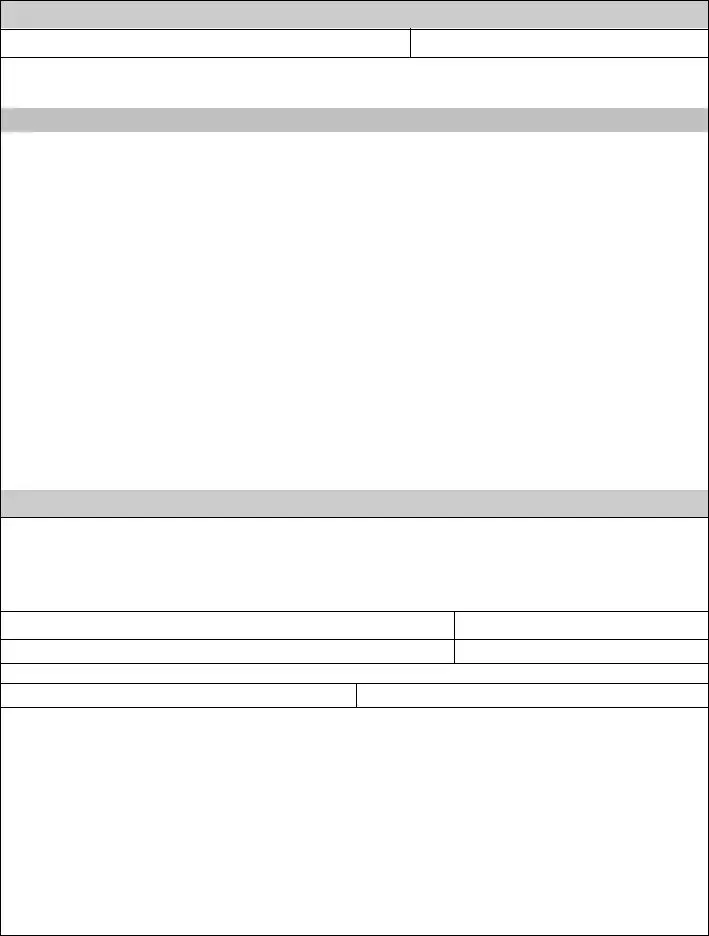
SECTION 7 - WASTE TRANSPORTER, DISPOSAL SITE, AND BUILDING OWNER INFORMATION
CHECK IF SECTION REVISED
WASTE TRANSPORTERTRANSPORTER CONTACT PERSON: NAME
TRANSPORTER’S MAILING ADDRESS:
CITY: |
STATE: |
ZIP: |
PHONE: |
FAX: |
|
|
|
|
|
All Detached
DISPOSAL SITE |
|
|
|
|
DI SPOSAL SI TE COUNTY: |
|
||||
NAME: |
|
|
|
|
|
|
|
|
|
|
DISPOSAL SITE ADDRESS: |
|
|
|
|
|
|
|
|
|
|
|
|
|
|
|
|
|
|
|
|
|
CITY: |
STATE: |
|
ZIP: |
|
|
PHONE: |
|
FAX: |
||
|
|
|
|
|
|
|
||||
PROJECT OWNER |
|
|
|
OWNER’S REPRESENTATIVE: |
|
|||||
NAME: |
|
|
|
|
|
|
|
|
|
|
OWNER’S STREET ADDRESS: |
|
|
|
|
|
|
|
|
|
|
|
|
|
|
|
|
|
|
|
|
|
OWNER’S MAILING ADDRESS (IF DIFFERENT): |
|
|
|
|
|
|
|
|
|
|
|
|
|
|
|
|
|
|
|
||
CITY: |
STATE: |
|
ZIP: |
|
|
PHONE: |
|
FAX: |
||
|
|
|
|
|
||||||
SECTION 8 - WORK METHODS: METHOD OF DEMOLITION AND/OR RENOVATION ACTIVITY (DESCRIPTION OF WORK PRACTICES, |
||||||||||
ENGINEERING CONTROLS, AND CLEARANCE METHODS) |
|
CHECK IF SECTION REVISED |
|
|||||||
|
|
|
|
|
||||||
|
|
|
|
|
||||||
|
|
|
|
|
||||||
SECTION 9 - ADDITIONAL PROJECT INFORMATION |
|
CHECK IF SECTION REVISED |
|
|||||||
WILL ASBESTOS REMAIN IN THE PROJECT AREA? |
NO |
|
YES |
|
UNKNOWN |
|
||||
EXPLAIN ‘YES’ OR ‘UNKNOWN’: |
|
|
|
|
|
|
|
|
|
|
|
|
|
|
|
|
|||||
IF NO ASBESTOS IS PRESENT, WAS THIS PROJECT PREVIOUSLY ABATED? |
|
NO |
YES |
UNKNOWN |
||||||
PRIOR ABATEMENT COMPANY: |
|
|
|
|
|
|
|
YEAR ABATED: |
|
|
|
|
|
|
|
|
|
|
|
|
|
PRIOR COMPANY CONTACT PERSON: |
|
|
|
|
|
|
|
PHONE: |
|
|
|
|
|
|
|
|
|
|
|
|
|
CERTIFICATION OF INFORMATION AND ACKNOWLEDGEMENT
CHECK IF SECTION REVISED
I, THE UNDERSIGNED, CERTIFY THAT AN INDIVIDUAL TRAINED IN THE PROVISIONS OF FEDERAL REGULATIONS (NESHAP/40 CFR PART 61 SUBPART M) WILL BE
ON THE PROJECT SITE DURING DEMOLITION AND/OR RENOVATION ACTIVITIES DESCRIBED IN THE NOTIFICATION. EVIDENCE THAT THIS PERSON AND ALL OTHER PROJECT PERSONNEL HAVE ACCOMPLISHED APPROPRIATE TRAINING AND TRAINING CERTIFICATES WILL BE AVAILABLE FOR INSPECTION DURING NORMAL BUSINESS HOURS AND ANYTIME REGULATED ACTIVITIES ARE BEING CONDUCTED ON SITE.
I FURTHERMORE UNDERSTAND THAT I AM RESPONSIBLE FOR THE ACCURACY AND COMPLETENESS OF THE INFORMATION SUBMITTED WITH THIS
NOTIFICATION AND I SHALL PROMPTLY SUBMIT REVISIONS, SUPPORTING DOCUMENTS, AND PROJECT FEES.
PRINTED NAME:
SIGNATURE:
PHONE:
DATE:
REPRESENTING: OWNER |
ABATEMENT CONTRACTOR DEMOLITION CONTRACTOR OTHER _________________ |
COMPANY NAME IF “OTHER” CHECKED:
ADDRESS IF “OTHER” CHECKED:
•REFER TO THE DETAILED INSTRUCTIONS WHEN IN DOUBT ABOUT PROPER COMPLETION OF ANY SECTION.
•NEVER LEAVE BLANK SPACES – INSERT ‘N/A’ OR ‘UNKNOWN’ FOR ANY BLANK WHERE YOU DO NOT HAVE THE INFORMATION REQUESTED.
•PRINT RESPONSES NEATLY AND LEGIBLY.
•ALWAYS KEEP A COPY OF THIS FORM FOR YOUR RECORDS, AND PROVIDE COPIES TO ALL OTHER INVOLVED PARTIES.
•EPD NO LONGER ACCEPTS ‘FAX ONLY DOCUMENTS’. SUBMIT THE ENTIRE FORM VIA MAIL.
•NEVER SUBMIT PROJECTS WHERE FEES ARE DUE WITHOUT ATTACHING THE REQUIRED FEE CHECK OR MONEY ORDER.
•NOTIFICATIONS WITH FEES MUST BE MAILED TO THE EPD ASBESTOS FEES POST OFFICE ADDRESS. NOTIFICATIONS WITHOUT FEES SHOULD BE MAILED DIRECTLY TO THE EPD OFFICE ADDRESS.
(ADDRESSES ARE ON THE FIRST PAGE.)
•DO NOT SUBMIT
•If a Project Notification is submitted by someone other than the asbestos abatement or demolition contractor - such as the Consultant or Owner,
A REVISED NOTIFICATION MUST BE SUBMITTED BY THE CONTRACTOR TO WHOM THE PROJECT IS AWARDED BEFORE WORK BEGINS. THE CONTRACTOR MUST SIGN THE CERTIFICATION OF THE REVISED NOTIFICATION FORM.
IT IS YOUR RESPONSIBILITY TO SUBMIT THIS FORM ACCURATELY AND COMPLETLY AND INCLUDE BY ALL
APPLICABLE FEES.
REV 062012005F |
- 3 - |
SUMMARY INSTRUCTIONS FOR COMPLETING THE GEORGIA EPD
PROJECT NOTIFICATION FOR ASBESTOS RENOVATION, ENCAPSULATION, OR DEMOLITION PROJECTS
Complete the following Sections and provide the information requested according to the type of project being performed.
To Be Completed For Demolition Work (No fees due for Demolition Projects.)
Section 1AVType of Notice
Section 1BVType of Project
Section 2 - Site Information
Section 3B - Demolition Contractor
Section 4 - ACM Information Asbestos Inspection Required for Compliance of Georgia Rules.
Section 5 - Work Schedules for Demolition
Section 6 - ACM Amounts & Type Codes
All ACM which already is or will become friable must be removed before demolition; only
If all ACMs have been removed from the project site, Page 2 is not required.
Section 7 - Waste Transporter and Disposal Site of Demolition Waste, and Building Owner (All Required) Section 8 - Work Methods
Section 9 - Additional Project Information
Certification of Information and Acknowledgement (No fees due for Demolition Projects.)
To Be Completed For Asbestos Removal and Encapsulation Projects (Fees due for Abatement Projects.)
Section 1A - Type of Notice
Section 1B - Type of Project
Section 2 - Site information
Section 3A - Abatement Contractor
Section 4 - ACM Information Asbestos Inspection Required for Compliance of Georgia Rules.
Section 5 - Work Schedules for Abatement and Encapsulation Projects.
Section 6 - ACM Amounts, Type Codes, and Fee Calculation
Section 7 - Waste Transporter, Disposal Site, and Building Owner Information
Section 8 - Work Methods
Certification of Information and Acknowledgment
To Be Completed for A Revision To A Prior Notification
Section 1A Type of Notice
Section(s) All Sections, In Which the Prior Information Has Changed or Needs To Be Updated.
Check the Revision Box In Each of The Revised Sections and Update the Information.
Certification of Information and Acknowledgment
DETAILED INSTRUCTIONS ARE AVAILABLE FOR FILLING OUT EACH OF THESE SECTIONS.
REV 062012005F |
- 4 - |
| Fact Name | Details |
|---|---|
| Form Purpose | This form is used to notify the Georgia Environmental Protection Division (EPD) about asbestos renovation, encapsulation, or demolition projects. |
| Governing Law | The form is governed by the Georgia Rules for Asbestos, which comply with federal regulations under NESHAP (40 CFR Part 61 Subpart M). |
| Submission Requirements | All sections must be completed. If information is unknown, use 'N/A' or 'UNKNOWN' instead of leaving blanks. |
| Fee Payment | Fees are required for abatement projects and must be sent to the EPD Asbestos Fees Lockbox. Demolition projects do not require fees. |
| Notification Timeline | A 10-working day advance notification is required for non-emergency projects. |
| Emergency Projects | For emergency projects, immediate notification is required, and a letter explaining the situation must be included. |
| Inspection Requirement | An AHERA accredited inspector must inspect the site to confirm the presence of asbestos before project initiation. |
| Record Keeping | Keep a copy of the submitted form for your records and provide copies to all involved parties. |
Completing the Georgia Notification Form is an essential step in ensuring compliance with asbestos regulations. This guide provides a clear outline of the steps to fill out the form accurately. Follow each step carefully to ensure that all necessary information is provided and that nothing is left blank.
After completing the form, ensure that you have provided all necessary attachments and that no sections are left blank. It is important to keep a copy for your records. Once everything is in order, submit the form to the appropriate address based on whether fees are due or not. Following these steps will help ensure that your notification is processed smoothly.
The Georgia Notification Form is used to inform the Environmental Protection Division (EPD) about projects involving the renovation, encapsulation, or demolition of structures containing asbestos. This notification is crucial for ensuring that proper safety measures are in place to protect workers and the public from potential asbestos exposure.
Any contractor or individual planning to undertake renovation, encapsulation, or demolition work that involves asbestos must submit this form. This includes abatement contractors, demolition contractors, and even property owners who are managing these types of projects. It is essential that the form is completed accurately to avoid any delays or penalties.
The form requires various details, including:
Each section must be filled out completely, and if any information is not available, you should indicate that by using "N/A" or "unknown."
Fees vary depending on the type of project. For residential projects, the fee is $0.10 per square foot or linear foot of friable asbestos, with a minimum fee of $25 and a maximum of $50 per residence. For non-residential projects, the fee is similarly calculated but can go up to $1,000 per facility. It's important to check the specific section of the form for detailed fee calculation instructions.
For non-emergency projects, the notification must be submitted at least 10 working days before the scheduled start of the abatement or demolition work. This allows the EPD to process the notification and ensure that all safety measures are in place. Emergency projects, however, have different requirements and must be reported within 24 hours of the emergency situation.
If there are any changes to the project after the original notification has been submitted, a revised notification must be submitted. You should check the revision box on the form, indicate the changes clearly, and resubmit the form with the updated information. This ensures that the EPD has the most current details about the project.
The destination for your completed form depends on whether fees are due. If fees are required, send the form to the EPD Asbestos Fees Lockbox at P.O. Box 101173, Atlanta, Georgia 30392. If no fees are due, mail it directly to the EPD Asbestos Program at 4244 International Parkway, Suite 104, Atlanta, Georgia 30354. Always ensure that you keep a copy for your records.
Completing the Georgia Notification Form for asbestos renovation, encapsulation, or demolition can be a complex process. Mistakes during this process can lead to delays or complications. Here are eight common errors that individuals often make when filling out this form.
One frequent mistake is leaving sections blank. The form explicitly states that no section should be left unfilled. If certain information is unknown, individuals should write "unknown" or "N/A" instead. Failing to do so can result in the form being rejected or delayed.
Another common error is selecting the wrong type of project in Section 1B. It is crucial to accurately indicate whether the project involves renovation, demolition, or encapsulation. Misidentifying the project type can lead to improper fee calculations and regulatory complications.
Inaccurate site information is also a significant issue. Individuals sometimes provide incomplete addresses or fail to specify the exact location of the asbestos. This information is essential for regulatory authorities to assess the project correctly and ensure compliance.
People often overlook the requirement for an AHERA accredited inspector's signature in Section 4. This section must confirm that an inspection has been conducted and that the inspector’s details are provided. Neglecting this can raise questions about the legitimacy of the project.
Moreover, individuals frequently miscalculate fees due in Section 6. It is important to follow the fee calculation instructions carefully. Errors in calculating fees can lead to unnecessary delays in processing the notification.
Another mistake involves not submitting the form to the correct address. Notifications that require fees must be sent to the EPD Asbestos Fees Lockbox, while those without fees should go to the EPD office. Sending the form to the wrong address can result in processing delays.
Some individuals also fail to keep copies of the submitted form. Keeping a copy is essential for record-keeping and can help resolve any disputes or questions that arise later.
Finally, not signing or dating the certification section is a common oversight. This section is crucial as it confirms that the information provided is accurate and complete. Without a signature, the form may be deemed invalid.
By being aware of these common mistakes, individuals can improve their chances of submitting a complete and accurate Georgia Notification Form, facilitating a smoother process for asbestos-related projects.
The Georgia Notification Form for asbestos-related projects is a crucial document that ensures compliance with state regulations regarding the handling of asbestos. Along with this form, several other documents are often required to provide a comprehensive overview of the project and ensure that all parties involved are informed and compliant with the necessary regulations. Below is a list of additional forms and documents commonly used in conjunction with the Georgia Notification Form.
Each of these documents plays a significant role in the overall process of managing asbestos-related projects in Georgia. They ensure that all necessary precautions are taken to protect the health and safety of workers and the public, while also complying with legal requirements. Proper documentation is not just a regulatory formality; it is essential for the successful and safe completion of any project involving asbestos.
When filling out the Georgia Notification form for asbestos renovation, encapsulation, or demolition, it is essential to follow certain guidelines to ensure compliance and accuracy. Below are five key do's and don'ts to consider.
Adhering to these guidelines can facilitate a smoother process and help maintain compliance with regulations.
Misconception 1: The Georgia Notification form is only necessary for demolition projects.
This is incorrect. The form is required for various types of projects, including renovation, encapsulation, and abatement. Any work involving asbestos must be reported, regardless of whether it involves demolition.
Misconception 2: If asbestos is not present, the form does not need to be submitted.
Even if asbestos is confirmed absent, the notification must still be filed if the project involves any potential disturbance of materials that could contain asbestos. This ensures compliance and maintains a record of the project.
Misconception 3: All sections of the form can be left blank if information is unknown.
Leaving sections blank can lead to delays or rejections. Instead, insert "N/A" or "unknown" where applicable. This practice helps ensure that the form is processed without issues.
Misconception 4: The form can be submitted via fax or email.
This is false. The Georgia EPD requires that the entire form be mailed. Submissions must be sent to the appropriate address based on whether fees are due, and faxed documents are no longer accepted.
When filling out the Georgia Notification Form for asbestos projects, keep the following key points in mind: