The Georgia Notice to Quit form serves as a crucial document in the landlord-tenant relationship, particularly when a landlord seeks to terminate a tenancy. This form outlines the landlord's intent to reclaim possession of the rental property, specifying the reasons for the termination, which may include non-payment of rent, lease violations, or simply the expiration of a lease term. It is essential for landlords to provide this notice in a timely manner, as it initiates the legal process for eviction, should the tenant fail to vacate the premises. The form must include pertinent details such as the tenant's name, the address of the rental property, and the date by which the tenant must vacate. Additionally, it is important for landlords to understand the specific legal requirements surrounding the notice, including the appropriate delivery method and the required notice period, which can vary based on the circumstances. By adhering to these guidelines, landlords can ensure compliance with Georgia law while also protecting their rights to their property.
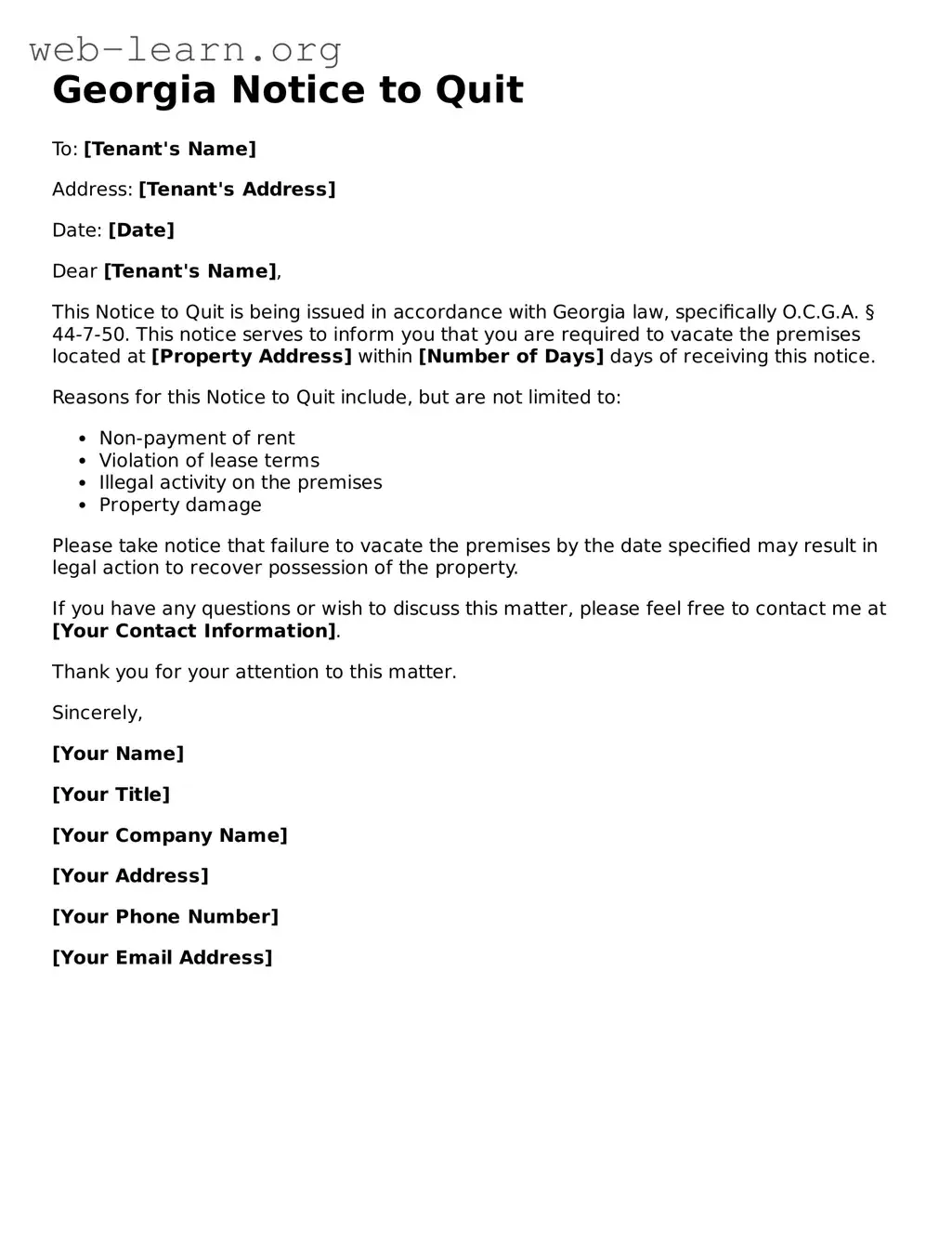
Georgia Notice to Quit
To: [Tenant's Name]
Address: [Tenant's Address]
Date: [Date]
Dear [Tenant's Name],
This Notice to Quit is being issued in accordance with Georgia law, specifically O.C.G.A. § 44-7-50. This notice serves to inform you that you are required to vacate the premises located at [Property Address] within [Number of Days] days of receiving this notice.
Reasons for this Notice to Quit include, but are not limited to:
Please take notice that failure to vacate the premises by the date specified may result in legal action to recover possession of the property.
If you have any questions or wish to discuss this matter, please feel free to contact me at [Your Contact Information].
Thank you for your attention to this matter.
Sincerely,
[Your Name]
[Your Title]
[Your Company Name]
[Your Address]
[Your Phone Number]
[Your Email Address]
| Fact Name | Description |
|---|---|
| Purpose | The Georgia Notice to Quit form is used by landlords to formally notify tenants to vacate the rental property. |
| Governing Law | This form is governed by Georgia law, specifically O.C.G.A. § 44-7-50 through § 44-7-56. |
| Notice Period | In most cases, a landlord must provide a minimum of 60 days' notice before a tenant must vacate. |
| Delivery Methods | The notice can be delivered in person, via certified mail, or posted on the tenant's door. |
| Tenant's Rights | Tenants have the right to contest the eviction in court if they believe the notice was improper or unjustified. |
| Form Availability | The Georgia Notice to Quit form can be obtained online or through local legal aid organizations. |
After obtaining the Georgia Notice to Quit form, the next step involves carefully filling it out to ensure all necessary information is accurately provided. This form is essential for communicating the intention to terminate a tenancy and requires attention to detail.
Once the form is filled out and delivered to the tenant, it is important to keep track of any responses or actions taken. This will help ensure that the process moves forward smoothly and in accordance with legal requirements.
What is a Georgia Notice to Quit form?
The Georgia Notice to Quit form is a legal document used by landlords to formally notify tenants that they must vacate the rental property. This notice is typically issued when a tenant has violated the terms of their lease agreement or has failed to pay rent.
When should a landlord issue a Notice to Quit?
A landlord may issue a Notice to Quit for various reasons, including but not limited to:
It is essential for landlords to follow the proper legal procedures when issuing this notice.
How much notice must be given?
In Georgia, the required notice period can vary based on the reason for the eviction. Generally, a landlord must provide a minimum of seven days for non-payment of rent. For other lease violations, the notice period may be longer, depending on the specific circumstances.
What information must be included in the Notice to Quit?
The Notice to Quit should include the following information:
Including all relevant details helps ensure clarity and compliance with legal requirements.
Can a tenant contest a Notice to Quit?
Yes, tenants have the right to contest a Notice to Quit. If they believe the notice was issued incorrectly or if they have resolved the issue, they can communicate with the landlord. Legal assistance may also be sought to understand their rights and options.
What happens if a tenant does not comply with the Notice to Quit?
If a tenant does not vacate the property by the specified date, the landlord may proceed with legal action to initiate eviction proceedings. This typically involves filing a complaint in the local court.
Is a Notice to Quit the same as an eviction notice?
No, a Notice to Quit is not the same as an eviction notice. The Notice to Quit is a preliminary step that informs the tenant of the need to vacate. An eviction notice is issued after the tenant fails to comply with the Notice to Quit and legal proceedings have begun.
Can a tenant be evicted without a Notice to Quit?
In Georgia, a landlord cannot evict a tenant without first providing a Notice to Quit. Skipping this step may result in legal complications for the landlord.
Where can I find a Georgia Notice to Quit form?
Georgia Notice to Quit forms can typically be found through legal aid organizations, online legal resources, or local courthouse websites. It is important to ensure that the form used complies with current state laws.
What should I do if I receive a Notice to Quit?
If you receive a Notice to Quit, it is crucial to read it carefully and understand the reasons for the eviction. Consider reaching out to the landlord to discuss the situation. Seeking legal advice can also provide clarity on your rights and options moving forward.
Completing the Georgia Notice to Quit form can be a straightforward process, yet many individuals encounter pitfalls that can complicate their situations. One common mistake is failing to provide accurate tenant information. It is crucial to include the full names of all tenants involved in the lease agreement. Omitting even one name can lead to delays and confusion in the eviction process.
Another frequent error is neglecting to specify the reason for the eviction. The form requires a clear statement of the grounds for the Notice to Quit. Without this information, the notice may be deemed insufficient, and the eviction may not proceed as intended. It is important to articulate the reason succinctly and clearly.
Many individuals also overlook the importance of proper dates. The Notice to Quit must indicate the date by which the tenant must vacate the premises. Failing to include this date can result in ambiguity and potentially prolong the eviction process. It is essential to ensure that the timeline is both realistic and compliant with Georgia’s legal requirements.
Additionally, some people mistakenly believe that a verbal agreement suffices. A written Notice to Quit is necessary to document the eviction process formally. Relying solely on oral communication can lead to misunderstandings and disputes later on.
Another common mistake is not providing adequate notice. Georgia law requires specific timeframes for different types of evictions. For instance, a tenant may need a minimum of seven days for non-payment of rent. Ignoring these requirements can invalidate the notice and hinder the eviction process.
Some individuals also fail to sign the Notice to Quit. A signature is a critical component that validates the document. Without it, the notice may not be considered official, and the intended eviction could be jeopardized.
Moreover, individuals may forget to keep copies of the completed Notice to Quit. Retaining a copy for personal records is essential for future reference and may be necessary if the case goes to court. Documentation serves as evidence of the actions taken throughout the eviction process.
Another mistake involves delivering the Notice to Quit improperly. Georgia law outlines specific methods for serving this notice, such as personal delivery or certified mail. Using an incorrect method can lead to disputes regarding whether the tenant received the notice.
Lastly, many people do not seek legal advice before filling out the form. Consulting with an attorney can provide valuable insights and help avoid common pitfalls. Legal guidance can ensure that the form is completed accurately and in compliance with local laws.
The Georgia Notice to Quit form is an essential document in the eviction process, signaling to tenants that they must vacate the premises. Several other forms and documents often accompany this notice, each serving a specific purpose in the legal process of managing rental agreements and evictions. Below is a list of commonly used forms that may be relevant in conjunction with the Notice to Quit.
Understanding these documents can significantly aid both landlords and tenants in navigating the legal landscape of rental agreements and eviction processes. Properly utilizing these forms ensures compliance with Georgia laws and helps protect the rights of all parties involved.
Eviction Notice: This document formally informs a tenant that they must vacate the rental property. Similar to the Notice to Quit, it specifies the reasons for eviction and the time frame for leaving.
Lease Termination Letter: A lease termination letter is used by landlords to end a rental agreement. Like the Notice to Quit, it outlines the reasons for termination and provides a deadline for the tenant to move out.
Notice of Non-Renewal: This notice indicates that a landlord will not renew a tenant’s lease. It serves a similar purpose as the Notice to Quit by giving tenants a clear timeline to vacate the premises.
Demand for Possession: This document requests that a tenant vacate the property. It is similar to the Notice to Quit in that it emphasizes the urgency of the situation and often precedes formal eviction proceedings.
Notice to Cure: This notice informs a tenant of a lease violation and gives them a chance to fix the issue. While it focuses on resolving problems, it can lead to a Notice to Quit if the issue is not addressed.
Notice of Rent Increase: This document informs tenants of a rent increase. While not a direct eviction notice, it can lead to a tenant deciding to leave, similar to the implications of a Notice to Quit.
Notice of Abandonment: This notice is used when a landlord believes a tenant has abandoned the property. It is similar to the Notice to Quit in that it serves to reclaim possession of the rental unit.
Notice of Default: This document informs a tenant that they have failed to meet lease obligations, such as non-payment of rent. Like the Notice to Quit, it can lead to eviction if the issue is not resolved.
Pet Violation Notice: If a tenant violates pet policies, this notice informs them of the violation. Similar to the Notice to Quit, it gives tenants an opportunity to correct the issue or face further action.
Notice to Enter: This notice informs tenants that the landlord will be entering the property for maintenance or inspections. While it does not directly lead to eviction, it shares the purpose of communication regarding property access and tenant rights.
When filling out the Georgia Notice to Quit form, it is important to follow certain guidelines to ensure the process is handled correctly. Below is a list of things you should and shouldn't do.
The Georgia Notice to Quit form is often misunderstood. Below are nine common misconceptions about this important document, along with clarifications to help ensure a better understanding.
While it is a step in the eviction process, a Notice to Quit is not the final eviction notice. It serves as a formal request for tenants to vacate the premises.
Ignoring the notice can lead to legal consequences. It is crucial for tenants to respond appropriately, as failure to do so may result in eviction proceedings.
Landlords may have different forms based on their needs, but they must comply with Georgia state law regarding the content and delivery of the notice.
Delivery can occur through various methods, including certified mail or posting on the property, as long as it adheres to legal requirements.
Tenants typically have a limited timeframe to respond, often around 7 days, depending on the reason for the notice. Prompt action is necessary.
Notices can vary based on the reason for eviction, such as non-payment of rent or lease violations. Each situation may require a different approach.
Landlords must have a valid legal reason to issue a Notice to Quit. Personal grievances or arbitrary reasons are not sufficient grounds.
Landlords may choose to withdraw the notice or negotiate with the tenant before proceeding with eviction, depending on the situation.
Issuing a Notice to Quit does not guarantee that eviction will occur. It is simply a step in the legal process that may or may not lead to eviction.
Understanding these misconceptions can help both landlords and tenants navigate the eviction process more effectively and ensure that their rights are protected.
When dealing with the Georgia Notice to Quit form, it is important to understand its purpose and the correct way to fill it out. Here are some key takeaways to keep in mind:
Following these guidelines can help ensure that you handle the situation appropriately and legally.
Colorado Notice to Quit - This form typically outlines the reason for the eviction and the time frame for the tenant to leave.
3 Day Notice to Pay or Quit California 2023 - Can be contested by tenants through proper channels.
Arkansas 3 Day Eviction Notice - It helps clarify expectations between landlords and tenants.
Free Eviction Notice Alabama - Landlords should be familiar with the specific laws governing Notices to Quit in their state.