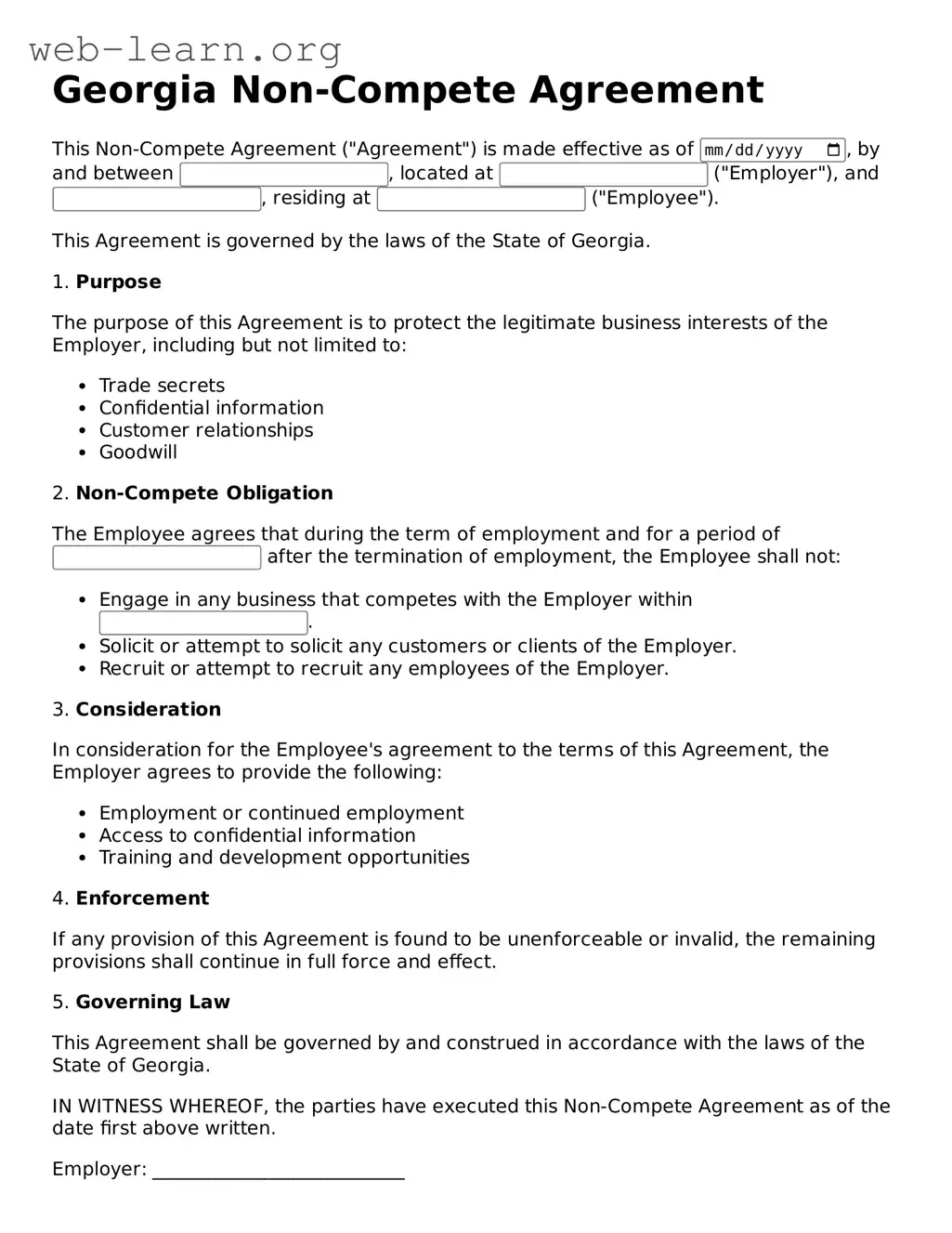
In Georgia, a Non-compete Agreement is an essential tool for businesses looking to protect their interests while balancing the rights of employees. This legal document outlines the terms under which an employee agrees not to engage in activities that directly compete with their employer's business for a specified period and within a defined geographic area. Key aspects of the agreement include the duration of the restriction, the specific activities that are prohibited, and the geographical limits that apply. Georgia law requires that these agreements be reasonable in scope to be enforceable, meaning they must not overly restrict an employee’s ability to find work in their field. Additionally, the agreement often includes provisions regarding the sharing of confidential information and trade secrets, ensuring that sensitive company information remains protected even after the employment relationship ends. Understanding these components is crucial for both employers drafting the agreement and employees considering its implications on their future career opportunities.
Georgia Non-Compete Agreement
This Non-Compete Agreement ("Agreement") is made effective as of , by and between , located at ("Employer"), and , residing at ("Employee").
This Agreement is governed by the laws of the State of Georgia.
1. Purpose
The purpose of this Agreement is to protect the legitimate business interests of the Employer, including but not limited to:
2. Non-Compete Obligation
The Employee agrees that during the term of employment and for a period of after the termination of employment, the Employee shall not:
3. Consideration
In consideration for the Employee's agreement to the terms of this Agreement, the Employer agrees to provide the following:
4. Enforcement
If any provision of this Agreement is found to be unenforceable or invalid, the remaining provisions shall continue in full force and effect.
5. Governing Law
This Agreement shall be governed by and construed in accordance with the laws of the State of Georgia.
IN WITNESS WHEREOF, the parties have executed this Non-Compete Agreement as of the date first above written.
Employer: ___________________________
Employee: ___________________________
| Fact Name | Description |
|---|---|
| Governing Law | The Georgia Non-compete Agreement is governed by Georgia state law, specifically O.C.G.A. § 13-8-50 et seq. |
| Enforceability | In Georgia, non-compete agreements are enforceable if they are reasonable in duration, geographic area, and scope of activity. |
| Duration Limitations | Georgia law does not specify a maximum duration for non-compete agreements, but they must be reasonable to be enforceable. |
| Geographic Scope | The geographic scope of a non-compete must be limited to the area where the employee worked or where the employer does business. |
| Consideration Requirement | For a non-compete agreement to be valid, it must be supported by adequate consideration, such as employment or a promotion. |
| Trade Secrets Protection | Non-compete agreements can be used to protect trade secrets and proprietary information, but they cannot be overly broad. |
| Employee Rights | Georgia law allows employees to challenge the enforceability of non-compete agreements in court. |
| Modification by Courts | Courts in Georgia may modify overly broad non-compete agreements to make them enforceable, rather than voiding them entirely. |
| Public Policy Considerations | Non-compete agreements must align with public policy, promoting fair competition and employee mobility. |
Once you have the Georgia Non-compete Agreement form, you are ready to fill it out. This document is essential for outlining the terms of a non-compete arrangement between an employer and an employee. Carefully following the steps below will help ensure that the form is completed accurately.
After completing the form, keep copies for both parties. This ensures that everyone has access to the terms agreed upon, which is vital for future reference.
What is a Georgia Non-compete Agreement?
A Georgia Non-compete Agreement is a legal document that restricts an employee from engaging in activities that compete with their employer's business for a specified period and within a defined geographical area after leaving the company. This agreement aims to protect the employer's business interests, including trade secrets and client relationships.
Are Non-compete Agreements enforceable in Georgia?
Yes, Non-compete Agreements are generally enforceable in Georgia, but they must meet specific criteria. The agreement must be reasonable in scope, duration, and geographic area. Courts will evaluate whether the restrictions protect legitimate business interests without unduly restricting an individual's ability to work.
What are the limitations of a Non-compete Agreement in Georgia?
In Georgia, a Non-compete Agreement cannot last longer than two years. Additionally, the geographic scope must be reasonable and related to the employer's business. The agreement should not impose undue hardship on the employee or prevent them from earning a living.
What should be included in a Non-compete Agreement?
A well-drafted Non-compete Agreement should include:
Can an employee negotiate a Non-compete Agreement?
Yes, employees can negotiate the terms of a Non-compete Agreement. It is advisable to discuss any concerns or desired changes with the employer before signing. Negotiating terms such as duration and geographic scope can lead to a more balanced agreement.
What happens if I violate a Non-compete Agreement?
If an employee violates a Non-compete Agreement, the employer may take legal action. This could include seeking an injunction to prevent the employee from continuing the competing activity or pursuing damages for any losses incurred as a result of the violation.
How can I determine if a Non-compete Agreement is enforceable?
To determine the enforceability of a Non-compete Agreement, consider consulting with a legal professional. They can analyze the agreement's terms and assess whether it meets Georgia's legal standards for reasonableness and necessity in protecting business interests.
Are there alternatives to Non-compete Agreements?
Yes, alternatives to Non-compete Agreements include Non-disclosure Agreements (NDAs) and Non-solicitation Agreements. NDAs protect sensitive information, while Non-solicitation Agreements prevent employees from soliciting clients or employees after leaving the company. These alternatives may provide adequate protection without imposing strict employment restrictions.
What should I do if I am asked to sign a Non-compete Agreement?
If asked to sign a Non-compete Agreement, review the document carefully. Consider the implications for your future employment opportunities. If you have any concerns, seek legal advice before signing. Understanding your rights and obligations is crucial for making informed decisions.
When individuals fill out the Georgia Non-compete Agreement form, they often overlook critical details that can render the agreement ineffective or unenforceable. One common mistake is failing to specify the duration of the non-compete clause. Without a clearly defined time frame, the agreement may be deemed unreasonable. Courts in Georgia typically require that non-compete agreements have a reasonable duration, often ranging from six months to two years, depending on the nature of the industry.
Another frequent error is neglecting to outline the geographic scope of the non-compete. A vague or overly broad geographic area can lead to challenges in enforcement. For instance, if the agreement states that the individual cannot work within the entire state of Georgia, it may be considered excessive. Instead, it is advisable to limit the area to where the employer conducts business, ensuring that the restrictions are both fair and justifiable.
Individuals also often fail to identify the specific activities that are restricted under the agreement. A non-compete should clearly articulate what constitutes competition. Without this clarity, the individual may find it difficult to understand what actions could lead to a breach of the agreement. This lack of specificity can create confusion and may ultimately undermine the purpose of the non-compete.
Additionally, many people overlook the importance of mutual consideration. In Georgia, a non-compete agreement must provide something of value to both parties. If an employee signs the agreement without receiving any additional compensation or benefits, the agreement may be invalidated. Therefore, it is crucial to ensure that the employee receives something in return, such as a promotion, training, or access to proprietary information.
Finally, individuals frequently forget to review the entire document before signing. This oversight can lead to agreements that include terms or conditions that the individual does not fully understand or agree with. It is essential to read through the entire non-compete agreement carefully and seek clarification on any ambiguous terms. This diligence can prevent future legal complications and ensure that the agreement serves its intended purpose.
When drafting a Georgia Non-compete Agreement, several other forms and documents may be necessary to ensure comprehensive coverage and compliance with state laws. Below is a list of commonly used documents that often accompany a non-compete agreement.
Each of these documents plays a vital role in protecting a business's interests and ensuring clarity in the employer-employee relationship. Properly integrating these forms with a Georgia Non-compete Agreement can help mitigate legal risks and foster a healthy work environment.
A Non-compete Agreement is a legal document that restricts an individual from engaging in business activities that compete with their employer after leaving the company. Several other documents serve similar purposes in protecting business interests. Below are eight documents that share similarities with a Non-compete Agreement:
When filling out the Georgia Non-compete Agreement form, it is important to follow certain guidelines to ensure the document is valid and enforceable. Here are seven things you should and shouldn't do:
Understanding the Georgia Non-compete Agreement form is essential for both employers and employees. However, several misconceptions often arise. Here’s a breakdown of eight common myths:
This is not true. While Georgia law allows non-compete agreements, they must meet specific criteria to be enforceable, such as being reasonable in scope and duration.
This misconception overlooks the fact that non-compete agreements can be limited to specific geographic areas and time frames. You may still find opportunities outside those parameters.
Non-compete agreements can vary widely. Each agreement should be tailored to the specific circumstances of the employment relationship and the nature of the business.
Georgia law restricts the scope of non-compete agreements. They cannot prevent someone from working in an entirely different field or industry.
This is a common misunderstanding. Non-compete agreements can apply to employees at various levels, especially if they have access to sensitive information.
Non-compete agreements can expire. The duration specified in the agreement dictates how long the restrictions last, and they can be voided under certain conditions.
Employers must act in good faith. If they attempt to enforce an unreasonable agreement, they may face legal challenges or penalties.
Independent contractors and business partners can also be subject to non-compete agreements. The key is that the agreement must be reasonable and necessary to protect legitimate business interests.
By dispelling these misconceptions, individuals can better navigate the complexities of non-compete agreements in Georgia.
When considering a Georgia Non-compete Agreement, it’s essential to understand the nuances of the form and its implications. Here are some key takeaways to keep in mind:
Understanding these key aspects can help ensure that the Non-compete Agreement serves its intended purpose while remaining compliant with Georgia law.
How to Beat a Non Compete in Pa - Legal precedents can influence the enforceability of Non-compete Agreements.
Non Compete Agreement Hawaii - These agreements can vary widely in their terms and enforceability based on location.
How to Beat a Non Compete in Pa - The effectiveness of a Non-compete Agreement often depends on how well it is drafted and its alignment with state regulations.
How to Beat a Non Compete in New Jersey - A well-crafted Non-compete Agreement balances the interests of the employer with the employee's right to work.