Homepage Blank Georgia Mv 9D Form
Outline

In the state of Georgia, the MV-9D form serves a crucial purpose for individuals with disabilities seeking parking accommodations. This application allows eligible persons to request either a Person with Disability Parking Placard or a Disabled Person’s License Plate. It's important to note that this form is specifically designed for these requests and should not be used for changes in ownership, address updates, or license plate classifications. The form requires applicants to provide essential information, including their personal details, the type of placard or plate being requested, and a certification from a licensed health care provider confirming the disability. Different options are available, such as temporary and permanent placards, each with specific instructions for completion. Additionally, there are fees associated with obtaining a disabled license plate, and the application must be submitted to the local County tag office for processing. Understanding the nuances of the MV-9D form can make the application process smoother and ensure that individuals receive the accommodations they need.
Sample - Georgia Mv 9D Form

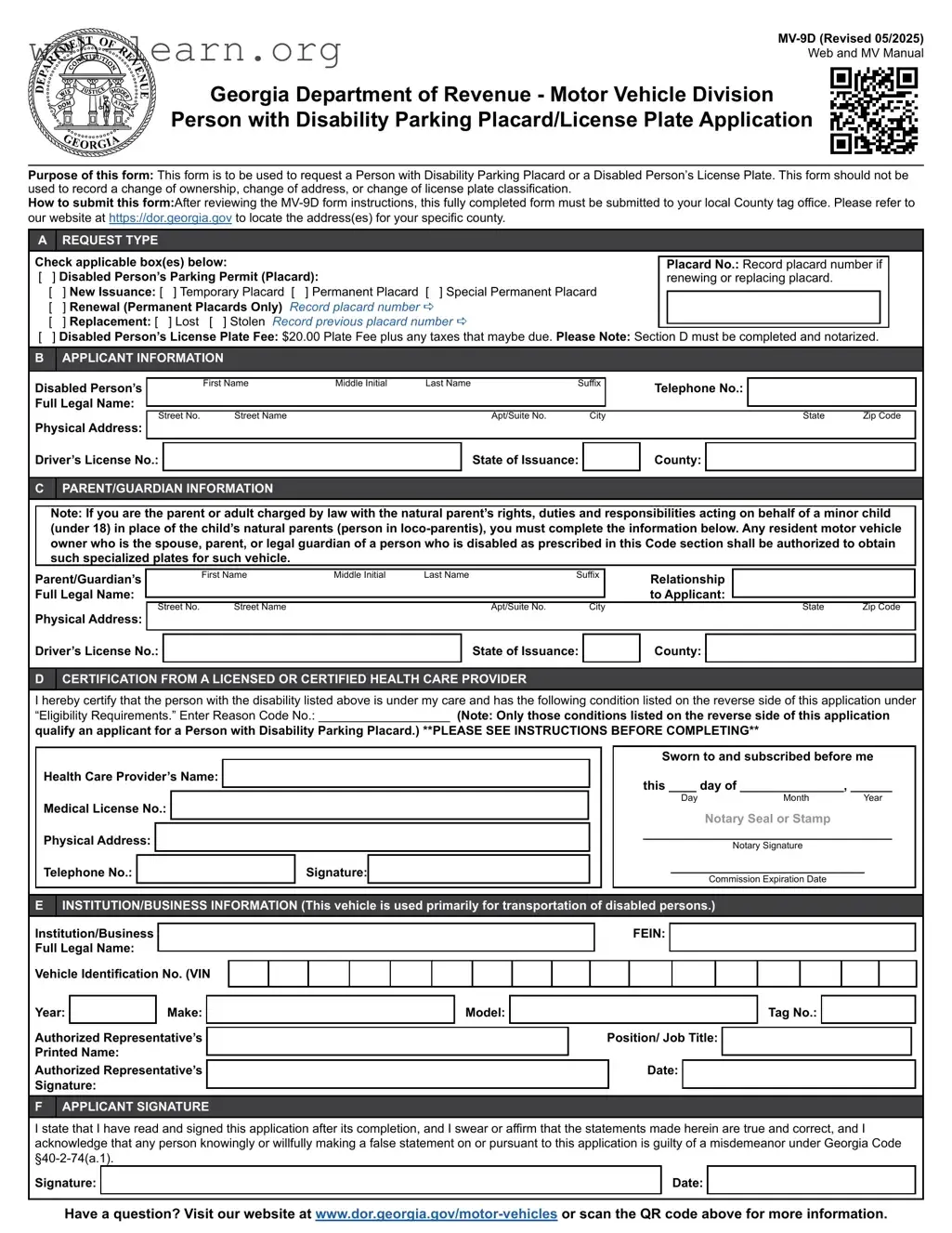
Georgia Department of Revenue - Motor Vehicle Division
Person with Disability Parking Placard/License Plate Application
MV-9D (Revised 05/2025)
Web and MV Manual
Purpose of this form: This form is to be used to request a Person with Disability Parking Placard or a Disabled Person’s License Plate. This form should not be
used to record a change of ownership, change of address, or change of license plate classication.
How to submit this form:After reviewing the MV-9D form instructions, this fully completed form must be submitted to your local County tag o󰀩ce. Please refer to
our website at https://dor.georgia.gov to locate the address(es) for your specic county.
A REQUEST TYPE
Check applicable box(es) below:
[ ] Disabled Person’s Parking Permit (Placard):
[ ] New Issuance: [ ] Temporary Placard [ ] Permanent Placard [ ] Special Permanent Placard
[ ] Renewal (Permanent Placards Only) Record placard number
[ ] Replacement: [ ] Lost [ ] Stolen Record previous placard number
[ ] Disabled Person’s License Plate Fee: $20.00 Plate Fee plus any taxes that maybe due. Please Note: Section D must be completed and notarized.
B APPLICANT INFORMATION
Disabled Person’s
Telephone No.:
Full Legal Name:
Physical Address:
Drivers License No.: State of Issuance: County:
C PARENT/GUARDIAN INFORMATION
Note: If you are the parent or adult charged by law with the natural parent’s rights, duties and responsibilities acting on behalf of a minor child
(under 18) in place of the child’s natural parents (person in loco-parentis), you must complete the information below. Any resident motor vehicle
owner who is the spouse, parent, or legal guardian of a person who is disabled as prescribed in this Code section shall be authorized to obtain
such specialized plates for such vehicle.
Parent/Guardian’s Relationship
Full Legal Name: to Applicant:
Physical Address:
Drivers License No.: State of Issuance: County:
D CERTIFICATION FROM A LICENSED OR CERTIFIED HEALTH CARE PROVIDER
I hereby certify that the person with the disability listed above is under my care and has the following condition listed on the reverse side of this application under
“Eligibility Requirements.” Enter Reason Code No.: ___________________ (Note: Only those conditions listed on the reverse side of this application
qualify an applicant for a Person with Disability Parking Placard.) **PLEASE SEE INSTRUCTIONS BEFORE COMPLETING**
Health Care Providers Name:
Medical License No.:
Physical Address:
Telephone No.: Signature:
Sworn to and subscribed before me
this ____ day of _______________, ______
Day Month Year
Notary Seal or Stamp
____________________________________
Notary Signature
____________________________
Commission Expiration Date
E INSTITUTION/BUSINESS INFORMATION (This vehicle is used primarily for transportation of disabled persons.)
Institution/Business FEIN:
Full Legal Name:
Vehicle Identication No. (VIN
Year: Make: Model: Tag No.:
Authorized Representative’s
Position/ Job Title:
Printed Name:
Authorized Representative’s Date:
Signature:
F APPLICANT SIGNATURE
I state that I have read and signed this application after its completion, and I swear or a󰀩rm that the statements made herein are true and correct, and I
acknowledge that any person knowingly or willfully making a false statement on or pursuant to this application is guilty of a misdemeanor under Georgia Code
§40-2-74(a.1).
Signature:
Date:
Placard No.: Record placard number if
renewing or replacing placard.
Have a question? Visit our website at
www.dor.georgia.gov/motor-vehicles
or scan the QR code above for more information.
First Name Middle Initial Last Name Su󰀩x
Street No. Street Name
Apt/Suite No. City
State
Zip Code
First Name Middle Initial Last Name Su󰀩x
Street No. Street Name
Apt/Suite No. City
State
Zip Code
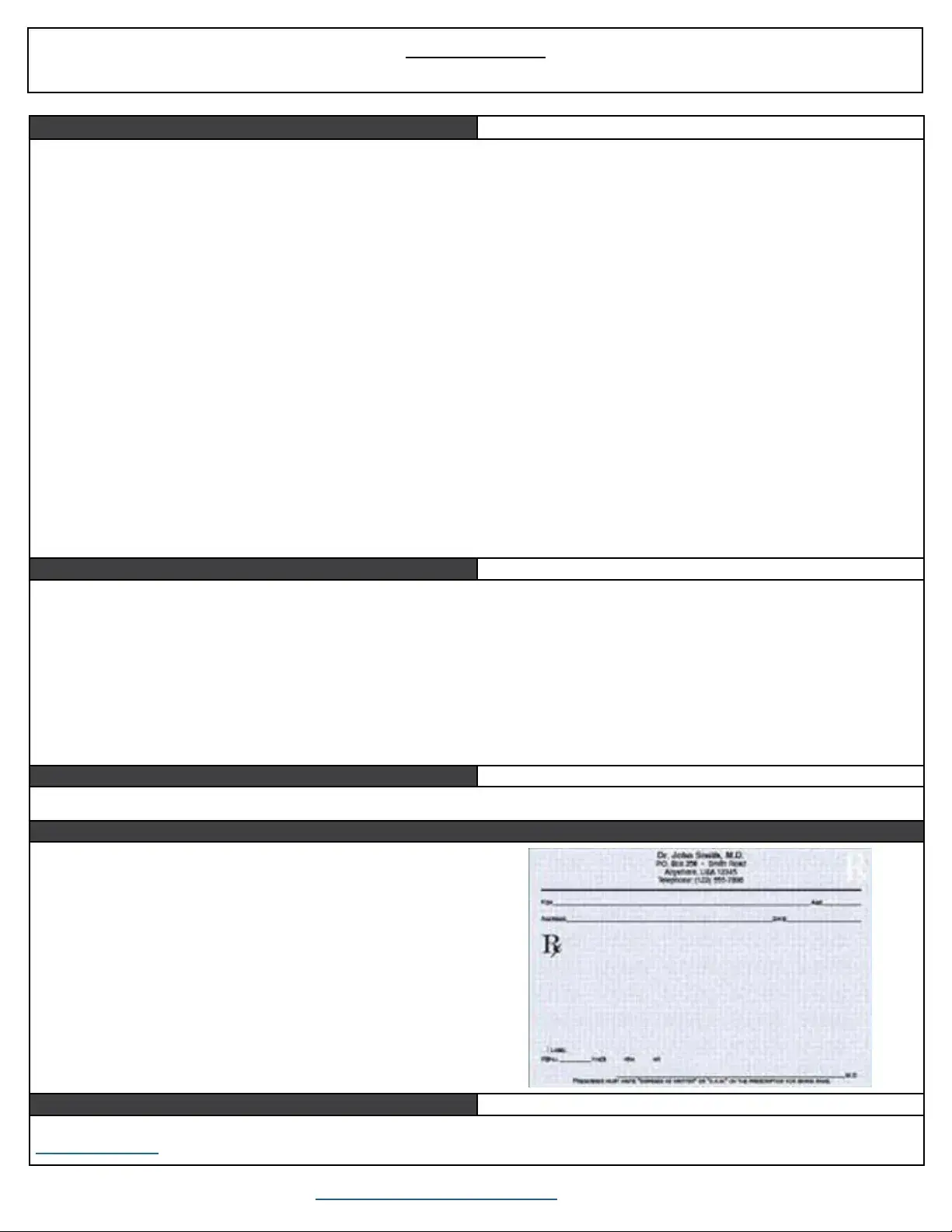
INSTRUCTIONS
How to complete the MV-9D Form
COMPLETING THIS FORM
Temporary Placard: Complete Sections A, B, C, D and F. Note: Only licensed health care providers may certify disabilities for temporary placards. Temporary
placards may not be extended for an additional period of time. When additional time is needed, a new application must be completed and certied by a health
care provider. In addition, please list your previous placard number. Temporary placards are only issued for a period of time not to exceed six months.
Permanent Placard: Complete Sections A, B, C, D and F. Note: Individuals should list their Georgia Driver’s License number or Photo ID number in the space
provided. Businesses should list their Business ID number (Bus. ID) where indicated (i.e., E.I.N.) and provide a copy of business license.
Special Permanent Placard: Follow the instructions for a Permanent Placard. A Special Permanent Placard (gold placard) is issued only to an individual with a
disability who (1) drives a motor vehicle equipped with hand controls for the operation of brakes and accelerator or (2) is disabled due to loss, or loss of use, of
both upper extremities.
Renewal Request: Complete Sections A, B and F. Note: Notarization is not required.
Replacement Request: Indicate if applying for a replacement placard. Please check reason for replacement (Lost or Stolen). List your previous placard number
and complete Sections A, B and F.
Institution/Business Information: Complete Sections A, B, E and F. Follow these additional special instructions:
Institutions, as dened by Georgia Code §31-7-1, must attach a copy of the institutional license. Note: To qualify for a permit, the institution must oper-
ate the vehicle primarily to transport individuals with disabilities.
Businesses, to qualify for a special plate, must meet the requirements of Georgia Code §40-2-74, including limits on the type of business organization.
Note: The business vehicle must be used only or primarily by the disabled employee for whom the plate was issued.
Please Note:
A placard is to be used only when the vehicle in which it is displayed is parked and is being used for the transportation of the person with disability or
the severely disabled veteran.
Any vehicle lawfully displaying a placard will qualify for parking in areas designated for use by persons with disability only.
The placard will not allow vehicles to park where parking is prohibited.
The placard is required to be displayed when the vehicle is parked in areas designated for use by persons with disability only and must not be dis-
played when the vehicle is being operated on the highway.
Each eligible individual will be issued only one placard.
ELIGIBILITY REQUIREMENTS – REASON CODES
1. Applicant is so ambulatory disabled that he/she cannot walk 200 feet
without stopping to rest.
2. Applicant cannot walk without the use of assistance from a brace, a cane,
a crutch, another person, a prosthetic device, a wheelchair, or other
assistive device.
3. Applicant is restricted by lung disease to such an extent that his/her
forced respiratory volume for one second, when measured by spironmetry
is less than one liter, or when at rest his/her arterial oxygen tension is less
than 60 millimeters of mercury on room air.
4. Applicant uses portable oxygen.
5. Applicant has a cardiac condition to the extent that his/her functional
limitations are classied in severity as Class III or Class IV according to
standards set by the American Heart Association.
6. Applicant is severely limited in his/her ability to walk due to an arthritic,
neurological, orthopedic condition or complications due to pregnancy.
7. Applicant is hearing impaired person pursuant to Georgia Code §24-6-
651.
8. Applicant is a blind individual whose central visual acuity does not exceed
20/200 in the better eye with correcting lenses or whose visual acuity, if
better than 20/200, is accompanied by a limit to the eld of vision in the
better eye to such a degree that its widest diameter subtends an angle of
no greater than 20 degrees.
QUALIFYING VEHICLES
A passenger vehicle or truck with a registered gross weight of not more than 10,000 lbs. This restriction does not apply to institution or business applications.
CERTIFICATION FROM A LICENSED OR CERTIFIED HEALTH CARE PROVIDER
“For purposes of this Code section (40-2-74.1) the department shall accept,
in lieu of an a󰀩davit, a signed and dated statement from the doctor which
includes the same information as required in an a󰀩davit written upon security
paper as dened in paragraph (38.5) of Code Section 26-4-5.”
Please Note: Certication in lieu of an a󰀩davit (completion and notarization
of Section D) can only be submitted for placards and cannot be provided on
license plate applications.
Who may provide certication: Health care providers that are permitted to
provide a certication are limited to medical practitioners licensed to practice
under Article 2 of Chapter 34 of Title 43 (physicians); Chapter 35 of Title 43
SUBMITTING THIS FORM
After reviewing the MV-9D form instructions, this fully completed form must be submitted to your local County tag o󰀩ce. Please refer to our website at
https://dor.georgia.gov to locate the address(es) for your specic county.
Jane Doe 40
123 Main St.
Secured paper document (as dened by GA Code
26-4-5) from healthcare provider must include:
Specic disability as indicated on MV-9D
instructions form.
Indication of permanent or temporary
disability
Stamp or signature of healthcare provider
Date
SAMPLE
Have a question? Visit our website at
www.dor.georgia.gov/motor-vehicles
or scan the QR code above for more information.

Form Information

Fact Name Details
Form Purpose This form is used to request a Person with Disability Parking Placard or a Disabled Person’s License Plate.
Governing Law The form is governed by Georgia Code §40-2-74.
Submission Location Completed forms must be submitted to the local County tag office.
Request Types Options include new issuance, renewal, temporary, and special permanent placards.
Application Fee A fee of $20.00 is required for a Disabled Person’s License Plate.
Notarization Requirement Section D must be completed and notarized for certain applications.
Eligibility Criteria Eligibility is based on specific medical conditions as outlined in the form.
Health Care Provider Certification Only licensed health care providers can certify disabilities for temporary placards.
One Placard Rule Each eligible individual will only receive one placard.
Vehicle Requirements The vehicle must be a passenger vehicle or truck with a registered gross weight of not more than 10,000 lbs.

Detailed Guide for Filling Out Georgia Mv 9D

Filling out the Georgia MV-9D form is a straightforward process that requires attention to detail. This form is essential for requesting a Person with Disability Parking Placard or a Disabled Person’s License Plate. After completing the form, it must be submitted to your local County tag office for processing.

  1. Obtain the Form: Download the MV-9D form from the Georgia Department of Revenue website or pick up a physical copy from your local County tag office.
  2. Check the Request Type: In Section A, check the applicable box(es) to indicate whether you are applying for a new placard, renewing, replacing, or requesting a temporary placard.
  3. Provide Applicant Information: Fill out Section B with the disabled person’s first name, middle initial, last name, telephone number, and full legal address, including street number, street name, apartment or suite number, city, state, and ZIP code. Include the driver’s license number and state of issuance.
  4. Complete Parent/Guardian Information: If applicable, fill out Section C with the parent or guardian’s details, including their relationship to the applicant.
  5. Certification from a Health Care Provider: In Section D, have a licensed health care provider complete the certification. This section must be notarized. Ensure the provider includes their name, medical license number, and the reason code for the disability.
  6. Institution/Business Information: If the vehicle is primarily used for transporting disabled persons, complete Section E with the institution or business details, including the FEIN and vehicle information.
  7. Sign the Application: In Section F, the applicant must sign and date the application, affirming the truthfulness of the information provided.
  8. Review the Form: Carefully check all sections for accuracy and completeness before submission.
  9. Submit the Form: After completing the form, submit it to your local County tag office. You can find the address on the Georgia Department of Revenue website.

Obtain Answers on Georgia Mv 9D

  1. What is the purpose of the Georgia MV-9D form?

    The Georgia MV-9D form is designed to request a Person with Disability Parking Placard or a Disabled Person’s License Plate. It is important to note that this form should not be used for recording changes of ownership, address changes, or license plate classification changes.

  2. How do I submit the MV-9D form?

    After completing the form, you must submit it to your local County tag office. To find the address for your specific county, you can visit the Georgia Department of Revenue website at dor.georgia.gov.

  3. What types of requests can I make using the MV-9D form?

    The form allows for several types of requests, including:

    • New issuance of a disabled person’s parking permit (placard)
    • Renewal of a permanent placard
    • Replacement of a lost or stolen placard
    • Issuance of a temporary placard
    • Issuance of a special permanent placard
  4. Who needs to certify my disability on the MV-9D form?

    A licensed or certified health care provider must certify your disability. This can include physicians, podiatrists, and chiropractors who are licensed under Georgia law. They must provide a statement that includes your specific disability and whether it is permanent or temporary.

  5. What is the fee for a Disabled Person’s License Plate?

    The fee for a Disabled Person’s License Plate is $20.00, in addition to any applicable taxes. Ensure you have the necessary funds ready when submitting your application.

  6. Can I apply for a temporary placard if I have a permanent disability?

    Yes, you can apply for a temporary placard if you have a permanent disability. However, it is essential to understand that temporary placards are issued for a maximum of six months and cannot be extended. A new application must be submitted for additional time.

  7. What vehicles qualify for a Disabled Person’s Parking Placard?

    A passenger vehicle or truck with a registered gross weight of not more than 10,000 lbs qualifies for a Disabled Person’s Parking Placard. This restriction does not apply to applications made by institutions or businesses.

Common mistakes

Filling out the Georgia MV-9D form can be straightforward, but many individuals make common mistakes that can delay the process. One frequent error is failing to select the correct request type. The form includes various options, such as new issuance, renewal, or replacement. Omitting this detail can lead to confusion and result in a rejected application.

Another common mistake is not providing complete applicant information. Applicants often forget to include their full legal name, physical address, and telephone number. Incomplete information can hinder the processing of the application and may require resubmission.

Many applicants overlook the requirement for notarization in Section D. This section must be completed and signed by a licensed health care provider, and it also needs to be notarized. Failing to do this can lead to delays or denials of the application.

Some people mistakenly think that any health care provider can certify their disability. However, only licensed practitioners, such as physicians, podiatrists, or chiropractors, are authorized to complete this section. Not adhering to this guideline can result in the application being rejected.

In addition, applicants sometimes neglect to include their previous placard number when applying for a replacement. This is crucial information that helps the authorities track the status of the placard and ensure that the correct individual is receiving the replacement.

Another frequent oversight is not checking the eligibility requirements carefully. Each applicant must meet specific criteria to qualify for a disability placard. Ignoring these requirements can lead to unnecessary complications and wasted time.

Additionally, applicants may fail to sign the application. The signature in Section F is a declaration that the information provided is true and correct. Without this signature, the application is incomplete and cannot be processed.

Some individuals also misinterpret the fees associated with the application. It's essential to understand that there is a fee for the disabled person’s license plate, which is $20.00, plus any applicable taxes. Not including the correct payment can delay the issuance of the placard or plate.

Lastly, many applicants do not keep a copy of the submitted form for their records. Retaining a copy can be helpful if there are any questions or issues regarding the application later on. A simple oversight like this can create unnecessary stress and confusion down the line.

Documents used along the form

When applying for a Person with Disability Parking Placard or a Disabled Person’s License Plate in Georgia, several other forms and documents may be needed alongside the MV-9D form. Each of these documents serves a specific purpose in the application process. Below is a list of commonly used forms and documents.

  • MV-1 Form: This is the standard application for a title and registration of a motor vehicle in Georgia. It is often required when registering a vehicle for the first time or transferring ownership.
  • MV-4 Form: This form is used to apply for a Georgia title for a vehicle that has been purchased or acquired. It provides information about the vehicle and the buyer.
  • MV-9 Form: This form is a request for a Person with Disability Parking Permit. It is similar to the MV-9D but is specifically for temporary permits and requires different information.
  • Notarized Affidavit: In some cases, a notarized affidavit may be required to confirm the applicant’s disability status. This document must be signed by a licensed healthcare provider.
  • Proof of Residency: Applicants may need to provide documentation proving their residency in Georgia. This could include utility bills, lease agreements, or bank statements.
  • Healthcare Provider Certification: A statement from a licensed healthcare provider is often necessary. This document must confirm the applicant’s disability and is typically included in Section D of the MV-9D form.

Each of these documents plays a vital role in ensuring that the application process runs smoothly. It's important to gather all necessary forms and information before submission to avoid delays. For further assistance, refer to the Georgia Department of Revenue's website or contact your local County tag office.

Similar forms

  • Georgia MV-9 Form: Similar to the MV-9D, the Georgia MV-9 form is used for vehicle registration and titling purposes. Both forms require personal information and must be submitted to the local County tag office, but the MV-9 focuses on ownership changes rather than disability-related requests.
  • Georgia MV-1 Form: The MV-1 form is an application for a title and registration of a vehicle. Like the MV-9D, it requires detailed applicant information and must be submitted to the County tag office. However, the MV-1 is primarily for new vehicles or ownership transfers, while the MV-9D specifically addresses disability parking needs.
  • Georgia MV-4 Form: This form is utilized for the application of a motor vehicle title, similar to the MV-9D in that it requires notarization. Both forms necessitate the applicant's signature and personal information but serve different purposes—MV-4 is for title applications while MV-9D is for disability parking permits.
  • Georgia Form T-22: The T-22 form is a request for a temporary tag for a vehicle. While the MV-9D focuses on disability placards and license plates, both forms require similar applicant details and submission to the County tag office. The T-22 is specifically for temporary vehicle registration, contrasting with the MV-9D's focus on disability accommodations.

Dos and Don'ts

When filling out the Georgia MV-9D form, there are important guidelines to follow to ensure a smooth application process. Here’s a list of what you should and shouldn't do:

  • Do print clearly and legibly to avoid any confusion.
  • Do check the appropriate boxes to indicate the type of placard or license plate you are applying for.
  • Do provide accurate personal information, including your full legal name and address.
  • Do ensure that Section D is completed and notarized if required.
  • Do submit the form to your local County tag office after it has been fully completed.
  • Don't use this form for changes of ownership, address, or license plate classification.
  • Don't forget to include your previous placard number if you are applying for a replacement.
  • Don't leave any sections blank; every section that applies to you should be filled out completely.
  • Don't submit the form without reviewing the instructions carefully first.

By following these guidelines, you can help ensure that your application is processed efficiently and correctly.

Misconceptions

Misconceptions about the Georgia MV-9D form can lead to confusion and delays in obtaining the necessary parking placard or license plate. Here are ten common misconceptions:

  1. This form can be used for any vehicle registration changes. The MV-9D form is specifically for requesting a Person with Disability Parking Placard or a Disabled Person’s License Plate, not for ownership or address changes.
  2. Only permanent placards are available. In fact, the MV-9D form allows for temporary, permanent, and special permanent placards, catering to different needs.
  3. Health care provider certification is optional. Certification from a licensed health care provider is mandatory for all applications, ensuring that the disability is properly documented.
  4. Notarization is required for all applications. Notarization is only required for certain requests, such as new issuances or replacements, but not for renewals.
  5. Any doctor can certify disabilities. Only specific licensed health care providers, such as physicians, podiatrists, and chiropractors, can provide the necessary certification for the form.
  6. Temporary placards can be extended. Temporary placards cannot be extended; a new application must be submitted for continued use.
  7. Placards can be used by anyone in the vehicle. A placard must only be displayed when the vehicle is used to transport the person with a disability.
  8. There is no fee for the license plate. A fee of $20.00 is required for the Disabled Person’s License Plate, along with any applicable taxes.
  9. All disabilities qualify for a placard. Only specific conditions, as outlined in the eligibility requirements, qualify an applicant for a placard.
  10. Placards can be used in any parking space. Placards are only valid in designated parking areas for persons with disabilities and do not allow parking where prohibited.

Understanding these misconceptions can help ensure a smoother application process and proper use of the Georgia MV-9D form.

Key takeaways

Key Takeaways for Filling Out and Using the Georgia MV-9D Form

  • The MV-9D form is specifically for requesting a Person with Disability Parking Placard or a Disabled Person’s License Plate.
  • This form cannot be used for changes in ownership, address, or license plate classification.
  • Complete the form and submit it to your local County tag office. Check the Georgia Department of Revenue website for the correct address.
  • Indicate the type of request by checking the appropriate box in Section A, such as new issuance or replacement.
  • Section D requires certification from a licensed health care provider, which must be completed and notarized.
  • Temporary placards are issued for a maximum of six months and require a new application for extension.
  • Permanent placards and special permanent placards have specific eligibility requirements that must be met.
  • Each eligible individual can receive only one placard, which must be displayed properly when parked in designated areas.
  • Ensure that all information is accurate and complete, as any false statements may lead to legal consequences.