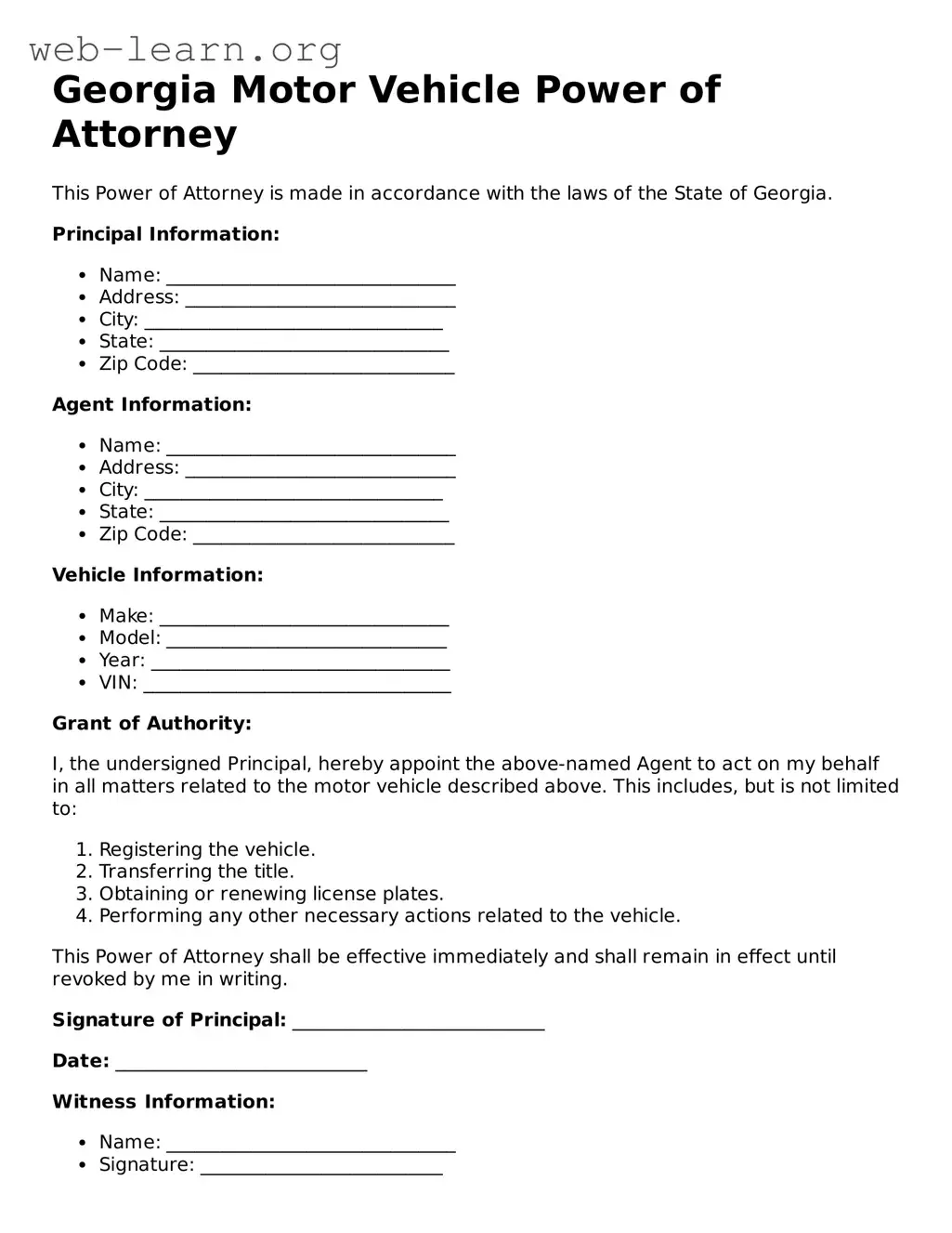
The Georgia Motor Vehicle Power of Attorney form serves as a crucial legal document that empowers an individual to act on behalf of another in matters related to motor vehicles. This form is particularly useful when the vehicle owner is unable to attend to necessary transactions, such as transferring ownership, registering a vehicle, or obtaining title documents. By designating an agent through this form, the principal can ensure that their interests are represented without the need for their physical presence. The document outlines the specific powers granted, which can include signing documents, making decisions about the vehicle, and handling any related financial transactions. It is important for both the principal and the agent to understand the responsibilities and limitations associated with this authority. Properly completing and notarizing the form is essential to ensure its validity, making it a key tool in facilitating smooth vehicle-related transactions in Georgia.
Georgia Motor Vehicle Power of Attorney
This Power of Attorney is made in accordance with the laws of the State of Georgia.
Principal Information:
Agent Information:
Vehicle Information:
Grant of Authority:
I, the undersigned Principal, hereby appoint the above-named Agent to act on my behalf in all matters related to the motor vehicle described above. This includes, but is not limited to:
This Power of Attorney shall be effective immediately and shall remain in effect until revoked by me in writing.
Signature of Principal: ___________________________
Date: ___________________________
Witness Information:
Notary Public:
State of Georgia
County of ___________________________
Subscribed and sworn to before me on this ____ day of ____________, 20__.
Notary Public Signature: ___________________________
My Commission Expires: ___________________________
| Fact Name | Description |
|---|---|
| Purpose | The Georgia Motor Vehicle Power of Attorney form allows an individual to designate another person to handle motor vehicle transactions on their behalf. |
| Governing Law | This form is governed by Georgia state law, specifically under Title 10, Chapter 6 of the Official Code of Georgia Annotated (OCGA). |
| Authorized Actions | The appointed agent can perform tasks such as signing titles, transferring ownership, and applying for registration or renewal. |
| Duration | The authority granted through this form remains in effect until revoked by the principal or until the specified task is completed. |
| Signing Requirements | The form must be signed by the principal in the presence of a notary public to ensure its validity. |
| Revocation | The principal can revoke the Power of Attorney at any time, provided the revocation is documented and communicated to the agent. |
| Use Cases | This form is commonly used when the vehicle owner is unable to attend to transactions due to absence, illness, or other reasons. |
Completing the Georgia Motor Vehicle Power of Attorney form requires careful attention to detail. After filling out the form, it will need to be signed and submitted according to the instructions provided. Ensure that all required information is accurate to avoid any delays in processing.
What is a Motor Vehicle Power of Attorney in Georgia?
A Motor Vehicle Power of Attorney is a legal document that allows an individual (the principal) to appoint another person (the agent) to act on their behalf regarding motor vehicle transactions. This may include buying, selling, or transferring ownership of a vehicle, as well as handling registration and title issues.
Who can be appointed as an agent?
In Georgia, any competent adult can be appointed as an agent. This can include family members, friends, or professionals such as attorneys or car dealers. It is essential to choose someone trustworthy, as they will have the authority to make decisions regarding your vehicle.
Do I need to have the form notarized?
Yes, the Motor Vehicle Power of Attorney form in Georgia typically requires notarization. Having the document notarized adds an extra layer of authenticity and ensures that the signatures are valid, which can be important for transactions involving the Department of Motor Vehicles (DMV).
Can I limit the powers granted to my agent?
Absolutely. You can specify the scope of authority granted to your agent in the Motor Vehicle Power of Attorney form. For example, you may limit their powers to only selling a specific vehicle or handling a particular transaction. Clearly outlining these limitations can help prevent misunderstandings.
Is there a specific format for the form?
While there is no official state form mandated by Georgia law, it is advisable to use a standard template that includes all necessary information. This typically includes the names of the principal and agent, a description of the vehicle, and the powers being granted. Ensuring that the form is complete and clear will help facilitate the process.
How long does the Power of Attorney remain valid?
The validity of a Motor Vehicle Power of Attorney in Georgia generally continues until the principal revokes it or until a specified expiration date, if included in the document. It is important to communicate with your agent about the duration of their authority to avoid any confusion.
What happens if the principal becomes incapacitated?
If the principal becomes incapacitated, the Power of Attorney may become invalid unless it is a durable Power of Attorney. A durable Power of Attorney remains effective even if the principal loses the ability to make decisions. It's crucial to specify this in the document if that is the intent.
Can I revoke the Power of Attorney once it is granted?
Yes, you can revoke a Motor Vehicle Power of Attorney at any time, as long as you are mentally competent. To revoke it, you should provide written notice to your agent and, if possible, notify any relevant institutions, such as the DMV. It is wise to document the revocation formally to prevent any future issues.
Are there any fees associated with using this form?
There may be fees associated with notarizing the document, as well as any fees incurred during the vehicle transaction itself, such as registration or title transfer fees. It is advisable to check with the DMV or a legal professional for a comprehensive list of potential costs.
Where can I obtain a Motor Vehicle Power of Attorney form?
You can often find templates for the Motor Vehicle Power of Attorney form online, through legal document providers, or at local legal offices. Additionally, some local DMV offices may provide forms or guidance on how to create one. Ensure that the form you use complies with Georgia state requirements.
Filling out the Georgia Motor Vehicle Power of Attorney form can be straightforward, but mistakes often occur. One common error is failing to provide accurate information about the vehicle. The form requires specific details, such as the vehicle identification number (VIN) and the make and model. Omitting or incorrectly entering this information can lead to complications when the agent tries to act on behalf of the principal.
Another mistake involves not properly identifying the agent. The person designated to act on behalf of the principal must be clearly named. If the agent’s name is misspelled or incomplete, it could create confusion. This could potentially invalidate the authority granted in the document.
People sometimes forget to sign and date the form. A signature is essential for the document to be considered valid. Without it, the Power of Attorney may not hold up in legal situations. Additionally, the date is important as it establishes when the authority begins, which can affect the timing of transactions.
Lastly, many individuals overlook the need for witnesses or notarization. Depending on the specific requirements in Georgia, having the form witnessed or notarized may be necessary for it to be legally binding. Neglecting this step can result in the form being challenged or rejected.
When dealing with vehicle transactions in Georgia, several important documents often accompany the Motor Vehicle Power of Attorney form. These documents help ensure that everything is handled smoothly and legally. Here’s a brief overview of some key forms you might encounter.
Having these documents prepared can make the process of buying or selling a vehicle much easier. They help clarify ownership and ensure compliance with state laws, providing peace of mind for everyone involved.
The Motor Vehicle Power of Attorney form allows someone to act on behalf of another person regarding vehicle-related matters. Several other documents serve similar purposes in different contexts. Here are four such documents:
Each of these documents allows for delegation of authority, ensuring that someone you trust can handle important matters when you are unable to do so.
When filling out the Georgia Motor Vehicle Power of Attorney form, it is important to follow certain guidelines to ensure accuracy and compliance. Here are five things you should and shouldn't do:
Following these guidelines can help prevent delays or issues with the processing of your Power of Attorney form.
When it comes to the Georgia Motor Vehicle Power of Attorney form, several misconceptions can lead to confusion. Understanding the realities behind these misunderstandings is crucial for anyone considering this legal document. Below are six common misconceptions:
Many believe that the Motor Vehicle Power of Attorney is solely for the purpose of transferring ownership during a sale. In fact, it can also be used for various tasks, such as registering a vehicle, obtaining title documents, or handling other motor vehicle-related matters.
While notarization can add an extra layer of authenticity, it is not always a requirement for the Georgia Motor Vehicle Power of Attorney. The form can be valid without a notary, as long as it meets the necessary criteria set forth by the state.
Some individuals think that only legal professionals can create a Motor Vehicle Power of Attorney. However, the form is designed for public use, and individuals can fill it out themselves, provided they follow the guidelines.
There is a misconception that this type of Power of Attorney has an automatic expiration date. In reality, it remains valid until the specific task is completed or until the principal revokes it, unless otherwise stated in the document.
While the form is specific to Georgia law, individuals from other states can use it if they are dealing with a vehicle registered in Georgia. This can be particularly relevant for those who have moved or are handling transactions across state lines.
Some may think that the Motor Vehicle Power of Attorney applies to all types of vehicles, including boats and motorcycles. However, it is specifically tailored for motor vehicles as defined by Georgia law, which may not encompass all vehicle types.
By dispelling these misconceptions, individuals can better navigate the process of using the Georgia Motor Vehicle Power of Attorney form and ensure that they are making informed decisions.
When dealing with the Georgia Motor Vehicle Power of Attorney form, it's essential to understand a few key points to ensure a smooth process. Here are some important takeaways:
Understanding these aspects will help ensure that you can effectively utilize the Georgia Motor Vehicle Power of Attorney form. Take your time to fill it out correctly, and consult with a professional if you have any questions.
Arkansas Dept of Motor Vehicles - A Motor Vehicle Power of Attorney can be revoked at any time, giving you control over your vehicle matters.
Appointment of Agent Form Michigan - This form allows for seamless vehicle transactions, even when you're not available.
Kansas Vehicle Power of Attorney - The Motor Vehicle Power of Attorney is a practical tool for busy individuals managing multiple responsibilities.