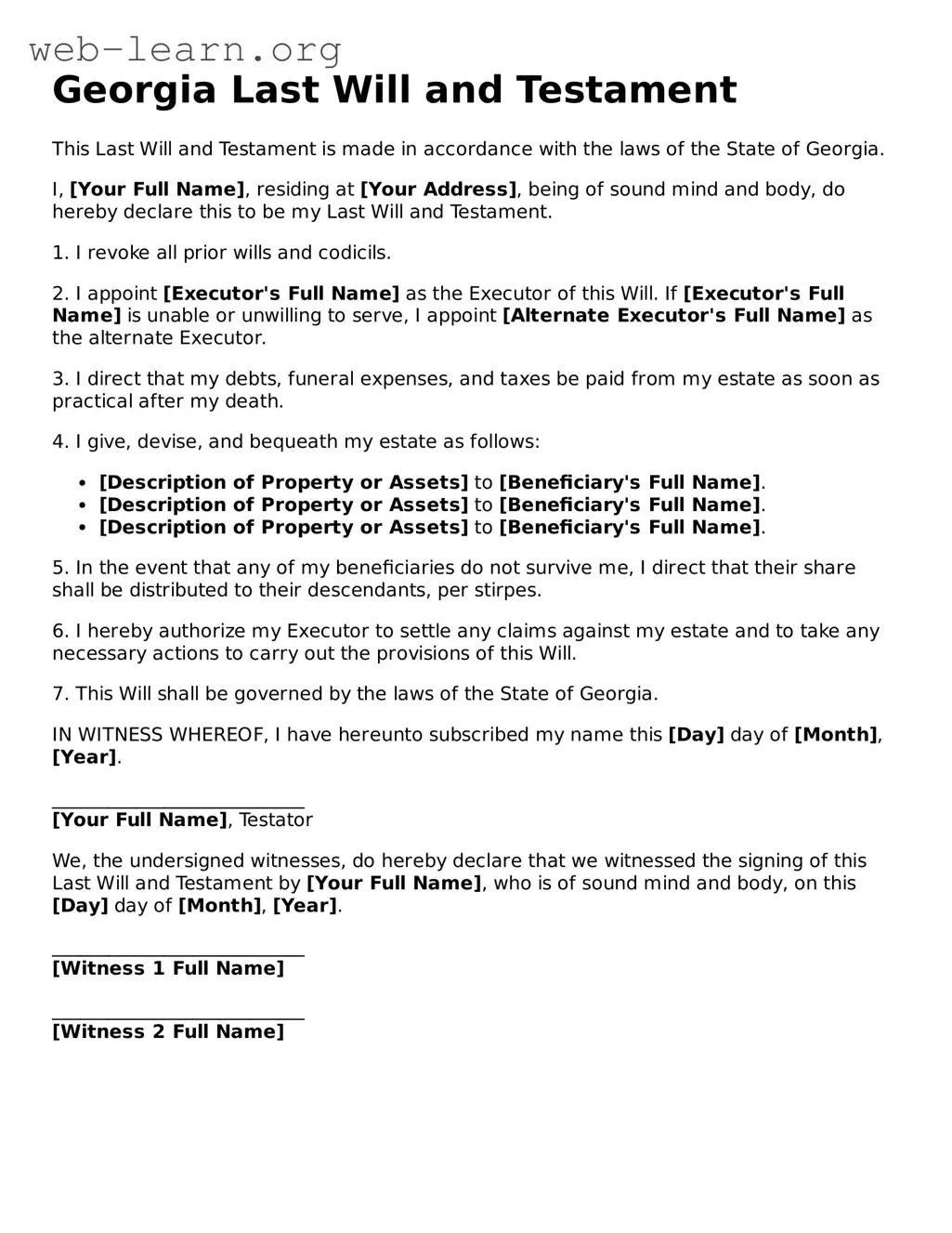
Creating a Last Will and Testament in Georgia is an essential step for anyone looking to ensure their wishes are honored after their passing. This legal document allows individuals to specify how their assets will be distributed, who will serve as guardians for minor children, and who will manage their estate. The form must be signed in the presence of at least two witnesses, who must also sign the document, affirming its validity. Additionally, it is crucial to understand that the will can be modified or revoked at any time, provided the individual is of sound mind. By clearly outlining intentions and designating trusted individuals, the Georgia Last Will and Testament form serves as a vital tool in estate planning, providing peace of mind for both the testator and their loved ones.
Georgia Last Will and Testament
This Last Will and Testament is made in accordance with the laws of the State of Georgia.
I, [Your Full Name], residing at [Your Address], being of sound mind and body, do hereby declare this to be my Last Will and Testament.
1. I revoke all prior wills and codicils.
2. I appoint [Executor's Full Name] as the Executor of this Will. If [Executor's Full Name] is unable or unwilling to serve, I appoint [Alternate Executor's Full Name] as the alternate Executor.
3. I direct that my debts, funeral expenses, and taxes be paid from my estate as soon as practical after my death.
4. I give, devise, and bequeath my estate as follows:
5. In the event that any of my beneficiaries do not survive me, I direct that their share shall be distributed to their descendants, per stirpes.
6. I hereby authorize my Executor to settle any claims against my estate and to take any necessary actions to carry out the provisions of this Will.
7. This Will shall be governed by the laws of the State of Georgia.
IN WITNESS WHEREOF, I have hereunto subscribed my name this [Day] day of [Month], [Year].
___________________________
[Your Full Name], Testator
We, the undersigned witnesses, do hereby declare that we witnessed the signing of this Last Will and Testament by [Your Full Name], who is of sound mind and body, on this [Day] day of [Month], [Year].
___________________________
[Witness 1 Full Name]
___________________________
[Witness 2 Full Name]
| Fact Name | Details |
|---|---|
| Governing Law | The Georgia Last Will and Testament is governed by the Official Code of Georgia Annotated (O.C.G.A.) § 53-4-1. |
| Age Requirement | Individuals must be at least 14 years old to create a valid will in Georgia. |
| Witness Requirement | Two witnesses are required to sign the will for it to be valid. |
| Notarization | While notarization is not required, having a will notarized can simplify the probate process. |
| Revocation | A will can be revoked by a subsequent will or by physically destroying the document. |
| Holographic Wills | Georgia recognizes holographic wills, which are handwritten and signed by the testator. |
| Residency | There is no residency requirement for creating a will in Georgia, but it must comply with state laws. |
| Distribution of Assets | The will outlines how the testator's assets will be distributed after death, including specific bequests. |
Filling out the Georgia Last Will and Testament form is an important step in ensuring that your wishes are respected after your passing. Once you have completed the form, it is advisable to store it in a safe place and consider discussing your decisions with your loved ones to avoid any confusion in the future.
What is a Last Will and Testament in Georgia?
A Last Will and Testament is a legal document that outlines how a person's assets and affairs should be handled after their death. In Georgia, this document allows individuals to specify who will inherit their property, appoint guardians for minor children, and designate an executor to manage the estate. It is essential for ensuring that your wishes are respected and can help avoid disputes among heirs.
Who can create a Last Will and Testament in Georgia?
In Georgia, any individual who is at least 14 years old and of sound mind can create a Last Will and Testament. However, it is advisable for those creating a will to be at least 18 years old to ensure that they have a clear understanding of the legal implications. Additionally, the testator, or person making the will, must be free from undue influence or coercion.
What are the requirements for a valid will in Georgia?
To ensure that a Last Will and Testament is valid in Georgia, it must meet the following criteria:
Can I change or revoke my will in Georgia?
Yes, you can change or revoke your Last Will and Testament at any time while you are alive and mentally competent. To make changes, you can either create a new will that explicitly revokes the previous one or make a codicil, which is an amendment to the existing will. It is important to follow the same formalities as the original will when making changes to ensure that they are legally recognized.
What happens if I die without a will in Georgia?
If you pass away without a valid Last Will and Testament, you are considered to have died "intestate." In this case, Georgia's intestacy laws dictate how your assets will be distributed. Typically, your property will be divided among your closest relatives, such as your spouse and children. However, this may not align with your wishes, making it essential to have a will in place.
How do I choose an executor for my will?
Choosing an executor is a significant decision. This person will be responsible for managing your estate, ensuring that your wishes are carried out, and handling any legal matters that arise. It is advisable to select someone trustworthy, organized, and capable of handling financial and legal responsibilities. Many people choose a family member, close friend, or a professional such as an attorney or accountant.
Is it necessary to hire a lawyer to create a will in Georgia?
While it is not legally required to hire a lawyer to draft a Last Will and Testament in Georgia, it is highly recommended. An attorney can provide guidance on the legal requirements, help you navigate complex family dynamics, and ensure that your will accurately reflects your wishes. Additionally, having a lawyer involved can help prevent potential disputes and challenges to the will after your passing.
Can I include specific bequests in my will?
Yes, you can include specific bequests in your Last Will and Testament. This means you can designate particular items or amounts of money to specific individuals. For example, you might leave your grandmother's jewelry to your sister or a certain sum of money to a charity. Clearly outlining these bequests can help ensure that your wishes are honored.
How should I store my will once it is created?
After creating your Last Will and Testament, it is important to store it in a safe yet accessible location. Many people choose to keep their will in a safe deposit box, a fireproof safe at home, or with their attorney. Informing your executor and close family members about where the will is stored can help ensure that it is located easily when needed.
Filling out a Last Will and Testament form in Georgia can be a straightforward process, but mistakes can lead to complications. One common error is failing to clearly identify the testator. The testator is the person making the will. It’s essential to include the full legal name and address to avoid any confusion about who the will belongs to.
Another frequent mistake is not properly signing the document. In Georgia, the will must be signed by the testator in the presence of at least two witnesses. If this step is overlooked, the will may be deemed invalid. Additionally, witnesses must also sign the will, and their signatures should be dated to confirm when they witnessed the signing.
Many individuals neglect to update their wills after significant life changes. Events such as marriage, divorce, or the birth of a child can affect the distribution of assets. Failing to revise the will to reflect these changes can lead to unintended consequences.
Some people make the mistake of being vague about their assets. It is crucial to provide a clear and detailed list of assets, including property, bank accounts, and personal belongings. Ambiguity can create disputes among heirs and complicate the probate process.
Another common error is not naming an executor. The executor is responsible for managing the estate after death. Without naming someone, the court may appoint an executor, which may not align with the testator's wishes.
Additionally, individuals often forget to include a clause for the distribution of debts and taxes. It is important to specify how debts and taxes will be paid from the estate before assets are distributed to beneficiaries. Omitting this can lead to disputes and delays in the probate process.
Some testators also fail to consider their beneficiaries carefully. Choosing individuals who are not legally capable of inheriting, such as minors, can complicate matters. Establishing a trust or appointing a guardian can help manage assets for minors until they reach adulthood.
Another mistake is not discussing the will with family members. Open communication can prevent misunderstandings and disputes after the testator's passing. It is advisable to inform beneficiaries of their roles and the contents of the will.
Finally, individuals may overlook the importance of storing the will safely. A will should be kept in a secure location, such as a safe deposit box or with an attorney. If the will cannot be found after the testator's death, it may be treated as if no will existed, leading to the state's intestacy laws taking effect.
In Georgia, individuals often prepare several documents alongside a Last Will and Testament to ensure their estate planning is comprehensive. Each of these documents serves a specific purpose and can help clarify intentions regarding assets, healthcare decisions, and guardianship. Below is a list of common forms used in conjunction with a Last Will and Testament.
These documents, when used together with a Last Will and Testament, create a more thorough estate plan. Each serves a unique function and helps individuals express their wishes clearly, providing peace of mind for both the individual and their loved ones.
When filling out the Georgia Last Will and Testament form, it is important to follow certain guidelines to ensure your wishes are clearly expressed. Here are four things you should and shouldn't do:
When it comes to creating a Last Will and Testament in Georgia, several misconceptions can lead to confusion. Here are eight common misunderstandings:
This is not true. Everyone can benefit from having a will, regardless of their financial situation. A will ensures that your wishes are honored after your passing.
In Georgia, oral wills are not recognized. A valid will must be in writing and signed by the testator and witnesses.
Your circumstances may change, and so should your will. Major life events, like marriage or having children, often require updates to your will.
This is a misconception. While many assets may transfer to a spouse, not all do. A will can specify how assets should be distributed.
While Georgia does allow handwritten wills, they must meet specific legal requirements. It’s usually best to have a professionally drafted will.
This is false. You can modify or revoke your will at any time, as long as you follow the legal procedures.
Even if a lawyer drafts your will, you still need at least two witnesses to sign it for it to be valid in Georgia.
While a will can simplify the probate process, it does not eliminate it. Probate is still necessary to validate the will and distribute assets.
Understanding these misconceptions can help ensure that your estate planning is effective and meets your needs.
Filling out and using the Georgia Last Will and Testament form requires careful attention to detail. Here are some key takeaways to keep in mind:
Understanding these points can help ensure that your Last Will and Testament accurately reflects your wishes and is legally enforceable in Georgia.
Will Template Alabama - Helps protect the interests of the testator's loved ones after their passing.
How to Make a Will in Arkansas - May include alternate beneficiaries in case primary ones predecease the testator.
Will Template Indiana - Helps safeguard your family's financial future and well-being.