The Georgia IT 303 form serves as an essential tool for taxpayers seeking an extension on their state income tax returns. This application allows individuals and businesses to request additional time to file their returns due to various circumstances, such as illness or absence. The form must be completed in triplicate and submitted to the Georgia Department of Revenue before the original due date of the return. It is crucial to attach one copy of the extension request to the completed return and keep the other for personal records. Each spouse must file a separate application if they are submitting individual returns. Notably, extensions are limited to six months, and an additional request is necessary for further extensions. Corporations have specific requirements as well, particularly those filing consolidated returns, which need to submit separate applications for each subsidiary. Timely filing is vital, as late submissions incur penalties and interest. Understanding the nuances of this form can help taxpayers navigate their obligations effectively and avoid unnecessary financial penalties.
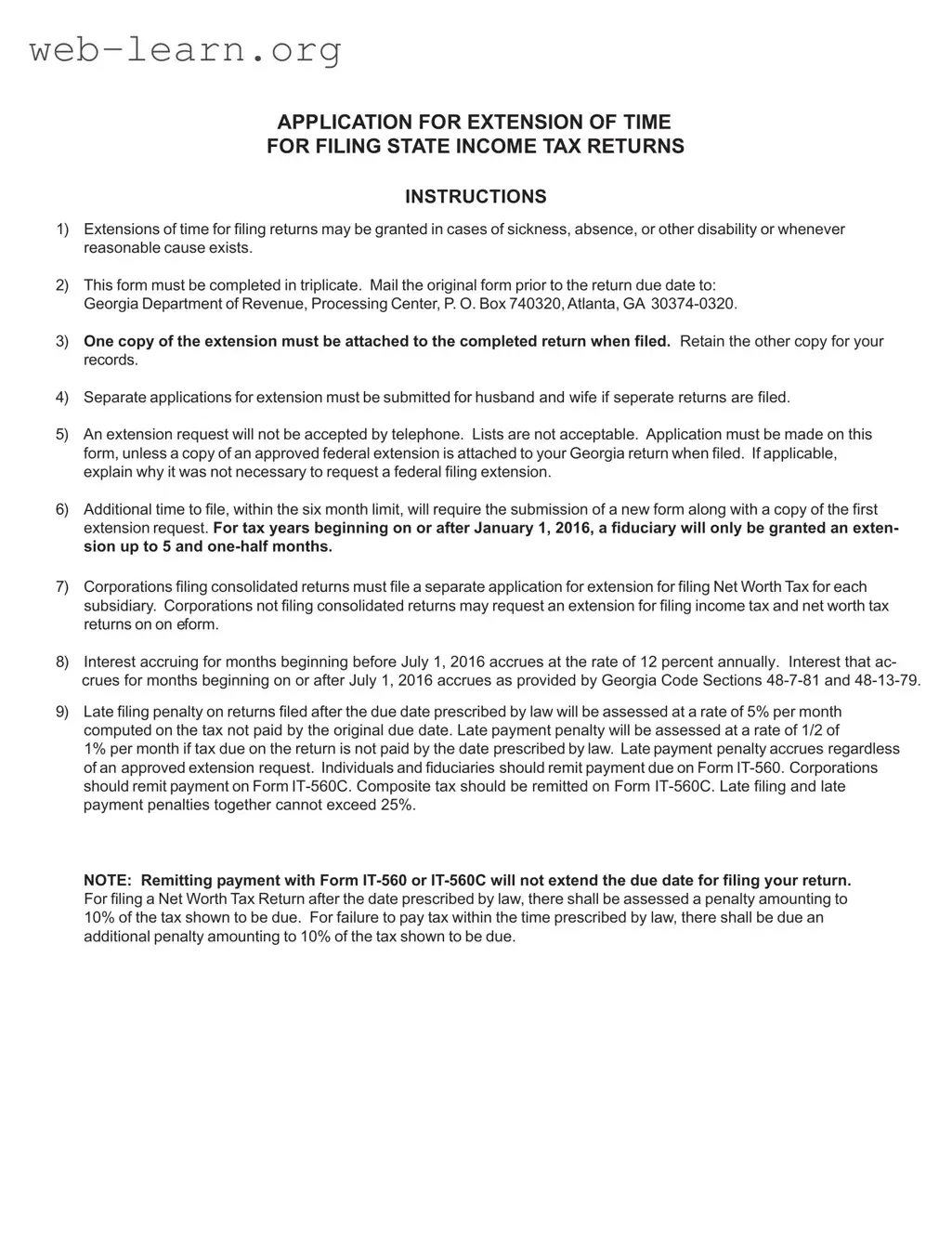
APPLICATION FOR EXTENSION OF TIME
FOR FILING STATE INCOME TAX RETURNS
INSTRUCTIONS
1)Extensions of time for filing returns may be granted n cases of sickness, absence, or other disability or whenever reasonable cause exists.
2)This form must be completed n triplicate. Mail the original form prior to the return due date to: Georgia Department of Revenue, Processing Center, P. O Box 740320,Atlanta GA
3)One copy of the extension must be attached to the completed return when filed. Retain the other copy for your records.
4)Separate applications for extension must be submitted for husband and wife if seperate returns are filed.
5)An extension request will not be accepted by telephone. Lists are not acceptable. Application must be made on this form, unless a copy of an approved federal extension is attached to your Georgia return when filed. If applicable, explain why t was not necessary to request a federal filing extension.
6)Additional time to file, within the six month imit, will require the submission of a new form along with a copy of the first extension request. For tax years beginning on or after January 1, 2016, a fiduciary will only be granted an exten- sion up to 5 and
7)Corporations filing consolidated returns must file a separate application for extension for filing Net Worth Tax for each subsidiary. Corporations not filing consolidated returns may request an extension for filing income tax and net worth tax returns on on eform.
8)Interest accruing for months beginning before July 1, 2016 accrues at the rate of 12 percent annually. Interest that ac- crues for months beginning on or after July 1, 2016 accrues as provided by Georgia Code Sections
9)Late iling penalty on returns iled after he due date prescribed by aw will be assessed at a rate of 5% per month computed on the tax not paid by the original due date. Late payment penalty will be assessed at a rate of 1/2 of
1% per month f ax due on he return s not paid by he date prescribed by law. Lat e payment penal ty accrues regardless of an approved extension request. Individuals and fiduciaries should remi t payment due on Form
NOTE: Remitting payment with Form
Form
MAIL TO:
Georgia Department of Revenue
Processing Center
PO Box 740320
Atlanta, GA
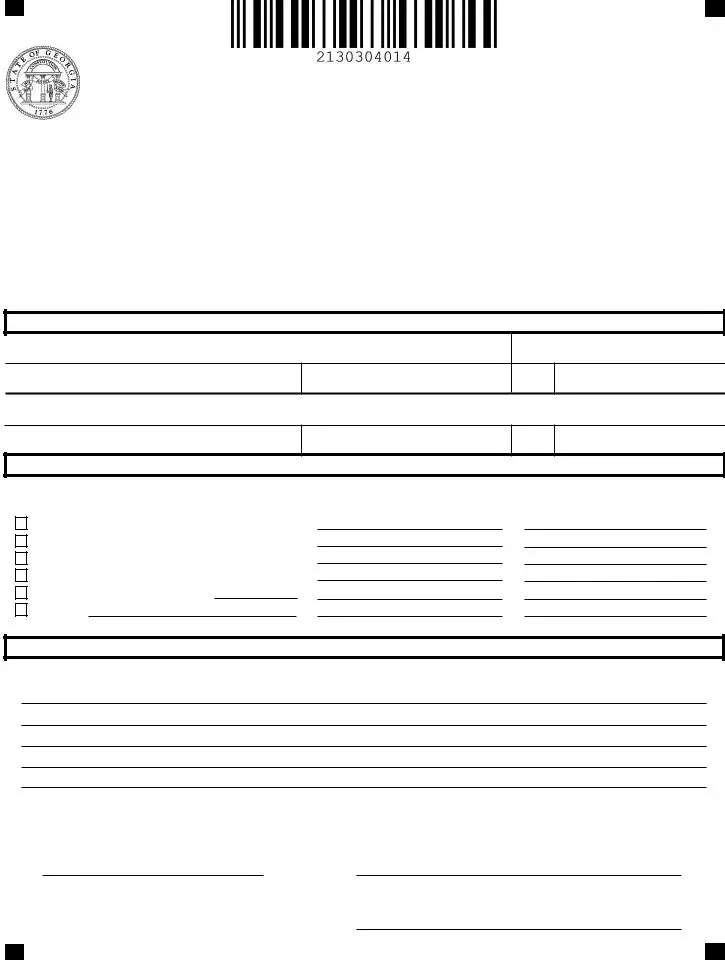
Georgia Department of Revenue
APPLICATION FOR EXTENSION OF TIME
FOR FILING STATE INCOME TAX RETURNS
IMPORTANT! ACCEPTANCE OF FEDERAL EXTENSIONS
AFEDERAL EXTENSION WILL BEACCEPTEDAS AGEORGIAEXTENSION IF: (1) THE RETURN IS RECEIVED WITHIN THE TIMEAS EXTENDED BY THE NTERNAL REVENUE SERVICE, AND (2) A COPY OF THE FEDERAL EXTENSION(S) S ATTACHED TO THE RETURN WHEN FILED. NOTE:
THERE S NO EXTENSION FOR PAYMENT OF TAX. INCOME TAX OR CORPORATE NET WORTH TAX MUST BE PAID BY THE PRESCRIBED DUE DATE TOAVOID THE ASSESSMENT OF LATE PAYMENT PENALTIES AND INTEREST.
THIS IS NOT A PAYMENT FORM! REMIT PAYMENT ON FORM
COMPLETE THIS FORM IN TRIPLICATE. MAIL THE ORIGINAL PRIOR TO THE RETURN DUE DATE AND KEEP 2 COPIES. ATTACH ONE COPY TO RETURN WHEN FILED AND RETAIN ONE COPY FOR YOUR RECORDS. WE WILL NOTIFY YOU ONLY IF YOUR EXTENSION REQUEST IS DENIED.
SECTION 1
NAME
SOCIAL SECURITY NUMBER OR FEIN
ADDRESS
CITY
STATE ZIP CODE
NAME OF TAXPAYER FOR WHOM EXTENSION IS FILED, IF DIFFERENT FROM ABOVE
ADDRESS
CITY
STATE ZIP CODE
SECTION 2
APPLICATION IS HEREBY MADE FOR AN EXTENSION OF TIME FOR THE FOLLOWING STATE TAX RETURN:
1. Type of return (check proper type):2. For Period Ending:3. Extension Requested To:
Corporate IncomeTax
Net Worth Tax (For Period Beginning)
Other
NOTE: Except as noted above, extensions are limited by law to six (6) months, please see line 6 of instructions.
SECTION 3
REASON FOR EXTENSION:
I AFFIRM THAT THE ABOVE INFORMATION IS, TO THE BEST OF MY KNOWLEDGE AND BELIEF, TRUE AND ACCURATE. THIS AFFIRMATION IS MADE UNDER THE PENALTIES PRESCRIBED BY LAW.
DATE |
SIGNATURE OF TAXPAYER OR AUTHORIZED AGENT |
IF SIGNED BYAGENT, AGENT’S FIRM OR TRADE NAME
| Fact Name | Details |
|---|---|
| Purpose | This form is used to request an extension of time for filing state income tax returns in Georgia. |
| Submission Requirements | The form must be completed in triplicate and mailed to the Georgia Department of Revenue before the return due date. |
| Separate Applications | If filing separately, both spouses must submit individual applications for extension. |
| Governing Law | Extensions are governed by Georgia Code Sections 48-7-81 and 48-13-79. |
| Penalties | Late filing incurs a penalty of 5% per month on unpaid taxes, with a maximum of 25% for combined penalties. |
Filling out the Georgia IT 303 form is a straightforward process that allows you to request an extension for filing your state income tax return. It's important to ensure that all information is accurate and that the form is submitted on time to avoid any penalties. Below are the steps to guide you through the completion of this form.
After submitting the form, you will receive notification only if your extension request is denied. Make sure to keep track of your submission and be aware of any deadlines to avoid penalties.
The Georgia IT 303 form is used to request an extension of time for filing state income tax returns. This form allows taxpayers to gain additional time to prepare their returns without incurring late filing penalties, provided that they have a valid reason for the extension, such as sickness or other reasonable causes.
To submit the IT 303 form, you must complete it in triplicate. The original form should be mailed to the Georgia Department of Revenue at the Processing Center, P.O. Box 740320, Atlanta, GA 30374-0320 before the due date of your return. You should keep two copies: one to attach to your completed return and another for your personal records.
Yes, there are penalties associated with late filing and late payment. If you file your return after the due date, a late filing penalty of 5% per month on the unpaid tax will be assessed. For late payments, a penalty of 0.5% per month will apply. Together, these penalties cannot exceed 25% of the total tax due. It is important to note that remitting payment with the IT 560 or IT 560C forms does not extend your filing deadline.
Yes, a federal extension will be accepted as a Georgia extension if you file your return within the time extended by the Internal Revenue Service and attach a copy of the federal extension to your Georgia return. However, it is crucial to understand that this does not extend the deadline for payment of any taxes owed.
If you require additional time to file beyond the initial extension granted, you must submit a new IT 303 form along with a copy of the first extension request. Keep in mind that for tax years beginning on or after January 1, 2016, fiduciaries are limited to an extension of only 5.5 months.
Filling out the Georgia IT 303 form can be straightforward, but mistakes can lead to delays or complications. One common error is not completing the form in triplicate. The instructions clearly state that three copies are required: one to mail, one to attach to your return, and one to keep for your records. Failing to provide all three copies can result in your extension request being incomplete.
Another mistake often made is not mailing the original form before the due date. It's essential to send the original to the Georgia Department of Revenue on time. If you miss this deadline, your request for an extension may be denied. People sometimes overlook the importance of timing, which can lead to unnecessary penalties.
Many individuals also forget that separate applications are necessary for married couples filing separately. Each spouse must submit their own extension request. This requirement is easy to overlook, especially during a busy tax season, but it is crucial for ensuring compliance with state regulations.
Some taxpayers mistakenly believe that they can request an extension over the phone or through a list. However, the form must be filled out and submitted as instructed. This misunderstanding can lead to frustration and delays, as the request will not be accepted without the proper form.
Another frequent error involves not attaching a copy of an approved federal extension when applicable. If you have received a federal extension, you must include a copy with your Georgia return. If you do not, your extension request may not be honored, and you could face penalties for late filing.
People sometimes fail to provide a reason for the extension in Section 3 of the form. It is important to affirm that the information provided is accurate and true. Not including a reason can make your request appear incomplete, which may lead to denial.
Additionally, some taxpayers overlook the need for a new extension form if they require additional time beyond the initial six-month limit. If you need more time, you must submit a new form along with a copy of the first extension request. Ignoring this step can lead to penalties for late filing.
Finally, individuals often misunderstand the payment requirements associated with the extension. While the extension allows more time to file, it does not extend the deadline for payment. Tax payments must be made by the original due date to avoid penalties. Being aware of this can help prevent unnecessary financial consequences.
When filing your state income tax return in Georgia, the IT 303 form is an essential document for requesting an extension. However, there are several other forms and documents that may also be required or helpful in conjunction with the IT 303. Understanding these can simplify your tax filing process and ensure compliance with state regulations.
Being prepared with the correct forms and documentation can alleviate some of the stress associated with tax season. Each form serves a specific purpose, and ensuring that they are completed accurately will help you avoid unnecessary penalties and complications. If you have questions or need further assistance, consider consulting with a tax professional who can provide personalized guidance tailored to your situation.
The Georgia IT 303 form is an important document for requesting an extension of time to file state income tax returns. Here are five other documents that are similar to the IT 303 form, along with explanations of how they relate:
When filling out the Georgia IT 303 form, it is essential to follow specific guidelines to ensure that your application for an extension is processed smoothly. Below is a list of what you should and shouldn't do while completing this form.
By adhering to these guidelines, individuals and businesses can avoid common pitfalls when applying for an extension on their state income tax returns in Georgia.
Understanding the Georgia IT 303 form can be challenging, especially with the various misconceptions that often arise. Here’s a breakdown of ten common misunderstandings regarding this important document.
By clearing up these misconceptions, taxpayers can navigate the extension process more effectively and avoid unnecessary penalties. Always consult the latest guidelines and consider seeking professional advice if needed.
Filing the Georgia IT 303 form can be a straightforward process if you understand its requirements and implications. Here are some key takeaways to keep in mind:
Understanding these points can help ensure that you navigate the extension process smoothly and avoid potential penalties. Always keep copies of your submissions for your records, and be mindful of deadlines to maintain compliance with Georgia tax laws.