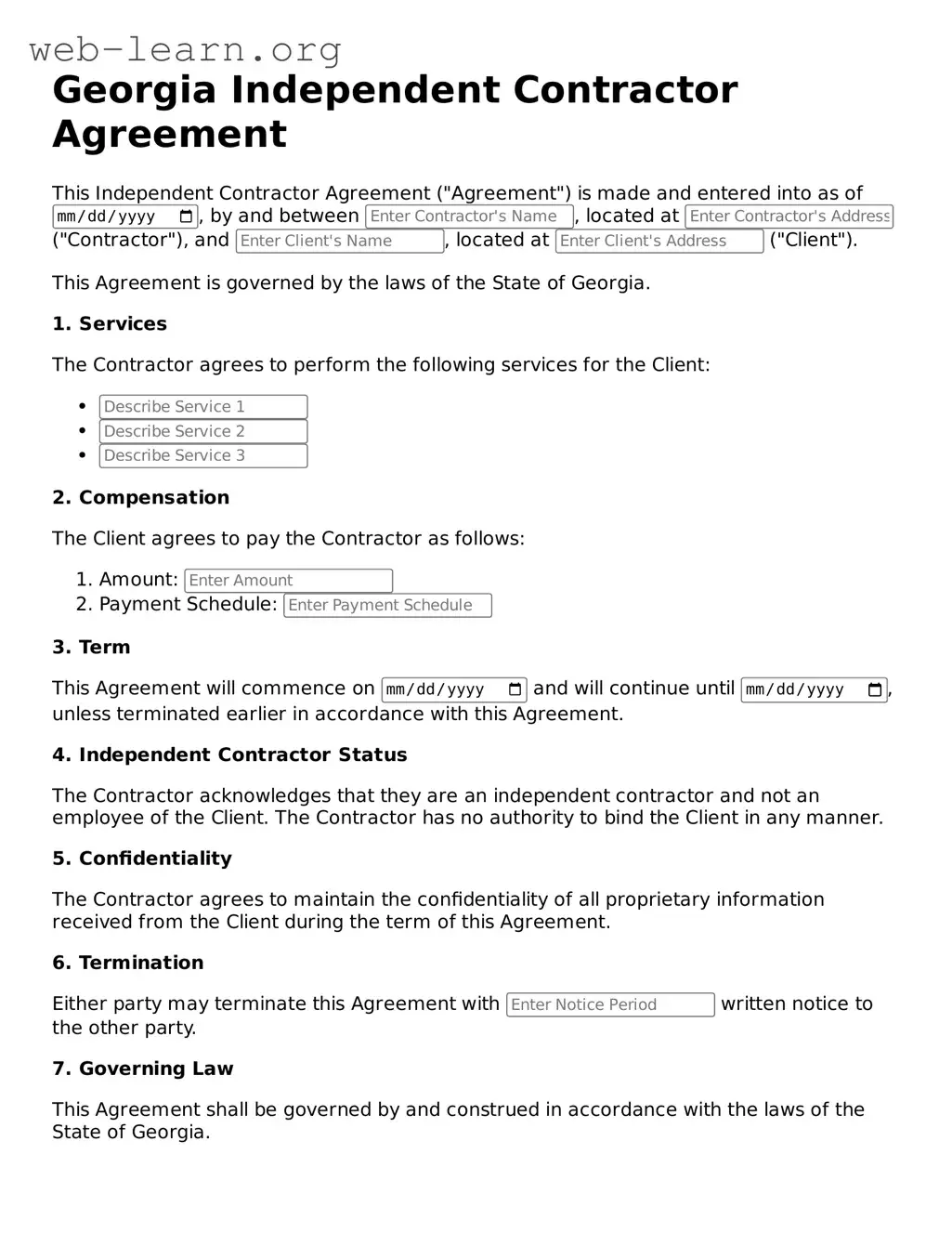
The Georgia Independent Contractor Agreement form serves as a vital document in the realm of freelance and contract work, establishing clear expectations between the hiring party and the contractor. This form outlines essential details such as the scope of work, payment terms, and deadlines, ensuring that both parties are on the same page from the outset. Additionally, it addresses issues like confidentiality, intellectual property rights, and termination clauses, which are crucial for protecting the interests of both the contractor and the client. By defining the relationship and responsibilities, the agreement helps to minimize misunderstandings and disputes. Furthermore, this form is particularly important in Georgia, where specific state laws may influence the classification of workers. Understanding these elements can empower both parties to navigate their professional relationship more effectively, fostering a productive and legally sound collaboration.
Georgia Independent Contractor Agreement
This Independent Contractor Agreement ("Agreement") is made and entered into as of , by and between , located at ("Contractor"), and , located at ("Client").
This Agreement is governed by the laws of the State of Georgia.
1. Services
The Contractor agrees to perform the following services for the Client:
2. Compensation
The Client agrees to pay the Contractor as follows:
3. Term
This Agreement will commence on and will continue until , unless terminated earlier in accordance with this Agreement.
4. Independent Contractor Status
The Contractor acknowledges that they are an independent contractor and not an employee of the Client. The Contractor has no authority to bind the Client in any manner.
5. Confidentiality
The Contractor agrees to maintain the confidentiality of all proprietary information received from the Client during the term of this Agreement.
6. Termination
Either party may terminate this Agreement with written notice to the other party.
7. Governing Law
This Agreement shall be governed by and construed in accordance with the laws of the State of Georgia.
IN WITNESS WHEREOF, the parties hereto have executed this Independent Contractor Agreement as of the date first above written.
__________________________ (Contractor)
__________________________ (Client)
| Fact Name | Description |
|---|---|
| Definition | The Georgia Independent Contractor Agreement outlines the terms between a business and an independent contractor. |
| Governing Law | This agreement is governed by the laws of the State of Georgia. |
| Payment Terms | It specifies how and when the contractor will be compensated for their services. |
| Scope of Work | The agreement details the specific tasks and responsibilities assigned to the contractor. |
| Duration | The length of the agreement can be defined, including start and end dates. |
| Confidentiality | It may include clauses regarding the protection of confidential information. |
| Termination Clause | The agreement often outlines the conditions under which either party can terminate the contract. |
| Liability | Liability limitations may be included to protect both parties from unforeseen issues. |
| Dispute Resolution | Methods for resolving disputes, such as mediation or arbitration, can be specified. |
| Independent Status | The agreement clarifies that the contractor is not an employee, ensuring compliance with tax laws. |
Filling out the Georgia Independent Contractor Agreement form is a straightforward process. This form is essential for establishing the terms of the working relationship between the contractor and the hiring party. Once completed, the agreement will help clarify expectations and responsibilities for both parties.
A Georgia Independent Contractor Agreement is a legal document that outlines the terms and conditions between a business and an independent contractor. It specifies the nature of the work to be performed, payment terms, and other important details related to the contractor's services.
This agreement helps protect both parties by clearly defining expectations and responsibilities. It reduces the risk of misunderstandings and provides a framework for resolving disputes should they arise. Additionally, it helps establish the contractor's status, which can be important for tax and liability purposes.
Essential elements of a Georgia Independent Contractor Agreement include:
Independent contractors are typically responsible for their own taxes, including self-employment taxes. The agreement should clarify that the contractor is not an employee and will receive a 1099 form for tax reporting purposes, rather than a W-2.
Yes, the agreement can be modified, but both parties must agree to any changes. It is advisable to document any modifications in writing to avoid confusion in the future.
If a dispute occurs, the agreement may outline the process for resolution, such as mediation or arbitration. Having a clear dispute resolution process helps both parties handle conflicts more effectively.
While it is not legally required, having a lawyer review the agreement can provide peace of mind. A legal professional can ensure that the document complies with Georgia law and adequately protects your interests.
The validity of the agreement typically depends on the duration specified within the document. Once the agreed-upon term ends, the contract may need to be renewed or renegotiated if both parties wish to continue the relationship.
Termination procedures should be outlined in the agreement. Generally, either party can terminate the contract by providing written notice, adhering to any notice period specified in the document.
While there is no specific statute governing Independent Contractor Agreements in Georgia, general contract law applies. It is essential to ensure that the agreement complies with both state and federal regulations regarding independent contractors.
Filling out the Georgia Independent Contractor Agreement form can be straightforward, but several common mistakes often lead to confusion or disputes. One frequent error is failing to clearly define the scope of work. It’s essential to specify what tasks the contractor will perform. Without this clarity, misunderstandings may arise about expectations and responsibilities.
Another common mistake is neglecting to include payment terms. The agreement should detail how much the contractor will be paid and when payments will occur. Omitting this information can lead to disputes over compensation and may complicate the working relationship.
Many individuals also overlook the importance of including a termination clause. This section should outline the conditions under which either party can terminate the agreement. Without it, one party may find themselves in a difficult position if the working relationship needs to end unexpectedly.
Lastly, some people forget to review the agreement for signatures. Both parties must sign the document for it to be legally binding. Without signatures, the agreement holds no legal weight, leaving both parties vulnerable to misunderstandings and potential conflicts.
When entering into an Independent Contractor Agreement in Georgia, several other forms and documents may be necessary to ensure clarity and compliance. These documents help define the relationship between the parties involved and outline various aspects of the work arrangement.
Utilizing these forms in conjunction with the Georgia Independent Contractor Agreement can help establish a clear and professional working relationship. Each document serves a specific purpose and contributes to a smoother collaboration between independent contractors and their clients.
When filling out the Georgia Independent Contractor Agreement form, it is essential to be thorough and accurate. Here are five things you should and shouldn't do:
Many individuals and businesses have misunderstandings about the Georgia Independent Contractor Agreement form. Here are seven common misconceptions:
While it is true that verbal agreements can be binding, having a written contract provides clarity and protection for both parties. It outlines the scope of work, payment terms, and other important details.
While many independent contractors operate as self-employed individuals, some may work through an agency or company. This distinction can affect tax obligations and liability issues.
In fact, one of the benefits of being an independent contractor is the ability to take on multiple clients simultaneously. This flexibility can lead to increased income and diverse work experiences.
While independent contractors typically do not receive traditional employee benefits, they can negotiate certain perks, such as flexible work hours or reimbursement for specific expenses.
Each state has its own laws and regulations governing independent contractor agreements. It is essential to ensure that the agreement complies with Georgia's specific requirements.
Agreements can be amended if both parties agree to the changes. It is important to document any modifications in writing to avoid misunderstandings later.
Independent contractors are required to report their income to the IRS. They must also pay self-employment taxes, making it crucial to keep accurate records of earnings and expenses.
The Georgia Independent Contractor Agreement form is an important document for defining the relationship between a business and an independent contractor. Here are key takeaways to consider when filling out and using this form:
Using the Georgia Independent Contractor Agreement form correctly can help prevent disputes and clarify expectations. It is advisable to review the agreement periodically and update it as necessary to reflect changes in the working relationship.
1099 Agreement - The agreement can outline the contractor's obligations for reporting progress on work.
Independent Contractor Agreement Colorado - It can help both parties navigate the complexities of a contractor-client relationship.