In Georgia, families who choose to homeschool their children embark on an educational journey that is both rewarding and challenging. A crucial step in this process is the completion of the Homeschool Letter of Intent form, which serves as a formal notification to the local school district of a family's decision to educate their child at home. This document is not merely a formality; it outlines essential details such as the names and ages of the children being homeschooled, the educational curriculum being utilized, and the intended duration of the homeschooling program. By submitting this letter, parents affirm their commitment to providing a quality education tailored to their child's needs. Additionally, the form plays a vital role in ensuring compliance with state regulations, which helps to maintain a structured approach to homeschooling. Understanding the significance of this form can empower parents to navigate the homeschooling landscape with confidence, ensuring that their children receive the best possible educational experience outside traditional classroom settings.
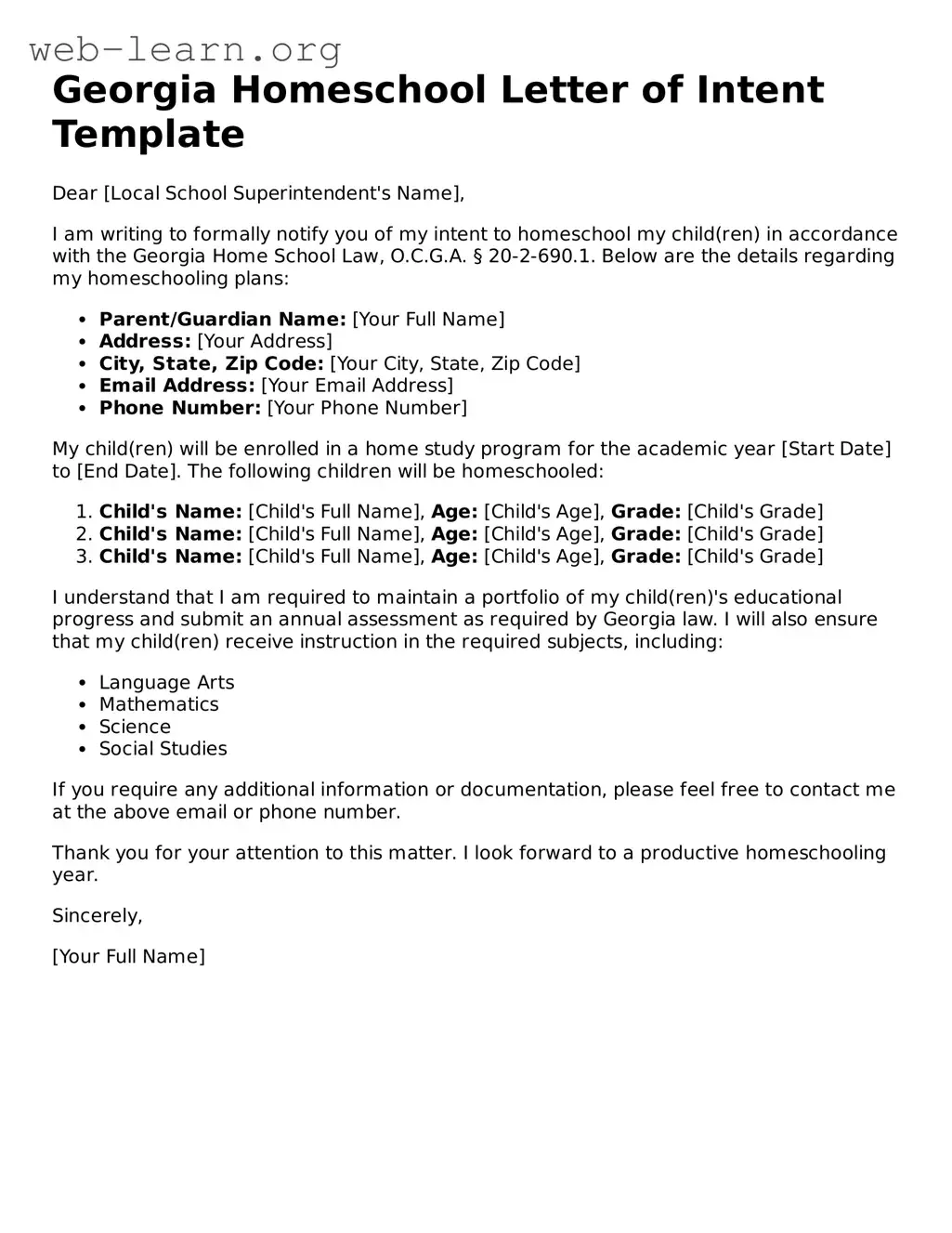
Georgia Homeschool Letter of Intent Template
Dear [Local School Superintendent's Name],
I am writing to formally notify you of my intent to homeschool my child(ren) in accordance with the Georgia Home School Law, O.C.G.A. § 20-2-690.1. Below are the details regarding my homeschooling plans:
My child(ren) will be enrolled in a home study program for the academic year [Start Date] to [End Date]. The following children will be homeschooled:
I understand that I am required to maintain a portfolio of my child(ren)'s educational progress and submit an annual assessment as required by Georgia law. I will also ensure that my child(ren) receive instruction in the required subjects, including:
If you require any additional information or documentation, please feel free to contact me at the above email or phone number.
Thank you for your attention to this matter. I look forward to a productive homeschooling year.
Sincerely,
[Your Full Name]
| Fact Name | Description |
|---|---|
| Governing Law | The Georgia Homeschool Letter of Intent is governed by O.C.G.A. § 20-2-690.1. |
| Purpose | This form notifies the Georgia Department of Education of a family's intent to homeschool. |
| Submission Deadline | The form must be submitted within 30 days of starting the homeschool program. |
| Annual Requirement | Families must submit a new Letter of Intent each year for continued homeschooling. |
| Content Requirements | The form requires basic information about the student and the homeschooling parent. |
| Notification Process | Once submitted, the Department of Education will acknowledge receipt of the form. |
| Record Keeping | Parents should keep a copy of the Letter of Intent for their records. |
| Educational Philosophy | The form does not require an educational philosophy statement, but it is encouraged. |
| Submission Method | The Letter of Intent can be submitted by mail or electronically, depending on the local district. |
| Local District Requirements | Some local districts may have additional requirements; check with your local school board. |
Once you have your Georgia Homeschool Letter of Intent form ready, you’ll need to fill it out accurately to ensure compliance with state requirements. This step is crucial for officially notifying the local school district of your intent to homeschool your child. Follow these steps to complete the form.
After submitting your form, keep an eye out for any communication from the school district. They may reach out to confirm receipt or provide additional instructions. It’s important to stay engaged and informed as you embark on your homeschooling journey.
The Georgia Homeschool Letter of Intent is a formal document that parents or guardians must submit to the local school superintendent. This letter notifies the school district of the intent to homeschool their child or children. It is a necessary step to comply with state regulations regarding homeschooling.
Any parent or guardian who wishes to homeschool a child in Georgia must file a Letter of Intent. This applies to all children aged 6 to 16 years old, as these are the ages during which school attendance is mandatory in Georgia.
The Letter of Intent should be submitted within 30 days of beginning the homeschooling process. If you are withdrawing a child from public or private school, it is advisable to submit the letter before the withdrawal to ensure compliance with state laws.
The Letter of Intent must include the following information:
While there is no official form provided by the state, the letter should be clear and concise. It should include all required information and be signed by the parent or guardian. It is best to keep a copy for personal records.
Yes, the Letter of Intent must be submitted annually. This means that you will need to send a new letter at the beginning of each school year to continue homeschooling your child legally.
After submission, the local school district will acknowledge receipt of your Letter of Intent. You will not receive a formal approval or denial, as the letter serves primarily as a notification of your intent to homeschool.
If you have further questions, consider reaching out to local homeschooling groups or organizations. They can provide valuable resources and support. Additionally, the Georgia Department of Education website offers information and guidance on homeschooling requirements.
When filling out the Georgia Homeschool Letter of Intent form, many families make common mistakes that can lead to unnecessary complications. One frequent error is failing to provide all required information. Each section of the form must be completed fully. Missing information can delay the processing of your intent.
Another mistake is not including the correct names of the students. Ensure that the names match the birth certificates or other official documents. This consistency helps avoid confusion later on.
Some individuals overlook the importance of signing the form. A signature is essential to validate the intent. Without it, the form is incomplete and may not be accepted.
Inaccurate dates can also pose a problem. Entering the wrong school year or starting date can lead to misunderstandings with local school authorities. Double-check all dates before submitting the form.
Many people forget to keep a copy of the submitted form. Having a record is crucial for your own documentation and for any future reference. It can serve as proof of your intent to homeschool.
Another common error is not notifying the local school district. Georgia law requires that you inform the district of your homeschooling plans. Failing to do so can lead to complications and potential legal issues.
Lastly, some families neglect to review the form for clarity and accuracy. Taking the time to read through the completed form can help catch any mistakes before submission. A well-prepared form reflects your commitment to homeschooling.
When families decide to homeschool in Georgia, they often need to complete several forms and documents in addition to the Homeschool Letter of Intent. These documents help ensure compliance with state regulations and provide essential information about the homeschooling process. Below is a list of commonly used forms that may accompany the Homeschool Letter of Intent.
These documents collectively support the homeschooling process in Georgia, ensuring families remain informed and organized. Proper preparation and documentation can lead to a successful homeschooling experience.
The Homeschool Letter of Intent serves as a formal notification to the relevant educational authorities that a parent or guardian intends to homeschool their child. This document shares similarities with several other forms used in various educational contexts. Below is a list of ten documents that are comparable to the Homeschool Letter of Intent, along with explanations of their similarities.
When filling out the Georgia Homeschool Letter of Intent form, attention to detail is crucial. Here’s a guide to help you navigate the process effectively. Below are nine essential dos and don’ts to consider.
By adhering to these guidelines, you can ensure a smoother experience as you embark on your homeschooling journey in Georgia.
The Georgia Homeschool Letter of Intent is straightforward. It requires basic information such as the names of the parents and children, along with the address. There are no complex legal terms or requirements.
In Georgia, submitting the Letter of Intent is mandatory for families who choose to homeschool. This document must be filed with the local school district to officially notify them of your homeschooling plans.
Once a Letter of Intent is submitted, it does not need to be resubmitted annually. However, families should update their information if there are significant changes, such as moving to a new address or changing the number of children being homeschooled.
While the Letter of Intent is essential, it is not the only requirement. Georgia law mandates that homeschooling families also maintain certain educational records and provide instruction in specific subjects.
The Letter of Intent serves as a notification rather than a request for approval. As long as the form is completed correctly and submitted on time, families can homeschool without needing explicit approval from the school district.
When filling out and using the Georgia Homeschool Letter of Intent form, consider the following key takeaways:
These takeaways will help streamline the process of submitting your Letter of Intent and ensure a successful homeschooling experience in Georgia.
Kansas Home-schooling - Affirms the parent's willingness to comply with state requirements.
Michigan Homeschool Requirements - Ensures compliance with state homeschooling laws.