Homepage Blank Georgia Final Decree Divorce Form
Outline

The Georgia Final Decree Divorce form is a crucial document for couples seeking to finalize their divorce, especially when minor children are involved. This form outlines the court's decision regarding the dissolution of marriage, effectively severing the legal ties between the parties. It includes essential elements such as custody arrangements, visitation rights, and child support obligations. The court will determine how these issues are addressed, often referencing a Permanent Parenting Plan Order and a Child Support Addendum. Additionally, the form covers health insurance for children and outlines any necessary life insurance provisions to ensure the children’s financial security. Alimony and property division are also addressed, detailing the responsibilities and rights of each party post-divorce. By clearly outlining these aspects, the form aims to provide a comprehensive resolution to the complexities of divorce, ensuring that both parties and their children can move forward with clarity and support.


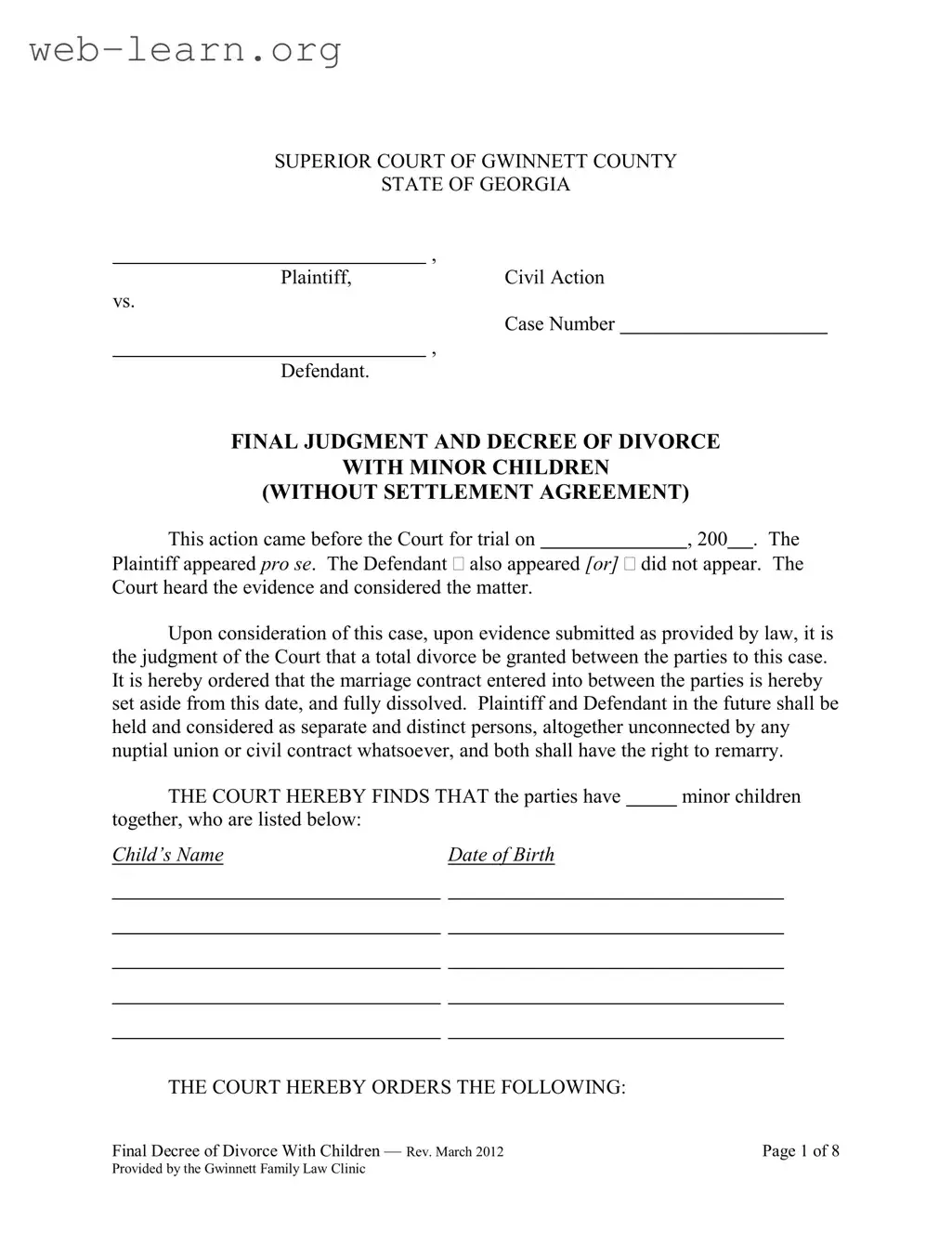
Sample - Georgia Final Decree Divorce Form

Final Decree of Divorce With Children Rev. March 2012 Page 1 of 8
Provided by the Gwinnett Family Law Clinic
SUPERIOR COURT OF GWINNETT COUNTY
STATE OF GEORGIA
,
Plaintiff,
vs.
,
Defendant.
Civil Action
Case Number
FINAL JUDGMENT AND DECREE OF DIVORCE
WITH MINOR CHILDREN
(WITHOUT SETTLEMENT AGREEMENT)
This action came before the Court for trial on
, 200 . The
Plaintiff appeared pro se. The Defendant also appeared [or] did not appear. The
Court heard the evidence and considered the matter.
Upon consideration of this case, upon evidence submitted as provided by law, it is
the judgment of the Court that a total divorce be granted between the parties to this case.
It is hereby ordered that the marriage contract entered into between the parties is hereby
set aside from this date, and fully dissolved. Plaintiff and Defendant in the future shall be
held and considered as separate and distinct persons, altogether unconnected by any
nuptial union or civil contract whatsoever, and both shall have the right to remarry.
THE COURT HEREBY FINDS THAT the parties have
minor children
together, who are listed below:
Child’s Name
Date of Birth
THE COURT HEREBY ORDERS THE FOLLOWING:
_____________________________________________________________________________________
Final Decree of Divorce With Children Rev. March 2012 Page 2 of 8
Provided by the Gwinnett Family Law Clinic
1. CUSTODY AND VISITATION
These issues have been addressed in the attached Permanent Parenting Plan
Order which is hereby made a part of this Final Judgment as if fully set forth here.
2. OTHER PARENTAL RIGHTS
These issues have been addressed in the attached Permanent Parenting Plan
Order which is hereby made a part of this Final Judgment as if fully set forth here.
3. CHILD SUPPORT
[Check and complete either (a) or (b). Do not check both (a) and (b).]
(a) This issue is not addressed in this Final Judgment, either because the Court lacks
personal jurisdiction over the Defendant, or because the parties have not asked the Court
to decide the issue of child support.
(b) This issue has been addressed in the attached Child Support Addendum which is
hereby made a part of this Final Judgment as if fully set forth here.
4. INCOME DEDUCTION ORDER
[Check and complete either (a) or (b). Do not check both (a) and (b).]
(a) No Income Deduction Order shall be entered, because ______________________
_______________________________________________________________________.
(b) This issue has been addressed in the attached Child Support Addendum which is
hereby made a part of this Final Judgment as if fully set forth here.
5. HEALTH INSURANCE FOR CHILDREN
[Check and complete either (a) or (b). Do not check both (a) and (b).]
(a) This issue is not addressed in this Final Judgment, either because the Court lacks
personal jurisdiction over the Defendant, or because neither party has asked the Court to
address the issue of health insurance in this action.
(b) This issue has been addressed in the attached Child Support Addendum which is
hereby made a part of this Final Judgment as if fully set forth here.
Final Decree of Divorce With Children Rev. March 2012 Page 3 of 8
Provided by the Gwinnett Family Law Clinic
6. OTHER HEALTH CARE EXPENSES FOR THE CHILDREN
[Check and complete either (a) or (b. Do not check both (a) and (b).]
(a) This issue is not addressed in this Final Judgment, either because the Court lacks
personal jurisdiction over the Defendant.
(b) This issue has been addressed in the attached Child Support Addendum which is
hereby made a part of this Final Judgment as if fully set forth here.
7. LIFE INSURANCE FOR THE BENEFIT OF THE CHILDREN
[Check and complete either (a) or (b. Do not check both (a) and (b).]
(a) This issue is not addressed in this Final Judgment, either because the Court lacks
personal jurisdiction over the Defendant, or because neither party has asked the Court to
address the issue of life insurance for the benefit of the children in this action.
(b) The children depend on the for financial support, and
therefore the
shall maintain a policy of insurance on his/her life,
with a face amount of at least $
, for the benefit of the minor children. The
policy shall be maintained for so long as at least one of the children is a minor or is
otherwise entitled to support under the Child Support Addendum.
□ (b) The children depend on both of the parties for financial support, and therefore
each party shall maintain a policy of insurance on his/her life, with a face amount of at
least $
, for the benefit of the minor children. The policy shall be
maintained for so long as at least one of the children is a minor or is otherwise entitled to
support under the Child Support Addendum.
8. ALIMONY
.
[Check and complete only one of these, either (a), (b) or (c). Do not check more than one.]
(a) This issue is not addressed in this Final Judgment, either because the Court lacks
personal jurisdiction over the Defendant, or because neither party has asked the Court to
address the issue of alimony in this action.
(b) The
shall pay to the as alimony, the sum
of
Dollars ($ ) per month,
Final Decree of Divorce With Children Rev. March 2012 Page 4 of 8
Provided by the Gwinnett Family Law Clinic
beginning on
, and continuing monthly thereafter,
[To finish (b), you must check and complete either (1) or (2). Do not check both (1) and (2)]
(1) until the recipient remarries or dies.
(2) for a period of .
(c) Neither party is entitled to receive alimony from the other party.
9. PROPERTY DIVISION
.
[Check and complete either (a), (b) or (c). Do not check more than one.]
(a) This issue is not addressed because the Court does not have personal jurisdiction
over the Defendant.
(b) The parties did not obtain any property during their marriage.
(c) The parties have already made a division of their marital property, including any
real estate, vehicles, household furniture, furnishings, household goods, equipment, bank
accounts, pensions and other personal property. Neither party shall claim any of the
property in the possession of the other party as of the date of this Final Judgment.
(d) The parties possess various items of marital property, which shall be divided as
provided in this Final Judgment. The parties shall transfer possession and title to their
property as follows:
[If you have chosen (c), check and complete only the parts that apply, from (1) through (4) below.]
(1) Marital Home - The marital home of the parties, located at the following
address:
,
which has the following legal description on the deed to the property:
_____________________________________________________________________________________
Final Decree of Divorce With Children Rev. March 2012 Page 5 of 8
Provided by the Gwinnett Family Law Clinic
shall be conveyed to the
in fee simple. The
shall be responsible for all taxes, assessments and mortgage loan payments on the
home after the date of
.
[If you have chosen and completed the preceding paragraph (1), concerning a marital home,
you may also check and complete (A) or (B), or both (A) and (B), but neither one is required.]
(A) The
shall have a lien against the home in the
amount of
Dollars
($
). Upon the sale or transfer of the home, the lien
shall be paid.
(B) The
shall immediately begin making reasonable
efforts to refinance the outstanding mortgage/mortgages on the
marital home, so that the
shall no longer be
liable on the mortgage loan(s). If the
is not
able to refinance by
, 200 , the home shall
then be listed for sale at a reasonable price, and all reasonable offers
to purchase the home shall be accepted until sold.
(2) Mobile Home - The parties’ mobile home, which is described as a ______
___________________, with Vehicle Identification Number (VIN) of _________
________________________ shall be transferred to the
.
The
shall be responsible for all loan payments on the mobile
home after the date of
.
(3) Vehicles - The vehicles owned by the parties shall be transferred or
retained as follows:
Year/Make/Model of Vehicle
Vehicle ID # (VIN) Goes to
______________________ ___________
___________
______________________ ___________
___________
The party listed above for each vehicle shall be responsible for all car loan
payments, ad valorem taxes, registration fees and insurance on that vehicle
accruing after the following date: .
_____________________________________________________________________________________
Final Decree of Divorce With Children Rev. March 2012 Page 6 of 8
Provided by the Gwinnett Family Law Clinic
(4) Other Personal Property - The parties own various other items of
personal property, which shall be transferred to the party listed below, on or before
___________________________, 20 .
To the Wife
To the Husband
Except as otherwise specifically provided in this Final Judgment, the transfers
listed above shall be completed no later than
, and each
party shall execute all documents necessary to promptly complete the transfer.
Upon the failure of either party to execute and deliver any deed or other document
necessary to complete the transfers required by this Final Judgment, this Judgment
shall constitute and operate as the properly executed document. The county
auditor, county recorder, Department of Motor Vehicles, and all other public and
private officials are authorized and directed to accept this Judgment or a properly
certified copy of it in lieu of the document regularly required for the conveyance
or transfer.
Except as provided in this Judgment, the parties have divided their marital
property, including any real estate, vehicles, household furniture, furnishings,
household goods, equipment, bank accounts, pensions and other personal property.
Neither party shall claim any of the property in the possession of the other party as
of the date of this Final Judgment, except as provided in this Final Judgment.
_____________________________________________________________________________________
Final Decree of Divorce With Children Rev. March 2012 Page 7 of 8
Provided by the Gwinnett Family Law Clinic
10. DEBTS
.
[Check and complete either (a), (b) or (c). Do not check more than one. Do not list complete account
numbers.]
(a) This issue is not addressed in this Final Judgment because the Court does not have
personal jurisdiction over the Defendant
(b) The parties have no outstanding joint or marital debts.
(c) The responsibility for payment of the parties’ joint and marital debts shall be as
follows:
Creditor
Amount Responsible Party
$
$
$
$
$
$
$
The responsible party listed above for each debt shall hold the other party
harmless for any collections on that debt. If legal action is brought against the other party
to recover that debt, the responsible party shall indemnify or hold the other party
harmless and, in addition, to pay all attorney’s fees and costs of collection which the
other party may incur as a result of the legal action.
11. BANKRUPTCY CONSTRUCTION OF THIS JUDGMENT
The Court finds that, but for the payments and transfers provided in this Final
Judgment, the receiving party’s financial independence would be impaired. Therefore, it
is the Court’s intention that if either party ever seeks bankruptcy protection, the amounts
payable under this Agreement should not be dischargeable in bankruptcy under 11 United
Final Decree of Divorce With Children Rev. March 2012 Page 8 of 8
Provided by the Gwinnett Family Law Clinic
States Code Section 523(a)(5), as the payments are in the nature of spousal or child
support and maintenance. Alternatively, the payments should be nondischargeable in
bankruptcy under 11 United States Code Section 523(a)(15).
12. RESTRAINING ORDER
[Check and complete (a) or (b) below. Do not check both.]
(a) No permanent restraining order is entered in this action.
(b) The shall be permanently restrained and enjoined
from assaulting, beating, wounding, threatening, harassing and stalking the
.
This provision shall be enforceable by the Court’s contempt power.
13. RESTORATION OF NAME
[Optional Check and complete only if applicable.]
The Wife’s former name of
shall
be restored.
14. OTHER SPECIAL PROVISION
[Optional Check and complete only if applicable.]
This decree entered on , 200 .
JUDGE
Superior Court of Gwinnett

Form Information

Fact Name Description
Governing Law The Georgia Final Decree Divorce form is governed by the Official Code of Georgia Annotated (O.C.G.A.) § 19-5-1 et seq.
Court Jurisdiction This form is specifically used in the Superior Court of Gwinnett County, Georgia.
Pro Se Representation Parties may represent themselves in court, as indicated by the term "pro se" used in the form.
Minor Children The form addresses custody and visitation for minor children, which must be detailed in an attached Permanent Parenting Plan Order.
Child Support Child support issues can be included or excluded in the final judgment, depending on the parties' requests and jurisdiction.
Income Deduction Order The form allows for an income deduction order to be established for child support payments, or to be excluded if not applicable.
Health Insurance Health insurance for children can be addressed in the final judgment, ensuring their medical needs are covered.
Alimony Provisions The form includes sections for alimony, allowing the court to determine if payments will be made, and under what conditions.
Property Division Property division is a critical aspect of the divorce decree, specifying how marital assets will be allocated between the parties.
Final Judgment The form culminates in a final judgment that officially dissolves the marriage, allowing both parties to remarry.

Detailed Guide for Filling Out Georgia Final Decree Divorce

Filling out the Georgia Final Decree Divorce form is a crucial step in finalizing a divorce, especially when minor children are involved. After completing this form, it will need to be submitted to the court for approval. Ensure that all information is accurate and complete to avoid delays in the process.

  1. Begin by entering the Superior Court of Gwinnett County and the State of Georgia at the top of the form.
  2. Fill in the plaintiff's name and the defendant's name.
  3. Write the case number assigned to your divorce case.
  4. Indicate the date of the trial in the designated space.
  5. Check the appropriate box to indicate whether the plaintiff and defendant appeared at the trial.
  6. In the section regarding the court's judgment, confirm that a total divorce is granted.
  7. List the names and dates of birth of any minor children involved.
  8. Address custody and visitation by referencing the attached Permanent Parenting Plan Order.
  9. For child support, check either (a) or (b) and complete the necessary details.
  10. For income deduction orders, check either (a) or (b) and provide the required information.
  11. For health insurance for children, check either (a) or (b) and fill in the details as necessary.
  12. For other health care expenses, check either (a) or (b) and complete as required.
  13. For life insurance for the benefit of the children, check either (a) or (b) and provide the necessary information.
  14. For alimony, check only one of the options (a), (b), or (c) and complete the relevant sections.
  15. For property division, check one of the options (a), (b), or (c) and fill in the details regarding property division as applicable.
  16. Complete any additional sections related to the marital home, mobile home, or vehicles as needed.
  17. Review the entire form for accuracy and completeness before submission.

Obtain Answers on Georgia Final Decree Divorce

  1. What is the purpose of the Georgia Final Decree Divorce form?

    The Georgia Final Decree Divorce form serves as the official document that finalizes the divorce process in Georgia. It outlines the court's judgment regarding the dissolution of the marriage, including any decisions made about custody, child support, and property division. This form is essential for ensuring that both parties understand their rights and obligations following the divorce.

  2. What information is required to complete the form?

    To complete the form, you will need to provide details such as the names of both parties, the case number, and the date of the trial. Additionally, information about any minor children, including their names and dates of birth, must be included. You will also need to specify decisions related to custody, visitation, child support, health insurance, and property division.

  3. What happens if one party does not appear in court?

    If one party does not appear in court, the court may still proceed with the hearing. The judge will consider the evidence presented by the appearing party and make a decision based on that information. However, the absent party may lose the opportunity to present their side of the case, which could affect the outcome.

  4. How are custody and visitation arrangements determined?

    Custody and visitation arrangements are typically outlined in the attached Permanent Parenting Plan Order, which is incorporated into the Final Decree. The court prioritizes the best interests of the children when making these determinations. Factors such as the children's needs, the parents' ability to provide care, and the children's relationship with each parent are considered.

  5. What if child support is not addressed in the Final Decree?

    If child support is not addressed in the Final Decree, it may be due to a lack of jurisdiction or because the parties did not request it. In such cases, parents may need to seek a separate court order to establish child support obligations. It is crucial to ensure that child support is addressed to provide for the children's needs.

  6. Can the court order health insurance for the children?

    Yes, the court can order that health insurance be provided for the children. This issue is typically addressed in the Child Support Addendum, which may specify which parent is responsible for obtaining health insurance and how any additional health care expenses will be handled.

  7. What is alimony, and how is it determined?

    Alimony, or spousal support, is financial support one spouse may be required to pay to the other after a divorce. The court will determine whether alimony is appropriate based on various factors, including the length of the marriage, the financial needs of both parties, and their ability to support themselves. The Final Decree will specify if alimony is to be paid and under what terms.

  8. How is property divided in a divorce?

    Property division is addressed in the Final Decree and can vary based on the specifics of each case. The court may find that the parties have already divided their property or may outline how specific assets will be divided. It is essential to clearly detail any agreements regarding marital property to avoid future disputes.

  9. What should I do if I have further questions about the Final Decree?

    If you have further questions about the Final Decree or the divorce process, consider consulting with a family law attorney. They can provide guidance tailored to your situation and help ensure that your rights are protected throughout the process.

  10. Is the Final Decree a public document?

    Yes, the Final Decree is generally considered a public document. This means that it can be accessed by the public, although certain sensitive information may be sealed or redacted in specific cases. It's important to be aware of this when filing for divorce and to consider the implications of public access to your divorce records.

Common mistakes

When filling out the Georgia Final Decree Divorce form, several common mistakes can lead to complications or delays in the divorce process. One significant error occurs when individuals neglect to provide complete and accurate information about their children. The court requires specific details such as the children's names and dates of birth. Failing to include this information can result in the court being unable to process the decree effectively.

Another frequent mistake is checking both options in sections that require a choice, such as child support or health insurance for children. The form explicitly states to check only one option. If both are checked, it can create confusion and may lead to the rejection of the form. It’s essential to read each section carefully and select the appropriate choice based on the circumstances.

People often overlook the requirement to attach relevant documents, such as the Permanent Parenting Plan Order or Child Support Addendum. These attachments are not just formalities; they are integral to the final judgment. Without these documents, the court may not have all the necessary information to make informed decisions regarding custody, visitation, and support.

In addition, individuals sometimes fail to specify the terms of alimony or property division clearly. The form provides multiple options, and selecting the wrong one or leaving it blank can lead to misunderstandings. It’s crucial to provide detailed and accurate financial information to avoid potential disputes later.

Another common oversight involves the signatures. Many people forget to sign the form or ensure that both parties have signed where required. This can halt the process, as the court needs valid signatures to proceed with the divorce decree. Ensuring that all necessary parties have signed is a simple yet vital step.

Lastly, individuals might not pay attention to the deadlines associated with submitting the form. Each court may have specific timelines for filing documents, and missing these deadlines can result in additional complications or even the need to restart the process. Keeping track of these timelines is essential for a smooth divorce experience.

Documents used along the form

The Georgia Final Decree Divorce form is a crucial document in the divorce process, especially when minor children are involved. Along with this form, several other documents may be required to address various aspects of the divorce. Below is a list of related forms and documents that are often used in conjunction with the Final Decree Divorce form in Georgia.

  • Permanent Parenting Plan Order: This document outlines the custody and visitation arrangements for the minor children. It specifies how parents will share responsibilities and time with their children post-divorce.
  • Child Support Addendum: This addendum details the financial support obligations of each parent regarding the children. It may include specifics about the amount, payment schedule, and any additional expenses related to the children's upbringing.
  • Income Deduction Order: This order facilitates the automatic deduction of child support payments from the paying parent's income. It ensures timely payments and helps maintain financial stability for the children.
  • Health Insurance Order: This document addresses the responsibility for providing health insurance for the children. It outlines which parent will maintain coverage and any additional health care costs that may arise.
  • Life Insurance Policy Requirement: This requirement ensures that one or both parents maintain life insurance policies for the benefit of their children. It provides financial security in case of unforeseen circumstances.
  • Alimony Agreement: This document specifies whether one spouse will provide financial support to the other after the divorce. It outlines the amount, duration, and conditions under which alimony will be paid.
  • Property Division Agreement: This agreement details how marital property will be divided between the spouses. It can include real estate, vehicles, and other assets acquired during the marriage.
  • Notice of Hearing: This document informs both parties of the scheduled court hearing regarding the divorce. It ensures that all involved are aware of the proceedings and can prepare accordingly.

Understanding these documents can help streamline the divorce process and ensure that all necessary issues are addressed. Each form plays a vital role in protecting the rights and responsibilities of both parents and the welfare of the children involved.

Similar forms

  • Georgia Petition for Divorce: This document initiates the divorce process by outlining the reasons for the divorce and the desired outcomes regarding custody, support, and property division. Like the Final Decree, it addresses the same issues but serves as the starting point for the legal proceedings.
  • Georgia Parenting Plan: This document details the arrangements for child custody and visitation. It is similar to the Final Decree in that it outlines parental responsibilities and rights, ensuring the best interests of the children are prioritized.
  • Georgia Child Support Worksheet: This worksheet calculates the amount of child support owed based on the parents' incomes and other factors. Both documents aim to address financial support for children, with the worksheet providing the calculations that may be included in the Final Decree.
  • Georgia Alimony Agreement: This document details the terms of spousal support, including the amount and duration. Similar to the Final Decree, it addresses financial obligations between the parties post-divorce, ensuring clarity on alimony arrangements.
  • Georgia Property Settlement Agreement: This agreement outlines how marital property will be divided between the parties. It is comparable to the Final Decree as both documents finalize the division of assets and liabilities resulting from the marriage.
  • Georgia Child Custody Modification Form: This form is used to request changes to an existing custody arrangement. Like the Final Decree, it focuses on custody issues, but it is specifically for adjusting terms as circumstances change after the divorce is finalized.

Dos and Don'ts

When filling out the Georgia Final Decree Divorce form, consider the following guidelines:

  • Do: Carefully read all instructions before starting the form.
  • Do: Provide accurate information about both parties and any minor children.
  • Do: Complete all required sections, checking only one option where specified.
  • Do: Include any necessary attachments, such as the Permanent Parenting Plan Order.
  • Do: Sign and date the form where indicated.
  • Don't: Leave any sections blank unless instructed to do so.
  • Don't: Check more than one option in sections that require a single choice.
  • Don't: Submit the form without reviewing it for errors or omissions.
  • Don't: Forget to keep a copy of the completed form for your records.

Misconceptions

When it comes to the Georgia Final Decree Divorce form, several misconceptions can lead to confusion. Understanding these can help individuals navigate the process more smoothly. Here are four common misunderstandings:

  • The form is only for couples with a settlement agreement. Many believe that this form is applicable only if both parties have reached a settlement. In reality, it can also be used in cases where the parties have not settled their disputes, especially concerning custody and child support.
  • Filing the form guarantees immediate approval. Some individuals think that submitting the Final Decree Divorce form will automatically result in a quick divorce. However, the court must review the case, and approval can take time, depending on various factors, including court schedules and the complexity of the case.
  • Child support and custody are automatically included in the decree. There is a misconception that child support and custody arrangements are automatically included when filing the divorce form. In fact, these issues must be explicitly addressed in the attached documents, such as the Permanent Parenting Plan Order or Child Support Addendum.
  • Once the decree is signed, it cannot be changed. Many people assume that a Final Decree Divorce is set in stone once signed by the judge. While it is a legal document, modifications can be requested in the future if circumstances change, such as a change in income or living arrangements.

By dispelling these misconceptions, individuals can approach the divorce process with a clearer understanding and better prepare themselves for what lies ahead.

Key takeaways

  • Ensure all parties are correctly identified as plaintiff and defendant in the form.

  • Fill in the case number accurately to avoid processing delays.

  • Check the appropriate boxes for custody, visitation, and other parental rights, making sure to attach the Permanant Parenting Plan Order.

  • Clearly indicate whether child support is addressed, and complete the relevant sections accordingly.

  • Review the income deduction order section carefully. Only check one option.

  • For health insurance, choose the correct option and provide details if applicable.

  • Complete the alimony section with precision, ensuring only one option is checked.

  • Address property division thoroughly, specifying how marital property will be divided.

  • Sign and date the form before submission to ensure it is legally binding.