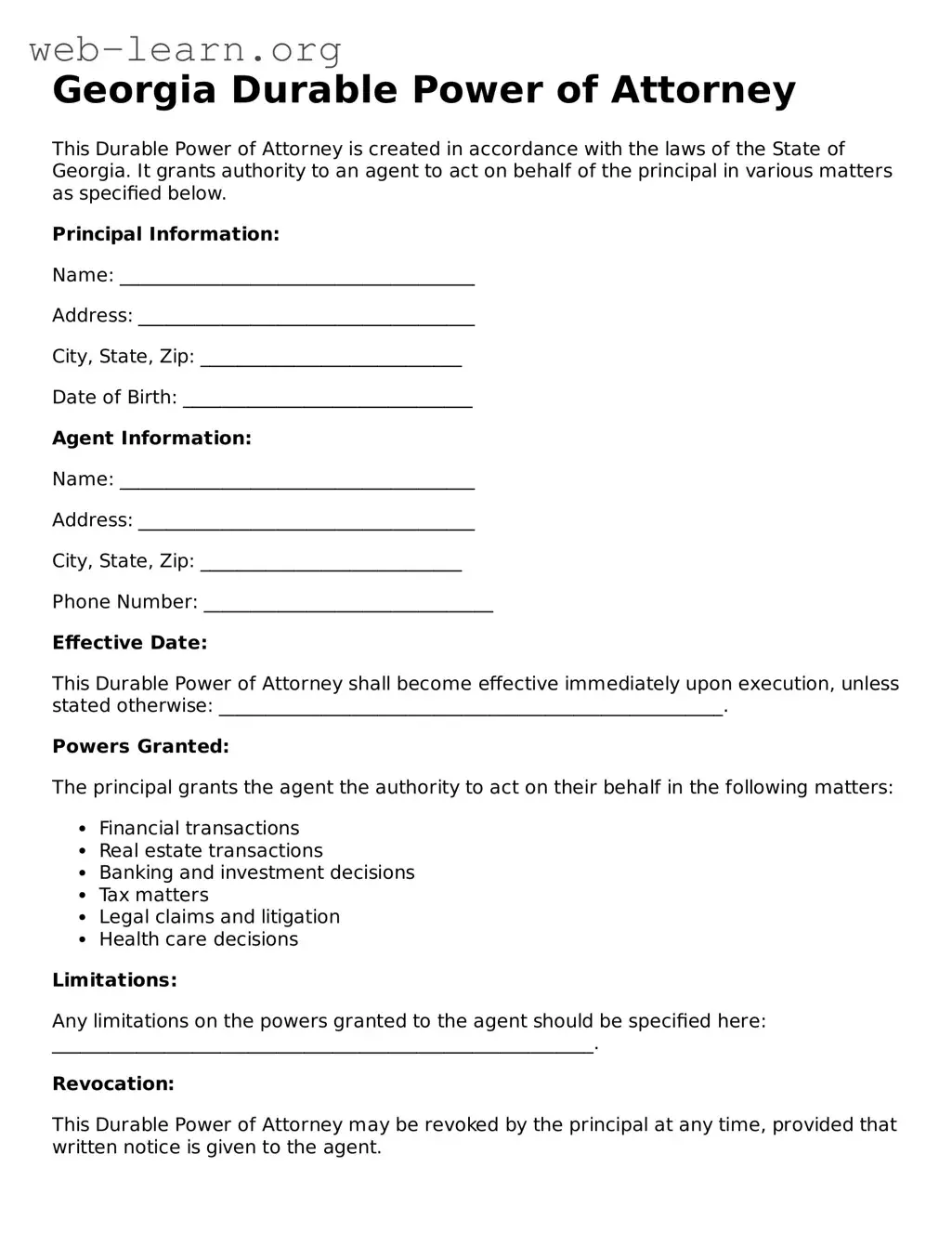
The Georgia Durable Power of Attorney form serves as a vital legal tool for individuals seeking to appoint someone they trust to manage their financial and legal affairs in the event they become incapacitated. This document allows the designated agent, often referred to as an attorney-in-fact, to make decisions on behalf of the principal, the person granting the authority. Key aspects of the form include the ability to specify the scope of powers granted, which can range from handling bank transactions to managing real estate. Importantly, the durable nature of this power means it remains effective even if the principal becomes mentally or physically unable to make decisions. Additionally, the form must be signed in the presence of a notary public to ensure its validity. Understanding the implications of this form is essential for anyone looking to safeguard their interests and ensure their wishes are respected during times of incapacity.
Georgia Durable Power of Attorney
This Durable Power of Attorney is created in accordance with the laws of the State of Georgia. It grants authority to an agent to act on behalf of the principal in various matters as specified below.
Principal Information:
Name: ______________________________________
Address: ____________________________________
City, State, Zip: ____________________________
Date of Birth: _______________________________
Agent Information:
Name: ______________________________________
Address: ____________________________________
City, State, Zip: ____________________________
Phone Number: _______________________________
Effective Date:
This Durable Power of Attorney shall become effective immediately upon execution, unless stated otherwise: ______________________________________________________.
Powers Granted:
The principal grants the agent the authority to act on their behalf in the following matters:
Limitations:
Any limitations on the powers granted to the agent should be specified here: __________________________________________________________.
Revocation:
This Durable Power of Attorney may be revoked by the principal at any time, provided that written notice is given to the agent.
Signature:
Principal's Signature: ___________________________
Date: ________________________________________
Witness Information:
Witness Name: __________________________________
Witness Signature: ______________________________
Date: ________________________________________
Notarization (if required):
State of Georgia
County of ____________________________
Subscribed and sworn before me this ______ day of __________, 20__.
Notary Public: ________________________________
My Commission Expires: ______________________
| Fact Name | Description |
|---|---|
| Definition | A Georgia Durable Power of Attorney allows an individual to designate someone else to manage their financial and legal affairs when they are unable to do so themselves. |
| Governing Law | The form is governed by the Georgia Uniform Power of Attorney Act, found in O.C.G.A. § 10-6B-1 et seq. |
| Durability | This document remains effective even if the principal becomes incapacitated, unlike a regular power of attorney. |
| Principal and Agent | The person granting authority is called the principal, while the person receiving authority is known as the agent or attorney-in-fact. |
| Signing Requirements | The form must be signed by the principal and notarized to be legally valid in Georgia. |
| Scope of Authority | The agent can be granted broad powers, including handling banking transactions, real estate, and business operations, unless limited by the principal. |
| Revocation | The principal can revoke the Durable Power of Attorney at any time, as long as they are mentally competent. |
| Important Considerations | Choosing a trustworthy agent is crucial, as they will have significant control over the principal's financial matters. |
Filling out the Georgia Durable Power of Attorney form is an important step in designating someone to manage your financial and legal affairs if you become unable to do so. This process requires careful attention to detail to ensure that your wishes are clearly expressed and legally binding.
Once you have completed these steps, the form will be ready for use. It is advisable to review the document periodically and update it as needed, especially if there are changes in your circumstances or your chosen agent's availability.
What is a Durable Power of Attorney in Georgia?
A Durable Power of Attorney is a legal document that allows an individual, known as the principal, to appoint someone else, referred to as the agent or attorney-in-fact, to make decisions on their behalf. This authority remains in effect even if the principal becomes incapacitated. In Georgia, this type of power of attorney is particularly useful for managing financial matters, healthcare decisions, or any other personal affairs when the principal is unable to do so themselves.
How do I create a Durable Power of Attorney in Georgia?
To create a Durable Power of Attorney in Georgia, the principal must complete a specific form that complies with state laws. The form should include:
Once completed, it is advisable to keep the document in a safe place and provide copies to the agent and any relevant institutions, such as banks or healthcare providers.
What powers can be granted through a Durable Power of Attorney?
The principal can grant a wide range of powers to the agent, which may include:
It is important for the principal to specify which powers are granted to ensure that the agent acts within the desired scope of authority.
Can I revoke a Durable Power of Attorney in Georgia?
Yes, a principal can revoke a Durable Power of Attorney at any time, as long as they are mentally competent. To do this, the principal should create a written revocation document and notify the agent and any institutions that were provided with the original power of attorney. It is also advisable to destroy any copies of the original document to prevent confusion.
What happens if the agent cannot serve or is unable to act?
If the designated agent is unable to serve or act on behalf of the principal, the principal can name an alternate agent in the Durable Power of Attorney document. If no alternate agent is named, the principal may need to seek a court-appointed guardian or conservator to handle their affairs, which can be a more complex and time-consuming process.
Filling out a Georgia Durable Power of Attorney form can be a straightforward process, but many individuals make common mistakes that can lead to complications later. One frequent error is failing to specify the powers granted to the agent. Without clear instructions, the agent may not have the authority to act in the principal's best interest, potentially leading to legal disputes.
Another mistake is not signing the document in front of a notary public. In Georgia, a Durable Power of Attorney must be notarized to be valid. Skipping this step can render the document ineffective, leaving the principal without the intended protections.
People often overlook the importance of selecting the right agent. Choosing someone who lacks the necessary skills or who may not act in the principal's best interest can create issues. It is crucial to select an agent who is trustworthy, responsible, and capable of handling the designated tasks.
Additionally, many individuals forget to discuss their wishes with the chosen agent before completing the form. Open communication ensures that the agent understands the principal's intentions and can act accordingly when the time comes. Without this conversation, the agent may make decisions that do not align with the principal's desires.
Another common pitfall is failing to update the document after significant life changes, such as marriage, divorce, or the death of a previously appointed agent. Life events can alter the appropriateness of the selected agent or the powers granted, making it essential to review and revise the document regularly.
Some people also neglect to consider alternate agents. In the event that the primary agent is unavailable or unable to fulfill their duties, having a backup can prevent delays and confusion. This foresight can save time and stress during challenging situations.
Moreover, individuals may not fully understand the implications of granting broad powers. While it can be tempting to give the agent extensive authority, it is wise to limit powers to specific areas to avoid potential abuse. Clearly defined powers can help protect the principal's interests.
Lastly, many fail to keep copies of the completed Durable Power of Attorney form in accessible locations. Having multiple copies can ensure that the agent and relevant parties can quickly access the document when needed. Without proper distribution, the document may not be utilized effectively, undermining its purpose.
When creating a Georgia Durable Power of Attorney, it's important to consider other documents that may complement or enhance its effectiveness. These additional forms can help ensure that your wishes are clearly communicated and legally upheld. Below are four commonly used documents that often accompany a Durable Power of Attorney.
By considering these additional documents, you can create a comprehensive plan that addresses both your health and financial needs. This proactive approach helps ensure that your wishes are respected and your interests are protected.
A Durable Power of Attorney (DPOA) is an important legal document that allows one person to act on behalf of another in financial or legal matters. Several other documents serve similar purposes, providing authority to act on someone else's behalf. Here are five documents that share similarities with a Durable Power of Attorney:
When filling out the Georgia Durable Power of Attorney form, it's essential to follow certain guidelines to ensure the document is valid and effective. Here are six things you should and shouldn't do:
The Georgia Durable Power of Attorney (DPOA) form is an essential legal document that allows individuals to designate someone to make decisions on their behalf. However, several misconceptions surround this form. Understanding the truth behind these misconceptions is crucial for effective planning and decision-making.
This is not true. While many people associate DPOAs with aging individuals, anyone over the age of 18 can create one. Life can be unpredictable, and having a DPOA in place ensures that someone can act on your behalf if you become incapacitated.
In reality, the authority granted can be tailored to specific needs. The principal can limit the powers granted to their agent, ensuring control over what decisions can be made.
This is misleading. The Durable Power of Attorney remains effective even if the principal becomes incapacitated. This is the key difference between a durable and a non-durable power of attorney.
While consulting a lawyer can be beneficial, it is not a legal requirement. Individuals can create a DPOA using forms available online, provided they follow the state’s guidelines.
This is incorrect. A separate document, often called a healthcare power of attorney or advance directive, is needed to address medical decisions. A DPOA typically focuses on financial matters.
This is false. The principal can revoke or amend a DPOA at any time, as long as they are mentally competent. Keeping the document updated is essential to reflect current wishes.
While financial decisions are a primary focus, a DPOA can also include authority over other areas, such as property management. The scope of authority can be customized based on individual needs.
Understanding these misconceptions can empower individuals to make informed decisions about their legal and financial planning. It is essential to address any uncertainties and ensure that your DPOA reflects your wishes accurately.
Understanding the Georgia Durable Power of Attorney form is crucial for anyone looking to establish a trusted decision-maker in financial or healthcare matters. Here are some key takeaways to consider:
By keeping these points in mind, you can effectively utilize the Georgia Durable Power of Attorney form to safeguard your interests and ensure your decisions are respected when it matters most.
Louisiana Durable Power of Attorney Pdf - Be clear about the powers you are granting to your agent.
Can You Have Two Power of Attorneys - It is a proactive step in managing your future and protecting your interests.
Free Printable Durable Power of Attorney Form Alabama - Creating this document can help avoid court intervention in your affairs.
Idaho Poa - It can be a vital part of a comprehensive estate plan, protecting your interests in various scenarios.