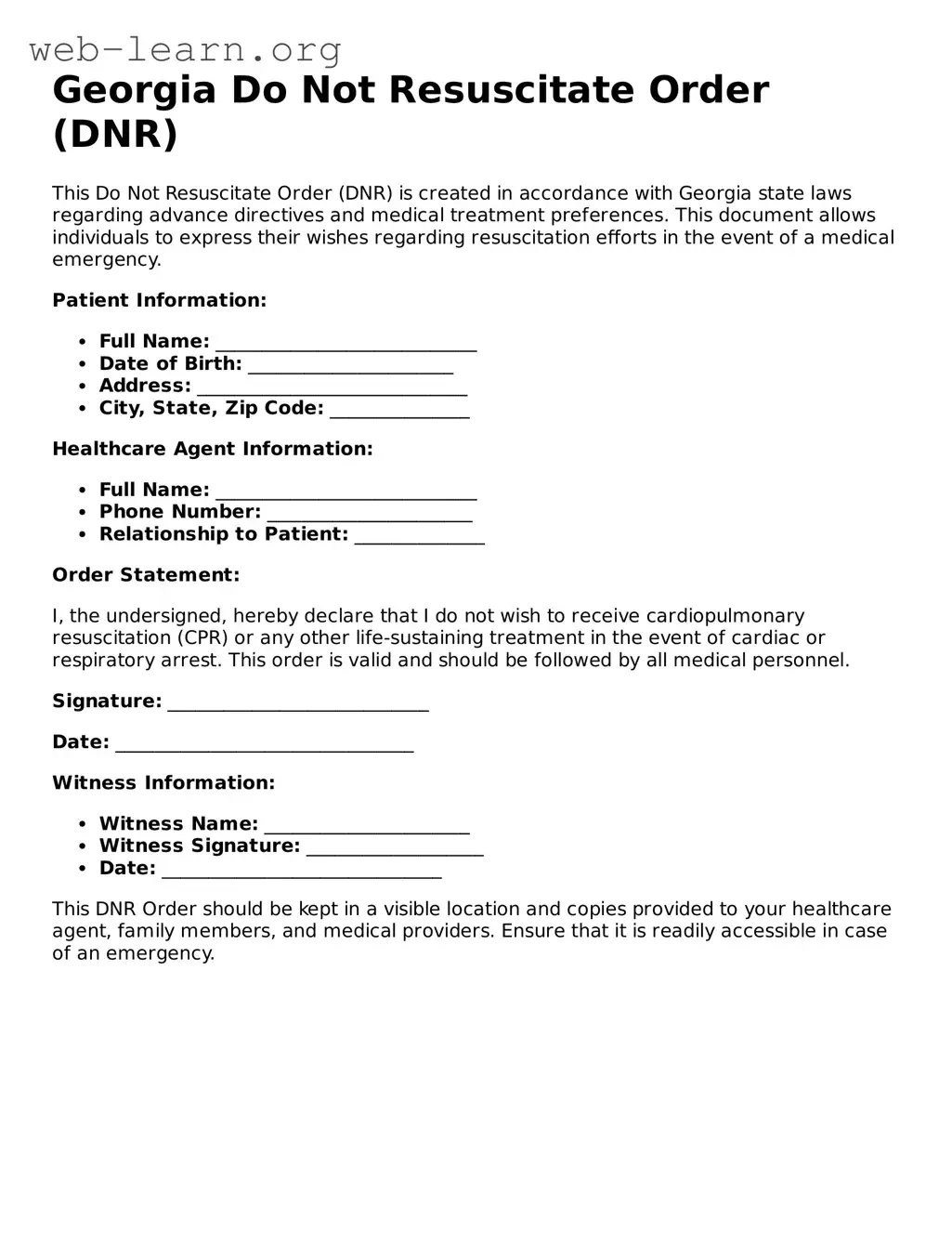
In the realm of healthcare, individuals often face difficult decisions regarding end-of-life care, and one important tool available in Georgia is the Do Not Resuscitate (DNR) Order form. This legal document empowers patients to express their wishes regarding resuscitation efforts in the event of a medical emergency. By completing this form, individuals can clearly communicate their desire to forgo life-saving measures such as CPR or advanced cardiac life support, allowing for a more peaceful transition when facing terminal conditions. The DNR Order must be signed by both the patient and a physician, ensuring that medical professionals are aware of and respect these wishes. Additionally, the form is designed to be easily accessible and can be presented in various healthcare settings, from hospitals to nursing homes. Understanding the implications of a DNR Order is crucial, as it not only reflects personal values and preferences but also provides clarity for family members and healthcare providers during emotionally charged moments.
Georgia Do Not Resuscitate Order (DNR)
This Do Not Resuscitate Order (DNR) is created in accordance with Georgia state laws regarding advance directives and medical treatment preferences. This document allows individuals to express their wishes regarding resuscitation efforts in the event of a medical emergency.
Patient Information:
Healthcare Agent Information:
Order Statement:
I, the undersigned, hereby declare that I do not wish to receive cardiopulmonary resuscitation (CPR) or any other life-sustaining treatment in the event of cardiac or respiratory arrest. This order is valid and should be followed by all medical personnel.
Signature: ____________________________
Date: ________________________________
Witness Information:
This DNR Order should be kept in a visible location and copies provided to your healthcare agent, family members, and medical providers. Ensure that it is readily accessible in case of an emergency.
| Fact Name | Details |
|---|---|
| Purpose | The Georgia Do Not Resuscitate (DNR) Order form allows individuals to refuse resuscitation efforts in the event of cardiac or respiratory arrest. |
| Governing Law | The DNR Order is governed by the Georgia Advance Directives for Health Care Act, specifically O.C.G.A. § 31-39. |
| Eligibility | Any adult, or a minor with parental consent, can complete a DNR Order in Georgia. |
| Signature Requirements | The form must be signed by the individual or their authorized representative and witnessed by two adults. |
| Healthcare Provider Notification | Healthcare providers must be informed of the existence of a DNR Order to honor it during emergencies. |
| Revocation | A DNR Order can be revoked at any time by the individual or their representative, verbally or in writing. |
| Availability | The DNR Order form is available through healthcare providers, hospitals, and online resources. |
Completing the Georgia Do Not Resuscitate Order form involves several important steps to ensure that your wishes regarding medical treatment are accurately documented. Once the form is filled out, it will need to be signed and submitted according to the guidelines provided by healthcare professionals.
After completing these steps, ensure that the form is readily accessible to your healthcare team and family members. This will facilitate the implementation of your wishes in a medical emergency.
What is a Do Not Resuscitate (DNR) Order in Georgia?
A Do Not Resuscitate Order is a legal document that allows individuals to refuse cardiopulmonary resuscitation (CPR) and other life-saving measures in the event of cardiac arrest or respiratory failure. In Georgia, this order must be signed by a physician and can provide peace of mind for patients and their families regarding end-of-life care preferences.
Who can request a DNR Order?
In Georgia, any adult who is capable of making their own medical decisions can request a DNR Order. Additionally, parents or legal guardians can request a DNR Order for minors. It is important that the individual fully understands the implications of the order before making this decision.
How is a DNR Order created in Georgia?
To create a DNR Order in Georgia, the individual must have a conversation with their physician. The physician will assess the patient's medical condition and discuss the patient's wishes. Once both parties agree, the physician will complete and sign the DNR Order form, which must then be presented in the patient's medical records.
Where should the DNR Order be kept?
The DNR Order should be kept in a place that is easily accessible to medical personnel. It is advisable to keep a copy in the patient's medical records, at home, and in any location where emergency medical services might be called. Some individuals choose to wear a bracelet or necklace that indicates the presence of a DNR Order.
Can a DNR Order be revoked?
Yes, a DNR Order can be revoked at any time by the individual who requested it. To revoke the order, the individual should inform their physician and ensure that any copies of the DNR Order are destroyed or marked as void. Communication is key to ensuring that healthcare providers are aware of the change.
What happens if a DNR Order is not available during an emergency?
If a DNR Order is not available during an emergency, medical personnel are required to perform life-saving measures. It is crucial for individuals with a DNR Order to inform their family members and caregivers about its existence to prevent confusion during emergencies.
Are there any legal protections for healthcare providers regarding DNR Orders?
Yes, healthcare providers are protected under Georgia law when they follow the directives outlined in a valid DNR Order. As long as the order is properly executed and presented, medical personnel cannot be held liable for not performing resuscitation efforts in accordance with the patient's wishes.
Can a DNR Order be combined with other advance directives?
Yes, a DNR Order can be included as part of a broader advance directive, which may also cover other medical decisions, such as the appointment of a healthcare proxy or preferences regarding life-sustaining treatments. Combining these documents can provide comprehensive guidance for healthcare providers.
How can family members support someone with a DNR Order?
Family members can support someone with a DNR Order by understanding the individual's wishes and discussing them openly. They should ensure that the DNR Order is accessible and communicate with healthcare providers about the patient's preferences. Emotional support and respecting the individual's decisions are also vital during this process.
Completing the Georgia Do Not Resuscitate (DNR) Order form can be a crucial step in ensuring that a person's healthcare preferences are respected. However, several common mistakes can undermine the effectiveness of this important document. Understanding these pitfalls can help individuals and families avoid confusion during critical moments.
One frequent error is failing to sign the form. A DNR order is not valid unless it bears the signature of the patient or their authorized representative. Without this signature, healthcare providers may not honor the DNR wishes, leading to unwanted resuscitation efforts.
Another common mistake is neglecting to date the form. A DNR order should be dated to ensure that it reflects the most current wishes of the patient. Without a date, there can be ambiguity regarding the validity of the order, potentially leading to complications during medical emergencies.
Inaccurate patient information is also a significant issue. Providing incorrect personal details, such as the patient's name or date of birth, can create confusion. This mistake may delay the implementation of the DNR order when it is needed most.
Some individuals mistakenly believe that a verbal agreement suffices. However, a written DNR order is essential. Verbal instructions can be misinterpreted or forgotten, making a formal document critical for clarity and enforcement.
Additionally, individuals may overlook the need for copies of the DNR order. It is vital to distribute copies to healthcare providers, family members, and any facilities where the patient may receive care. Without these copies, the DNR order may not be recognized in an emergency situation.
Another mistake involves not reviewing the DNR order regularly. As health conditions change, so may a person's wishes regarding resuscitation. Regularly reviewing and updating the DNR order ensures that it remains aligned with the patient’s current preferences.
Lastly, failing to communicate the existence of the DNR order can lead to misunderstandings. Family members and caregivers should be informed about the DNR order so they can advocate for the patient’s wishes effectively. Open communication is key to ensuring that everyone involved understands the patient’s preferences.
When considering end-of-life decisions, it's essential to understand various documents that complement the Georgia Do Not Resuscitate (DNR) Order. Each document serves a unique purpose and helps ensure that your wishes are respected. Below is a list of forms that are often used alongside the DNR Order.
Understanding these documents can help you make informed decisions about your healthcare preferences. It’s important to discuss your choices with loved ones and healthcare providers to ensure that your wishes are clearly understood and respected.
A Do Not Resuscitate (DNR) Order form is an important document that outlines a person's wishes regarding resuscitation efforts in the event of a medical emergency. Several other documents serve similar purposes in guiding medical decisions. Here are five documents that share similarities with a DNR Order:
When filling out the Georgia Do Not Resuscitate (DNR) Order form, it is essential to follow specific guidelines to ensure your wishes are accurately represented. Here are five things you should and shouldn't do:
Understanding the Georgia Do Not Resuscitate (DNR) Order form is essential for both patients and healthcare providers. Here are nine common misconceptions about the DNR form:
This is incorrect. A DNR order specifically addresses resuscitation efforts in the event of cardiac arrest but does not prevent other forms of medical care.
DNR orders can be requested by any patient who wishes to forgo resuscitation efforts, regardless of their overall health status.
While both documents relate to end-of-life care, a DNR specifically focuses on resuscitation, whereas a living will outlines a broader range of healthcare preferences.
Patients can revoke or modify their DNR orders at any time, as long as they are mentally competent to do so.
Healthcare providers are legally obligated to honor valid DNR orders unless they believe the order was made under duress or is otherwise invalid.
DNR orders are valid in various settings, including homes, nursing facilities, and other healthcare environments, as long as they are properly documented.
There are different types of DNR orders, and each state may have its own specific requirements and forms. Georgia has its own DNR form that must be completed according to state guidelines.
Patients can request a DNR order while they are fully conscious and aware of their decision, allowing them to make informed choices about their care.
A DNR order is a personal choice that reflects a patient's values and wishes regarding their end-of-life care. It does not equate to a desire to end life but rather to avoid invasive procedures in certain situations.
When considering a Do Not Resuscitate (DNR) Order in Georgia, it is important to understand the implications and procedures involved. Here are key takeaways to keep in mind:
Understanding these key points can help individuals navigate the process of creating and implementing a DNR order effectively in Georgia.
Free Printable Dnr Form - The order is often placed in medical records to ensure that healthcare providers are aware of the patient’s wishes.
Hawaii Do Not Resuscitate - Patients can request a DNR order at any point in their healthcare journey.