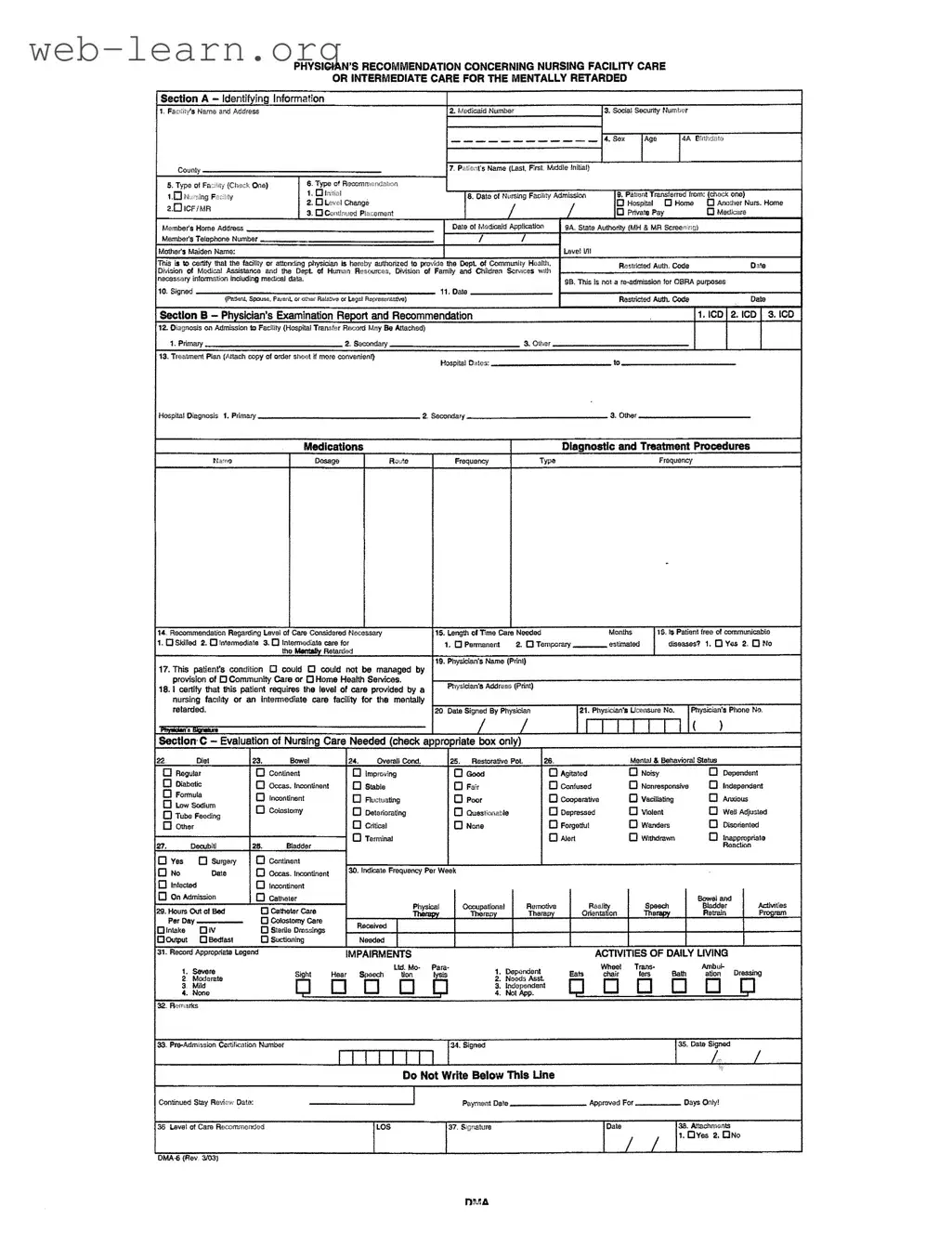
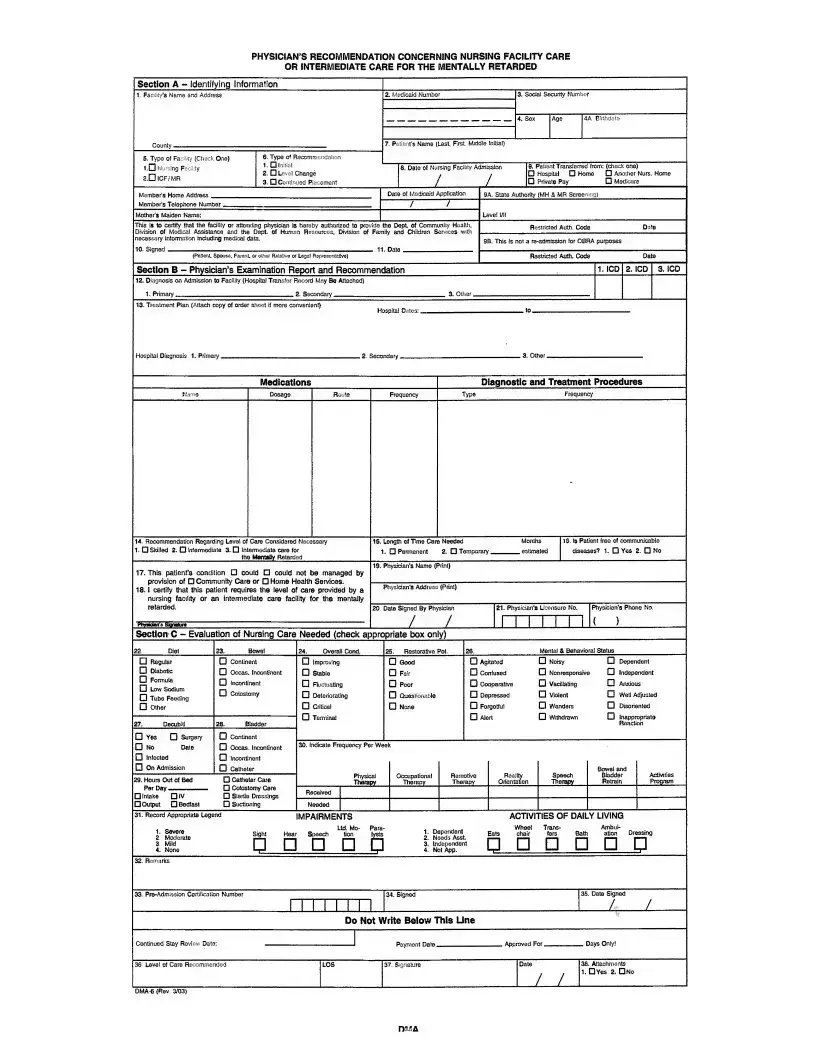
The Georgia DMA 6 form is an essential document for families seeking Medicaid coverage for pediatric nursing care. It serves as a physician's recommendation for children who may require institutional care due to medical needs. The form includes sections that collect identifying information about the applicant, such as their name, address, Medicaid number, and social security number. It also captures details about the primary care physician and the applicant's caregivers. A significant part of the form focuses on the physician's assessment, including medical history, diagnoses, medications, and treatment plans. There are specific questions regarding the applicant's current health status and the level of care recommended, whether it be in a nursing facility or another type of medical institution. Additionally, the form allows for the evaluation of nursing care needs, covering aspects like nutrition, mobility, and behavioral status. By providing this comprehensive information, the DMA 6 form helps determine eligibility for Medicaid services, ensuring that children receive the appropriate care they need.
| Fact Name | Description |
|---|---|
| Type of Program | This form is used for Nursing Facility GAPP TEFRA/Katie Beckett Pediatric care. |
| Governing Law | The form is governed by Georgia Medicaid regulations. |
| Applicant Information | Section A collects identifying information such as name, address, and Medicaid number. |
| Guardian's Opinion | The form asks if the guardian believes the applicant should be institutionalized. |
| Medicaid Application Date | Applicants must provide the date of their Medicaid application. |
| Physician's Recommendation | Section B requires a physician's report and recommendation for care. |
| Diagnosis Information | Physicians must list diagnoses using ICD codes in Section B. |
| Authorization for Disclosure | The form includes an authorization for the release of protected health information. |
| Length of Care Needed | Section B asks for an estimate of the length of time care is needed. |
| Evaluation of Nursing Care | Section C evaluates various aspects of nursing care required by the applicant. |
After gathering the necessary information, you can begin filling out the Georgia DMA 6 form. This form requires personal details, medical history, and a physician's recommendation. Ensure you have all relevant documents at hand to complete the form accurately.
After completing all sections, review the form for accuracy and completeness before submission. Ensure that all required attachments are included, as this will facilitate the processing of the application.
What is the Georgia DMA 6 form?
The Georgia DMA 6 form is a document used to assess the medical needs of pediatric patients seeking Medicaid benefits for nursing facility care. It collects essential information about the applicant, their medical history, and the recommended level of care. This form is vital for determining eligibility for Medicaid services under programs like GAPP and TEFRA/Katie Beckett.
Who needs to fill out the DMA 6 form?
The form must be completed by the child's physician, who will provide necessary medical information and recommendations. Additionally, the parent or legal representative of the child must also provide identifying information and sign the authorization section.
What information is required in Section A of the form?
Section A requires various details, including:
What should be included in Section B regarding the physician's report?
Section B focuses on the medical history and recommendations from the physician. It includes:
This section provides a comprehensive view of the child's medical needs.
How does the physician certify the need for nursing facility care?
The physician certifies the need for nursing facility care by signing the form and providing their licensure number. This signature indicates that the physician believes the patient requires the level of care offered by a nursing facility, IC/MR facility, or hospital.
What happens if the patient does not require institutional care?
If the physician determines that the patient’s condition can be managed through community care or home health services, they will indicate this on the form. This information is crucial for Medicaid eligibility and helps ensure that resources are allocated appropriately.
What is the significance of the authorization section?
The authorization section allows the physician and other health care providers to share the applicant's medical records with the Department of Community Health and the Department of Human Resources. This sharing of information is essential for determining Medicaid eligibility and must be signed by the parent or legal representative.
How long is the authorization valid?
The authorization to disclose protected health information is valid for twelve months from the date it is signed or until it is revoked by the parent or legal representative, whichever comes first. This time frame ensures that the necessary information can be accessed during the eligibility determination process.
What should be done after completing the DMA 6 form?
Once the DMA 6 form is completed, it should be submitted to the appropriate Medicaid authority for processing. It is important to keep copies of the form and any attachments for personal records. Follow up may be necessary to ensure that the application is being processed in a timely manner.
Filling out the Georgia DMA 6 form can be a daunting task, and many people make common mistakes that can lead to delays or complications in the Medicaid application process. Understanding these pitfalls can help ensure that your application is processed smoothly and efficiently.
One frequent mistake is failing to provide complete identifying information. The form requires specific details such as the applicant's name, address, Medicaid number, and Social Security number. Omitting any of these details can result in a rejection or a request for additional information, which can slow down the entire process. Always double-check that all sections are filled out accurately and completely.
Another common error involves the signature section. Many applicants forget to sign the form or neglect to include the date of the signature. This step is crucial, as the signature serves as an authorization for the physician or healthcare provider to disclose necessary health information. Without a proper signature, the application may be deemed invalid, causing unnecessary delays.
Inaccuracies in the medical history or diagnosis section can also create significant issues. It’s essential to ensure that all medical conditions, medications, and treatment plans are documented correctly. Misrepresenting or omitting information can lead to misunderstandings about the applicant’s needs and may affect eligibility for services. If additional space is needed, attaching a separate sheet is advisable.
Lastly, many applicants overlook the importance of providing accurate anticipated dates of hospitalization and the recommended level of care. This information is vital for determining the appropriate services required. Providing vague or incorrect dates can lead to confusion and may result in an inappropriate level of care being recommended.
By avoiding these common mistakes, applicants can improve their chances of a successful Medicaid application. Attention to detail and thoroughness are key to navigating the complexities of the Georgia DMA 6 form.
When applying for Medicaid in Georgia, several forms and documents may accompany the Georgia DMA 6 form. Each document serves a specific purpose in the process of determining eligibility and ensuring the applicant receives the appropriate care. Below is a list of commonly used forms that may be required.
These documents, along with the Georgia DMA 6 form, play a vital role in ensuring that applicants receive the appropriate medical care and support they need. It is essential to provide accurate and complete information to facilitate a smooth application process.
The Georgia DMA 6 form is essential for determining Medicaid eligibility for pediatric care in nursing facilities. It shares similarities with several other important documents in the healthcare and Medicaid landscape. Understanding these similarities can help streamline the application process and ensure that all necessary information is accurately conveyed. Below is a list of nine documents that are similar to the Georgia DMA 6 form, along with a brief explanation of how they relate:
Familiarizing yourself with these documents can facilitate a smoother application process and ensure that all necessary information is provided to secure the required care for those in need. Timeliness is crucial, so gathering these forms promptly can make a significant difference in receiving timely medical assistance.
When filling out the Georgia DMA 6 form, it is essential to ensure accuracy and completeness. Here are four important do's and don'ts to keep in mind:
Understanding the Georgia DMA 6 form is crucial for applicants seeking Medicaid eligibility for nursing facilities. However, several misconceptions can lead to confusion. Below are six common misunderstandings about this form, along with clarifications.
This form is specifically designed for pediatric care, catering to children who may require institutionalization or specialized services.
While the DMA 6 form is an essential part of the application process, approval depends on various factors, including eligibility criteria and medical necessity.
Although a physician's recommendation is required, parents or legal representatives can assist in completing sections of the form, especially those pertaining to the applicant's personal information.
Applicants must attach supporting documents, such as medical records and treatment plans, to provide a comprehensive view of the applicant's health status.
Renewals and updates may be necessary, particularly if the applicant's condition changes or if the authorization expires after twelve months.
The DMA 6 form is also applicable for other types of facilities, including Intermediate Care Facilities for Individuals with Mental Retardation (IC/MR), and it assesses the overall level of care needed.
Clarifying these misconceptions can help applicants navigate the Medicaid process more effectively and ensure they provide the necessary information for their child's care needs.
Filling out the Georgia DMA 6 form is an essential step for families seeking Medicaid services for children who may require specialized care. Understanding the process can make it smoother and more efficient. Here are some key takeaways to keep in mind: