The Georgia Deed in Lieu of Foreclosure form serves as a crucial tool for homeowners facing the possibility of foreclosure. This legal document allows a property owner to voluntarily transfer ownership of their home to the lender, thereby providing a way to avoid the lengthy and often stressful foreclosure process. By signing this form, the homeowner can settle their mortgage obligations more amicably, potentially alleviating some financial burdens and protecting their credit score from the severe impacts of foreclosure. It is important to understand that this option is typically pursued when the homeowner can no longer keep up with mortgage payments and wishes to avoid the stigma and complications associated with foreclosure. The process involves various steps, including negotiations with the lender, ensuring that all liens are cleared, and confirming that the property is in good condition. This form not only facilitates a smoother transition for the homeowner but also allows lenders to recover their losses more efficiently. Overall, the Georgia Deed in Lieu of Foreclosure form offers an alternative path for those in financial distress, providing a sense of closure and a chance to move forward with their lives.
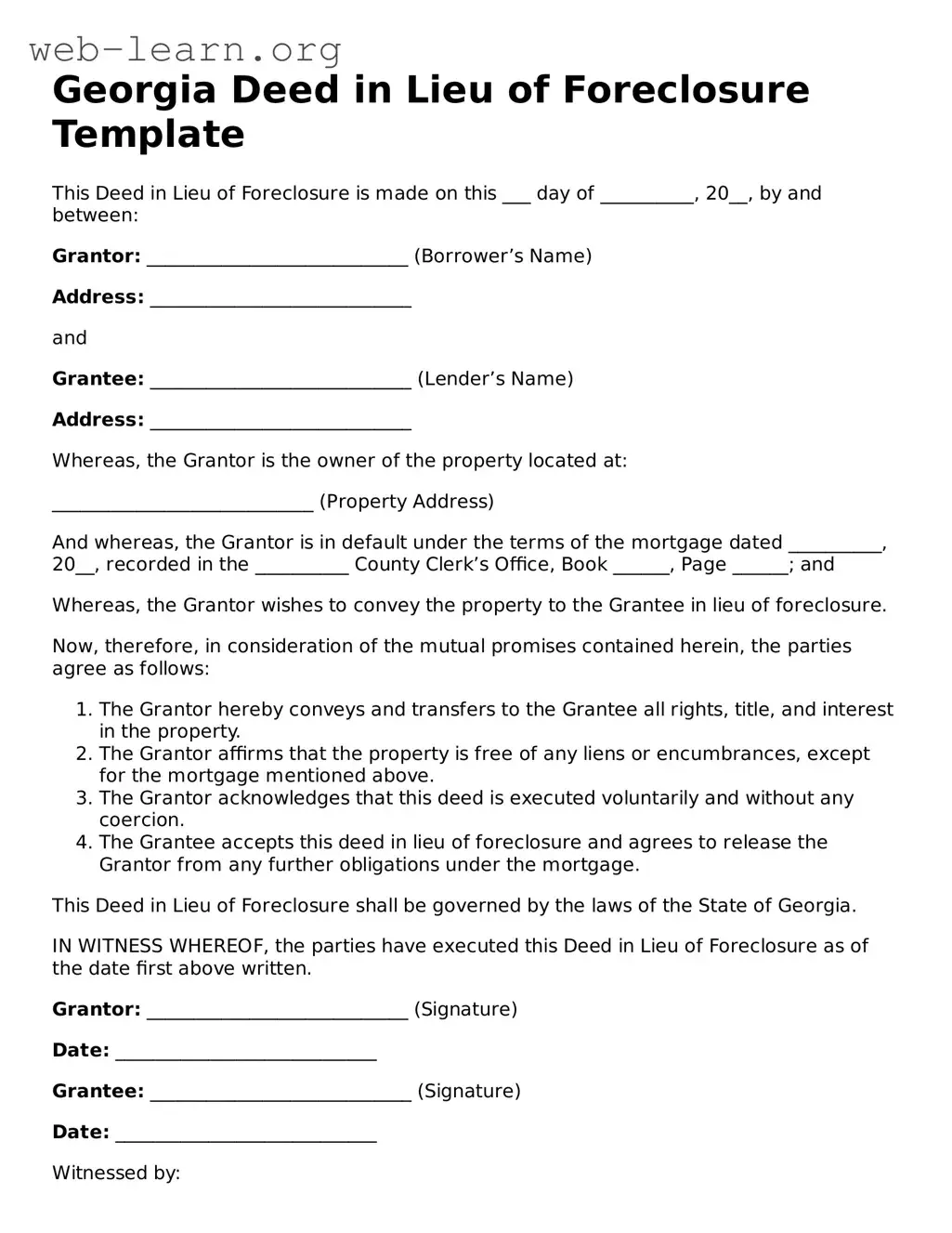
Georgia Deed in Lieu of Foreclosure Template
This Deed in Lieu of Foreclosure is made on this ___ day of __________, 20__, by and between:
Grantor: ____________________________ (Borrower’s Name)
Address: ____________________________
and
Grantee: ____________________________ (Lender’s Name)
Address: ____________________________
Whereas, the Grantor is the owner of the property located at:
____________________________ (Property Address)
And whereas, the Grantor is in default under the terms of the mortgage dated __________, 20__, recorded in the __________ County Clerk’s Office, Book ______, Page ______; and
Whereas, the Grantor wishes to convey the property to the Grantee in lieu of foreclosure.
Now, therefore, in consideration of the mutual promises contained herein, the parties agree as follows:
This Deed in Lieu of Foreclosure shall be governed by the laws of the State of Georgia.
IN WITNESS WHEREOF, the parties have executed this Deed in Lieu of Foreclosure as of the date first above written.
Grantor: ____________________________ (Signature)
Date: ____________________________
Grantee: ____________________________ (Signature)
Date: ____________________________
Witnessed by:
Name: ____________________________
Signature: ____________________________
Date: ____________________________
Notarization:
State of Georgia
County of ________________
Subscribed and sworn to before me this ___ day of __________, 20__.
Notary Public: ____________________________
My Commission Expires: ____________________________
| Fact Name | Description |
|---|---|
| Definition | A Deed in Lieu of Foreclosure is a legal document where a borrower voluntarily transfers ownership of their property to the lender to avoid foreclosure proceedings. |
| Governing Law | The process and requirements for a Deed in Lieu of Foreclosure in Georgia are governed by Georgia state law, particularly the Official Code of Georgia Annotated (O.C.G.A.) § 44-14-162. |
| Eligibility | Homeowners facing financial difficulties may qualify for a Deed in Lieu if they are unable to meet mortgage payments and have exhausted other options like loan modifications. |
| Advantages | This option can be less damaging to a borrower’s credit score compared to a foreclosure and may allow for a quicker resolution of the debt. |
| Process | The borrower must contact the lender to express interest in a Deed in Lieu, and both parties must agree to the terms of the transfer. |
| Documentation | A Deed in Lieu typically requires the completion of specific documents, including the deed itself and a release of liability for the mortgage debt. |
| Potential Drawbacks | Borrowers may still face tax implications, as the IRS may consider forgiven debt as taxable income, depending on individual circumstances. |
| Impact on Credit | While a Deed in Lieu is generally less harmful than foreclosure, it can still negatively affect a borrower’s credit score for several years. |
| Legal Advice | It is advisable for homeowners to seek legal counsel before proceeding with a Deed in Lieu to fully understand their rights and obligations. |
Once you have the Georgia Deed in Lieu of Foreclosure form ready, it is important to complete it accurately. After filling out the form, you will need to submit it to the appropriate parties involved in the foreclosure process. This may include your lender and the local county recorder's office.
What is a Deed in Lieu of Foreclosure?
A Deed in Lieu of Foreclosure is a legal document where a borrower voluntarily transfers ownership of their property to the lender to avoid foreclosure. This option can help both parties by allowing the borrower to walk away from the mortgage debt and the lender to take possession of the property without going through the lengthy foreclosure process.
What are the benefits of a Deed in Lieu of Foreclosure?
There are several benefits to this arrangement:
What are the requirements to qualify for a Deed in Lieu of Foreclosure?
To qualify, a borrower typically must:
How does the process work?
The process generally involves the following steps:
Will I still owe money after signing a Deed in Lieu of Foreclosure?
It depends on the agreement made with the lender. Some lenders may forgive the remaining debt, while others may require the borrower to pay a deficiency amount. It is essential to clarify this point before signing the deed.
How will a Deed in Lieu of Foreclosure affect my credit score?
While a Deed in Lieu of Foreclosure is less damaging than a foreclosure, it will still impact your credit score. Typically, it can result in a significant drop in your score, but it may be less severe than the impact of a foreclosure.
Can I still apply for a mortgage after a Deed in Lieu of Foreclosure?
Yes, you can apply for a mortgage after a Deed in Lieu of Foreclosure. However, you may face challenges due to the impact on your credit score. Lenders will consider your overall financial situation and may require a waiting period before approving a new mortgage.
Do I need a lawyer to complete a Deed in Lieu of Foreclosure?
While it is not legally required to have a lawyer, consulting with one is advisable. A lawyer can help ensure that your rights are protected and that you fully understand the implications of the deed.
Filling out the Georgia Deed in Lieu of Foreclosure form can be a daunting task, and many people make mistakes that can complicate the process. One common error is failing to provide accurate property information. It's essential to include the correct legal description of the property. An incorrect description can lead to delays and even legal issues down the line.
Another mistake is not obtaining the necessary signatures. All parties involved, including co-owners or spouses, must sign the document. Missing a signature can render the deed invalid, which can cause significant problems when trying to transfer ownership.
People often overlook the importance of understanding the implications of signing a deed in lieu of foreclosure. This document transfers ownership of the property to the lender, and it may affect your credit score. Failing to grasp these consequences can lead to regret later on.
In some cases, individuals forget to consult with their lender before completing the form. It’s crucial to communicate with the lender about the deed in lieu of foreclosure process. They may have specific requirements or documents that need to accompany the form, and skipping this step can lead to unnecessary complications.
Another frequent error is not including a statement about the condition of the property. The form should clearly state whether the property is in good condition or if there are any known issues. Omitting this information can create misunderstandings and disputes later.
People sometimes neglect to keep copies of the completed form and any related documents. Having a record of what was submitted is essential for future reference. Without these copies, you may find it difficult to prove what was agreed upon.
Additionally, some individuals fail to record the deed with the county. After signing the deed in lieu of foreclosure, it’s important to file it with the appropriate county office. If you don’t do this, the deed may not be recognized legally, which can lead to problems with ownership.
Lastly, many people rush through the process without fully understanding each section of the form. Taking the time to read and comprehend every part of the document can prevent costly mistakes. A well-completed form can save time and reduce stress in the long run.
When dealing with a Georgia Deed in Lieu of Foreclosure, several other forms and documents may be necessary to ensure a smooth process. Each of these documents serves a specific purpose and can help clarify the terms of the agreement between the borrower and the lender.
Understanding these additional documents can help borrowers navigate the complexities of a Deed in Lieu of Foreclosure. Each form plays a critical role in ensuring that both parties are protected and that the process is as straightforward as possible.
The Deed in Lieu of Foreclosure is a legal document that allows a homeowner to transfer ownership of their property to the lender to avoid foreclosure. Several other documents serve similar purposes in the context of property ownership and mortgage agreements. Here are four such documents:
When filling out the Georgia Deed in Lieu of Foreclosure form, it is crucial to approach the task with care. Below are five important dos and don'ts to consider during this process.
Adhering to these guidelines can help ensure that the process goes smoothly and that your rights are protected throughout the transaction.
Understanding the Georgia Deed in Lieu of Foreclosure can be challenging, and several misconceptions can lead to confusion. Here’s a list of common misunderstandings:
Being informed about these misconceptions can help homeowners make better decisions regarding their options in difficult financial situations.
Filling out and using the Georgia Deed in Lieu of Foreclosure form can be a straightforward process, but it’s essential to understand its key aspects to ensure a smooth transaction. Here are some important takeaways:
What Does an Arizona Homeowner Lose When Choosing to Use Deed in Lieu of Foreclosure? - Homeowners should evaluate their financial situation thoroughly before proceeding.
Sample Deed in Lieu of Foreclosure - Engaging with a real estate attorney can help clarify complex aspects of the agreement.
California Voluntary Property Surrender Document - It is a legal way to give back the property to the lender without court involvement.
A Deed in Lieu of Foreclosure - The Deed in Lieu of Foreclosure can be a viable solution for those facing unavoidable financial hardship.