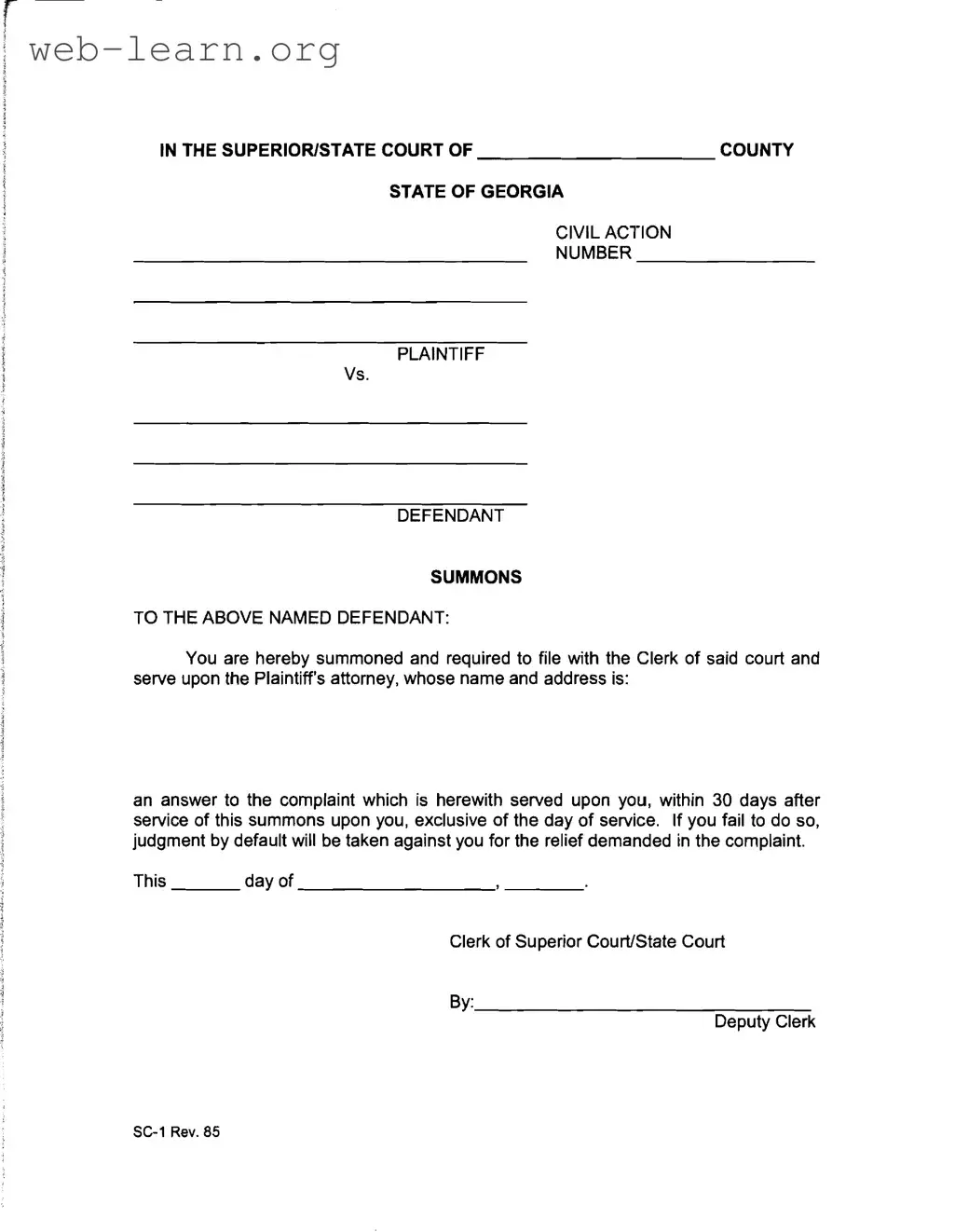
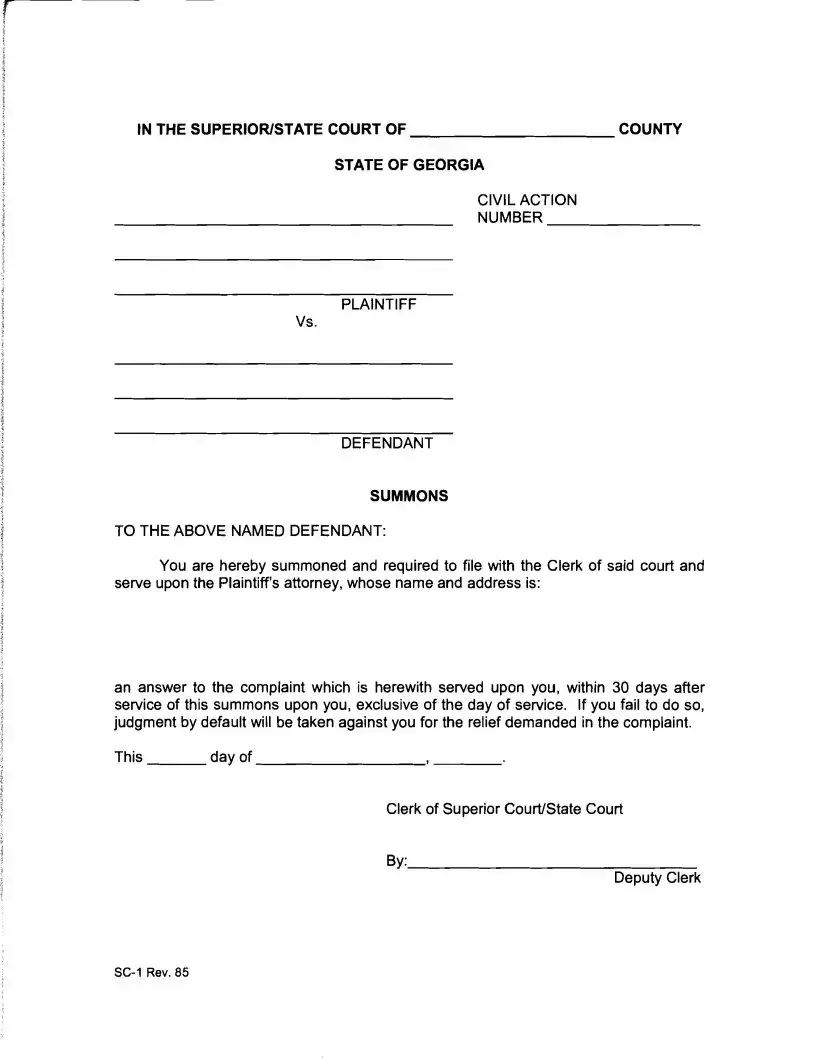
The Georgia Civil Summons form is a crucial document used in civil legal proceedings. It serves as an official notification to a defendant that a lawsuit has been filed against them. This form outlines important details, including the names of the parties involved, the civil action number, and the specific court handling the case. The summons instructs the defendant to respond to the complaint within 30 days, ensuring they have the opportunity to present their side of the story. Failure to respond can lead to a default judgment, meaning the court may rule in favor of the plaintiff without hearing the defendant's arguments. Additionally, the form includes information about the plaintiff's attorney, making it clear where the defendant should send their response. Understanding this form is essential for anyone involved in a civil case in Georgia, as it sets the stage for the legal process that follows.
| Fact Name | Details |
|---|---|
| Purpose | The Georgia Civil Summons form notifies a defendant of a civil action filed against them and requires a response. |
| Filing Deadline | Defendants must file their answer within 30 days of receiving the summons, excluding the day of service. |
| Default Judgment | If the defendant fails to respond within the specified time, a default judgment may be entered against them. |
| Governing Law | This form is governed by the Official Code of Georgia Annotated (O.C.G.A.) § 9-11-4. |
| Clerk's Role | The Clerk of the Court issues the summons and is responsible for maintaining court records. |
| Attorney Information | The summons must include the name and address of the plaintiff's attorney, who will receive the defendant's response. |
After completing the Georgia Civil Summons form, the next step is to ensure it is properly filed with the court and served to the defendant. This process is crucial for moving forward with your case.
What is a Georgia Civil Summons?
A Georgia Civil Summons is a legal document issued by the court to notify a defendant that a lawsuit has been filed against them. It outlines the requirement for the defendant to respond to the complaint within a specified time frame, typically 30 days.
What should I do when I receive a Civil Summons?
Upon receiving a Civil Summons, you must take it seriously. You are required to file an answer with the Clerk of the Court and serve it to the plaintiff's attorney. This must be done within 30 days, excluding the day you received the summons. Failing to respond may result in a default judgment against you.
What happens if I ignore the Civil Summons?
If you ignore the Civil Summons, the court may issue a default judgment. This means the plaintiff could win the case without your input, and you may be ordered to pay damages or comply with other court orders.
How do I file a response to the Civil Summons?
To file a response, prepare a document called an "Answer" that addresses each point in the complaint. Submit this document to the Clerk of the Court where the summons was issued and serve a copy to the plaintiff's attorney. Ensure you do this within the 30-day period.
Can I request an extension to respond to the Civil Summons?
Yes, you may request an extension to respond, but it is not guaranteed. You must file a motion with the court explaining your reasons for the delay and obtain the court's approval. Always do this before the 30-day deadline expires.
Where can I find more information about the Georgia Civil Summons process?
For more information, you can visit the Georgia court's official website or consult with a legal professional. Local law libraries and legal aid organizations may also provide resources and assistance regarding civil summons and related processes.
Filling out the Georgia Civil Summons form can be straightforward, but there are common mistakes that individuals often make. One significant error is failing to include the correct civil action number. This number is crucial as it identifies the case in court. Without it, the court may struggle to locate the relevant documents, which can lead to delays or complications in the legal process.
Another frequent mistake is neglecting to provide complete information about the plaintiff and defendant. It is essential to include full names and addresses. Inaccurate or incomplete information can result in improper service, meaning the defendant may not receive the summons at all. This oversight can cause unnecessary delays and may even impact the outcome of the case.
Many people also forget to sign the form. The signature of the plaintiff or their attorney is necessary to validate the summons. Without a signature, the court may reject the form, which can hinder the progression of the case. It’s a simple step, but one that should not be overlooked.
Additionally, individuals often misinterpret the timeframe for response. The summons specifies that the defendant has 30 days to respond, excluding the day of service. Misunderstanding this timeline can lead to default judgments, where the court may rule in favor of the plaintiff simply because the defendant did not respond in time.
Lastly, some people fail to properly serve the summons. The form must be served in accordance with Georgia law, which may require specific methods of delivery. Not adhering to these requirements can invalidate the summons, leaving the plaintiff without a legal basis to proceed with their case. Understanding the importance of proper service is crucial for ensuring that the legal process runs smoothly.
When dealing with a civil case in Georgia, several important forms and documents are often used alongside the Georgia Civil Summons form. Each of these documents serves a specific purpose in the legal process. Below is a list of commonly used forms that you may encounter.
Understanding these documents can help you navigate the civil legal process more effectively. Each plays a crucial role in ensuring that all parties have the opportunity to present their case and that the court has the necessary information to make informed decisions.
The Georgia Civil Summons form serves as a critical document in the legal process, particularly in civil cases. It shares similarities with several other legal documents, each serving a specific purpose in the judicial system. Here’s a list of nine documents that are comparable to the Georgia Civil Summons form:
Understanding these documents and their relationships can help individuals navigate the complexities of the legal system more effectively.
When filling out the Georgia Civil Summons form, it is important to follow specific guidelines to ensure accuracy and compliance. Below are four essential do's and don'ts to consider.
Adhering to these guidelines can help avoid delays and complications in your legal proceedings.
Understanding the Georgia Civil Summons form is essential for anyone involved in a legal dispute. However, several misconceptions can lead to confusion. Here are six common misunderstandings:
Being aware of these misconceptions can help individuals navigate the legal system more effectively and avoid potential pitfalls.
When filling out and using the Georgia Civil Summons form, keep these key points in mind: