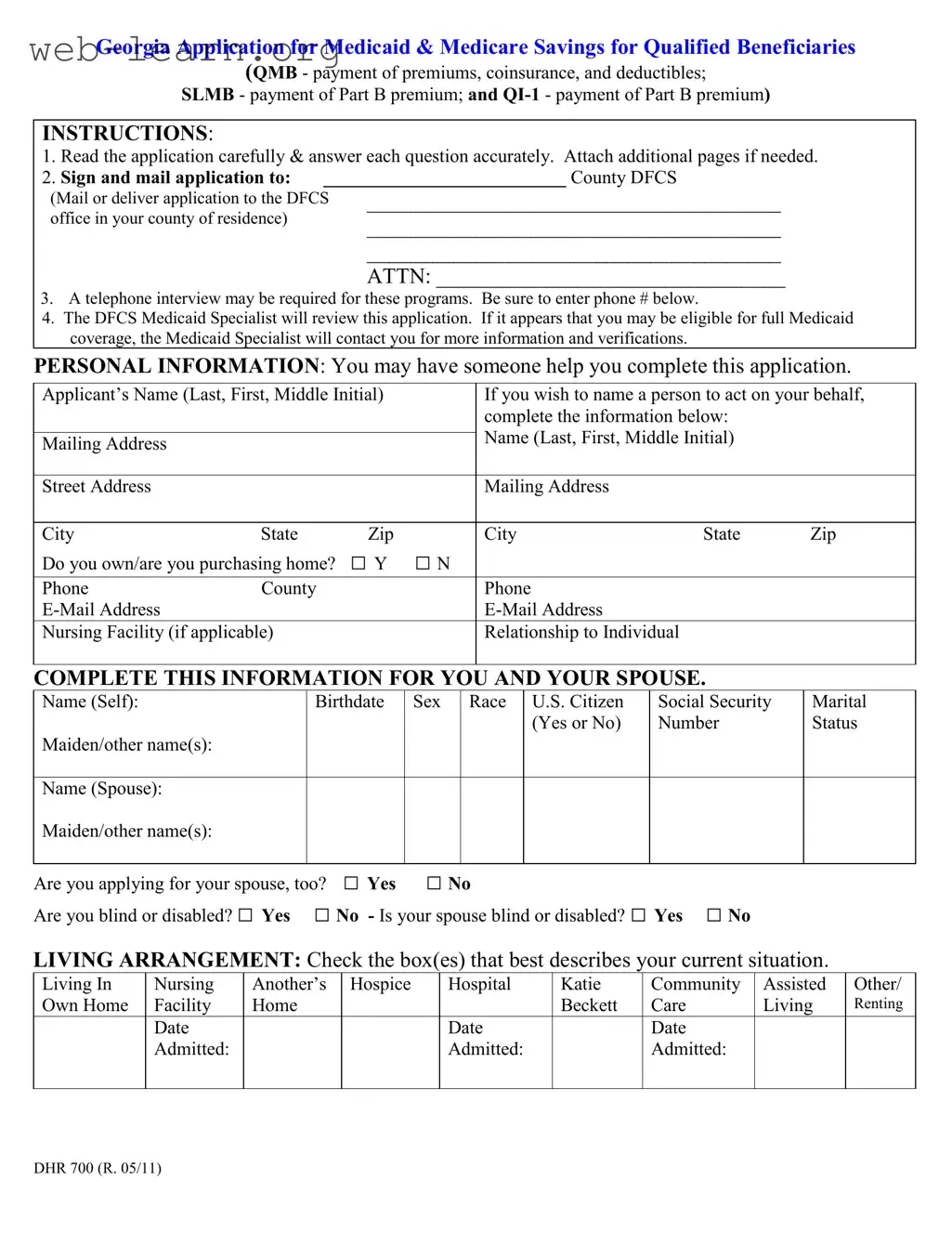
Homepage Blank Georgia Application For Medicaid Form
Outline

The Georgia Application for Medicaid is a crucial document for individuals seeking assistance with healthcare costs. This form serves multiple purposes, including applying for Medicaid and Medicare Savings for Qualified Beneficiaries. It encompasses various programs such as the Qualified Medicare Beneficiary (QMB), which covers premiums, coinsurance, and deductibles; the Specified Low-Income Medicare Beneficiary (SLMB), which assists with Part B premiums; and the Qualified Individual (QI-1) program, also aimed at covering Part B premiums. Completing the application requires careful attention to detail, as applicants must provide personal information, including names, addresses, and Social Security numbers. The form also requests details about living arrangements, health insurance coverage, assets, income, and resources. Additionally, applicants may need to include information about their spouse and any other individuals they are applying for. A signature is required to confirm the accuracy of the information provided, and applicants should be prepared for a possible telephone interview. Understanding these components is essential for a smooth application process and to ensure that all necessary information is accurately reported.


Sample - Georgia Application For Medicaid Form

DHR 700 (R. 05/11)
Georgia Application for Medicaid & Medicare Savings for Qualified Beneficiaries
(
QMB - payment of premiums, coinsurance, and deductibles;
SLMB - payment of Part B premium; and QI-1 - payment of Part B premium)
INSTRUCTIONS:
1. Read the application carefully & answer each question accurately. Attach additional pages if needed.
2. Sign and mail application to: __________________________ County DFCS
(Mail or deliver application to the DFCS
office in your county of residence)
______________________________________
______________________________________
______________________________________
ATTN: ________________________________
3. A telephone interview may be required for these programs. Be sure to enter phone # below.
4. The DFCS Medicaid Specialist will review this application. If it appears that you may be eligible for full Medicaid
coverage, the Medicaid Specialist will contact you for more information and verifications.
PERSONAL INFORMATION: You may have someone help you complete this application.
Applicant’s Name (Last, First, Middle Initial)
If you wish to name a person to act on your behalf,
complete the information below:
Name (Last, First, Middle Initial)
Mailing Address
Street Address
Mailing Address
City State Zip
Do you own/are you purchasing home?
Y
N
City State Zip
Phone County
E-Mail Address
Phone
E-Mail Address
Nursing Facility (if applicable)
Relationship to Individual
COMPLETE THIS INFORMATION FOR YOU AND YOUR SPOUSE.
Name (Self):
Maiden/other name(s):
Birthdate
Sex
U.S. Citizen
(Yes or No)
Social Security
Number
Marital
Status
Name (Spouse):
Maiden/other name(s):
Are you applying for your spouse, too? Yes No
Are you blind or disabled? Yes No - Is your spouse blind or disabled? Yes No
LIVING ARRANGEMENT: Check the box(es) that best describes your current situation.
Living In
Own Home
Nursing
Facility
Another’s
Home
Hospice
Hospital
Katie
Beckett
Community
Care
Assisted
Living
Other/
Renting
Date
Admitted:
Date
Admitted:
Date
Admitted:
DHR 700 (R. 05/11)
HEALTH INSURANCE:
Do you have Medicare?
Yes No
Are you enrolled in a Medicare
HMO or Medicare Drug program?
Yes
No
Type of Coverage
Part A Part B
(hospital) (doctor)
Part D
(RX)
Effective Date:
______________
Medicare Number:
____________
Have you ever
received SSI?
Yes No
If so, when did it
end?________
Does your spouse have
Medicare?
Yes No
Type of Coverage
Part A Part B
Part D
Effective Date:
______________
Medicare Number:
____________
Has your spouse
ever received SSI?
Yes No
If so, when did it
end?________
Do you have other health insurance? Yes No
Does your spouse have other health insurance?
Yes No
If you answered yes to either of these questions, please complete the following information:
Health Insurance
Company Name,
Address, and Telephone
Number
Type of Coverage
(Hospital, Medicare
Supplement, Drugs, Major
Medical,)
Effective
Date
Policy
Number
Self
Spouse
Attach copies (front and back) of Medicare and insurance cards if applicable.
REAL PROPERTY: Do you own all or part of any real estate in which you do not live?Yes No
If yes, please complete the following for each piece of real estate. Do not list the house or mobile
home in which you live.
Address
Value
Amount Owed
Do you or your spouse own a car, truck, boat, camper, utility trailer, recreational vehicle, etc.?
Yes No If yes, please complete the following information about each vehicle. Attach
additional pages if needed.
Type
Make
Model
Value
Amount Owed
DHR 700 (R. 05/11)
RESOURCES: Check all resources (assets) owned by you, your spouse, or jointly owned with
someone else. Include any accounts or properties on which your name(s) appear. Attach additional
pages if necessary.
Do you or your spouse have any of the following resources?
Checking account Yes No Funeral plans/ prepaid burial item Yes No
Savings account
Yes No Burial plots or contracts Yes No
Government bonds
Yes No Stocks and bonds Yes No
Trust funds
Yes No Other (IRA, CD, promissory note, etc.) Yes No
Have you or your spouse given away any assets for less than its value?
Yes
No
If you answered yes to any of these questions, describe below. Attach additional pages if necessary.
Type of Resource
Account/ Policy
Number
Value
Name of Bank, Insurance Company,
Etc.
Do you or your spouse have a life insurance policy? Yes No
If yes, please complete the following information. Attach additional pages if necessary.
Policy Owner
Insurance Company
Policy Number
Face
Value
Cash Value
INCOME AND EARNINGS: List all types of earnings and income that you and your spouse
receives. List the income amount before deductions (such as taxes, insurance, or Medicare
premiums) are taken out. Attach additional pages if needed. Income includes, but is not limited to:
Social Security SSI Wages/ Self-Employment
Railroad Retirement Benefits Veterans’ Benefits Trust or Annuity Payments
Pensions/ Retirement Benefits Rental Income Paid to You Oil Royalties/ Mineral Rights
Name of
Person Who
Receives
Income
Type of
Income
Source of Income or
Name of Employer
Amount
How Often
Received?
(weekly,
monthly, etc.)
Claim Number
(if applicable)
Are you a veteran? Yes No Is your spouse a veteran? Yes No
Where did you and spouse work in the past? ____________________________________________________
Do you or your spouse have any unpaid medical bills ? Yes No
DHR 700 (R. 05/11)
PRIVACY STATEMENT:
Federal and state laws and regulations limit the use and disclosure of confidential information concerning applicants
and recipients of all agency programs to purposes directly related to the administration of these programs.
ASSIGNMENT OF RIGHTS OF PAYMENT FOR MEDICAL SUPPORT AND
OTHER MEDICAL CARE:
(If you are applying on behalf of another individual and do not have the power to execute an assignment for that
individual, the individual will need to execute an assignment of the rights described below, as a condition of his or her
eligibility for the benefits covered by this application.) As a condition of my eligibility, I agree to assign to the
State all rights to medical support and to payment for medical care from any third party (hospital and medical
benefits). I agree to cooperate with the state in identifying and providing information to assist the state in pursuing
any third party who may be liable to pay for care and services. I understand that I must report any payments received
for medical care within ten days.
APPLICANT’S STATEMENT OF UNDERSTANDING AND AGREEMENT:
I understand that, by signing this application, I am agreeing to a full investigation or review of my eligibility by state
and/or federal officials. This may include inquiries of employers, medical providers, financial institutions, and other
business and professional persons and review of any agency records. I also agree that my application authorizes these
agencies to release to this agency the information needed to determine my eligibility. I agree to provide the
documents necessary to establish eligibility. If documents are not available, I agree to give the name of the person or
organization from which this agency may obtain the necessary proof.
I understand that each individual who receives assistance must provide or apply for a Social Security Number. I
authorize the use of my (our) Social Security Number for such purposes as identification, program reviews or audits,
and computer matching with other agencies and institutions such as banks, saving and loan associations, and other
government agencies, including Internal Revenue Service, to verify eligibility for assistance.
I understand that my application will be considered without regard to race, color, sex, age, handicap, religion, national
origin, or political belief. I understand that I may request a fair hearing if I disagree with an agency decision in my
case and that I may be represented by any person I choose.
I understand that Medicaid members who, are an inpatient in a nursing facility, intermediate care facility for
the mentally retarded, or other mental institution that have their medical care paid by Medicaid will be subject to the
Medicaid Estate Recovery Program. Additionally, Medicaid members who are 55 years of age or older and who
receive home and community based services or are enrolled in and receive services through a waiver program are
also subject to Estate Recovery. I acknowledge receipt of a written notice that medical assistance payments made on
my behalf may be recovered from my estate after my death.
I certify that I (or if filing for my spouse, my spouse and I) am a U.S. citizen, national, or alien in qualified alien
status. If this application is being filed on behalf of another individual or individuals, the actual applicant(s) will need
to make this certification.
APPLICANT(S) OR REPRESENTATIVE MUST READ AND SIGN:
State and federal law provide for fine, imprisonment, or both for any person who withholds or gives false information
to obtain assistance to which he is not entitled. I understand the questions on this application and I certify, under
penalty of perjury, that the information given by me on this form is correct and complete to the best of my knowledge.
I agree to notify this agency of changes in my income, resources, or living arrangements, which might affect my right
to receive assistance.
Signature of Applicant or Representative:
Date:
Signature of Applicant’s Spouse or Representative:
Date:
Form 216 (R. 05/11)
DECLARATION OF CITIZENSHIP/IMMIGRATION STATUS
Georgia Department of Human Services
Division of Family and Children Services
I understand that the Georgia Division of Family and Children Services (DFCS) may require verification from the United
States Department of Homeland Security (DHS) of my/my children’s citizenship or immigration status when seeking
benefits. Information received from DHS may affect my/my children’s eligibility.
Please fill out and sign ONE or BOTH of the following statements as it pertains to the status of each person seeking
benefits.
CHILDREN SEEKING BENEFITS
U.S. Lawfully Date Naturalized
Citizen Admitted or Admitted into U.S.
Immigrant
Name Place of Birth(city,state,country) (check whichever applies) (If applicable)
I, ________________________ attest to the identity of the child/children listed above and
(PRINT NAME)
certify under penalty of perjury, that the information written and checked above is true.
____________________________________ ________________________
SIGNATURE (PARENT/GUARDIAN) (DATE)
ADULT(S) SEEKING BENEFITS
U.S. Lawfully Date Naturalized
Citizen Admitted or Admitted into U.S.
Immigrant
Name Place of Birth(city,state,country)
(check whichever applies) (If applicable)
I, ________________________ certify under penalty of perjury, that the information
(PRINT NAME)
written and checked above is true.
____________________________________ ________________________
SIGNATURE (PARENT/GUARDIAN) (DATE)
______________________________________________________ _____________________________________
SIGNATURE (PARENT/GUARDIAN) (DATE)

Form Information

Fact Name Details
Form Title Georgia Application for Medicaid & Medicare Savings for Qualified Beneficiaries
Governing Laws Georgia Medicaid Program regulations and federal Medicaid laws
Purpose This form is used to apply for Medicaid and Medicare savings programs for eligible individuals.
Eligibility Programs Includes Qualified Medicare Beneficiary (QMB), Specified Low-Income Medicare Beneficiary (SLMB), and Qualifying Individual (QI-1).
Submission Method Applicants must mail or deliver the completed application to their local County DFCS office.
Interview Requirement A telephone interview may be required for applicants seeking these benefits.
Personal Assistance Applicants may have someone assist them in completing the application.
Privacy Statement Confidential information is protected by federal and state laws concerning applicants and recipients.
Signature Requirement Applicants must sign the form to certify the accuracy of the information provided.
Estate Recovery Program Medicaid members may be subject to recovery of medical assistance payments from their estate after death.

Detailed Guide for Filling Out Georgia Application For Medicaid

Filling out the Georgia Application for Medicaid can be a straightforward process if you follow the steps carefully. After completing the form, it will need to be submitted to your county's Department of Family and Children Services (DFCS) office. A review will follow, and you may be contacted for further information if necessary.

  1. Begin by reading the application thoroughly to understand what information is required.
  2. Fill in your personal information, including your name, address, and phone number.
  3. If someone is helping you, provide their name and relationship to you.
  4. Complete the section for you and your spouse, if applicable, including names, birthdates, and Social Security numbers.
  5. Indicate your living arrangement by checking the appropriate boxes that describe your current situation.
  6. Provide details about your health insurance, including Medicare and any other insurance you or your spouse may have.
  7. Answer questions regarding real property and vehicles you or your spouse own.
  8. List all resources, such as bank accounts and life insurance policies, and provide the necessary details for each.
  9. Document all types of income and earnings for you and your spouse, including amounts and frequency of receipt.
  10. Read and sign the privacy statement and the assignment of rights of payment for medical support.
  11. Sign the applicant's statement of understanding and agreement, certifying the accuracy of the information provided.
  12. Complete the declaration of citizenship/immigration status for yourself and any children seeking benefits, if applicable.
  13. Attach any required documents, such as copies of insurance cards, and ensure all necessary information is included.
  14. Mail or deliver the completed application to your county DFCS office, ensuring it is addressed correctly.

Obtain Answers on Georgia Application For Medicaid

  1. What is the Georgia Application for Medicaid?

    The Georgia Application for Medicaid is a form that individuals must complete to apply for Medicaid benefits in the state of Georgia. This application helps determine eligibility for various programs, including Medicaid and Medicare Savings for Qualified Beneficiaries, which can assist with costs related to healthcare premiums, coinsurance, and deductibles.

  2. Who can help me fill out the application?

    You are allowed to have someone assist you in completing the application. This could be a family member, friend, or a professional who understands the requirements. It is important that the information provided is accurate and complete, as this will affect your eligibility for benefits.

  3. What personal information do I need to provide?

    The application requires various personal details, including:

    • Your name, address, and contact information
    • Information about your spouse, if applicable
    • Details about your living arrangements and health insurance
    • Information regarding your income and resources

    Make sure to provide accurate and complete information to avoid delays in processing your application.

  4. What happens after I submit the application?

    Once your application is submitted, a Medicaid Specialist from the Division of Family and Children Services (DFCS) will review it. If the specialist believes you may qualify for full Medicaid coverage, they will reach out for additional information or verification. Be prepared for a possible telephone interview as part of this process.

  5. What types of income should I report?

    It is crucial to list all sources of income accurately. This includes:

    • Social Security benefits
    • Wages from employment or self-employment
    • Pensions or retirement benefits
    • Rental income or any other form of earnings

    Reporting your income correctly helps ensure that you receive the benefits you may be entitled to.

  6. What if I have other health insurance?

    If you or your spouse has other health insurance, you must disclose this information on the application. The form will ask for details about your coverage, including the type of insurance and the effective dates. This information is necessary for determining how Medicaid may coordinate with your existing coverage.

  7. Are there any assets I need to disclose?

    Yes, the application requires you to report all assets, including real estate, vehicles, bank accounts, and any other resources. This includes assets owned jointly with others. Be thorough in this section, as failing to disclose assets can affect your eligibility.

  8. What is the privacy statement about?

    The privacy statement included in the application assures you that your personal information will be kept confidential and used only for purposes directly related to the administration of Medicaid programs. It is important to understand that your information may be verified with other agencies to confirm eligibility.

  9. What should I do if I disagree with a decision made on my application?

    If you disagree with any decision made by the agency regarding your application, you have the right to request a fair hearing. This allows you to present your case and seek a resolution. You may also choose to have someone represent you during this process.

Common mistakes

Filling out the Georgia Application for Medicaid can be a complex process, and many applicants make common mistakes that can delay their eligibility or even lead to denials. One frequent error is failing to read the application instructions thoroughly. The application clearly states the importance of answering each question accurately. Skipping questions or providing incomplete information can result in the application being returned or delayed. It is crucial to take the time to understand what is being asked and ensure that all sections are filled out completely.

Another common mistake involves not providing sufficient documentation. The application requires supporting documents, such as proof of income, resources, and health insurance. Applicants often overlook this requirement, thinking that their answers alone will suffice. It is essential to attach copies of necessary documents, like Medicare and insurance cards, as specified in the instructions. Without this documentation, the application may be considered incomplete, leading to further complications.

Many applicants also underestimate the significance of accuracy in reporting income and resources. It is vital to list all types of income before any deductions, including Social Security, wages, and any other benefits received. Some people mistakenly report net income instead of gross income, which can misrepresent their financial situation. Additionally, failing to disclose all resources, such as bank accounts or property, can lead to serious consequences, including potential legal issues.

Another mistake is neglecting to include contact information for follow-up. The application mentions that a telephone interview may be required. Providing an incorrect or missing phone number can hinder communication with the Medicaid Specialist, causing delays in the review process. It is advisable to double-check that all contact information is accurate and up to date.

Lastly, applicants often forget to sign and date the application before submitting it. This step is crucial, as the application cannot be processed without a signature. Some individuals may also overlook the importance of the declaration of citizenship or immigration status, which is a critical part of the application. Ensuring that all required signatures are present is necessary to avoid unnecessary delays.

Documents used along the form

The Georgia Application for Medicaid form is a crucial document for individuals seeking Medicaid benefits. Alongside this application, several other forms and documents are often required to ensure a complete submission and to facilitate the eligibility determination process. Below is a list of commonly used documents that may accompany the Medicaid application.

  • Proof of Income: This document includes recent pay stubs, tax returns, or Social Security benefit statements. It verifies the applicant's income and helps determine eligibility for Medicaid benefits.
  • Proof of Citizenship or Immigration Status: This form may include a birth certificate, passport, or immigration documents. It is necessary to confirm the applicant's legal status in the United States, which is a requirement for Medicaid eligibility.
  • Health Insurance Information: This includes copies of current health insurance cards or statements. It provides details about any existing health coverage, which can impact Medicaid eligibility and benefits.
  • Asset Documentation: This may consist of bank statements, property deeds, or vehicle titles. This documentation is essential for assessing the applicant's resources and determining if they meet the asset limits for Medicaid.

Submitting these additional documents along with the Georgia Application for Medicaid can streamline the application process and support a thorough review by the Medicaid Specialist. Ensuring all required information is included will help in achieving timely eligibility determinations.

Similar forms

  • Medicaid Application for Other States: Similar to the Georgia Application for Medicaid, other states have their own Medicaid application forms. These documents require personal information, income details, and asset disclosures to determine eligibility for state-specific Medicaid programs.
  • Medicare Application: The Medicare application process shares similarities with the Medicaid application in that both require applicants to provide personal and financial information. Both forms aim to assess eligibility for government health benefits, though Medicare primarily serves individuals aged 65 and older or those with certain disabilities.
  • Supplemental Security Income (SSI) Application: Like the Medicaid application, the SSI application collects detailed information about an individual's income, resources, and living arrangements. Both forms seek to determine eligibility for financial assistance based on similar criteria.
  • Food Stamp Application (SNAP): The application for the Supplemental Nutrition Assistance Program (SNAP) is akin to the Medicaid application in that it requires comprehensive information about household income, expenses, and resources. Both aim to provide assistance to low-income individuals and families.
  • Public Housing Application: The public housing application requires similar personal and financial disclosures as the Medicaid application. Both documents are designed to evaluate eligibility for assistance based on income and living situation.
  • Low-Income Home Energy Assistance Program (LIHEAP) Application: This application is similar to the Medicaid application in that it requires applicants to provide information about their income and household composition to determine eligibility for energy assistance.
  • Veterans Affairs (VA) Benefits Application: The VA benefits application also parallels the Medicaid application by requiring detailed personal and financial information. Both applications assess eligibility for government-provided benefits, though the VA focuses on veterans and their families.

Dos and Don'ts

When filling out the Georgia Application for Medicaid form, it is important to follow certain guidelines to ensure the process goes smoothly. Below is a list of things you should and shouldn't do.

  • Do read the application carefully and answer each question accurately.
  • Do sign and mail the application to your local County DFCS office.
  • Do provide a valid phone number for a potential telephone interview.
  • Do attach any necessary additional pages if you need more space for your answers.
  • Do include copies of Medicare and insurance cards if applicable.
  • Don't leave any questions unanswered; ensure all sections are completed.
  • Don't provide false information, as this can lead to penalties.

Following these guidelines can help facilitate the application process and improve your chances of a successful outcome.

Misconceptions

  • Misconception 1: The application is only for low-income individuals.
  • This is not entirely true. While income is a significant factor, eligibility for Medicaid in Georgia also considers other aspects such as assets, age, and disability status.

  • Misconception 2: You cannot get help filling out the application.
  • In fact, you can have someone assist you with the application process. This could be a family member, friend, or advocate who understands the requirements.

  • Misconception 3: You must have a Social Security Number to apply.
  • While having a Social Security Number is beneficial, there are provisions for individuals who do not have one. It’s important to discuss your situation with the Medicaid office.

  • Misconception 4: The application process is quick and straightforward.
  • Many applicants find that the process can take time. It often involves gathering documentation and potentially undergoing a phone interview, which can extend the timeline.

  • Misconception 5: If you are denied, you cannot reapply.
  • This is incorrect. You can reapply if your circumstances change or if you believe the denial was in error. Always review the reasons for denial to address any issues.

  • Misconception 6: All assets disqualify you from Medicaid.
  • Not all assets are counted against you. Certain resources, like your primary home and some personal items, may not affect your eligibility.

  • Misconception 7: You cannot apply for Medicaid if you have Medicare.
  • This is a common misunderstanding. Many individuals qualify for both Medicare and Medicaid, especially if they meet specific criteria regarding income and assets.

  • Misconception 8: You need to apply in person.
  • You can submit your application by mail or deliver it to your local DFCS office. This flexibility can make the process easier for many applicants.

  • Misconception 9: You will automatically be approved if you meet the income guidelines.
  • Approval is not guaranteed. The Medicaid Specialist will review your entire application and may request additional information before making a determination.

  • Misconception 10: Medicaid benefits are the same for everyone.
  • Benefits can vary based on individual circumstances, including income, health needs, and the specific Medicaid program for which you qualify. It’s essential to understand what is available to you.

Key takeaways

  • Read the application thoroughly. It's essential to understand each question and provide accurate answers. If necessary, attach additional pages for more information.
  • Submit your application correctly. Make sure to sign the form and send it to your local County DFCS office. Double-check the address to ensure it reaches the right place.
  • Be prepared for a phone interview. A representative may contact you for additional information, so include your phone number on the application.
  • Gather necessary documents. You may need to provide proof of income, resources, and health insurance, so have these documents ready when filling out the form.
  • Understand the eligibility process. A Medicaid Specialist will review your application. If you qualify for full Medicaid coverage, they will reach out for further details.
  • Know your rights and responsibilities. By signing the application, you agree to allow a review of your eligibility and must report any changes that could affect your assistance.