Homepage Blank Georgia 700 Form
Outline

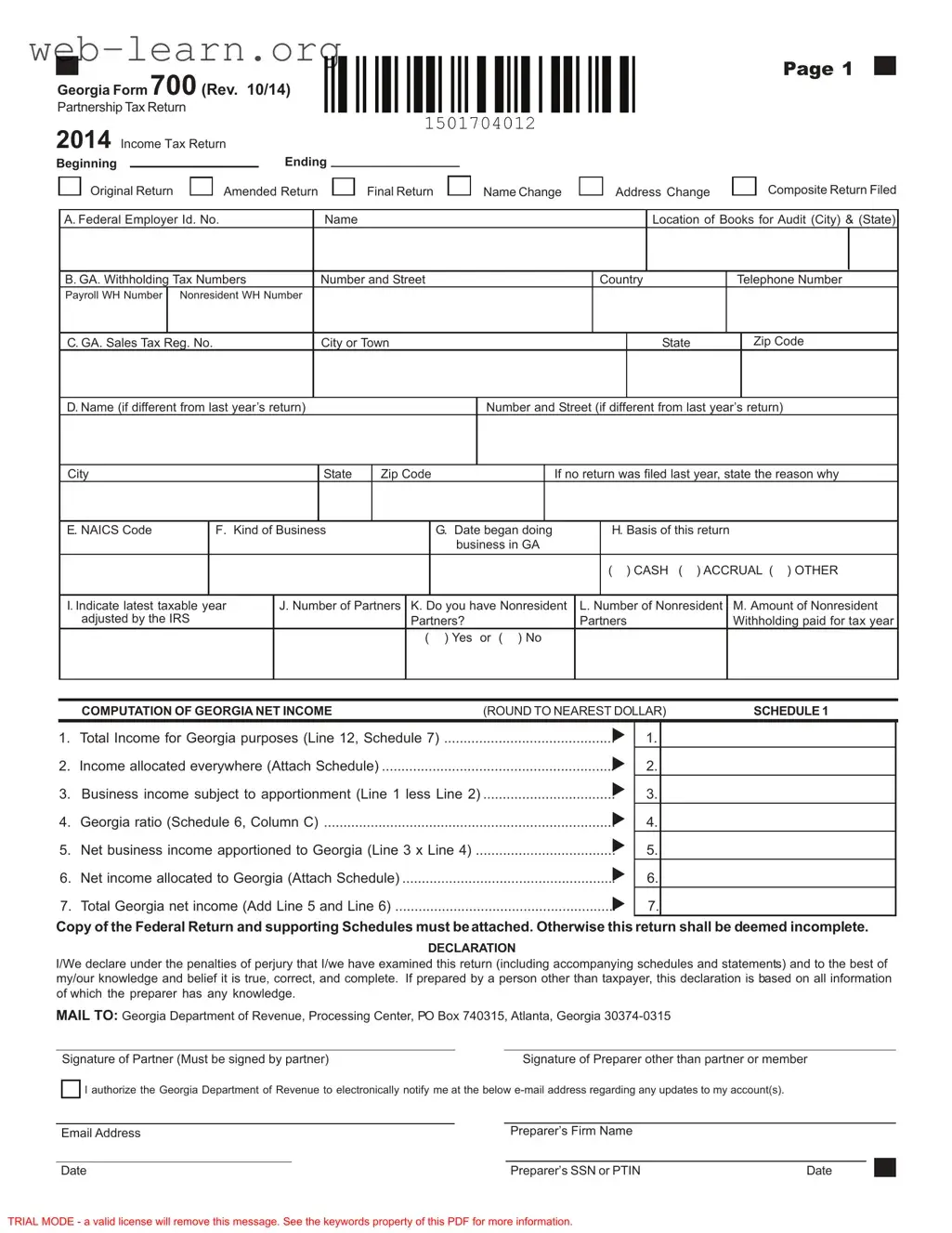
For partnerships operating in Georgia, understanding the Georgia Form 700 is essential for compliance with state tax regulations. This form serves as the Partnership Tax Return, capturing critical financial information that reflects the partnership's income and tax obligations. It includes sections for identifying the partnership, such as its name, address, and federal employer identification number. The form also requires details about the business's operations, including the type of business, the date it began operating in Georgia, and the basis of the return—whether cash, accrual, or other methods. Additionally, partnerships must indicate the number of partners and whether any are nonresidents. The computation of Georgia net income is a key aspect of the form, requiring partnerships to calculate total income, allocated income, and business income subject to apportionment. Various schedules within the form allow for the reporting of tax credits, distributions to partners, and adjustments to federal taxable income, ensuring a comprehensive view of the partnership's financial landscape. Filing the Georgia Form 700 accurately is crucial, as it not only affects tax liability but also ensures that partnerships remain in good standing with the Georgia Department of Revenue.

Sample - Georgia 700 Form

Preparer’s Firm Name
1. Total Income for Georgia purposes (Line 12, Schedule 7) ............................................ 1.
2. Income allocated everywhere (Attach Schedule) ............................................................ 2.
3. Business income subject to apportionment (Line 1 less Line 2) .................................. 3.
4. Georgia ratio (Schedule 6, Column C) ........................................................................... 4.
5. Net business income apportioned to Georgia (Line 3 x Line 4) .................................... 5.
6. Net income allocated to Georgia (Attach Schedule) ....................................................... 6.
7. Total Georgia net income (Add Line 5 and Line 6) ......................................................... 7.
Partnership Tax Return
MAIL TO: Georgia Department of Revenue, Processing Center, PO Box 740315, Atlanta, Georgia 30374-0315
2014 Income Tax Return
Page 1
Email Address
Signature of Partner (Must be signed by partner) Signature of Preparer other than partner or member
Date
Amended Return
Final Return
Name Change Address Change
Original Return
Composite Return Filed
Copy of the Federal Return and supporting Schedules must be attached. Otherwise this return shall be deemed incomplete.
COMPUTATION OF GEORGIA NET INCOME (ROUND TO NEAREST DOLLAR) SCHEDULE 1
E. NAICS Code F. Kind of Business G. Date began doing
business in GA
H. Basis of this return
adjusted by the IRS
( ) Yes or ( ) No
B. GA. Withholding Tax Numbers Number and Street
A. Federal Employer Id. No.
Country Telephone Number
C. GA. Sales Tax Reg. No. City or Town State
Payroll WH Number Nonresident WH Number
D. Name (if different from last year’s return) Number and Street (if different from last year’s return)
DECLARATION
I/We declare under the penalties of perjury that I/we have examined this return (including accompanying schedules and statements) and to the best of
my/our knowledge and belief it is true, correct, and complete. If prepared by a person other than taxpayer, this declaration is based on all information
of which the preparer has any knowledge.
City State Zip Code If no return was filed last year, state the reason why
( ) CASH ( ) ACCRUAL ( ) OTHER
I. Indicate latest taxable year
Location of Books for Audit (City) & (State)
I authorize the Georgia Department of Revenue to electronically notify me at the below e-mail address regarding any updates to my account(s).
Preparer’s SSN or PTIN Date
J. Number of Partners K. Do you have Nonresident
Partners?
L. Number of Nonresident
Partners
M. Amount of Nonresident
Withholding paid for tax year
Georgia Form 700 (Rev. 10/14)
Name
Beginning
Ending
Zip Code
TRIAL MODE − a valid license will remove this message. See the keywords property of this PDF for more information.
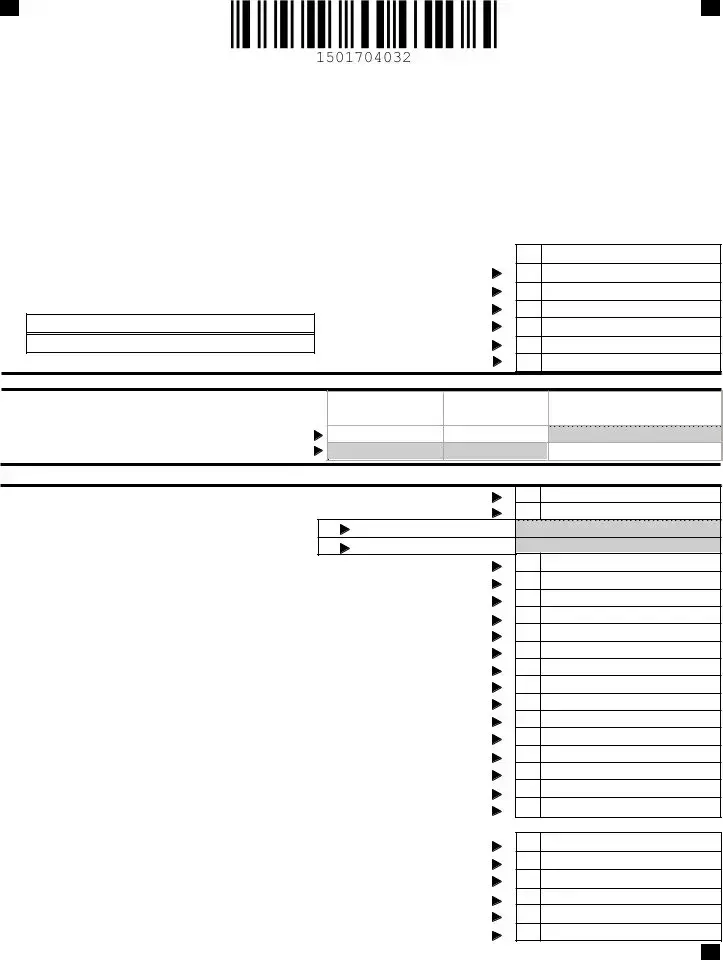
Credit Type Code Company Name FEIN % Amount of Credit
1. 1.
2. 2.
3. 3.
4. 4.
5. 5.
6. 6.
7. 7.
8. 8.
9. 9.
10. 10.
11. Enter the total from attached schedule(s) ........................................................................ 11.
12. TOTAL ALLOWABLE GEORGIA TAX CREDITS FOR THE YEAR ......................................... 12.
ADDITIONS TO FEDERAL TAXABLE INCOME (ROUND TO NEAREST DOLLAR) SCHEDULE 4
1. State and municipal bond interest other than Georgia or political subdivision thereof ..... 1.
2. Net income or net profits taxes imposed by taxing jurisdictions other than Georgia ........ 2.
3. Expenses attributable to tax exempt income ...................................................................... 3.
Schedule 4 continued on Page 3
GEORGIA TAX CREDITS (ROUND TO NEAREST DOLLAR) SCHEDULE 2
their applicable codes. You must list the appropriate credit type code in the area provided. If you claim more than ten credits, enclose a schedule. Enter
the schedule total on Line 11. List the percentage of credit claimed in the percent (%) column.
Profit Sharing % Georgia Source Income
2.
1.
5.
5.
5.
5.
5.
6.
6.
6.
6.
6.
3.
4.
2.
1.
3.
4.
2.
1.
3.
4.
2.
1.
3.
4.
2.
1.
3.
4.
TOTAL
A
B
C
D
E
(2.) Street and Number (4.) I.D. Number
(1.) Name (3.) City, State and Zip
INCOME TO PARTNERS (ROUND TO NEAREST DOLLAR) SCHEDULE 3
Page 2
Georgia Form 700/2014
FEIN
(Partnership) Name
These are for information purposes only and do not affect Schedules 1 or 3-7. See Pages 9 through 14 of the instructions for a list of available credits and
Attach the appropriate form or a detailed schedule for each credit claimed (See pages 9-14 of the instructions for additional information)
TRIAL MODE − a valid license will remove this message. See the keywords property of this PDF for more information.
1. Ordinary income (loss) ............................................................................................... 1.
2. Net income (loss) from rental real estate activities ....................................... 2.
3. a. Gross income from other rental activities ........ 3a.
b. Less expenses (attach schedule) ................... 3b.
c. Net income (loss) from other rental activities (Line 3a less Line 3b) ................... 3c.
4. Portfolio income (loss): a. Interest Income .............................................................. 4a.
b. Dividend Income ............................................................ 4b.
c. Royalty Income .............................................................. 4c.
d. Net short-term capital gain (loss) ................................. 4d.
e. Net long-term capital gain (loss) .................................. 4e.
f. Other portfolio income (loss) ........................................ 4f.
5. Guaranteed payments to partners .............................................................................. 5.
6. Net gain (loss) under Section 1231 ............................................................................ 6.
7. Other Income (loss) .................................................................................................... 7.
8. Total Federal income (add Lines 1 through 7) ........................................................... 8.
9. Additions to Federal income (Schedule 4, Line 9) ..................................................... 9.
10. Total (add Lines 8 and 9) ............................................................................................ 10.
11. Subtractions from Federal income (Schedule 5, Line 7) ........................................... 11.
12. Total income for Georgia purposes (Line 10 less Line 11) ....................................... 12.
Other Required Federal Information
1. Salaries and wages (Form 1065) ............................................................................... 1.
2. Taxes
and licenses (Form 1065) ................................................................................ 2.
3. Section 179 deduction (Form
1065) ........................................................................... 3.
4. Contributions (Form 1065) .......................................................................................
5. Investment interest expense (Form 1065) .................................................................
6. Section 59(e)(2) expenditures (Form 1065) ...............................................................
A. WITHIN GEORGIA B. EVERYWHERE C. DO NOT ROUND COL (A)/ COL (B)
2. Exception to intangible expenses and related interest cost (Attach IT-Addback)........
1. Interest on obligations of United States
(must be reduced by direct and indirect interest expenses)
3. Exception to captive REIT expenses and costs (Attach IT-REIT)....................................
4. Other subtractions (Attach Schedule) ..............................................................................
5.
6.
7. Total (Add Lines 1 through 6) enter here and on Line 11, Schedule 7..........................
APPORTIONMENT OF INCOME (ROUND TO NEAREST DOLLAR) SCHEDULE 6
2. Georgia Ratio (Divide Column A by Column B)...........
1. Gross receipts from business ...................................
COMPUTE TO SIX DECIMALS
COMPUTATION OF TOTAL INCOME FOR GEORGIA PURPOSES (ROUND TO NEAREST DOLLAR) SCHEDULE 7
SUBTRACTIONS FROM FEDERAL TAXABLE INCOME (ROUND TO NEAREST DOLLAR) SCHEDULE 5
3.
4.
5.
4. Federal deduction for income attributable to domestic production activities (IRC section 199) 4.
5. Intangible expenses and related interest costs ................................................................. 5.
6. Captive REIT expenses and costs ...................................................................................... 6.
7. O
8.
ther additions (Attach schedule) .............................................................................................. 7.
.......................................................... 8.
9. Total (Add Lines 1 through 8) Enter here and on Line 9, Schedule 7..................................... 9.
6.
2.
1.
7.
ADDITIONS TO FEDERAL TAXABLE INCOME (ROUND TO NEAREST DOLLAR) SCHEDULE 4 (continued)
Georgia Form 700/2014
Page 3
4.
5.
6.
FEIN
(Partnership) Name
TRIAL MODE − a valid license will remove this message. See the keywords property of this PDF for more information.

Form Information

Fact Name Description
Form Purpose The Georgia Form 700 is used for filing the Partnership Tax Return for income tax purposes.
Filing Requirements This form must be filed by partnerships doing business in Georgia, including those with nonresident partners.
Governing Law The form is governed by the Georgia Income Tax Act, O.C.G.A. § 48-7-1 et seq.
Submission Details Completed forms must be mailed to the Georgia Department of Revenue, Processing Center, PO Box 740315, Atlanta, GA 30374-0315.

Detailed Guide for Filling Out Georgia 700

Completing the Georgia Form 700 is an essential step for partnerships operating in Georgia. This form collects vital information about your partnership’s income, business activities, and tax obligations. Below are clear and concise steps to guide you through the process of filling out the form accurately.

  1. Begin by entering the Federal Employer Identification Number (FEIN) in the designated field.
  2. Provide the name of the partnership as it appears on official documents.
  3. Fill in the location of books for audit, including the city and state.
  4. List your Georgia Withholding Tax Numbers and other relevant identification numbers.
  5. Update your address if it has changed since last year’s return, and indicate if the name has also changed.
  6. Include the NAICS code that corresponds to your business activities.
  7. Indicate the kind of business your partnership conducts.
  8. Specify the date your partnership began doing business in Georgia.
  9. Choose the basis of this return (CASH, ACCRUAL, or OTHER).
  10. Indicate the latest taxable year for which you are filing.
  11. State the number of partners involved in the partnership.
  12. Answer whether you have nonresident partners and provide the number of nonresident partners if applicable.
  13. Report the amount of nonresident withholding paid for the tax year.
  14. Proceed to the Computation of Georgia Net Income section and complete the required calculations.
  15. Attach a copy of the Federal Return and any supporting schedules as these are necessary for your submission.
  16. In the declaration section, ensure that a partner signs the form, affirming the accuracy of the information provided.
  17. Provide an email address if you wish to receive electronic notifications from the Georgia Department of Revenue.
  18. Finally, mail the completed form to the specified address: Georgia Department of Revenue, Processing Center, PO Box 740315, Atlanta, Georgia 30374-0315.

Obtain Answers on Georgia 700

  1. What is the Georgia Form 700?

    The Georgia Form 700 is the Partnership Tax Return used by partnerships operating in Georgia to report their income, deductions, and credits. It is essential for partnerships to file this form to ensure compliance with state tax laws.

  2. Who needs to file the Georgia Form 700?

    Any partnership that conducts business in Georgia must file the Georgia Form 700. This includes both resident and nonresident partnerships. If the partnership has nonresident partners, additional information regarding their income and withholding may also be required.

  3. What information is required on the Georgia Form 700?

    The form requires various details, including:

    • Federal Employer Identification Number (FEIN)
    • Business name and address
    • Georgia withholding tax numbers
    • Type of business and NAICS code
    • Income details and apportionment information

    Additionally, partnerships must report the income allocated to Georgia and any applicable tax credits.

  4. How do partnerships calculate their Georgia net income?

    To determine Georgia net income, partnerships must follow these steps:

    1. Calculate total income for Georgia purposes.
    2. Identify income allocated everywhere and subtract it from the total income.
    3. Apply the Georgia ratio to the business income subject to apportionment.
    4. Add any income specifically allocated to Georgia.

    The final figure represents the total Georgia net income.

  5. What are Georgia tax credits, and how are they reported?

    Georgia tax credits are incentives provided by the state to encourage certain business activities. Partnerships must report these credits on Schedule 2 of the Form 700. Each credit claimed must include the credit type code, the company name, and the amount of credit. If more than ten credits are claimed, a detailed schedule should be attached.

  6. What is the purpose of the declaration section on the form?

    The declaration section requires the partner or preparer to affirm that the information provided is accurate and complete. This statement is made under penalties of perjury, emphasizing the importance of honesty in tax reporting.

  7. Can the Georgia Form 700 be amended?

    Yes, partnerships can file an amended return using the Georgia Form 700 if they need to correct errors or make changes to the originally filed return. The form provides a specific option to indicate that it is an amended return.

  8. Where should the completed Georgia Form 700 be mailed?

    The completed form should be mailed to the Georgia Department of Revenue, Processing Center, PO Box 740315, Atlanta, Georgia 30374-0315. It is crucial to ensure that the return is sent to the correct address to avoid processing delays.

  9. What happens if the Georgia Form 700 is not filed?

    If a partnership fails to file the Georgia Form 700, it may face penalties and interest on any taxes owed. Additionally, the partnership may be subject to audits and other enforcement actions by the Georgia Department of Revenue.

  10. Are there any filing deadlines for the Georgia Form 700?

    The Georgia Form 700 is generally due on the 15th day of the fourth month following the close of the partnership's tax year. For partnerships operating on a calendar year, this means the form is typically due by April 15. Extensions may be available, but they must be requested properly.

Common mistakes

Filling out the Georgia Form 700 can be a complex task, and many individuals make mistakes that can lead to delays or issues with their tax filings. One common error is failing to include the correct Federal Employer Identification Number (FEIN). This number is essential for the processing of the return. Without it, the form may be deemed incomplete, which can result in penalties or additional scrutiny from the Georgia Department of Revenue.

Another frequent mistake is neglecting to check the appropriate box for the type of return being filed. Whether it is an original, amended, or final return, this selection is crucial. Incorrectly marking this section can lead to confusion and miscommunication with tax authorities.

Many filers also overlook the importance of providing accurate contact information. The address, phone number, and email should be current and correct. If the Georgia Department of Revenue needs to reach out for clarification or additional information, having outdated contact details can cause significant delays.

Additionally, some individuals fail to attach the required copy of the Federal Return and supporting schedules. This attachment is mandatory; without it, the Georgia Form 700 may be considered incomplete. This oversight can lead to rejection of the return or additional requests for information.

Another common error involves the calculation of Georgia net income. It is essential to ensure that all income is accurately reported and that the calculations are correct. Mistakes in this section can lead to underreporting or overreporting of income, which may trigger audits or penalties.

Some filers also forget to sign the return. The signature of a partner is required for the return to be valid. A missing signature can delay processing and create complications in the filing status.

Lastly, failing to claim all eligible tax credits can result in lost savings. Many individuals do not take the time to review the available Georgia tax credits thoroughly. Ensuring that all applicable credits are claimed can significantly reduce the overall tax liability.

Documents used along the form

The Georgia Form 700 is a crucial document for partnerships operating in Georgia, serving as the Partnership Tax Return. However, it is often accompanied by several other forms and documents that provide additional information and fulfill various requirements. Understanding these documents can help ensure compliance and facilitate the filing process.

  • Georgia Form 600S: This is the S Corporation Tax Return, which partnerships may need to reference if they have S corporation partners. It provides details on the income and deductions specific to S corporations.
  • Georgia Form 500: This form is the Individual Income Tax Return. Partners in a partnership may need to file this form to report their share of the partnership income on their personal tax returns.
  • Schedule K-1 (Form 1065): This document reports each partner's share of income, deductions, and credits from the partnership. It is essential for partners to accurately report their income on their individual tax returns.
  • Georgia Form 500-ES: This is the Estimated Tax Payment form for individuals. Partners may use this form to make estimated tax payments on their share of partnership income.
  • Georgia Form 700-CR: This form is used to claim various tax credits available to partnerships. It helps partnerships document and claim credits that can reduce their overall tax liability.
  • Federal Form 1065: The U.S. Return of Partnership Income is the federal equivalent of the Georgia Form 700. It provides comprehensive details about the partnership's income, deductions, and distributions to partners.
  • Schedule A (Form 1065): This schedule details the partnership's income and expenses. It is an integral part of the federal return and helps in determining the taxable income.
  • Schedule B (Form 1065): This schedule provides information about the partnership's partners and their ownership percentages. It is essential for compliance with federal reporting requirements.
  • Georgia Form ST-3: This is the Sales and Use Tax Certificate of Exemption. Partnerships that make tax-exempt purchases may need to present this form to vendors to avoid sales tax on qualifying purchases.

Each of these forms and documents plays a significant role in the overall tax reporting process for partnerships in Georgia. By understanding their purposes and requirements, partnerships can better navigate the complexities of tax compliance and ensure that they meet all necessary obligations.

Similar forms

The Georgia Form 700 is a partnership tax return that shares similarities with several other tax documents. Here’s a look at four such documents:

  • IRS Form 1065: This is the federal partnership return. Like the Georgia Form 700, it reports income, deductions, gains, and losses from the partnership's operations. Both forms require information about the partners and the business's financial performance.
  • IRS Schedule K-1: This form is used to report each partner's share of income, deductions, and credits. Similar to the Georgia Form 700, it provides detailed information on how much income each partner must report on their individual tax returns.
  • Georgia Form 500: This is the individual income tax return for Georgia residents. It is similar in that it requires reporting of income, deductions, and credits, but it is specifically for individual taxpayers rather than partnerships.
  • Georgia Form 600: This is the corporate income tax return for Georgia. While it applies to corporations rather than partnerships, both forms require similar financial data and reporting structures, such as income and deductions.

Dos and Don'ts

When filling out the Georgia Form 700, it is essential to adhere to specific guidelines to ensure accuracy and compliance. Below is a list of things to do and avoid during this process.

  • Do verify all information before submission to prevent errors.
  • Do ensure that all required schedules and attachments are included with the form.
  • Do use the correct tax year when reporting income and expenses.
  • Do provide accurate contact information for the partnership and preparer.
  • Don't leave any sections of the form blank; all fields must be filled out appropriately.
  • Don't forget to sign the form; it must be signed by a partner.
  • Don't submit the form without double-checking the math and totals for accuracy.

Misconceptions

  • Misconception 1: The Georgia 700 form is only for large partnerships.
  • This is not true. The Georgia 700 form is designed for all partnerships operating in Georgia, regardless of size. Small partnerships must also file this return to report their income and fulfill state tax obligations.

  • Misconception 2: Filing the Georgia 700 form is optional if the partnership has no income.
  • Many believe that if a partnership has no income, it does not need to file. However, even partnerships with no income must submit the Georgia 700 form. This ensures compliance with state regulations and avoids potential penalties.

  • Misconception 3: The Georgia 700 form can be filed without attaching the federal return.
  • Some individuals think they can submit the Georgia 700 form independently. In reality, a copy of the federal return and supporting schedules must accompany the Georgia 700 form. Failing to do so can render the return incomplete.

  • Misconception 4: All partners must reside in Georgia for the partnership to file the Georgia 700 form.
  • This is a common misunderstanding. A partnership can file the Georgia 700 form even if some partners reside outside Georgia. However, the partnership must still report income earned within the state.

  • Misconception 5: The Georgia 700 form is the same as the federal partnership tax return.
  • While both forms serve similar purposes, they are not identical. The Georgia 700 form includes specific state requirements and calculations that differ from the federal partnership tax return. It is essential to understand these differences to ensure accurate reporting.

Key takeaways

  • Ensure that you provide accurate information on the Georgia 700 form. Double-check details such as the Federal Employer Identification Number (FEIN), business address, and partner information.

  • Attach all required schedules and documentation. A copy of the Federal Return and supporting schedules must accompany the form, or it may be considered incomplete.

  • Be aware of the different types of returns. Indicate whether you are filing an original, amended, or final return, as this affects how the form is processed.

  • Understand the importance of the declaration section. This section must be signed by a partner, affirming that the information provided is true and complete.