Homepage Blank Georgia 57 Form
Outline

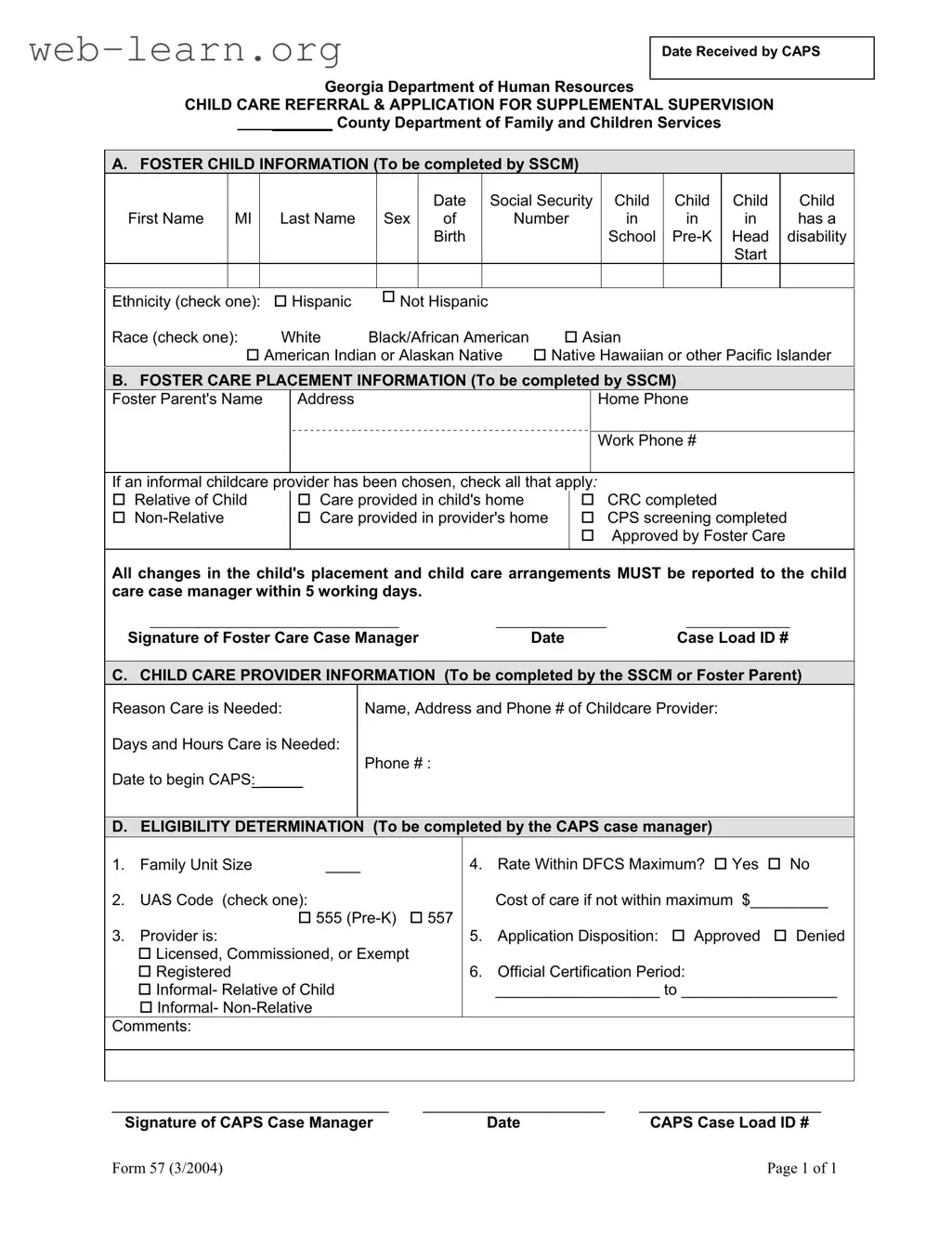
The Georgia 57 form plays a crucial role in the state's child welfare system, specifically concerning foster care and childcare arrangements. This form is primarily used by the Department of Human Resources to facilitate the referral and application process for supplemental supervision of children in foster care. It captures essential information about the foster child, including their name, date of birth, and social security number, as well as details about their disability status and ethnicity. Additionally, the form requires information about the foster care placement, including the foster parent's contact details and the nature of the childcare arrangement, whether with relatives or non-relatives. It also outlines the necessity for timely reporting of any changes in the child's placement or childcare to the case manager. The form further includes sections for determining eligibility, where the case manager assesses family unit size, childcare costs, and whether the provider meets the required standards. Ultimately, the Georgia 57 form is a vital tool for ensuring that children in foster care receive appropriate and timely childcare services while maintaining compliance with state regulations.
Sample - Georgia 57 Form

Georgia Department of Human Resources
CHILD CARE REFERRAL & APPLICATION FOR SUPPLEMENTAL SUPERVISION
___________
County Department of Family and Children Services
Form 57 (3/2004) Page 1 of 1
A. FOSTER CHILD INFORMATION (To be completed by SSCM)
First Name MI Last Name
Sex
Date
of
Birth
Social Security
Number
Child
in
School
Child
in
Pre-K
Child
in
Head
Start
Child
has a
disability
Ethnicity (check one): Hispanic
Not Hispanic
Race (check one): White Black/African American Asian
American Indian or Alaskan Native Native Hawaiian or other Pacific Islander
B. FOSTER CARE PLACEMENT INFORMATION (To be completed by SSCM)
Address
Home Phone Foster Parent's Name
Work Phone #
If an informal childcare provider has been chosen, check all that apply:
Relative of Child
Non-Relative
Care provided in child's home
Care provided in provider's home
CRC completed
CPS screening completed
Approved by Foster Care
All changes in the child's placement and child care arrangements MUST be reported to the child
care case manager within 5 working days.
____________________________________ ________________ _______________
Signature of Foster Care Case Manager Date Case Load ID #
C. CHILD CARE PROVIDER INFORMATION (To be completed by the SSCM or Foster Parent)
Reason Care is Needed:
Days and Hours Care is Needed:
Date to begin CAPS: _____
Name, Address and Phone # of Childcare Provider:
Phone # :
D. ELIGIBILITY DETERMINATION (To be completed by the CAPS case manager)
1. Family Unit Size ____
2. UAS Code (check one):
555 (Pre-K) 557
3. Provider is:
Licensed, Commissioned, or Exempt
Registered
Informal- Relative of Child
Informal- Non-Relative
4. Rate Within DFCS Maximum? Yes No
Cost of care if not within maximum $_________
5. Application Disposition: Approved Denied
6. Official Certification Period:
___________________ to __________________
Comments:
________________________________ _____________________ _____________________
Signature of CAPS Case Manager Date CAPS Case Load ID #
Date Received by CAPS

Form Information

Fact Name Details
Form Title Child Care Referral & Application for Supplemental Supervision
Governing Law Georgia Department of Human Services regulations
Date of Last Update March 2004
Purpose This form is used to apply for supplemental supervision for foster children.
Required Information Foster child information, foster care placement details, and child care provider information must be provided.
Eligibility Determination The CAPS case manager assesses eligibility based on family size and care costs.
Signature Requirement Signatures of both the Foster Care Case Manager and CAPS Case Manager are required.
Reporting Changes Any changes in the child's placement or care arrangements must be reported within 5 working days.
Confidentiality All information provided in this form is confidential and used for case management purposes only.

Detailed Guide for Filling Out Georgia 57

Completing the Georgia 57 form is a crucial step in ensuring that foster children receive the necessary care and supervision. This form gathers essential information about the child, their foster care placement, and the childcare provider. Following these steps will help you fill out the form accurately and efficiently.

  1. Begin by entering the date you received the form in the designated section at the top.
  2. In section A, provide the foster child's information. Fill in the first name, middle initial, last name, sex, date of birth, and social security number. Indicate the child's ethnicity and race by checking the appropriate boxes.
  3. Move to section B to complete the foster care placement information. Write the foster parent's name, address, home phone number, and work phone number. If an informal childcare provider is chosen, check all applicable boxes regarding the provider's relationship to the child and any completed screenings.
  4. In section C, state the reason care is needed and specify the days and hours care will be required. Enter the date you wish to begin CAPS and provide the name, address, and phone number of the childcare provider.
  5. Section D is for the eligibility determination, which must be filled out by the CAPS case manager. They will assess family unit size and other necessary details. Ensure to check the appropriate UAS code and indicate whether the provider is licensed, commissioned, or exempt.
  6. Lastly, the CAPS case manager will complete the application disposition and official certification period. They will also sign and date the form, along with their case load ID number.

Once the form is filled out, ensure that all required signatures are obtained and that any necessary documentation is attached. Timely submission of the completed form is essential for processing and to avoid delays in care for the child.

Obtain Answers on Georgia 57

  1. What is the purpose of the Georgia 57 form?

    The Georgia 57 form is used to apply for supplemental supervision for foster children. It serves as a referral and application document that helps the Department of Family and Children Services assess the need for additional childcare resources for children in foster care.

  2. Who needs to complete the Georgia 57 form?

    The form must be completed by the Social Services Case Manager (SSCM) for the foster child. In some sections, the foster parent may also provide necessary information, particularly regarding childcare providers and the reasons for care.

  3. What information is required about the foster child?

    Section A of the form collects vital details about the foster child, including:

    • Full name
    • Date of birth
    • Social Security number
    • Ethnicity and race
    • Information about any disabilities
  4. What details are needed regarding the foster care placement?

    In Section B, the form requires information about the foster parent, including:

    • Name and address
    • Home and work phone numbers
    • Details about the childcare provider, if applicable

    It is important to report any changes in the child's placement or childcare arrangements within five working days to ensure proper care.

  5. How is the eligibility for childcare determined?

    Section D is where the CAPS case manager assesses eligibility. This includes evaluating:

    • Family unit size
    • UAS code
    • Provider type (licensed, registered, etc.)
    • Application disposition (approved or denied)
  6. What should I do if my application is denied?

    If your application is denied, you may want to review the reasons for denial provided by the CAPS case manager. Understanding these reasons can help you address any issues or gather additional information needed for a potential reapplication.

  7. What is the significance of the signature on the form?

    The signatures of both the foster care case manager and the CAPS case manager validate the information provided and confirm that the application has been reviewed. This step is crucial for the processing of the application.

  8. How often should I update the information on the Georgia 57 form?

    Any changes in the child’s placement or childcare arrangements should be reported within five working days. Regular updates ensure that the child receives the appropriate level of care and support.

Common mistakes

Filling out the Georgia 57 form can be a straightforward process, but several common mistakes can lead to delays or issues in approval. One of the most frequent errors occurs in the section regarding foster child information. Many applicants fail to provide complete information, such as the child’s full name, date of birth, or Social Security number. Omitting any of these details can result in processing delays. Ensure that all fields are filled out accurately and completely to avoid unnecessary complications.

Another common mistake involves the foster care placement information. Applicants often overlook the requirement to report any changes in the child’s placement or childcare arrangements within five working days. This oversight can lead to compliance issues and may affect the child’s eligibility for services. It is essential to stay updated and communicate any changes promptly to the child care case manager.

In the child care provider section, applicants sometimes neglect to provide complete contact information for the childcare provider. This includes the provider’s name, address, and phone number. Incomplete information can hinder the verification process and delay the approval of the application. Always double-check that all necessary details are included before submitting the form.

Finally, applicants may misinterpret the eligibility determination section. Errors in family unit size or UAS code can lead to incorrect assessments of the application. Understanding the definitions and requirements for these fields is crucial. Take the time to review the eligibility criteria and ensure that all selections accurately reflect your situation. Doing so can help facilitate a smoother application process.

Documents used along the form

The Georgia 57 form is a critical document used in the child care referral and application process for supplemental supervision within the state. This form is often accompanied by several other documents to ensure a comprehensive evaluation of a child's needs and the suitability of their care arrangements. Below are some of the key forms and documents that are frequently utilized alongside the Georgia 57 form.

  • CAPS Application Form: This form is used to apply for the Childcare and Parent Services (CAPS) program. It collects information about the family’s income, household size, and the child’s specific needs to determine eligibility for financial assistance in childcare.
  • Background Check Authorization: This document allows for the necessary background checks on potential caregivers. It ensures that individuals providing care do not have a history that would endanger the child.
  • Child Care Provider Agreement: This agreement outlines the terms and conditions between the foster parent and the childcare provider. It specifies responsibilities, payment arrangements, and other essential details regarding the care of the child.
  • Foster Care Placement Agreement: This is a legal document that formalizes the placement of a child in a foster home. It includes information about the child’s needs and the responsibilities of the foster parents.
  • Health and Safety Checklist: This checklist is used to assess the safety and suitability of the childcare environment. It includes various criteria to ensure that the child will be in a safe and nurturing setting.
  • Individualized Education Plan (IEP): If the child has a disability, an IEP may be required. This plan outlines specific educational goals and services tailored to the child's unique needs.
  • Monthly Progress Reports: These reports are submitted by the childcare provider or foster parent to document the child’s development and any changes in their care needs. They help maintain communication between all parties involved.

Understanding these accompanying forms and documents is essential for ensuring that the child’s needs are met effectively. Each document plays a unique role in the overall process, contributing to the welfare and safety of the child in foster care.

Similar forms

The Georgia 57 form is an important document used in the context of child care referrals and applications for supplemental supervision. It serves a specific purpose but shares similarities with several other forms. Here’s a look at five documents that are comparable to the Georgia 57 form, highlighting how they are alike:

  • Child Care Subsidy Application: Like the Georgia 57 form, this document is designed to assess eligibility for financial assistance in child care. Both forms require detailed information about the child, the family, and the child care provider.
  • Foster Care Placement Agreement: This form outlines the terms and conditions of a child's placement in foster care. Similar to the Georgia 57, it collects essential information about the child and the foster family, ensuring that all parties are informed and in agreement.
  • Child Development Services Application: This application is used to access services for children with disabilities. It shares the same goal of determining eligibility and requires comprehensive information about the child's needs and family situation, just like the Georgia 57 form.
  • Child Care Provider Registration Form: This document is used to register child care providers with the state. It is similar to the Georgia 57 form in that it collects detailed information about the provider, ensuring that they meet the necessary standards for child care.
  • Eligibility Determination Form for Public Assistance: This form assesses a family's eligibility for various forms of public assistance, including child care. Much like the Georgia 57, it requires information about family size, income, and specific needs to determine eligibility.

Dos and Don'ts

When filling out the Georgia 57 form, it's essential to follow specific guidelines to ensure that the application process runs smoothly. Below are some important dos and don'ts to keep in mind.

  • Do provide accurate and complete information for each section of the form.
  • Do ensure that all signatures are obtained where required, especially from the Foster Care Case Manager.
  • Do report any changes in the child's placement or child care arrangements to the case manager within 5 working days.
  • Do check all applicable boxes for the child's ethnicity and race to ensure proper classification.
  • Do include the correct dates for when care is needed and when CAPS should begin.
  • Don't leave any sections blank; incomplete forms may lead to delays in processing.
  • Don't forget to verify the contact information for the childcare provider to avoid miscommunication.
  • Don't submit the form without reviewing it for any errors or omissions.
  • Don't provide false information, as this could jeopardize the application and future assistance.

By following these guidelines, you can help ensure that the Georgia 57 form is completed correctly, making the process easier for everyone involved.

Misconceptions

Understanding the Georgia 57 form can be challenging. Here are six common misconceptions that people often have:

  • It’s only for licensed childcare providers. Many believe that the Georgia 57 form is exclusively for licensed providers. In reality, it can also be used for informal care arrangements, including care provided by relatives or non-relatives.
  • All information must be filled out by the foster parent. Some think that the foster parent is solely responsible for completing the form. However, certain sections are designated for the Child and Adolescent Services (CAS) case manager to fill out.
  • It’s unnecessary to report changes in childcare arrangements. This is a common misunderstanding. Any changes in a child's placement or childcare must be reported to the case manager within five working days.
  • The form guarantees approval for childcare assistance. Many assume that submitting the Georgia 57 form will automatically result in approval. Approval is contingent upon eligibility criteria and the discretion of the CAPS case manager.
  • Eligibility is determined solely by income. While income is a factor, the eligibility determination also considers family size, the cost of care, and whether the provider meets certain standards.
  • Once submitted, the form does not need to be revisited. Some individuals think that after submitting the form, no further action is required. In fact, it’s important to keep the information updated and to check in with the case manager regularly.

Clearing up these misconceptions can help ensure that foster families navigate the process more smoothly and access the support they need.

Key takeaways

When filling out and using the Georgia 57 form, there are several important points to keep in mind:

  • Accurate Information is Crucial: Ensure that all details about the foster child, including their name, date of birth, and social security number, are filled out correctly. This information is essential for proper processing.
  • Timely Reporting of Changes: Any changes in the child's placement or childcare arrangements must be reported to the child care case manager within five working days. This helps maintain compliance and ensures the child's needs are met.
  • Eligibility Determination: The CAPS case manager will assess the family's eligibility based on various factors, including family size and the cost of care. Make sure to provide all necessary information to facilitate this process.
  • Signature Requirement: The form requires signatures from both the foster care case manager and the CAPS case manager. This step is vital for the application to be considered valid.