Homepage Blank Georgia 500 Nol Form
Outline

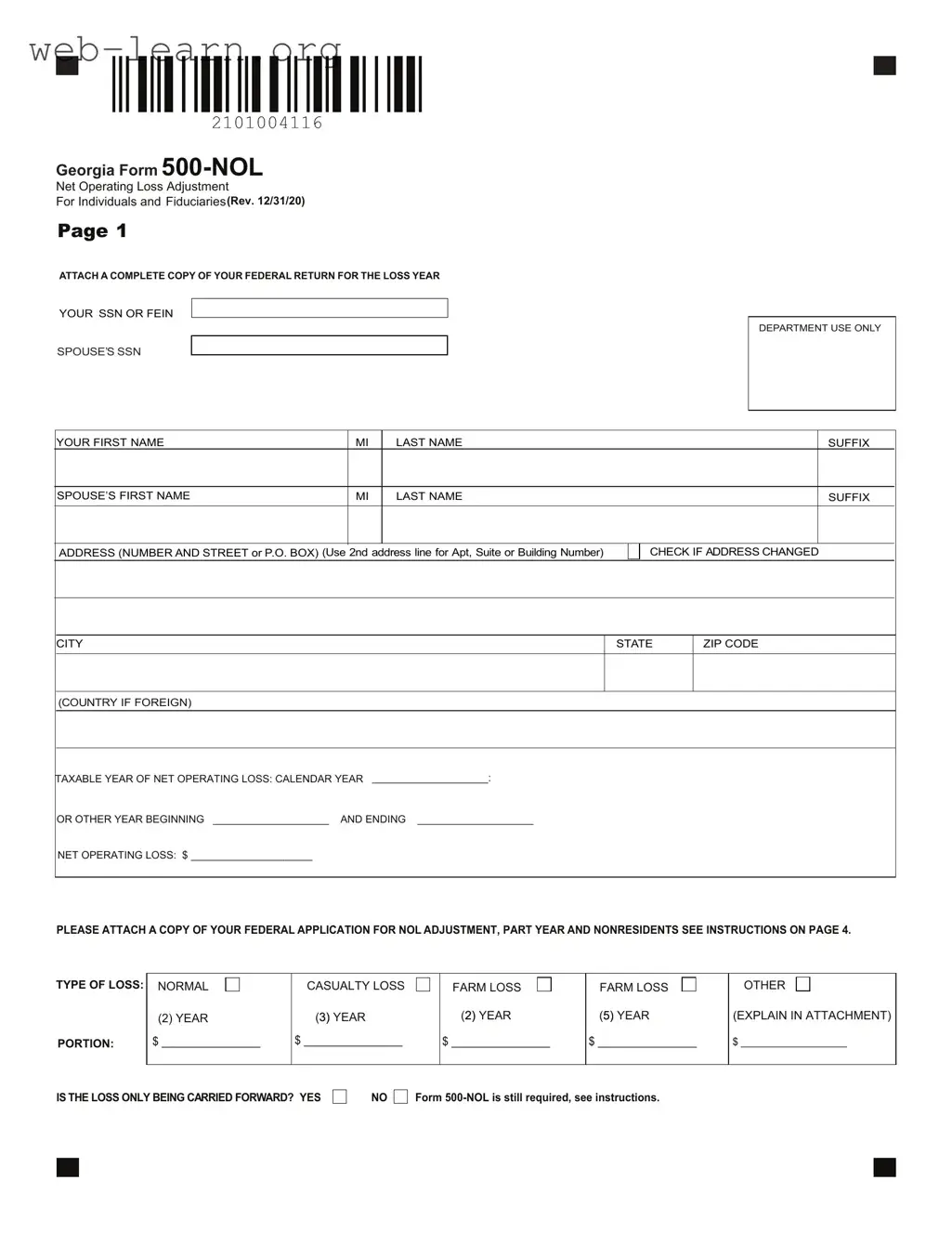
The Georgia Form 500-NOL serves as a crucial tool for individuals and fiduciaries seeking to adjust their net operating losses (NOL) for state tax purposes. This form is essential for those who have incurred a net operating loss and wish to either carry it back to previous tax years for a potential refund or carry it forward to offset future taxable income. The form requires the taxpayer's Social Security Number or Federal Employer Identification Number, along with pertinent personal information, including residency status and filing status. It outlines the taxable year of the loss, the amount of the net operating loss, and specifies whether the loss is being carried forward or back. Taxpayers must provide a complete copy of their federal tax return for the loss year, along with any necessary documentation for carryback years. The form also includes detailed calculations to determine the adjusted gross income, deductions, exemptions, and ultimately, the taxable income. Importantly, taxpayers must adhere to specific guidelines regarding the computation of their Georgia NOL, which may differ from federal calculations. This form must be filed within three years from the due date of the loss year return, including any extensions, making timely submission critical for tax compliance and potential refunds.

Sample - Georgia 500 Nol Form

$ ___________________
$ ________________
$ ________________
$ ________________
$ ________________
DEPARTMENT USE ONLY
MI
YOUR FIRST NAME
LAST NAME
SUFFIX
MI
SPOUSE’S FIRST NAME
LAST NAME
SUFFIX
CITY ZIP CODESTATE
CHECK IF ADDRESS CHANGED
CASUALTY LOSS
TYPE OF LOSS:
NORMAL
FARM LOSS FARM LOSS
PORTION:
ADDRESS (NUMBER AND STREET or P.O. BOX)
(Use 2nd address line for Apt, Suite or Building Number)
RAEY))33(
(COUNTRY IF FOREIGN)
TAXABLE YEAR OF NET OPERATING LOSS: CALENDAR YEAR
____________________:
OR OTHER YEAR BEGINNING ____________________ AND ENDING ____________________
NET OPERATING LOSS: $ _____________________
PLEASE ATTACH A COPY OF YOUR FEDERAL APPLICATION FOR NOL ADJUSTMENT, PART YEAR AND NONRESIDENTS SEE INSTRUCTIONS ON PAGE 4.
RAEY))22( RAEY))55(
NO Form 500-NOL is still required, see instructions.
IS
THE LOSS ONLY BEING CARRIED FORWARD? YES
OTHER
(EXPLAIN IN ATTACHMENT)
(2)
YEAR
m roF aigroeG 500-NOL
Net Operating Loss Adjustment
For Individuals and Fiduciaries
(Rev. 12/31/20)
Page 1
ATT
ACH
A
COMPLETE
COPY
OF
YOUR
FEDERAL
RETURN
FOR
THE
LOSS
YEAR
YOUR SSN OR FEIN
SPOUSE
S SSN
m roF aigroeG 500-NOL
Net Operating Loss Adjustment
For Individuals and Fiduciaries
Page 2
___________________ PRECEDING TAX
YEAR ENDED ______________________
___________________ PRECEDING TAX
YEAR ENDED ______________________
TAX YEAR:
RESIDENCY STATUS
FILING STATUS
__________________ PRECEDIN
G TAX
YEAR ENDE
D ______________________
(a) Return as filed or
liability as last
determined
(b) Liability after
application of
carry-back
(c) Return as filed or
liability as last
determined
(d) Liability after
application of
carry-back
(e) Return as filed or
liability as last
determined
(f) Liability after application
of
carry-back
Computation of overpayments
Mailing Address:
Georgia Department of Revenue Processing Center, PO Box 740318, Atlanta, GA. 30374-0318
Under penalty
of perjury
, I declare that I have examined this return, including accompanying schedules and statements, and to the best of my knowledge
and belief it is true, correct and complete.
Declaration of preparer (other than taxpayer) is based on all information of which preparer has any knowledge.
Taxpayer’s Signature
Date
Taxpayer’s Spouse Signature
Taxpayer’s Phone Number
By providing my e-mail address I am authorizing the Georgia Department of Revenue to electronically notify me at the below e-mail address regarding any updates to
my account(s).
Taxpayer’s E-mail Address
Signature of Preparer Other Than Taxpayer
Check the box to authorize the Georgia Department of Revenue to
discuss the contents of this return with the named preparer.
Preparer’s Phone Number
Preparer’s FEIN
Preparer’s SSN/PTIN/SIDN
Name of Preparer Other Than Taxpayer
TAXPAYER’S FEIN
Date
Preparer’s Firm Name
1. Federal adjusted gross income
(exclude Federal NOL)
2. Georgia adjustments. See Page 5
of the instructions
3. Net operating loss. See Page 5
for 80% rule and other instructions
4. Georgia adjusted gross income
Net total of Lines 1, 2 and 3.
5. Deductions. See Page 5 of the
instructions.
6. Subtract Line 5 from Line 4
7. Exemptions. See Page 5 of instructions.
8. Taxable Income. Subtract Line 7
from Line 6.
9. Income Tax.
10. Credits. See Page 5 of the instructions.
11. Tax after credits. Subtract Line 10
from Line 9.
12. Enter Line 11 column (b) (d) (f),
respectively.
13. Decrease in tax. Subtract Line 12
from Line 11.
1.
PAR
T
YEAR
AND
NONRESIDENTS, SEE INSTRUCTIONS ON PAGE 4
1.
2.
3.
m roF aigroeG 500-NOL
COMPUTATION OF NET
OPERATING LOSS - LOSS YEAR
Page 3
Adjusted gross income, Line 8 , Page 2 of form 500 ........................................................................................
2.
Line 9 adjustments . ..........................................................................................................................................
a.
Deductions (Applies to individuals only). ..........................................................................................................
3a.
b.
3b.
4.
Personal exemption, Line 14c of form 500. ................................................................................................
Enter amount of your St andard or Itemized Deductions, Line 1 1c or Line 12 of form 500. ........................
4.
5.
Tot
al (Lines 3a and 3b) .....................................................................................................................................
5.
6.
6.
7.
T
axable income. Tot al of Line 1 and Line 2 less Line 4 ...................................................................................
Exemptions claimed, Line 14c of form 500 ......................................................................................................
7.
9.
Nonbusiness capit al losses before limit ation. Enter as a positive number ................
8.
Tot al nonbusiness capit al gains (without regard to any I.R.C section 1202 exclusion)
10.
If Line 7 is more than Line 8, enter the dif ference; otherwise, enter -0- ....................
8.
9.
10.
11.
Enter either your standard deduction or itemized deductions
less casualty, 2106 deductions, and state and local
income taxes ..................................................................
11.
I
f Lin e 8 is more than Line 7, enter the dif ference; otherwise, enter -0- ....................
13.
14.
12.
Contributions to self-employed pension plan or Keogh
12.
Alimon
y (paid ) .............................................................
15.
16.
Forfeited interest/penalty on early withdrawal ............
Contribution to an IRA ................................................
Other (specify) ............................................................
13.
14.
15.
16.
17.
18.
18.
Dividend income .........................................................
19.
17. Total nonbusiness deductions (Lines 11 through 16)
19.
Interest income ...........................................................
20.
20.
21. GA adjustment for retirement exclusion, U.S. interest,
21.
22.
Alimony/pensions/annuities ...........................................
22.
23.
Other (specify) ............................................................
non-Georgia municipal interest, etc (See Page 4).......
23.
24.
24.
25.
Total nonbusiness income other than capital gains (Lines 18 through 22)
..............
Add Lines 10 and 23 .................................................................................................
25.
If Line 17 is more than Line 24, enter the difference; otherwise enter -0- .................
26.
27.
Do not enter more than Line 10 ................................................................................
26. If Line 24 is more than Line 17, enter the difference; otherwise enter -0-.
27.
28.
28.
29.
29.
Total business capital losses before limitation. Enter as a positive number ..............
30.
Total business capital gains (without regard to I.R.C. section 1202 exclusion) .........
Add Lines 26 and 28 .................................................................................................
30.
31.
31.
Add Lines 9 and 30. ..................................................................................................
If Line 27 is more than Line 29, enter the difference; otherwise enter -0- .................
32.
Line 3
1 .......................................................................................................................
33.
34.
33. I.R.C. section 1202 exclusion (50% exclusion for gain from certain small business
stock). Enter as a positive number. ..........................................................................
34.
Subtract Line 33 from Line 32. If zero or less enter -0- ............................................
35.
36.
35. Enter your net capital loss after the $3,000 Federal limitation.
Enter as a positive number ........................................................................................
36.
37.
If Line 34 is more than Line 35, enter the difference; otherwise enter -0- ..................
37.
38.
32. Enter your net capit al loss before the $3,000 federal limit ation, if any . Enter as a
positive number
. If you do not have this loss (and do not have an I.R.C. section
1202 exclusion) skip Lines 32 t hrough 37 and ent er on Line 38 t he amount from
If Line 35 is more than Line 34, enter the difference; otherwise enter -0- ........................................................
38.
39.
Subtract Line 36 from Line 31. If zero or less, enter -0- ..................................................................................
39.
40.
Previous net operating loss claimed. Enter as a positive number
...................................................................
Add Lines 6, 25, 33, 37, 38, 39 ...................................................................................................................................................................................
40.
41.
Loss amount. Combine Lines 5 and 40. If the result is less than zero, enter it here. If the loss is being carried
back to a part year or nonresident return,
42.
43.
IRC Section 461(1) loss eligible to be carried forward only (enter as negative)..........................................................................................................
42.
TAXPAYER’S FEIN
Total Net Operating Loss. Combine Lines 41 (if Line 41 is a negative) and Line 42. Enter on Page 1.....................................................................
43.
see instructions on Page 4. If the result is zero or more, you do not have a normal net operating loss. ...............................................................................
41.
_______________________
_______________________
_______________________
_______________________
_______________________
_______________________
_______________________
_______________________
_______________________
_______________________
_______________________
_______________________
_______________________
_______________________
_______________________
_______________________
_______________________
_______________________
_______________________
_______________________
_______________________
_______________________
_______________________
_______________________
_______________________
mroF aigroeG 500-NOL
Page 4
REVOYRRAC SSOL GNITAREPO TEN
Column A Column B Column C
Total Non Georgia Georgia
See instructions below.....................................................
PART YEA
R AND NONRESIDENTS
Complete if applicable
Year_________ Use a separate schedule for all applicable years.
1. Georgia Adjusted Gross Income (exclude Federal NOL).
Part Year and Nonresident schedule instructions. (Use if carrying the loss to a part year or nonresident return regardless of
whether the loss year is a part year or nonresident return.)
3.
2.
Georgia NOL. See instructions below............................
Additional instructions for part year and nonresidents.
Adjusted AGI for NOL purposes...................................
See instructions below.....................................................
4. Percentage. Line 3, column C divided by column A.
6.
7.
Personal exemptions.......................................................
Line 4 percentage times Line 7........................................8.
5. Itemized or standard deduction. See instructions below.
9. Adjusted taxable income, column C, Line 3 less Line 8,
Total deductions and exemptions; add Lines 5 & 6..........
enter here and on taxable income Line 8 of Page 2.......
___________________ PRECEDING TAX
YEAR ENDED ______________________
___________________ PRECEDING TAX
YEAR ENDED ______________________
1. Net operating loss deduction .....
carryback .........................................
2. Taxable income before N.O.L.
3. Net capital loss deduction. Enter
as a positive number........................
__________________ PRECEDING
TAX
YEAR ENDED
______________________
Complete one column before going
to the next column. Start with the earliest
carryback year.
Enter as a positive number..............
4. I.R.C. section 1202 exclusion.
income ...........................................
5. Adjustments to adjusted gross
6. Adjustments to itemized deductions
7. Exemptions ................................
9. Net operating loss carryover. Line
1 less Line 8. If zero or less, enter -0-
enter -0- ..............................................
8. Modified taxable income. Combine
Lines 2 through 7. If zero or less,
TAXPAYER’S FEIN
Complete if applicable. See page 5 for instructions.
1. 500-NOL Page 2. Lines 1 through 7 should not be completed for any years for which a part year or nonresident return was filed. Instead the part year
and nonresident schedule above should be completed.
2. 500-NOL Page 3 must be completed. If the loss year is a part year or nonresident year for Lines 3a, 3b, 6, and 11, compute the amount and then multiply
it by the percentage of Georgia AGI to adjusted Federal AGI on schedule 3 of the loss year return. For example, if you have one exemption, multiply
$2,700 by the percentage on schedule 3 of the loss year return. The other Lines on Page 3 that pertain to Georgia source income should also be filled in.
3. 500-NOL Page 4. net operating loss carryover schedule. If any years on this schedule are part year or nonresident years, for Lines 6 and 7, compute the
amount and then multiply it by the percentage on Line 4 of the part year and nonresident schedule. For example, if you have one exemption, multiply
$2,700 by the percentage on Line 4 of the above schedule. The other Lines on the net operating loss carryover schedule that pertain to Georgia source
income should also be filled in.
.ot deirrac gnieb si ssol eht raeyeh tro f, ylppayna f i271 noitceS .C.R. Iyb d eriuqerera tah ts tnemtsujdaeh tret fa,s tnuomaeh tretne ,5 dna 1 s eniL.1
2. Line 2 column A and C, enter loss from Page 3, Line 41 or from Page 4, Line 9 of the net operating loss carryover schedule.
deredisnoc si ega tnecrep 4 eniL eht ,evitagen ro orez si IGA laredeF detsujda eht fI .orez si egatnecrep eht ,evitagen ro orez si IGAa igroeG fi ,4 eniL.3
-pmexellu feh to tdeltitne s ireya pxateh t,esac siht nI .evitagen ro orez era IGA aigroeG dna IGA laredeF detsujda htob fi seilppa osla sihT .%001 eb ot
.snoitcudeddna tnuoman oit
500- NOL (Rev. 12/31/20)
General Instructions
A net operating loss carryback adjustment may be filed on this form
by an individual or fiduciary taxpayer that desires a refund of taxes afforded by
carryback of a net operating loss. This form must be filed no later than 3
years from the due date of the loss year income tax return, including any
extensions which have been granted. Form 500X should not be used to
carryback a NOL Form 500-NOL must also be filed by the due date
(including extensions) of the loss year return, when the taxpayer only carries
the loss forward. This is necessary so the NOL can be established in the
Department’s system. Page 2 carryback schedule should be left blank.
Generally a net operating loss must be carried back (if applicable) and forward
in the procedural sequence of taxable periods provided by Section 172
of the Internal Revenue Code of 1986, as defined in Code Section
48-1-2. For taxable years ending on or before December 31, 2017, generally
the carryback period is 2 years (with special rules for farmers (5
years), casualty losses (3 years); specified liability loss (10 years),
small business loss attributable to federally declared disasters (3 years);
etc.) For losses incurred in taxable years ending after December 31, 2017,
there is no carryback (with a 2 year carryback for farmers) and unlimited
carryover. Also, Georgia does not follow the following federal provisions:
Page 2 Instructions
Columns a, c, and e.
Special carryback rules enacted in 2009.
Special rules relating to Gulf Opportunity Zone public utility casualty
losses, I.R.C. Section 1400N(j).
5 year carryback of NOLs attributable to Gulf Opportunity Zone losses,
I.R.C. Section 1400N(k).
5 year carryback of NOLs incurred in the Kansas disaster area after May
3, 2007, I.R.C. Section 1400N(k).
5 year carryback
of certain disaster losses, I.R.C. Sections 172(b)(1)(J)
and 172(j).
The election to deduct public utility property losses attributable to May 4,
2007 Kansas storms and tornadoes in the fifth tax year before the year of
the loss, I.R.C. Section 1400N(o).
For losses incurred in taxable years beginning on or after January 1, 2018, the net
operating loss cannot offset more than 80% of Georgia taxable net income.
Within 90 days from the last day of the month in which this form is filed, the
Commissioner of Revenue shall make a limited examination of the form and
disallow without further action any form containing errors of computation not
correctable within such 90-day period or having material omissions. A decrease of
tax determined for prior year tax will first be credited against any unpaid tax and
any remaining balance will be refunded to the taxpayer without interest within the
90-day period.
*Note: This form shall constitute a claim for credit or refund.
If the commissioner should determine that the amount credited or refunded by
an application is in excess of the amount properly attributable to the carry-
back
with
r
espect to which such amount
was credited
or
re
funded,
t
he
commissioner may assess the amount of the excess as a deficiency as if it were
due to a mathematical error appearing on the face of the return.
What to attach:
Be sure to attach all required forms listed above and complete all lines of the
Form 500-NOL that apply. Otherwise your application may be disallowed.
The carryback period may be foregone and the NOL carried
forward.
Election: A taxpayer is bound by the Federal election to forego the
carryback period. A copy of this election should be attached to the Georgia
return. If there is a Georgia NOL but no Federal NOL, the taxpayer may make
an election “for Georgia purposes only” under the same rules and
restrictions as the Federal election. The Form 500-NOL should be filed even
when the carryback period is foregone.
Example: A taxpayer has a large Net Operating Loss in 1998 (both Federal and
Georgia). With his timely filed Federal return, he includes a statement that
he elects to forgo the carryback period. He must therefore carry his
Georgia (as well as his Federal) NOL forward without first carrying it back.
Any portion not absorbed after 20 years is lost.
1.
If the total nonbusiness income that is included in the retirement exclusion is
zero or less than zero, the percentage is zero. This would apply even if the total
income that is included in the retirement exclusion is zero or less than zero.
2.
If the total nonbusiness income that is included in the retirement exclusion is
greater than zero and exceeds the total income that is included in the retirement
exclusion, the percentage is 100%. This would apply even if the total income that is
included in the retirement exclusion is zero or less than zero.
Additionally, in situations where two people file married filing joint, a separate
computation should be made to determine each taxpayer’s portion of the retirement
exclusion that is related to nonbusiness income.
Line 42. Georgia follows the I.RC. Section 461(l) loss limitation. However, before the
I.RC. Section 461(l) loss limitation is applied, the business should compute the
business income and deductions pursuant to the I.R.C. as defined for Georgia
purposes (with the I.R.C. section 168(k) disallowance, etc.). Then the 461(l) provisions
should be applied. The 461(l) loss that is disallowed and is eligible to be carried
forward should be entered on line 42. This amount must be included when the 500-
NOL is filed to establish the NOL on the Department’s systems so the NOL will be
available when subsequent year returns are filed.
Page 4 Instructions
Net Operating Loss Carryover
1.
Copy of Federal Application for Net Operating Loss.
2.
Copy of Federal return for the loss year that includes pages 1 and 2,
schedules 1, A, D, and E.
3.
Copy of Federal returns for the carryback years that includes pages 1 and 2,
Schedule 1 and Schedule A and any schedules that were recalculated in carry-
back year.
4.
Copy of Georgia returns for the carryback or carryforward years
5.
Copy of Georgia form 500 for the loss year.
1. A Georgia Net Operating Loss (NOL) carryover must be computed separately
from any Federal NOL carryover. It is possible to have a Federal NOL carryover
but not a Georgia NOL carryover.
2. Line 3, enter as a positive number the adjustment as required by I.R.C.
Section 172, if it applies.
3. Line 4, enter as a positive number the gain excluded under I.R.C. section 1202
on the sale or exchange of qualified small business stock, if it applies.
4. Lines 5 and 6, enter the adjustments that are required by I.R.C. Section 172,
if any.
5. Line 9, if the 80% limitation applied to the year the loss was carried to,
an additional adjustment must be made before entering the loss on either the
carryover year on page 2 or the carryover year after the loss year. After
computing the amount on line 9, add the difference between the taxable income
before NOL carryback on line 2 and the NOL actually used considering the 80%
limitation. For example, the taxpayer has a 2019 NOL of 200,000. Their taxable
income in 2020 is 100,000 (they used 80,000 of the NOL after considering the
80% rule) and that $100,000 is entered on line 2 of the schedule at the top of
page 4. For simplicity sake assume the only adjustment that is required on the
top of page 4 are exemptions of 7,400 and that is entered on line 7.
Therefore the modified taxable income on line 8 is 107,400. Subtracting
the 107,400 from the 200,000 results in 92,600 being entered on line 9. The
difference of the 100,000 line 2 amount and the 80,000 is 20,000. This
would be added to the 92,600 and therefore 112,600 is available to be carried to
2021.
Enter the amounts from your original return or as previously adjusted by you or the
Department of Revenue.
Columns b, d, and f.
Lines 1 and 5, enter the amounts after adjustments that are required by I.R.C.
Section 172, if any. Line 1 should not be reduced by the Federal or Georgia NOL.
Lines 2 and 7, enter the amounts from your
original return or as previously adjusted
by you or the Department of Revenue.
Line 3. For the earliest carryback year, in column (b) enter the NOL from page 3, line
41. In column (d) and (f) if applicable, enter the amount from line 9 of the Net
Operating Loss Carryover schedule on page 4. For example, a taxpayer has a l oss
from 2013 which has a two year carryback period. The loss from page 3 line 41 i s
listed on line 3 in column (b) for 2011. Not all of the loss is utilized. The taxpay er
makes the adjustments as required for 2011 in the
Net Operating Loss Carryover
schedule on page 4 and lists the amount from line 9 (if it is a positive amount) on l ine
3 in column (d) for 2012.
Line 10, the credit for taxes paid to other states should be recomputed based on the
new Georgia AGI and deductions. Other credits that are based on liability should be
adjusted accordingly. Any credits that are not allowed and that are eligi
ble for carry-
forward can be carried forward. Do not enter more than Line 9.
Page 3 Instructions
A Georgia Net Operating Loss (NOL) must be computed separately from any
Federal NOL. It is possible to have a Federal NOL, but not a Georgia NOL.
Line 21. In computing a Georgia
N OL
only Georgia amounts can be used. Interest
on U.S. savings bonds should be entered as a negative number on this line. Non-
Georgia municipal interest should be entered as a positive number on this line. The
nonbusiness portion of the retirement exclusion should be entered as a negative
number on this line. This should be computed as follows. The total nonbusiness
income (as it is defined for NOL purposes) that is included in the retirement exclusion
should be divided by the total income that is included in the retirement exclusion.
This percentage should then be multiplied by the retirement exclusion.
For example,
if the taxpayer has $8,000 in wages and $20,000 in inter
est income, the taxpayer
would divide $20,000 by $28,000 and then multiply this by the retirement exclusion
amount. When computing the percentage, the following guidelines should be
followed:
500- NOL (Rev. 12/31/20)
Please note that the amount from line 9 of the year directly preceding the
loss year is the amount (if any) that can be carried to the year after the
loss year (carryover year). The same adjustments from this schedule must
be made to each year in the carryover period to determine the amount that is
available to be carried to the next carryover year. For example, a taxpayer
has a loss from 2013 which has a two year carryback period. The loss is
carried back to 2011 and 2012 on page 2 but not all of the loss is
utilized. The taxpayer makes the adjustments as required to 2011
and 2012 in the Net Operating Loss Carryover schedule at the top
of page 4. After computing the amount for 2012 there is a positive
amount on line 9 of the 2012 column. This amount can be carried
to 2014 and the amount used in 2014 should be listed on the 2014
return not on Form 500-NOL. If not all of the loss is utilized in 2014,
the taxpayer should make the same adjustments to 2014 as are
listed in the Net Operating Loss Carryover schedule on page
4 to determine if any loss is available to be carried to 2015. A schedule
showing this should be attached to the 2014 return and should not be
listed on the Form 500-NOL.
If the loss was carried to a part year or nonresident return, on line
2 of the carryover schedule enter the amount from line 14 schedule 3 of
Form 500 for the year it was carried to. For lines 3, 4, and 5, enter
amount if related to Georgia Income. For lines 6 and 7, multiply the amount
by the ratio on line 9, schedule 3 of Form 500 for the year the loss was
carried to.
Part Year and Nonresident Instructions. See instructions on page 4.

Form Information

Fact Name Details
Purpose The Georgia Form 500-NOL is used to adjust net operating losses for individuals and fiduciaries.
Governing Law It is governed by Georgia Code Section 48-1-2 and the Internal Revenue Code Section 172.
Filing Deadline This form must be filed no later than three years from the due date of the loss year income tax return.
Carryback Rules Generally, losses can be carried back two years, but farmers have a five-year carryback period.
80% Limitation For losses incurred after December 31, 2017, only 80% of Georgia taxable net income can be offset.
Required Attachments Taxpayers must attach a complete copy of their federal return for the loss year.
Signature Requirement Taxpayers must sign the form under penalty of perjury, affirming the accuracy of the information provided.

Detailed Guide for Filling Out Georgia 500 Nol

Filling out the Georgia Form 500-NOL is an important step for individuals and fiduciaries who have experienced a net operating loss. This form allows taxpayers to adjust their income tax returns based on losses incurred. Properly completing this form ensures that your application is processed smoothly.

  1. Gather necessary documents, including your complete federal return for the loss year.
  2. Enter your Social Security Number (SSN) or Federal Employer Identification Number (FEIN) at the top of the form.
  3. Provide your name, middle initial, last name, and suffix, if applicable.
  4. Fill in your spouse’s name, middle initial, last name, and suffix, if applicable.
  5. Complete your address, including street number, street name, city, state, and ZIP code. Check the box if your address has changed.
  6. Indicate the taxable year of the net operating loss, specifying if it is a calendar year or another year with start and end dates.
  7. Enter the amount of your net operating loss in the designated field.
  8. Attach a copy of your federal application for NOL adjustment, if applicable.
  9. Specify the type of loss by checking the appropriate box (normal, casualty, farm loss, or other).
  10. Complete the portion of the form that asks if the loss is only being carried forward by selecting "Yes" or "No."
  11. Proceed to page two and complete the residency and filing status sections.
  12. Fill in the required financial information, including adjusted gross income and deductions, as indicated on the form.
  13. Continue to fill out calculations for taxable income and tax credits as required.
  14. Sign and date the form, including your spouse's signature if applicable.
  15. Provide your phone number and email address if you wish to receive electronic notifications.
  16. Mail the completed form and all required attachments to the Georgia Department of Revenue at the specified address.

After submitting the form, the Georgia Department of Revenue will review your application. They may contact you if any additional information is needed. Be sure to keep copies of everything you submit for your records.

Obtain Answers on Georgia 500 Nol

  1. What is the purpose of the Georgia Form 500-NOL?

    The Georgia Form 500-NOL is used by individuals and fiduciaries to report a net operating loss (NOL) adjustment. This form allows taxpayers to claim a refund of taxes that may be owed due to the carryback of a net operating loss. It is essential for establishing the NOL in the Georgia Department of Revenue’s system, whether the loss is carried back or forward.

  2. Who needs to file the Georgia Form 500-NOL?

    Any individual or fiduciary who has incurred a net operating loss and wishes to carry that loss back to offset taxable income from previous years must file this form. It is also necessary for those who only wish to carry the loss forward. The form must be submitted no later than three years from the due date of the loss year income tax return, including any extensions.

  3. What information is required when completing the form?

    When filling out the Georgia Form 500-NOL, taxpayers need to provide various details, including:

    • Your Social Security Number (SSN) or Federal Employer Identification Number (FEIN)
    • Your name and address
    • The taxable year of the net operating loss
    • The amount of the net operating loss
    • Type of loss (normal, casualty, or farm loss)
    • Any federal applications for NOL adjustments

    Additionally, a complete copy of the federal return for the loss year and any applicable Georgia returns for the carryback or carryforward years must be attached.

  4. Are there any specific rules regarding the carryback and carryforward of losses?

    Yes, there are specific rules regarding the carryback and carryforward of net operating losses in Georgia. Generally, losses incurred in taxable years ending on or before December 31, 2017, can be carried back for two years. For losses incurred after December 31, 2017, there is no carryback allowed, but losses can be carried forward indefinitely. However, the net operating loss cannot offset more than 80% of Georgia taxable net income in any given year. Taxpayers should also note that Georgia does not follow certain federal provisions related to net operating losses.

Common mistakes

Filling out the Georgia Form 500-NOL can be a complex process, and mistakes can lead to delays or denials of your application. Here are ten common errors that individuals often make when completing this form.

One frequent mistake is failing to attach a complete copy of the federal return for the loss year. This document is crucial for the Georgia Department of Revenue to assess your net operating loss accurately. Without it, your application may be incomplete, which could result in rejection.

Another common error is neglecting to specify the correct taxable year of the net operating loss. It's essential to indicate whether the loss occurred in a calendar year or another specified year. Misidentifying this can lead to complications in processing your claim.

Some individuals mistakenly leave out the total amount of the net operating loss. This figure is vital for the calculation of your tax liability and must be clearly stated. Omitting this information can create confusion and may require additional follow-up with the tax department.

Many people also forget to check the box indicating whether the loss is being carried forward only. This detail is important as it informs the department of how to process your application. Failing to check this box can lead to misunderstandings about your intent regarding the loss.

Inaccuracies in reporting the type of loss can also be problematic. Whether it’s a normal loss, casualty loss, or farm loss, it’s important to select the appropriate category. Misclassification can affect the eligibility and calculation of the loss.

Additionally, some applicants do not provide the necessary residency and filing status information. This data is critical for determining your eligibility for the net operating loss adjustment. Without it, the processing of your application may be delayed.

Another mistake involves incorrect calculations in the income and deduction sections. Errors in these calculations can lead to significant discrepancies in your reported taxable income, which can ultimately affect your refund or tax liability.

People often overlook the requirement to include all relevant attachments, such as copies of previous Georgia returns for carryback or carryforward years. Missing documents can lead to an incomplete application, which may result in disallowance.

Some individuals also fail to sign the form or provide the necessary contact information. A missing signature can render the application invalid, and without proper contact details, the department may struggle to reach you for clarification or additional information.

Lastly, failing to keep copies of all submitted documents can create issues down the line. It's wise to maintain records of everything you send to the Georgia Department of Revenue, as these can be useful for future reference or if questions arise about your application.

By being aware of these common mistakes, individuals can better prepare their Georgia Form 500-NOL applications and increase the likelihood of a smooth processing experience.

Documents used along the form

The Georgia Form 500-NOL is an important document for individuals and fiduciaries seeking to adjust their net operating losses for state tax purposes. Alongside this form, several other documents are commonly used to ensure accurate reporting and compliance with Georgia tax regulations. Below is a list of these documents, each described briefly to provide clarity on their purpose and relevance.

  • Georgia Form 500: This is the standard income tax return form for individuals in Georgia. It reports income, deductions, and credits, and is essential for establishing the basis for any net operating loss adjustments.
  • Federal Form 1040: This is the individual income tax return form used by U.S. taxpayers. A complete copy is often required when filing the Georgia Form 500-NOL to verify the net operating loss claimed.
  • Federal Schedule A: This form is used to report itemized deductions. It may be necessary to attach this schedule to show the deductions that were claimed on the federal return.
  • Federal Schedule D: This schedule reports capital gains and losses. It is relevant for individuals who have capital losses that contribute to their net operating loss calculation.
  • Federal Form 4868: This form is an application for an automatic extension of time to file a federal tax return. It may be attached if an extension was granted for filing the federal return associated with the net operating loss.
  • Georgia Form 500X: This is the amended income tax return for Georgia. It is used to make corrections to previously filed returns, which might affect the net operating loss calculations.
  • Federal Form 1065: This is the U.S. Return of Partnership Income. If the taxpayer is a partner in a partnership, this form may be needed to report the partnership's income and losses.
  • Federal Form 1120: This is the U.S. Corporation Income Tax Return. Corporations claiming a net operating loss may need to include this form to show their income and losses.
  • Georgia Form 501: This is the Georgia Individual Income Tax Return for Nonresidents and Part-Year Residents. It is relevant for individuals who have a net operating loss from income earned in Georgia while residing elsewhere.
  • Georgia Form 500-NOL Carryover Schedule: This schedule is used to track the carryover of net operating losses to future tax years, ensuring proper reporting and utilization of the losses.

These documents collectively support the accurate filing and adjustment of net operating losses in Georgia. It is crucial to ensure that all required forms are completed and submitted correctly to avoid any potential issues with the state tax authority. Proper documentation facilitates a smooth process for taxpayers seeking to manage their tax obligations effectively.

Similar forms

The Georgia Form 500-NOL is similar to several other tax documents. Here are four documents that share similarities:

  • IRS Form 1040: This is the standard individual income tax return form used in the United States. Like the Georgia 500-NOL, it requires detailed financial information from the taxpayer, including income and deductions, to determine tax liability.
  • IRS Form 4868: This form is used to apply for an automatic extension of time to file an individual income tax return. Similar to the Georgia 500-NOL, it requires the taxpayer to estimate their tax liability and provide information about their income and deductions.
  • IRS Form 1120: This is the corporate income tax return form. It also includes sections for reporting income, deductions, and tax liability, similar to how the Georgia 500-NOL reports net operating losses and adjustments to income.
  • Georgia Form 500: This is the individual income tax return form for Georgia residents. Like the 500-NOL, it requires detailed financial information and is used to determine tax liability for individuals in Georgia.

Dos and Don'ts

When filling out the Georgia Form 500-NOL, it's essential to approach the task with care. Below is a list of important dos and don'ts to ensure that the form is completed accurately and efficiently.

  • Do attach a complete copy of your federal return for the loss year.
  • Do ensure all required fields are filled out completely, including your Social Security Number (SSN) or Federal Employer Identification Number (FEIN).
  • Do follow the instructions carefully regarding the type of loss and the corresponding amounts.
  • Do check your calculations thoroughly before submitting the form.
  • Don't leave any required sections blank; this may lead to delays or disallowance of your application.
  • Don't forget to sign and date the form, as an unsigned form may be rejected.
  • Don't submit the form without including all necessary attachments, such as prior year returns and any relevant schedules.
  • Don't assume that previous years' information is still valid; always verify and update your details as needed.

Misconceptions

Here are seven common misconceptions about the Georgia Form 500-NOL:

  • Misconception 1: You don’t need to file the form if you only carry the loss forward.
  • Even if you are only carrying the loss forward, you still need to file Form 500-NOL. This helps establish the loss in the state's system.

  • Misconception 2: The Georgia NOL is the same as the Federal NOL.
  • Georgia and Federal NOLs are calculated separately. You can have a Federal NOL but not a Georgia NOL, or vice versa.

  • Misconception 3: You can carry back NOLs for any number of years.
  • The carryback period is limited. Generally, for losses incurred after December 31, 2017, there is no carryback, except for farmers who may have a two-year carryback.

  • Misconception 4: You can ignore the 80% limitation on Georgia taxable income.
  • For losses incurred in taxable years beginning on or after January 1, 2018, the NOL cannot offset more than 80% of Georgia taxable net income.

  • Misconception 5: You don’t need to attach your federal return.
  • A complete copy of your federal return for the loss year must be attached when filing the Georgia Form 500-NOL.

  • Misconception 6: You can use any losses from other states without adjustments.
  • When calculating your Georgia NOL, only Georgia amounts can be used. Adjustments for non-Georgia sources are necessary.

  • Misconception 7: Filing late will not affect your NOL claim.
  • Form 500-NOL must be filed no later than three years from the due date of the loss year return. Late filings may result in disallowance of your claim.

Key takeaways

  • Understand the Purpose: The Georgia Form 500-NOL is used to adjust your net operating loss for state tax purposes. This form is essential for individuals and fiduciaries who want to claim a refund for taxes due to a net operating loss carryback.

  • Attach Required Documents: When submitting the form, make sure to include a complete copy of your federal return for the loss year, along with any necessary schedules. Missing documents can lead to delays or disallowance of your application.

  • Know the Filing Deadline: This form must be filed no later than three years from the due date of the loss year income tax return. Be mindful of extensions, as they can affect your deadline.

  • Carryforward and Carryback Rules: Generally, net operating losses can be carried back two years and carried forward up to 20 years. However, specific rules apply, especially for farmers and casualty losses, so it’s important to understand how these rules affect your situation.