Homepage Blank Georgia 3907 Form
Outline

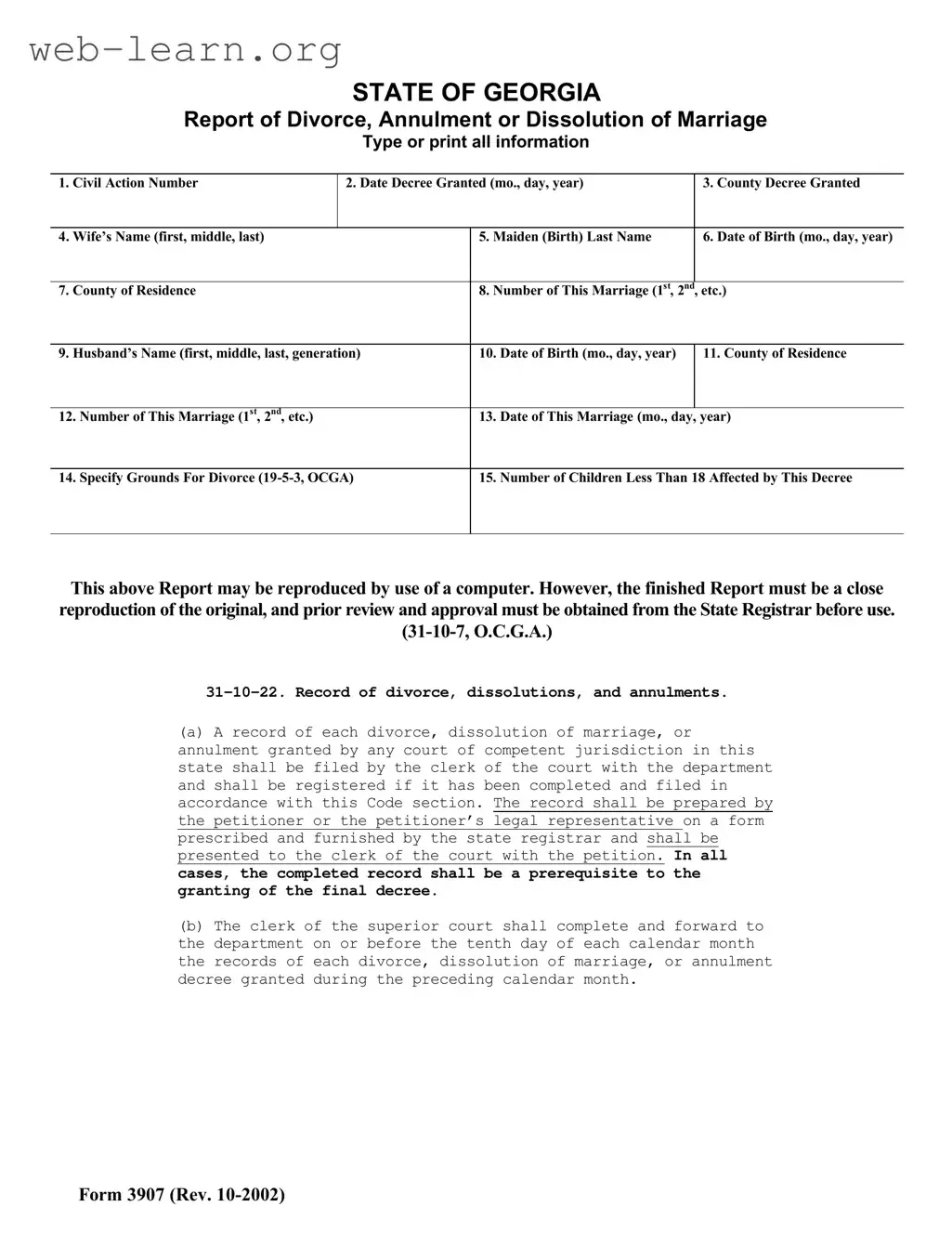
The Georgia 3907 form plays a crucial role in the legal process surrounding the dissolution of marriages within the state. This report, officially titled the "Report of Divorce, Annulment or Dissolution of Marriage," captures essential details about the divorce proceedings. It requires information such as the civil action number, the date the decree was granted, and the names and birth dates of both spouses. Additionally, it asks for the county of residence and the number of previous marriages for each party. Crucially, the form also specifies the grounds for divorce and notes the number of children under 18 affected by the decree. Proper completion and submission of this form are mandatory for the final decree to be granted. The clerk of the court is responsible for filing this record with the state department, ensuring that all divorces, annulments, and dissolutions are officially documented. The form must be closely reproduced if generated by a computer, and prior approval from the State Registrar is necessary for its use. Understanding the significance of the Georgia 3907 form is essential for anyone navigating the divorce process in Georgia.
Sample - Georgia 3907 Form

Form 3907 (Rev. 10-2002)
STATE OF GEORGIA
Report of Divorce, Annulment or Dissolution of Marriage
Type or print all information
1. Civil Action Number 2. Date Decree Granted (mo., day, year) 3. County Decree Granted
4. Wife’s Name (first, middle, last) 5. Maiden (Birth) Last Name 6. Date of Birth (mo., day, year)
7. County of Residence 8. Number of This Marriage (1
st
, 2
nd
, etc.)
9. Husband’s Name (first, middle, last, generation) 10. Date of Birth (mo., day, year) 11. County of Residence
12. Number of This Marriage (1
st
, 2
nd
, etc.) 13. Date of This Marriage (mo., day, year)
14. Specify Grounds For Divorce (19-5-3, OCGA) 15. Number of Children Less Than 18 Affected by This Decree
This above Report may be reproduced by use of a computer. However, the finished Report must be a close
reproduction of the original, and prior review and approval must be obtained from the State Registrar before use.
(31-10-7, O.C.G.A.)
31-10-22. Record of divorce, dissolutions, and annulments.
(a) A record of each divorce, dissolution of marriage, or
annulment granted by any court of competent jurisdiction in this
state shall be filed by the clerk of the court with the department
and shall be registered if it has been completed and filed in
accordance with this Code section. The record shall be prepared by
the petitioner or the petitioner’s legal representative on a form
prescribed and furnished by the state registrar and shall be
presented to the clerk of the court with the petition. In all
cases, the completed record shall be a prerequisite to the
granting of the final decree.
(b) The clerk of the superior court shall complete and forward to
the department on or before the tenth day of each calendar month
the records of each divorce, dissolution of marriage, or annulment
decree granted during the preceding calendar month.

Form Information

Fact Name Details
Form Title Report of Divorce, Annulment or Dissolution of Marriage
Civil Action Number This number is required to identify the specific court case.
Date Decree Granted The date must be provided in month, day, year format.
Governing Law O.C.G.A. § 19-5-3 outlines the grounds for divorce.
Children Affected The form requires information on the number of children under 18 affected by the decree.
Reproduction of Form The report can be reproduced, but must closely match the original.
Filing Requirement Clerks must file the completed form with the Department of Public Health.
Monthly Reporting Clerks are required to report all decrees granted by the tenth of each month.
Form Revision Date The current version of Form 3907 was revised in October 2002.

Detailed Guide for Filling Out Georgia 3907

Completing the Georgia 3907 form is an essential step in finalizing the divorce process. This form requires specific information about both spouses and the marriage. It is important to ensure that all fields are filled out accurately to avoid any delays in processing.

  1. Locate the Civil Action Number at the top of the form and enter it.
  2. Fill in the Date Decree Granted using the format (month, day, year).
  3. Indicate the County Decree Granted.
  4. Enter the Wife’s Name in the format of first, middle, and last name.
  5. Provide the Maiden (Birth) Last Name of the wife.
  6. Fill in the Date of Birth for the wife using the format (month, day, year).
  7. Specify the County of Residence for the wife.
  8. Indicate the Number of This Marriage (1st, 2nd, etc.) for the wife.
  9. Enter the Husband’s Name in the format of first, middle, last, and any generation suffix.
  10. Fill in the Date of Birth for the husband using the format (month, day, year).
  11. Specify the County of Residence for the husband.
  12. Indicate the Number of This Marriage (1st, 2nd, etc.) for the husband.
  13. Provide the Date of This Marriage using the format (month, day, year).
  14. Specify the Grounds For Divorce according to the appropriate code.
  15. Indicate the Number of Children Less Than 18 affected by this decree.

Obtain Answers on Georgia 3907

  1. What is the Georgia 3907 form?

    The Georgia 3907 form is a legal document used to report the finalization of a divorce, annulment, or dissolution of marriage in the state of Georgia. This form captures essential information about both parties involved and is required for official record-keeping.

  2. Who needs to fill out the Georgia 3907 form?

    The form must be completed by either the petitioner (the person who filed for divorce) or their legal representative. It is a crucial step in the divorce process, as it provides the court with necessary details for official records.

  3. What information is required on the form?

    The Georgia 3907 form requires a variety of information, including:

    • Civil action number
    • Date the decree was granted
    • Names and birth dates of both spouses
    • County of residence for both parties
    • Number of the marriage (first, second, etc.)
    • Grounds for divorce
    • Number of children under 18 affected by the decree
  4. When should the form be submitted?

    The completed Georgia 3907 form should be submitted to the clerk of the court at the time the divorce petition is filed. It is essential for the form to be filed correctly and promptly to ensure the final decree can be granted.

  5. What happens if the form is not filed?

    If the Georgia 3907 form is not filed, the final decree of divorce may be delayed or denied. The completed form is a prerequisite for the court to finalize the divorce, so it is crucial not to overlook this step.

  6. Can the form be filled out electronically?

    Yes, the Georgia 3907 form can be reproduced using a computer. However, the final version must closely resemble the original form. It’s important to obtain prior review and approval from the State Registrar before using any electronic reproduction.

  7. What is the role of the clerk of the court regarding the form?

    The clerk of the superior court is responsible for completing the form and forwarding it to the appropriate department. This must be done by the tenth day of each month for records from the previous month. Their role is vital in ensuring that all divorce records are accurately maintained.

  8. Are there any penalties for incorrect information on the form?

    Providing false or misleading information on the Georgia 3907 form can lead to legal consequences. It is essential to ensure that all details are accurate and truthful to avoid complications in the divorce process.

  9. Where can I obtain the Georgia 3907 form?

    The Georgia 3907 form can typically be obtained from the clerk of the superior court in your county or through the official website of the Georgia Department of Public Health. It’s advisable to ensure you have the most current version of the form.

Common mistakes

Filling out the Georgia 3907 form can be a straightforward process, but several common mistakes can lead to delays or complications. One frequent error is not providing complete information. Each section of the form requires specific details, such as the civil action number, names, and dates of birth. Omitting any of this crucial information can result in the form being returned or rejected.

Another mistake people often make is failing to use the correct names. It's essential to list names exactly as they appear on legal documents. This includes using the full first, middle, and last names of both the wife and husband. If there are any discrepancies, such as using a nickname instead of a legal name, it could cause issues in processing the form.

Many individuals also overlook the importance of accurately identifying the number of the marriage. Whether it’s the first, second, or subsequent marriage, this information must be precise. Misstating this detail can lead to confusion and further complications down the line.

Additionally, some people forget to specify the grounds for divorce clearly. The form requires a specific reference to the relevant section of the Georgia Code, and failing to provide this can result in delays. It is crucial to ensure that the grounds for divorce are articulated correctly to avoid misunderstandings.

Another common error is not including information about children affected by the decree. The form asks for the number of children under 18, and neglecting to fill this out can lead to incomplete processing. This detail is vital for any custody or support considerations.

Lastly, individuals sometimes fail to sign and date the form before submission. A missing signature can halt the entire process, as the form must be legally validated. Always double-check that the form is signed and dated to ensure it is processed without unnecessary delays.

Documents used along the form

The Georgia 3907 form is an essential document for reporting a divorce, annulment, or dissolution of marriage in the state of Georgia. However, it is often accompanied by other forms and documents that play a critical role in the divorce process. Understanding these documents can help streamline the legal proceedings and ensure that all necessary information is accurately reported.

  • Georgia 3906 Form: This form is used to provide additional information about the parties involved in the divorce, including financial disclosures. It helps the court understand the financial situation of both spouses, which can be crucial for decisions regarding alimony and property division.
  • Child Support Worksheet: If there are minor children involved, this worksheet calculates the amount of child support one parent may be required to pay. It considers various factors, such as income, the number of children, and custody arrangements, to ensure that children's needs are met.
  • Final Judgment and Decree of Divorce: This document outlines the court's final decisions regarding the divorce, including property division, custody arrangements, and support obligations. It serves as the official record of the divorce and is essential for both parties to understand their rights and responsibilities moving forward.
  • Parenting Plan: If children are involved, a parenting plan may be required. This document details how parents will share responsibilities and make decisions regarding their children's upbringing, including education, healthcare, and visitation schedules. It aims to provide a clear framework for co-parenting after the divorce.

Each of these documents serves a specific purpose in the divorce process, ensuring that both parties have a clear understanding of their rights and obligations. Properly completing and submitting these forms can help facilitate a smoother transition for everyone involved.

Similar forms

The Georgia 3907 form serves as an important document for reporting the dissolution of marriage, including divorce and annulment. There are several other forms and documents that share similarities with the Georgia 3907 form in terms of purpose, structure, or content. Below is a list of nine such documents:

  • Marriage Certificate: Like the Georgia 3907 form, a marriage certificate is an official document that provides essential information about a marriage, including the names of the parties involved and the date of the marriage. Both documents serve to record significant life events.
  • Divorce Decree: This legal document officially ends a marriage and outlines the terms of the divorce. Similar to the Georgia 3907 form, it includes details such as the names of both spouses and the date of the divorce.
  • Annulment Certificate: An annulment certificate declares that a marriage is null and void. It shares similarities with the Georgia 3907 form in that it records the dissolution of a marriage and includes information about the parties involved.
  • Child Custody Agreement: This document outlines the arrangements for the care of children following a divorce. Like the Georgia 3907 form, it addresses the impact of the marriage dissolution on children, specifically noting their details.
  • Property Settlement Agreement: This agreement details how property and assets will be divided after a divorce. It complements the Georgia 3907 form by addressing the financial implications of the dissolution.
  • Separation Agreement: A separation agreement is a contract between spouses who are living apart. Similar to the Georgia 3907 form, it outlines the terms of the separation, including custody and support arrangements.
  • Affidavit of Support: This document is often required in immigration cases where one spouse sponsors another. It includes personal information about both parties, akin to the data required in the Georgia 3907 form.
  • Petition for Divorce: This is the initial document filed to start the divorce process. It includes information about the marriage and grounds for divorce, similar to the details required in the Georgia 3907 form.
  • Final Judgment of Divorce: This document finalizes the divorce process and includes the court's decisions on various matters. It shares similarities with the Georgia 3907 form in that it officially records the outcome of the divorce proceedings.

Each of these documents plays a crucial role in the legal processes surrounding marriage and its dissolution, reflecting the personal and legal implications of such significant life changes.

Dos and Don'ts

When filling out the Georgia 3907 form, there are important guidelines to follow. Here’s a list of things you should and shouldn’t do to ensure your submission is correct and accepted.

  • Do type or print all information clearly. This helps prevent misunderstandings and delays.
  • Do double-check all dates, especially the date of the decree granted and the date of marriage. Accuracy is crucial.
  • Do ensure that you include the full names of both parties, including any middle names and generational suffixes.
  • Do specify the grounds for divorce clearly, referencing the appropriate code if necessary.
  • Don’t leave any required fields blank. Missing information can lead to rejection of your form.
  • Don’t use abbreviations or shorthand. Full names and complete addresses are necessary for clarity.
  • Don’t forget to review the form before submission. Errors can cause delays in processing.
  • Don’t submit the form without obtaining the necessary approvals if required, especially if reproducing the document.

Misconceptions

Understanding the Georgia 3907 form is essential for anyone involved in a divorce, annulment, or dissolution of marriage in Georgia. However, several misconceptions often arise regarding this form. Here are nine common misunderstandings explained:

  • The form is only for the wife to fill out. This is incorrect. Both parties, the husband and wife, are required to provide information on the form.
  • Only one party needs to submit the form. In reality, the form must be completed and submitted by the petitioner or their legal representative, but both parties are involved in the process.
  • The form can be submitted at any time after the divorce is finalized. This is a misconception. The form must be filed with the court as part of the divorce proceedings and is a prerequisite for the final decree.
  • There is no need to specify grounds for divorce. This is misleading. The form requires you to specify the grounds for divorce as per Georgia law, which is an essential part of the process.
  • Filing the form is optional. This is not true. Filing the Georgia 3907 form is mandatory for the official record of the divorce, annulment, or dissolution.
  • Information on the form is not public. In fact, the completed form becomes part of the public record, which means it can be accessed by others.
  • Only the final decree is important. While the final decree is significant, the Georgia 3907 form is equally important as it documents the details of the divorce.
  • Children's information is optional. This is incorrect. If there are children under 18 affected by the decree, their information must be included on the form.
  • The form can be filled out informally. The form must be filled out accurately and formally, as it is a legal document that requires precise information.

Being aware of these misconceptions can help ensure that the process goes smoothly and that all necessary steps are taken. Understanding the requirements and implications of the Georgia 3907 form is vital for anyone navigating this legal procedure.

Key takeaways

When filling out and using the Georgia 3907 form, it is essential to keep the following key points in mind:

  • Accurate Information: Ensure that all information is typed or printed clearly. This includes names, dates, and civil action numbers. Inaccuracies can lead to delays or complications.
  • Grounds for Divorce: Clearly specify the grounds for divorce as per the relevant code section (19-5-3, OCGA). This is a critical requirement for processing your application.
  • Children's Information: If applicable, include the number of children under 18 affected by the decree. This information is vital for the court's consideration.
  • Submission Requirements: The completed form must be submitted to the clerk of the court along with the petition. A copy of the report must be approved by the State Registrar before it can be used.