Homepage Blank Georgia 231 Form
Outline

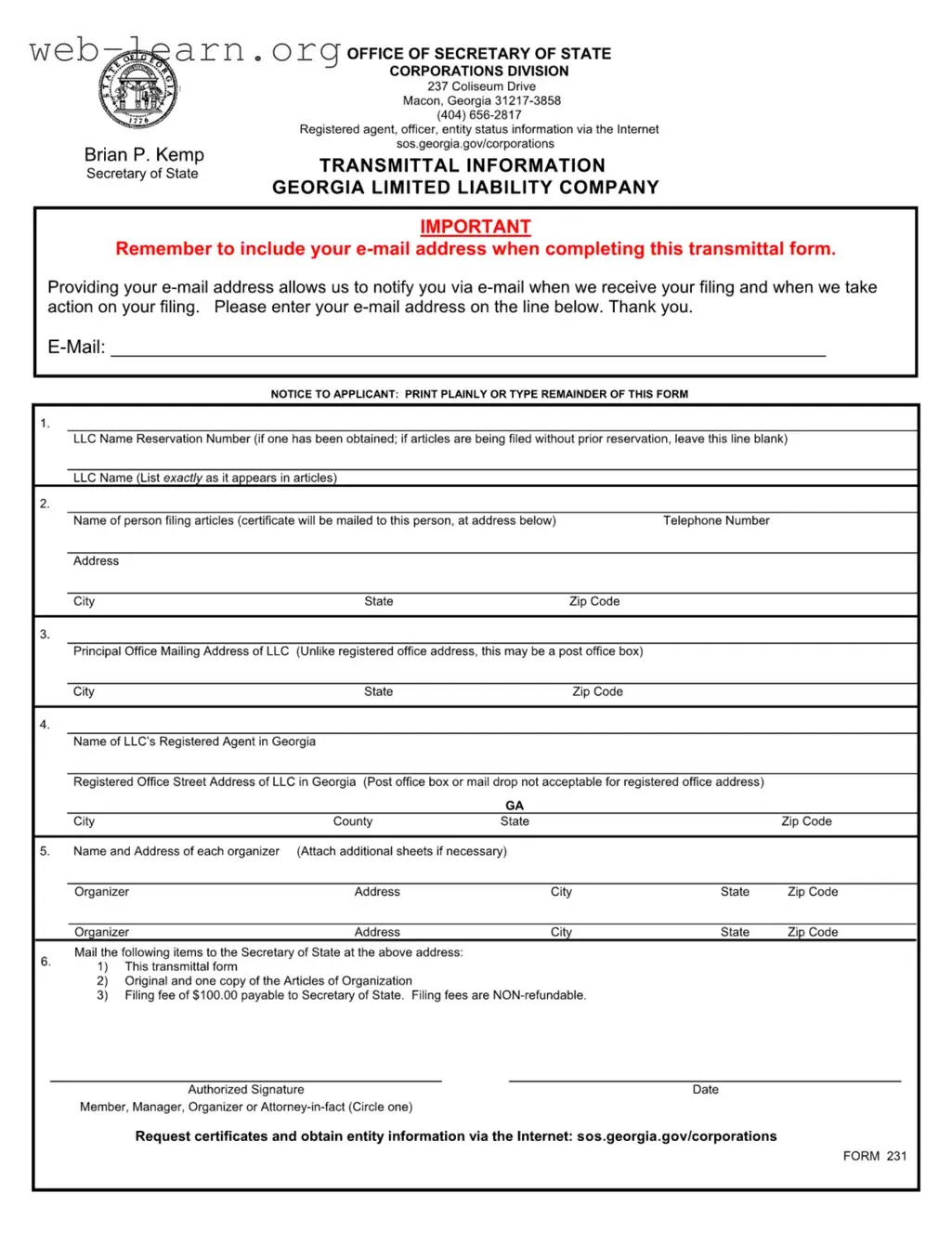
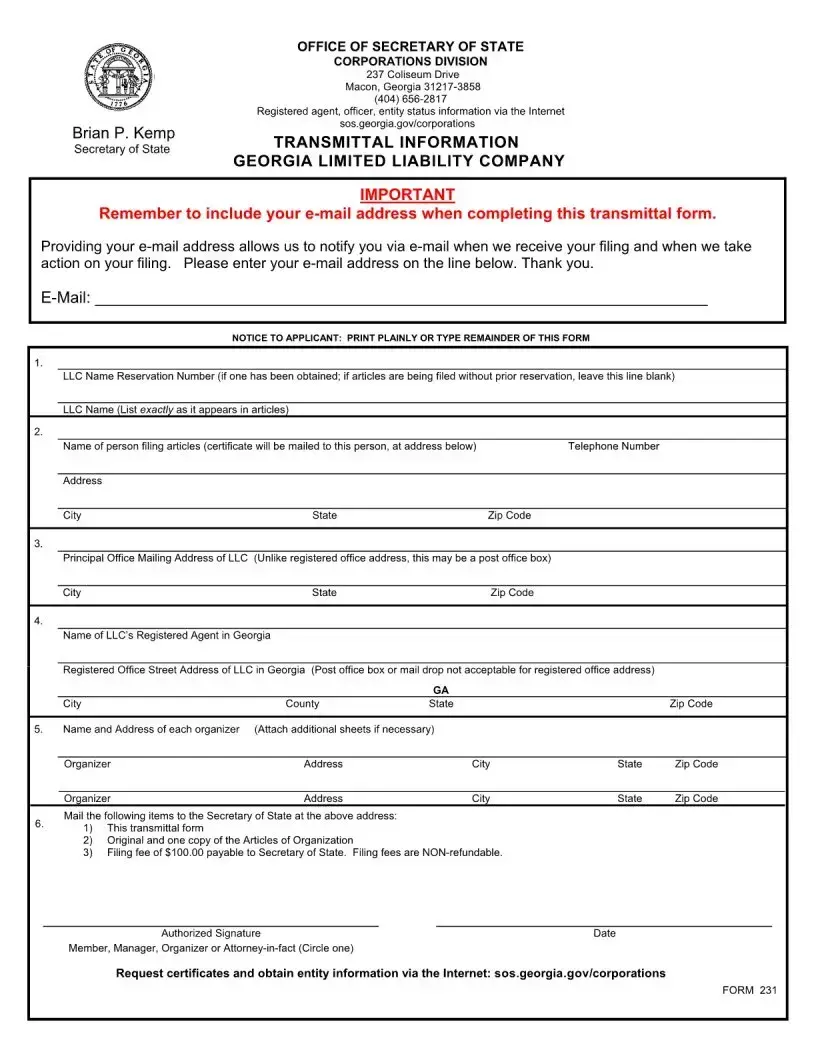
The Georgia 231 form is a crucial document for anyone looking to establish a Limited Liability Company (LLC) in the state of Georgia. This form facilitates the filing process by gathering essential information about the LLC, such as its name, registered agent, and principal office address. When completing the form, it is important to provide a valid email address, as this allows the Secretary of State's office to communicate updates regarding the filing status. The form requires details like the LLC name reservation number, if applicable, and the contact information of the person filing the articles. Additionally, it specifies the registered office address, which must be a physical location in Georgia and cannot be a P.O. box. Organizers must also be listed, ensuring that all parties involved are properly identified. To complete the filing, the form must be submitted along with the Articles of Organization and a non-refundable filing fee of $100. This straightforward process, while requiring attention to detail, ultimately paves the way for the formation of a legally recognized business entity in Georgia.
Sample - Georgia 231 Form

Form Information

Fact Name Details
Form Purpose The Georgia 231 form is used for filing Articles of Organization for a Limited Liability Company (LLC).
Filing Fee A filing fee of $100.00 is required. This fee is non-refundable.
Email Notification Applicants are encouraged to provide an email address to receive notifications regarding their filing status.
Registered Agent Requirement An LLC must designate a registered agent in Georgia. This agent must have a physical address in the state.
Principal Office Address The principal office mailing address can include a post office box, unlike the registered office address.
Organizer Information Each organizer's name and address must be provided. Additional sheets may be attached if necessary.
Governing Law This form is governed by the Georgia Limited Liability Company Act (O.C.G.A. § 14-11-101 et seq.).

Detailed Guide for Filling Out Georgia 231

After completing the Georgia 231 form, you will need to submit it along with the necessary documents and payment to the Secretary of State. Make sure to double-check all information for accuracy before sending it off.

  1. Enter your E-Mail address on the designated line. This allows for notifications regarding your filing.
  2. Fill in the LLC Name Reservation Number if applicable. If not, leave this line blank.
  3. Provide the LLC Name exactly as it appears in the articles.
  4. Complete the section for the Name of person filing articles. This is the person who will receive the certificate.
  5. Fill in the Address, Telephone Number, City, State, and Zip Code for the person filing.
  6. Provide the Principal Office Mailing Address of the LLC. A P.O. Box is acceptable here.
  7. Fill in the Name of LLC’s Registered Agent in Georgia.
  8. Complete the Registered Office Street Address of the LLC in Georgia. A P.O. Box is not acceptable.
  9. Provide the City, County, State, and Zip Code for the registered office address.
  10. List the Name and Address of each organizer. Attach additional sheets if necessary.
  11. Sign the form, indicating your status as Member, Manager, Organizer, or Attorney-in-fact. Circle one.
  12. Enter the Date of signing.

Mail the completed form along with the original and one copy of the Articles of Organization and a filing fee of $100.00 payable to the Secretary of State.

Obtain Answers on Georgia 231

  1. What is the Georgia 231 form?

    The Georgia 231 form is a transmittal form used for filing Articles of Organization for a Limited Liability Company (LLC) in Georgia. This form helps ensure that all necessary information is submitted correctly to the Secretary of State's office.

  2. Who needs to fill out the Georgia 231 form?

    Anyone looking to establish a Limited Liability Company in Georgia must complete this form. This includes individuals or groups who want to create a new LLC or file articles without a prior name reservation.

  3. What information is required on the form?

    • LLC name and reservation number (if applicable)
    • Name and address of the person filing the articles
    • Principal office mailing address of the LLC
    • Name and address of the registered agent in Georgia
    • Registered office street address
    • Name and address of each organizer
  4. How do I submit the Georgia 231 form?

    You must mail the completed form along with the original and one copy of the Articles of Organization and a filing fee of $100. The fee is payable to the Secretary of State. Remember, filing fees are non-refundable.

  5. What is the filing fee for the Georgia 231 form?

    The filing fee is $100. This fee must be included with your submission of the Georgia 231 form and the Articles of Organization.

  6. Can I use a post office box for the registered office address?

    No, you cannot use a post office box for the registered office address. The registered office must have a physical street address in Georgia.

  7. What happens after I submit the Georgia 231 form?

    Once you submit the form, you will receive a notification via email regarding the status of your filing. The Secretary of State will process your submission and mail the certificate to the address provided on the form.

  8. Is there a way to check the status of my filing?

    Yes, you can check the status of your filing online. Visit the Secretary of State's website at sos.georgia.gov/corporations for more information and to obtain entity information.

  9. What if I need to make changes after submitting the form?

    If you need to make changes after submitting, you may need to file an amendment. It's best to consult the Secretary of State's office for guidance on the process and any required forms.

Common mistakes

Filling out the Georgia 231 form can be a straightforward process, but many people still stumble on certain details. One common mistake is neglecting to provide a valid e-mail address. This address is essential because it allows the Secretary of State’s office to communicate updates regarding the status of your filing. Without it, applicants may miss important notifications.

Another frequent error involves the LLC name. It’s crucial to list the LLC name exactly as it appears in the articles. Some applicants mistakenly alter the name or use abbreviations that are not officially recognized. This discrepancy can lead to delays or even rejection of the application.

Additionally, many individuals forget to include the name of the registered agent. This agent serves as the official point of contact for legal documents and must be a resident of Georgia or a business entity authorized to conduct business in the state. Omitting this information can complicate matters down the line.

Addressing the principal office is another area where mistakes commonly occur. Some applicants mistakenly provide a post office box instead of a physical address. The form specifically states that a post office box is not acceptable for the registered office address, which can result in the application being returned for correction.

When it comes to listing the organizers, many forget to include complete information. Each organizer's name and address must be clearly stated, and if there are more organizers than space allows, additional sheets should be attached. Failing to do so can lead to incomplete submissions.

Lastly, applicants often overlook the payment details. The filing fee of $100 must be included, and it should be made out to the Secretary of State. Remember, this fee is non-refundable, so it’s essential to ensure that all other parts of the form are correct before submitting your payment.

Documents used along the form

The Georgia 231 form is essential for establishing a Limited Liability Company (LLC) in Georgia. However, several other documents and forms are often used in conjunction with it to ensure compliance and proper setup of the business. Below is a list of these important documents.

  • Articles of Organization: This document officially creates the LLC and outlines essential details such as the business name, registered agent, and management structure.
  • Operating Agreement: Although not required by law, this internal document defines the management structure and operating procedures of the LLC, helping to prevent disputes among members.
  • Registered Agent Consent Form: This form confirms that the registered agent has agreed to serve in this capacity, ensuring that the LLC has a designated point of contact for legal matters.
  • Certificate of Existence: This document verifies that the LLC is legally registered and in good standing with the state, often required for opening bank accounts or securing loans.
  • Business License Application: Depending on the type of business and location, this application may be necessary to operate legally within the city or county.
  • Employer Identification Number (EIN) Application: This form is submitted to the IRS to obtain an EIN, which is necessary for tax purposes and hiring employees.
  • Annual Registration: This document must be filed each year to maintain the LLC’s active status with the Secretary of State, ensuring compliance with state regulations.
  • Amendment Form: If any changes occur in the LLC's structure or information, this form updates the Secretary of State about those changes.
  • Foreign LLC Registration: If the LLC plans to operate in states outside Georgia, this form registers the business in those additional states.
  • Statement of Information: This form provides updated information about the LLC, including its address and registered agent, and may be required periodically by the state.

Using these documents alongside the Georgia 231 form helps ensure that your LLC is set up correctly and remains compliant with state laws. Proper documentation can save time and prevent issues in the future.

Similar forms

The Georgia 231 form, used for filing Articles of Organization for a Limited Liability Company (LLC), shares similarities with several other legal documents. Each of these documents serves a purpose in the formation and maintenance of business entities. Here’s a list of ten documents that are comparable to the Georgia 231 form:

  • Articles of Incorporation: Similar to the Georgia 231 form, this document is filed to establish a corporation. It includes essential information about the corporation, such as its name, purpose, and registered agent.
  • Certificate of Formation: This document is another term for Articles of Organization in some states. It outlines the basic details of the LLC and is required for official registration.
  • Operating Agreement: While not always required, this document outlines the management structure and operating procedures of the LLC, similar to how the Georgia 231 form establishes the entity’s framework.
  • Statement of Information: Many states require this document to update the state on key information about the business, akin to the details requested in the Georgia 231 form.
  • Bylaws: For corporations, bylaws serve a similar function to an operating agreement for LLCs. They govern the internal management of the corporation, much like how the Georgia 231 form outlines the LLC’s structure.
  • Business License Application: This document is necessary for legally operating a business. It requires similar information to the Georgia 231 form, such as the business name and address.
  • Registered Agent Designation: Like the registered agent information required in the Georgia 231 form, this document officially designates an individual or business to receive legal documents on behalf of the LLC.
  • Foreign LLC Registration: If an LLC wants to operate in a state other than where it was formed, it must file this document. It includes similar information to the Georgia 231 form regarding the LLC’s details.
  • Annual Report: Many states require LLCs to file an annual report, which updates the state on the business’s status and may include similar information found in the Georgia 231 form.
  • Certificate of Good Standing: This document verifies that an LLC is compliant with state regulations. It often requires the same foundational information as the Georgia 231 form to confirm the entity’s status.

Dos and Don'ts

When filling out the Georgia 231 form, there are several important dos and don'ts to keep in mind. Following these guidelines can help ensure a smooth filing process.

  • Do include your e-mail address on the form. This allows for timely notifications regarding your filing.
  • Do print plainly or type the information clearly. Legibility is crucial for processing.
  • Do provide the exact name of the LLC as it appears in the articles. Any discrepancies can lead to delays.
  • Do ensure that the registered office address is not a post office box. A physical address is required.
  • Don't forget to include the filing fee of $100.00. This fee is non-refundable.
  • Don't leave the LLC Name Reservation Number blank if one has been obtained. Include it to avoid confusion.
  • Don't forget to sign the form. An unsigned form may be rejected.
  • Don't submit additional documents without checking if they are necessary. Only include what is required to avoid complications.

Misconceptions

Understanding the Georgia 231 form can be challenging, and several misconceptions often arise. Here are seven common misunderstandings about this important document:

  • It’s only for new LLCs. Many believe the Georgia 231 form is exclusively for newly formed Limited Liability Companies (LLCs). In reality, this form can also be used for existing LLCs that need to update their information or file amendments.
  • Filing is optional. Some people think that submitting the Georgia 231 form is optional. However, if you want to officially register or update your LLC’s information, completing this form is a necessary step.
  • Only the registered agent needs to be listed. A common misconception is that only the registered agent's name and address are required. In fact, the form requires detailed information about the LLC, including the names and addresses of all organizers.
  • The filing fee is refundable. Many assume that the $100 filing fee for the Georgia 231 form is refundable if the application is rejected. Unfortunately, this fee is non-refundable, regardless of the outcome.
  • Email address is optional. Some individuals think that providing an email address on the form is optional. In truth, including your email allows the Secretary of State’s office to notify you about the status of your filing, which can be very helpful.
  • A post office box is acceptable for the registered office address. There is a misconception that using a post office box for the registered office address is permissible. However, the form specifically states that a physical street address is required.
  • Only one copy of the Articles of Organization is needed. Many believe that submitting just the original Articles of Organization is sufficient. However, the Georgia 231 form requires both the original and one copy to be submitted for processing.

By clarifying these misconceptions, individuals can better navigate the process of filing the Georgia 231 form and ensure their LLC is properly registered and compliant with state requirements.

Key takeaways

Filling out and using the Georgia 231 form is essential for establishing a Limited Liability Company (LLC) in Georgia. Here are key takeaways to consider:

  • Email Address Requirement: Always include your email address on the form. This allows the Secretary of State to notify you about the status of your filing.
  • Accurate LLC Name: Ensure that the LLC name is listed exactly as it appears in the articles. Any discrepancies may lead to delays or rejections.
  • Registered Agent Information: Provide the name and address of the registered agent in Georgia. This address cannot be a post office box.
  • Principal Office Address: The principal office mailing address may include a post office box, unlike the registered office address.
  • Filing Fee: A filing fee of $100.00 is required. This fee is non-refundable, so ensure all information is correct before submission.
  • Documentation Submission: Submit the completed transmittal form along with the original and one copy of the Articles of Organization to the Secretary of State.