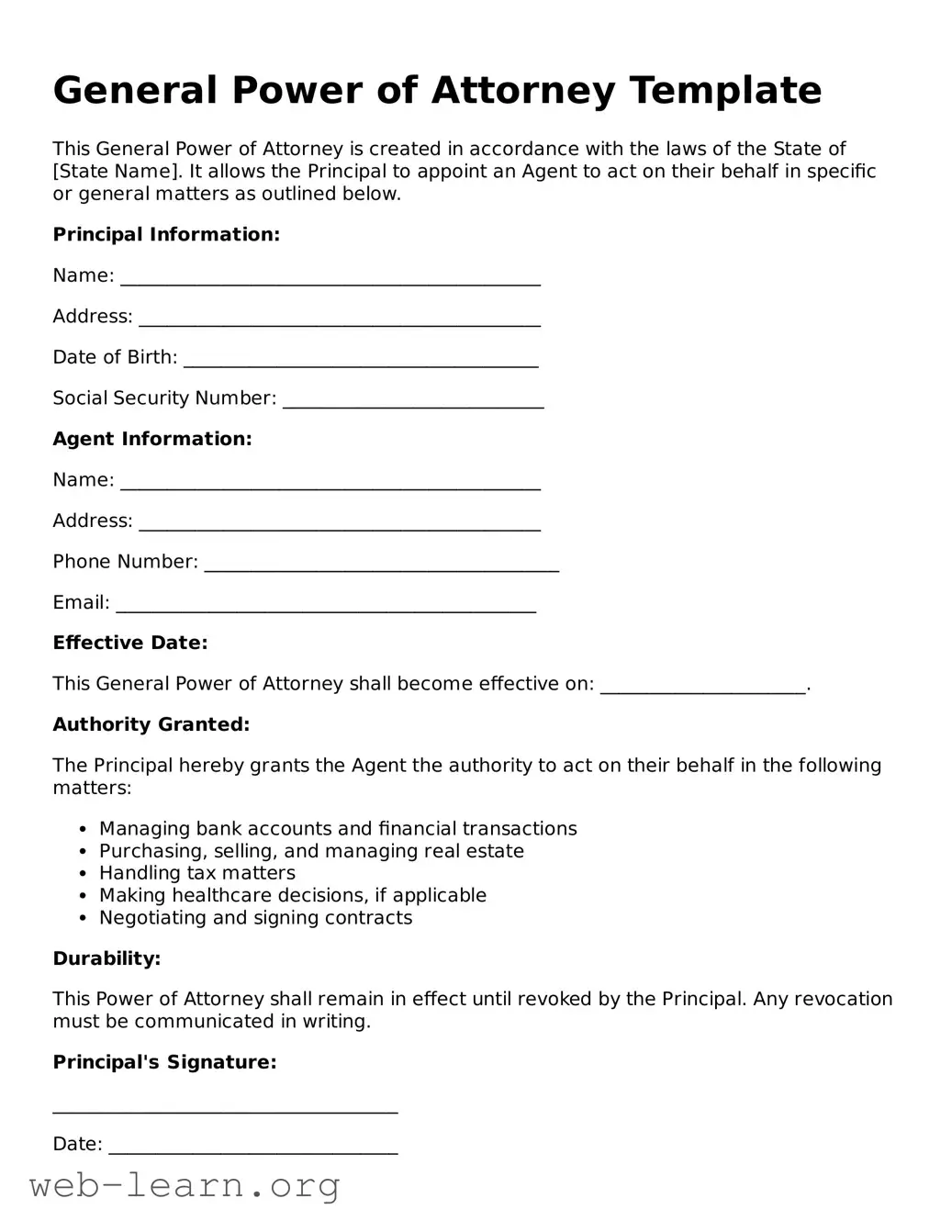
The General Power of Attorney form serves as a vital tool in personal and financial management, empowering an individual to appoint another person to make decisions on their behalf. This document is particularly important for those who may become incapacitated or for individuals looking to delegate their responsibilities due to travel or other commitments. A key aspect of this form is its flexibility; it allows the appointed agent, also known as the attorney-in-fact, to handle a wide range of matters including but not limited to financial transactions, real estate dealings, and legal issues. By clearly outlining the scope of authority, it provides both the principal and the agent with a sense of security and clarity. While the form typically remains in effect until revoked or until the principal's death, it can also be tailored to terminate after a specific transaction is completed. Understanding the nuances of the General Power of Attorney form is crucial, as it plays a significant role in one's estate planning and can greatly impact the management of assets and responsibilities. Such knowledge ensures that individuals can make informed choices about their wishes and protect their interests when they are unable to do so themselves.
General Power of Attorney Template
This General Power of Attorney is created in accordance with the laws of the State of [State Name]. It allows the Principal to appoint an Agent to act on their behalf in specific or general matters as outlined below.
Principal Information:
Name: _____________________________________________
Address: ___________________________________________
Date of Birth: ______________________________________
Social Security Number: ____________________________
Agent Information:
Name: _____________________________________________
Address: ___________________________________________
Phone Number: ______________________________________
Email: _____________________________________________
Effective Date:
This General Power of Attorney shall become effective on: ______________________.
Authority Granted:
The Principal hereby grants the Agent the authority to act on their behalf in the following matters:
Durability:
This Power of Attorney shall remain in effect until revoked by the Principal. Any revocation must be communicated in writing.
Principal's Signature:
_____________________________________
Date: _______________________________
Witness Signatures (if required by state law):
Notarization (if required):
State of ________________
County of _______________
Subscribed and sworn to before me this ____ day of ___________, 20__.
______________________________________
Notary Public Signature
My Commission Expires: ______________
| Fact Name | Description |
|---|---|
| Definition | A General Power of Attorney grants a person the authority to act on behalf of another in legal and financial matters. |
| Scope of Authority | The authority is broad and can cover various transactions, including banking, real estate, and personal affairs. |
| Duties of Agent | The appointed agent must act in the best interest of the principal, maintaining transparency and accountability. |
| Durability | A General Power of Attorney can be made durable, meaning it remains effective even if the principal becomes incapacitated. |
| Revocation | The principal retains the right to revoke the General Power of Attorney at any time, as long as they are competent. |
| State-Specific Regulations | Each state has its own laws governing the creation and execution of a General Power of Attorney. For example, in California, the Uniform Power of Attorney Act applies. |
| Notarization | Most states require the General Power of Attorney to be notarized to ensure its validity. |
Filling out a General Power of Attorney form is a straightforward process that requires careful attention to detail. Once you've gathered the necessary information and documents, you can move forward with designating someone to handle your affairs. Follow these steps to ensure the form is completed correctly.
After completing the form, check state-specific requirements. Ensuring compliance with local laws is vital for validity. Depending on your circumstances, you may wish to consult an attorney to confirm everything is in order.
What is a General Power of Attorney?
A General Power of Attorney (GPOA) is a legal document that allows one person, known as the principal, to grant another person, known as the agent or attorney-in-fact, the authority to manage their financial and legal affairs. This authority can cover a wide range of responsibilities, including handling bank transactions, managing real estate, and making health care decisions.
Why might someone need a General Power of Attorney?
Individuals often seek a GPOA for various reasons. For instance, it can be useful when someone is unable to manage their own affairs due to illness, travel, or other commitments. This document ensures that someone trustworthy can step in and handle important matters without delays.
Who can serve as an agent under a General Power of Attorney?
The agent can be a trusted family member, friend, or professional such as an attorney or accountant. It is important that the individual chosen is reliable and capable of making decisions in the principal's best interest. Some states may have specific requirements regarding who can be appointed as an agent.
What powers can be granted in a General Power of Attorney?
The principal can grant a wide range of powers in a GPOA. These may include:
However, the principal can specify any limitations or powers they wish to include in the document.
Is a General Power of Attorney revocable?
Yes, a General Power of Attorney can be revoked by the principal at any time, as long as they are competent to do so. The revocation should be documented and communicated to the agent, as well as any institutions relying on the GPOA.
What happens if the principal becomes incapacitated?
If the principal becomes incapacitated, a GPOA may remain effective depending on its specific language. However, many people opt to use a Durable Power of Attorney, which remains in effect even if the principal can no longer make decisions.
Do I need to notarize the General Power of Attorney?
Many states require that a General Power of Attorney document be notarized to be considered valid. Some also require witnesses. It is advisable to check your state’s requirements to ensure proper execution.
Can I get a General Power of Attorney template online?
Yes, there are many templates available online for a General Power of Attorney. However, it is recommended to ensure that any template complies with your state’s laws and addresses your specific needs. Consulting with a legal professional can help confirm that the document is appropriate and valid.
What should I consider before signing a General Power of Attorney?
Before signing a GPOA, consider the following:
Taking the time to understand these factors can help you make informed decisions and ensure your interests are protected.
When filling out a General Power of Attorney (GPOA) form, people often overlook important details that could impact their intentions or the authority granted to their agent. One common mistake is not clearly defining the powers being granted. While it's tempting to keep it simple, being too vague can lead to confusion. Specificity is key. When you clarify the exact powers your agent will have, you ensure they can act on your behalf as intended without any hitches.
Another prevalent error involves failing to consider the agent's qualifications. Trust is essential when selecting someone to manage your affairs, but that doesn't always mean a close friend or family member is the best choice. Evaluating their financial acumen and understanding of your preferences will help ensure your interests are adequately represented.
Many individuals neglect to date their GPOA form, which can lead to complications or challenges later on. A dated document provides clear evidence of when the authority was granted. Without a date, it might become difficult to determine its validity, especially if disputes arise among family members or other parties.
People also often forget that power of attorney is not a one-size-fits-all document. Some mistakenly attempt to use a GPOA for a specific purpose when a different type of power of attorney might be more appropriate. For example, a durable power of attorney is ideal for health-related decisions if you become incapacitated. Always assess your needs and pick the right type of power of attorney.
Another serious oversight is neglecting to discuss the arrangement with the appointed agent. It is crucial that the individual you choose understands the responsibilities they will assume. A lack of dialogue can lead to frustration and miscommunication when it matters most. An open discussion ensures your agent feels prepared to handle the responsibilities entrusted to them.
Many forms are often completed without a witness signature or notarization when required. Both witnessing and notarization serve to validate the document, providing an extra layer of authenticity. Failing to secure these can leave your power of attorney open to challenges in the future. Always check the state-specific requirements to ensure your form is executed correctly.
Finally, individuals frequently ignore the importance of maintaining copies of their GPOA. After the form is filled out and signed, keeping a record of it is essential for ensuring that both you and your agent have a copy readily available. This step helps prevent confusion and ensures the document can be referenced easily, facilitating smoother transactions when the need arises.
A General Power of Attorney (POA) is a vital document that allows one person to make decisions on behalf of another. However, several other forms and documents often complement it, providing clarity and additional legal authority in various situations. Below is a list of other common governmental and legal documents frequently associated with a General Power of Attorney.
Understanding these complementary documents is essential for anyone considering a General Power of Attorney. Each plays a unique role in ensuring that interests are protected and wishes are honored. Having these documents in place not only facilitates smoother legal and financial management but also provides peace of mind.
When filling out a General Power of Attorney form, caution is key. Here are some important do's and don'ts to keep in mind:
The General Power of Attorney form is often misunderstood. Here are seven common misconceptions surrounding it:
Filling out and using a General Power of Attorney (POA) form can be a straightforward process, but it’s crucial to understand its implications. Here are some key takeaways to keep in mind:
By keeping these takeaways in mind, you can navigate the process of setting up a General Power of Attorney with confidence.
Michigan Sales Tax Nexus - Applicants must include their U.S. DOT Number on the form.
Usda 7001 - It must be signed by a veterinarian within 10 days of travel.
Cr180 Form - Applicants must provide their full name and date of birth on the form.