Homepage Blank Gao W 9 Arizona Form
Outline

The GAO W-9 Arizona form serves as a critical tool for individuals and entities engaging in business with the State of Arizona. This form, officially titled the Substitute W-9: Request for Taxpayer Identification Number and Certification, is essential for collecting accurate taxpayer identification information. When submitting this form, users must indicate the type of request, whether it be a new application or a change in location. Additionally, the form requires the Taxpayer Identification Number (TIN) or Social Security Number (SSN), along with the legal name of the entity as recorded by the IRS or Social Security Administration. The form also includes sections for identifying the entity type, minority business status, and veteran-owned status, which can impact eligibility for certain programs and contracts. Furthermore, it allows for the designation of mailing addresses and contact information, ensuring that all communications are directed appropriately. Importantly, the form contains a certification section where the signer confirms the accuracy of the provided information and their exemption status regarding backup withholding and FATCA reporting. Overall, the GAO W-9 Arizona form is not just a bureaucratic requirement; it plays a vital role in facilitating smooth transactions between vendors and the state, while ensuring compliance with federal tax regulations.

Sample - Gao W 9 Arizona Form

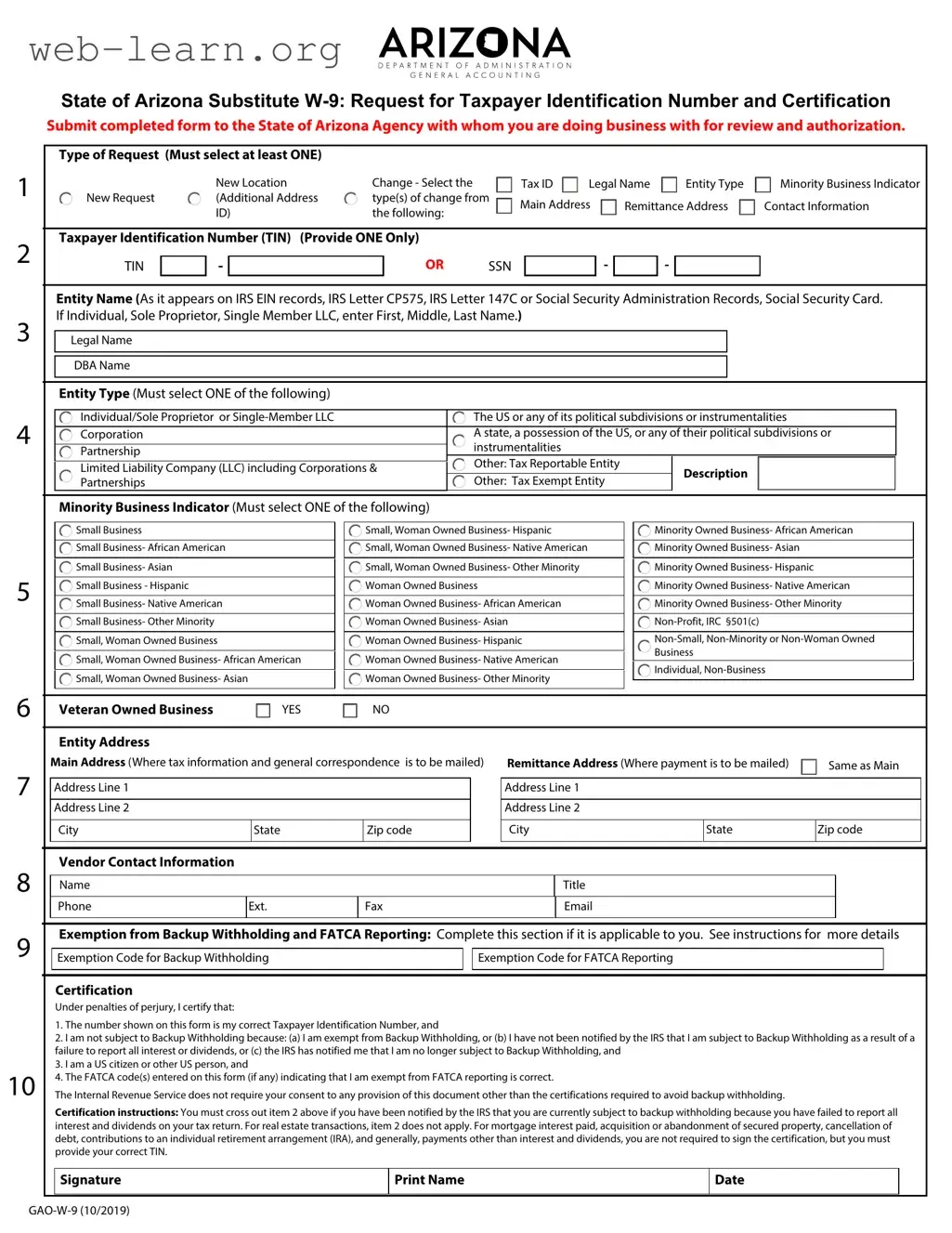
State of Arizona Substitute W-9: Request for Taxpayer Identification Number and Certification
Submit completed form to the State of Arizona Agency with whom you are doing business with for review and authorization.
1
Type of Request (Must select at least ONE)
Change - Select the
type(s) of change from
the following:
New Location
(Additional Address
ID)
New Request
Tax ID Legal Name Entity Type Minority Business Indicator
Main Address
Remittance Address Contact Information
2
Taxpayer Identification Number (TIN) (Provide ONE Only)
TIN
-
OR
SSN
- -
3
Entity Name (As it appears on IRS EIN records, IRS Letter CP575, IRS Letter 147C or Social Security Administration Records, Social Security Card.
If Individual, Sole Proprietor, Single Member LLC, enter First, Middle, Last Name.)
Legal Name
DBA Name
4
Entity Type (Must select ONE of the following)
Individual/Sole Proprietor or Single-Member LLC
Corporation
Partnership
Limited Liability Company (LLC) including Corporations &
Partnerships
The US or any of its political subdivisions or instrumentalities
A state, a possession of the US, or any of their political subdivisions or
instrumentalities
Other: Tax Reportable Entity
Other: Tax Exempt Entity
Description
5
Minority Business Indicator (Must select ONE of the following)
Small Business
Small Business- African American
Small Business- Asian
Small Business - Hispanic
Small Business- Native American
Small Business- Other Minority
Small, Woman Owned Business
Small, Woman Owned Business- African American
Small, Woman Owned Business- Asian
Small, Woman Owned Business- Hispanic
Small, Woman Owned Business- Native American
Small, Woman Owned Business- Other Minority
Woman Owned Business
Woman Owned Business- African American
Woman Owned Business- Asian
Woman Owned Business- Hispanic
Woman Owned Business- Native American
Woman Owned Business- Other Minority
Minority Owned Business- African American
Minority Owned Business- Asian
Minority Owned Business- Hispanic
Minority Owned Business- Native American
Minority Owned Business- Other Minority
Non-Profit, IRC §501(c)
Non-Small, Non-Minority or Non-Woman Owned
Business
Individual, Non-Business
6
Veteran Owned Business
NOYES
7
Entity Address
Main Address (Where tax information and general correspondence is to be mailed)
Address Line 1
Address Line 2
City State Zip code
Remittance Address (Where payment is to be mailed)
Same as Main
Address Line 1
Address Line 2
City State Zip code
8
Vendor Contact Information
Name Title
Phone Ext. Fax Email
9
Exemption from Backup Withholding and FATCA Reporting: Complete this section if it is applicable to you. See instructions for more details
Exemption Code for Backup Withholding Exemption Code for FATCA Reporting
10
Certification
Under penalties of perjury, I certify that:
1. The number shown on this form is my correct Taxpayer Identification Number, and
2. I am not subject to Backup Withholding because: (a) I am exempt from Backup Withholding, or (b) I have not been notified by the IRS that I am subject to Backup Withholding as a result of a
failure to report all interest or dividends, or (c) the IRS has notified me that I am no longer subject to Backup Withholding, and
3. I am a US citizen or other US person, and
4. The FATCA code(s) entered on this form (if any) indicating that I am exempt from FATCA reporting is correct.
The Internal Revenue Service does not require your consent to any provision of this document other than the certifications required to avoid backup withholding.
Certification instructions: You must cross out item 2 above if you have been notified by the IRS that you are currently subject to backup withholding because you have failed to report all
interest and dividends on your tax return. For real estate transactions, item 2 does not apply. For mortgage interest paid, acquisition or abandonment of secured property, cancellation of
debt, contributions to an individual retirement arrangement (IRA), and generally, payments other than interest and dividends, you are not required to sign the certification, but you must
provide your correct TIN.
Signature Print Name Date
GAO-W-9 (10/2019)
The State of Arizona Substitute W-9 Form Instructions
The State of Arizona (State), like all organizations that file an information return with the IRS, must obtain your correct
Taxpayer Identification Number (TIN) to report income paid to you or your organization. The State uses the Substitute W-9
Form to obtain certification of your TIN in order to ensure accuracy of information contained in its payee/vendor system and
to avoid Backup Withholding as mandated by the IRS. According to IRS regulations, the State must withhold 28% of all
payments if a vendor/payee fails to provide the State its certified TIN. The Substitute Form W-9 certifies a vendor/payee's TIN.
Any vendor/payee who wishes to do business with the State must complete the Substitute W-9 Form.
Part 1 - Type of Request: Select only one.
Part 2 - Taxpayer Identification Number (TIN): Enter your nine-digit TIN. The TIN is either your nine-digit Social Security
Number (SSN) assigned by the Social Security Administration (SSA) or Employer Identification Number (EIN) assigned by the
Internal Revenue Service (IRS).
Part 3 - Entity Name: Enter the legal name as it appears on IRS EIN records, IRS Letter CP575, IRS Letter 147C or Social Security
Administration Records, Social Security Card. If Individual, Sole Proprietor, Single Member LLC, enter First, Middle, Last Name.
Enter your DBA in the designated line if applicable.
Part 4 - Entity Type: Select only one for TIN given.
Part 5 - Minority Business Indicator: Select only one for TIN given.
Part 6 - Veteran Owned Business: Select only one for TIN given.
Part 7 - Entity Address: List the locations for tax reporting purposes and where payments should be mailed.
Part 8 - Entity Contact Information: List the contact information.
Part 9 - Backup Withholding and FATCA Exemptions: If you are exempt from Backup Withholding and/or FATCA reporting,
enter in the Exemptions box, any code(s) that may apply to you.
Backup Withholding Exemption Codes: Generally, Individuals (including Sole Proprietors) are not exempt from Backup Withholding. Additionally, Corporations
are not exempt from Backup Withholding when supplying legal or medical services. If you do not fall under the categories below, leave this field blank. The
following codes identify payees that are exempt from Backup Withholding:
Code 1: An organization exempt from tax under section 501(a), any IRA, or a custodial account under section 403(b) (7) if the account satisfies the requirements of
section 401(f) (2)
Code 2: The United States or any of its agencies or instrumentalities
Code 3: A state, the District of Columbia, a possession of the United States, or any of their political subdivisions or Instrumentalities
Code 4: A foreign government or any of its political subdivisions, agencies, or instrumentalities
Code 5: A corporation
Code 6: A dealer in securities or commodities required to register in the United States, the District of Columbia, or a possession of the United States Code 7: A
futures commission merchant registered with the Commodity Futures Trading Commission
Code 8: A real estate investment trust
Code 9: An entity registered at all times during the tax year under the Investment Company Act of 1940
Code 10: A common trust fund operated by a bank under section 584(a)
Code 11: A financial institution
Code 12: A middleman known in the investment community as a nominee or custodian
Code 13: A trust exempt from tax under section 664 or described in section 4947
FATCA Exemption Codes: The following codes identify payees that are exempt from reporting under FATCA. These codes apply to persons submitting this form
for accounts maintained outside of the United States by certain foreign financial institutions. If you are only submitting this form for an account you hold in the
United States, leave this field blank. The following codes identify payees that are exempt from FATCA Reporting:
Code A: An organization exempt from tax under section 501(a) or any individual retirement plan as defined in section 7701(a) (37)
Code B: The United States or any of its agencies or instrumentalities
Code C: A state, the District of Columbia, a possession of the United States, or any of their political subdivisions or instrumentalities
Code D: A corporation the stock of which is regularly traded on one or more established securities markets, as described in Reg. section 1.1472-1(c)(1)(i)
Code E: A corporation that is a member of the same expanded affiliated group as a corporation described in Reg. section 1.1472-1(c) (1) (i)
Code F: A dealer in securities, commodities, or derivative financial instruments (including notional principal contracts, futures, forwards, and options) that is
registered as such under the laws of the United States or any state
Code G: A real estate investment trust
Code H: A regulated investment company as defined in section 851 or an entity registered at all times during the tax year under the Investment Company Act of
1940
Code I: A common trust fund as defined in section 584(a)
Code J: A bank as defined in section 581 Code K: A broker
Code L: A trust exempt from tax under section 664 or described in section 4947(a) (1)
Code M: A tax-exempt trust under a section 403(b) plan or section 457(g) plan
Part 10 - Certification: Please sign, date and provide preparer's name in appropriate space.
GAO-W-9 (10/2019)

Form Information

Fact Name Description
Form Purpose The Gao W-9 form is used to request a taxpayer identification number and certification for the State of Arizona.
Submission Instructions Completed forms must be submitted to the Arizona agency with which the individual or entity is conducting business.
Entity Types Applicants must select their entity type, which includes options like Individual, Corporation, Partnership, and more.
Minority Business Indicator Applicants are required to select a minority business indicator, which reflects their business's ownership status.
Backup Withholding Failure to provide a certified TIN may result in a 28% backup withholding on payments made to the vendor or payee.
Exemption Codes The form includes sections for exemption codes related to backup withholding and FATCA reporting.
Governing Law The form is governed by IRS regulations and Arizona state law, ensuring compliance with federal and state tax requirements.

Detailed Guide for Filling Out Gao W 9 Arizona

To complete the GAO W-9 Arizona form, follow the steps outlined below. Make sure to provide accurate information to avoid any issues with processing. Once the form is filled out, submit it to the appropriate State of Arizona agency for review and authorization.

  1. Type of Request: Select at least one option from the list provided.
  2. Taxpayer Identification Number (TIN): Enter your nine-digit TIN, which can be your Social Security Number (SSN) or Employer Identification Number (EIN).
  3. Entity Name: Provide the legal name as it appears on IRS records or Social Security documents. If applicable, include your Doing Business As (DBA) name.
  4. Entity Type: Select one option that corresponds to your TIN.
  5. Minority Business Indicator: Choose one option that reflects your business status.
  6. Veteran Owned Business: Indicate whether your business is veteran-owned by selecting yes or no.
  7. Entity Address: Fill in the main address where tax information and correspondence will be sent. Include the remittance address if different.
  8. Entity Contact Information: Provide the name, title, phone number, fax, and email of the contact person.
  9. Exemption from Backup Withholding and FATCA Reporting: If applicable, enter any exemption codes in the designated fields.
  10. Certification: Sign and date the form, and print your name in the appropriate section.

Obtain Answers on Gao W 9 Arizona

  1. What is the purpose of the GAO W-9 Arizona form?

    The GAO W-9 Arizona form serves as a request for your Taxpayer Identification Number (TIN) and certification. The State of Arizona requires this information to accurately report income paid to you or your organization. By completing this form, you help ensure that your information is correctly recorded in the state’s vendor system, which helps avoid potential issues with backup withholding as mandated by the IRS.

  2. Who needs to complete the GAO W-9 Arizona form?

    Any vendor or payee wishing to do business with the State of Arizona must complete the GAO W-9 form. This includes individuals, sole proprietors, corporations, partnerships, and other entities. If you are providing services or goods to a state agency, this form is essential for tax reporting purposes.

  3. What information is required on the form?

    The form requires several key pieces of information:

    • Your Taxpayer Identification Number (TIN), which can be your Social Security Number (SSN) or Employer Identification Number (EIN).
    • The legal name of your entity as it appears on IRS records.
    • The type of entity you are (e.g., individual, corporation, partnership).
    • Your business address and contact information.
    • Minority business status, if applicable.

    Completing each section accurately is crucial to avoid delays in processing your request.

  4. What happens if I do not provide my TIN?

    If you fail to provide your TIN, the State of Arizona is required by the IRS to withhold 28% of all payments made to you. This withholding is a precautionary measure to ensure compliance with tax reporting requirements. Therefore, it is in your best interest to complete the form accurately and submit it promptly.

  5. Can I be exempt from backup withholding?

    Yes, you may be exempt from backup withholding if you meet certain criteria. You will need to indicate your exemption status on the form by providing the appropriate exemption codes. For example, certain organizations, government entities, and financial institutions may qualify for exemption. However, most individuals and sole proprietors are generally not exempt. Be sure to review the instructions carefully to determine your eligibility.

Common mistakes

Filling out the Gao W-9 Arizona form can seem straightforward, but many people make common mistakes that can lead to delays or issues with their submissions. Here are seven frequent errors to avoid.

First, one of the most common mistakes is failing to select the correct type of request. The form requires you to indicate whether you are making a new request or changing an existing one. Skipping this step can result in confusion and may delay the processing of your information.

Another frequent error is providing an incorrect Taxpayer Identification Number (TIN). Ensure that you enter your nine-digit TIN accurately. This number can be your Social Security Number (SSN) or Employer Identification Number (EIN). Mistakes here can lead to significant tax complications.

Many individuals also overlook the importance of using the legal name as it appears on official documents. If you are an individual or a sole proprietor, you must enter your full name as recorded by the IRS or Social Security Administration. Failing to do so can cause mismatches in records.

In addition, some people mistakenly leave out their DBA name, if applicable. If you operate under a "Doing Business As" name, it's essential to include it on the form. This helps clarify your business identity and ensures proper correspondence.

Another common oversight is not selecting the appropriate entity type. The form has specific categories, and selecting the wrong one can lead to complications in how your information is processed. Make sure to read the options carefully and choose the one that accurately reflects your business structure.

People often forget to indicate their minority business status as well. This section is vital for ensuring that your business is recognized appropriately. It is important to select the correct indicator that applies to your situation.

Finally, many individuals neglect to sign and date the certification section. This step is crucial as it certifies that the information you provided is accurate. Without a signature, your form may be deemed incomplete, which could result in delays or issues with your application.

By being aware of these common mistakes, you can ensure that your Gao W-9 Arizona form is filled out correctly. Taking the time to review each section carefully can save you from potential headaches down the line.

Documents used along the form

The GAO W-9 Arizona form is a crucial document used by individuals and entities to provide their taxpayer identification information to the State of Arizona. Along with this form, several other documents may be required or useful in various business and tax-related contexts. Below is a list of additional forms and documents often associated with the GAO W-9 Arizona form.

  • Form 1099-MISC: This form is used to report miscellaneous income to the IRS. Businesses use it to report payments made to independent contractors, freelancers, and other non-employees.
  • Form 1040: This is the standard individual income tax return form used by U.S. taxpayers to report their income, calculate taxes owed, and claim refunds.
  • Form SS-4: This form is the application for an Employer Identification Number (EIN). Businesses use it to obtain a unique identifier for tax purposes.
  • Form 941: This is the employer’s quarterly federal tax return. Employers use it to report income taxes, Social Security tax, and Medicare tax withheld from employee wages.
  • Form W-2: Employers use this form to report wages paid to employees and the taxes withheld from them. Employees receive a copy to file with their tax returns.
  • Form 4506-T: This form allows taxpayers to request a transcript of their tax return from the IRS. It is often used for verification purposes when applying for loans or other financial assistance.
  • State Tax Registration Forms: Various states require businesses to register for state tax purposes. These forms ensure compliance with state tax laws and regulations.

These forms and documents serve various purposes, from tax reporting to compliance with federal and state regulations. Understanding their functions can aid individuals and businesses in navigating their financial responsibilities effectively.

Similar forms

  • IRS Form W-9: The IRS Form W-9 is used by individuals and entities to provide their Taxpayer Identification Number (TIN) to those who are required to file information returns with the IRS. Similar to the GAO W-9 Arizona form, it serves to certify the TIN and avoid backup withholding.
  • IRS Form W-8BEN: This form is used by foreign individuals to certify their foreign status and claim any applicable tax treaty benefits. Like the GAO W-9 Arizona form, it is used to provide identification information for tax purposes.
  • IRS Form 1099: The Form 1099 is used to report various types of income other than wages, salaries, and tips. While it is a reporting form rather than a request for information, it relies on the TIN provided through forms like the GAO W-9 Arizona form to accurately report income to the IRS.
  • IRS Form 1040: This is the standard individual income tax return form. It requires the taxpayer’s TIN, similar to the GAO W-9 Arizona form, to ensure accurate reporting of income and tax obligations.
  • State Tax Forms: Various state tax forms require similar information to the GAO W-9 Arizona form, such as the taxpayer's identification number and entity type, to ensure compliance with state tax regulations.
  • Business License Applications: Many jurisdictions require businesses to provide their TIN when applying for a business license. This is akin to the GAO W-9 Arizona form, which collects necessary identification information for business transactions.
  • Vendor Registration Forms: Companies often require vendors to complete registration forms that request TIN and entity information. This parallels the purpose of the GAO W-9 Arizona form in establishing vendor credentials.
  • Contractor Forms: Independent contractors may be asked to fill out forms similar to the GAO W-9 Arizona form to provide their TIN and certification, ensuring compliance with tax withholding requirements.
  • Non-Profit Organization Forms: Non-profits often need to submit forms that require their TIN and other identifying information for tax-exempt status, similar to the GAO W-9 Arizona form's purpose of confirming TIN for tax reporting.

Dos and Don'ts

When filling out the GAO W-9 Arizona form, it's essential to follow certain guidelines to ensure accuracy and compliance. Here are five things you should and shouldn't do:

  • Do: Ensure your Taxpayer Identification Number (TIN) is accurate and corresponds to your legal name as recognized by the IRS.
  • Do: Select only one type of request when completing the form to avoid confusion.
  • Do: Provide complete contact information, including your phone number and email address, for any follow-up communication.
  • Do: Review the certification section carefully before signing to confirm that all statements are true and accurate.
  • Do: Submit the completed form to the appropriate State of Arizona agency for processing.
  • Don't: Leave any required fields blank, as this can lead to delays or rejections of your form.
  • Don't: Use a nickname or abbreviated name; always use your full legal name as it appears on IRS records.
  • Don't: Forget to cross out item 2 in the certification if you are subject to backup withholding.
  • Don't: Provide more than one TIN; only include one TIN or SSN as instructed.
  • Don't: Submit the form without reviewing it for accuracy; errors can result in withholding or processing issues.

Misconceptions

  • Misconception 1: The Gao W-9 Arizona form is only for businesses.
  • This form is often misunderstood as being exclusively for companies or organizations. In reality, individuals can also use it. Sole proprietors and single-member LLCs, for example, must complete this form to provide their taxpayer identification number when doing business with the state.

  • Misconception 2: The form is optional for vendors.
  • Some believe that completing the Gao W-9 Arizona form is optional. However, any vendor or payee wishing to do business with the State of Arizona is required to submit this form. It ensures that the state has accurate tax information and helps avoid backup withholding.

  • Misconception 3: Only large businesses need to worry about backup withholding.
  • This misconception overlooks the fact that backup withholding can apply to any vendor or payee, regardless of size. If a vendor fails to provide a certified taxpayer identification number, the state may withhold 28% of payments, impacting both small and large businesses alike.

  • Misconception 4: The form is the same as the federal W-9 form.
  • While the Gao W-9 Arizona form serves a similar purpose to the federal W-9, it is tailored specifically for use within the state. It includes additional sections relevant to Arizona’s requirements, such as the Minority Business Indicator and Veteran Owned Business status, which are not found on the federal version.

Key takeaways

  • The Gao W-9 Arizona form is essential for individuals and entities conducting business with the State of Arizona. It is used to request your Taxpayer Identification Number (TIN) and certify its accuracy.

  • When filling out the form, you must select a Type of Request. This could be a new request, a location change, or an additional address type.

  • Ensure that you provide your correct Taxpayer Identification Number (TIN), which can be your Social Security Number (SSN) or Employer Identification Number (EIN).

  • It is important to enter your Entity Name exactly as it appears on IRS records. If you are an individual or sole proprietor, include your full name.

  • Indicate your Entity Type and select a Minority Business Indicator if applicable. This helps in categorizing your business for state reporting purposes.

  • Finally, sign and date the form to certify that the information provided is correct and that you are not subject to backup withholding.