Homepage Blank G 45 Hawaii Form
Outline

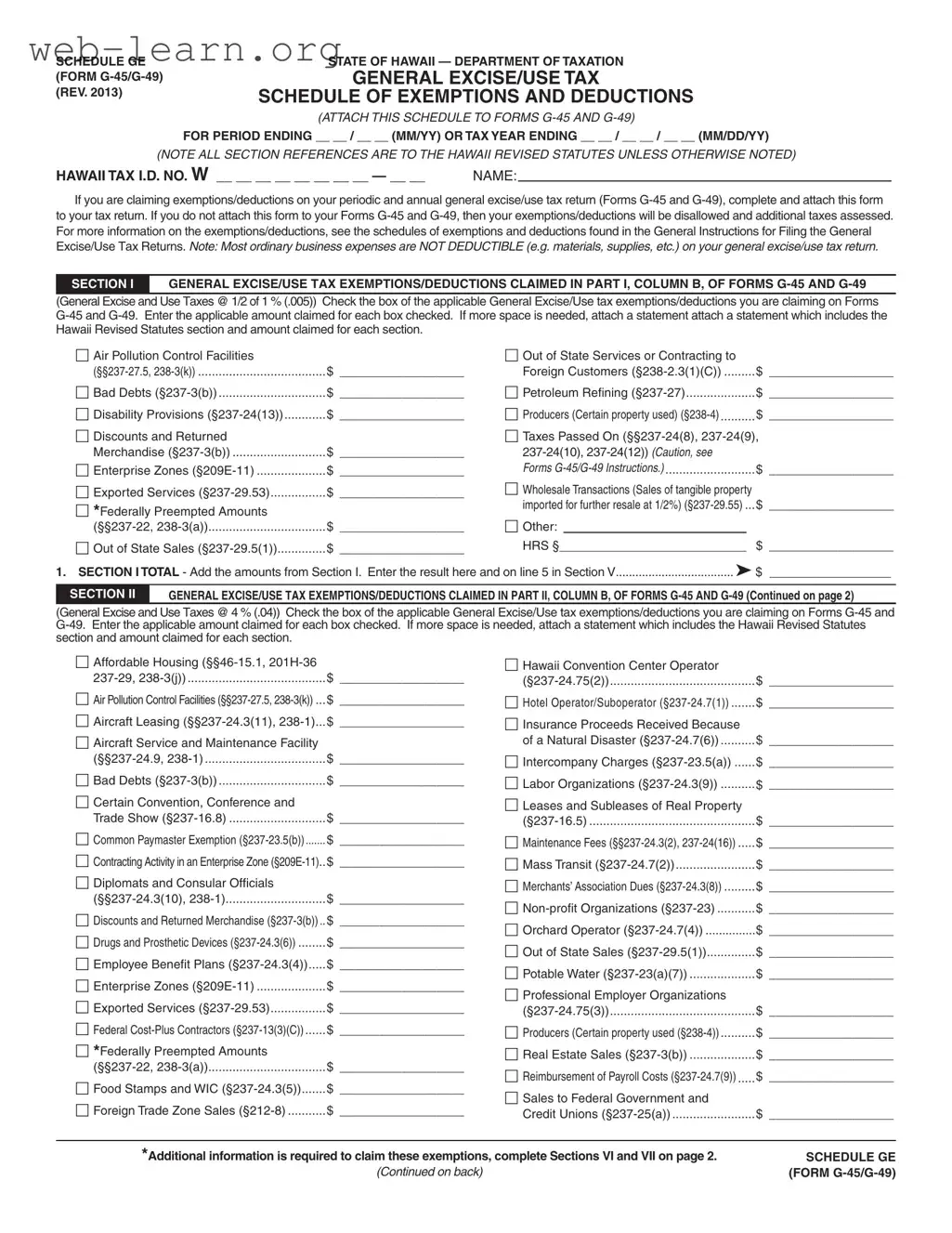
The G 45 Hawaii form serves as a crucial document for businesses operating in the state, particularly for those navigating the complexities of general excise and use tax obligations. This form is not merely a collection of numbers; it is a structured schedule that allows taxpayers to claim various exemptions and deductions that can significantly impact their tax liabilities. Each section of the form is meticulously designed to capture specific types of exemptions, ranging from air pollution control facilities to bad debts and exported services. Taxpayers must complete this form with precision, as failing to attach it to the periodic and annual returns—Forms G-45 and G-49—will result in the disallowance of claimed exemptions, leading to additional tax assessments. The form also outlines the importance of understanding which ordinary business expenses are not deductible under Hawaii law, thereby guiding taxpayers toward compliant and effective tax reporting. By providing detailed instructions and clear categories for exemptions, the G 45 Hawaii form aims to streamline the tax filing process while ensuring that businesses can take full advantage of the tax relief options available to them.
Sample - G 45 Hawaii Form

STATE OF HAWAII — DEPARTMENT OF TAXATION
GENERAL EXCISE/USE TAX
SCHEDULE OF EXEMPTIONS AND DEDUCTIONS
(ATTACH THIS SCHEDULE TO FORMS G-45 AND G-49)
FOR PERIOD ENDING __ __ / __ __ (MM/YY) OR TAX YEAR ENDING __ __ / __ __ / __ __ (MM/DD/YY)
(NOTE ALL SECTION REFERENCES ARE TO THE HAWAII REVISED STATUTES UNLESS OTHERWISE NOTED)
HAWAII TAX I.D. NO. W __ __ __ __ __ __ __ __ — __ __ NAME:
If you are claiming exemptions/deductions on your periodic and annual general excise/use tax return (Forms G-45 and G-49), complete and attach this form
to your tax return. If you do not attach this form to your Forms G-45 and G-49, then your exemptions/deductions will be disallowed and additional taxes assessed.
For more information on the exemptions/deductions, see the schedules of exemptions and deductions found in the General Instructions for Filing the General
Excise/Use Tax Returns. Note: Most ordinary business expenses are NOT DEDUCTIBLE (e.g. materials, supplies, etc.) on your general excise/use tax return.
GENERAL EXCISE/USE TAX EXEMPTIONS/DEDUCTIONS CLAIMED IN PART I, COLUMN B, OF FORMS G-45 AND G-49
(General Excise and Use Taxes @ 1/2 of 1 % (.005)) Check the box of the applicable General Excise/Use tax exemptions/deductions you are claiming on Forms
G-45 and G-49. Enter the applicable amount claimed for each box checked. If more space is needed, attach a statement attach a statement which includes the
Hawaii Revised Statutes section and amount claimed for each section.

Air Pollution Control Facilities
(§§237-27.5, 238-3(k)) .....................................$ __________________
Bad Debts (§237-3(b)) ...............................$ __________________
Disability Provisions (§237-24(13)) ............$ __________________

Discounts and Returned
Merchandise (§237-3(b)) ...........................$ __________________

Enterprise Zones (§209E-11) ....................$ __________________

Exported Services (§237-29.53) ................ $ __________________
*
Federally Preempted Amounts
(§§237-22, 238-3(a)) ..................................$ __________________

Out of State Sales (§237-29.5(1)) ..............$ __________________

Out of State Services or Contracting to
Foreign Customers (§238-2.3(1)(C)) .........$ __________________

Petroleum Refining (§237-27) .................... $ __________________

Producers (Certain property used) (§238-4)
..........
$ __________________
Taxes Passed On (§§237-24(8), 237-24(9),
237-24(10), 237-24(12)) (Caution, see
Forms G-45/G-49 Instructions.)
..........................$ __________________

Wholesale Transactions (Sales of tangible property
imported for further resale at 1/2%) (§237-29.55) ...$ ______________________

Other:
HRS § $ __________________
1. SECTION I TOTAL - Add the amounts from Section I. Enter the result here and on line 5 in Section V ....................................
$ __________________
GENERAL EXCISE/USE TAX EXEMPTIONS/DEDUCTIONS CLAIMED IN PART II, COLUMN B, OF FORMS G-45 AND G-49 (Continued on page 2)
(General Excise and Use Taxes @ 4 % (.04)) Check the box of the applicable General Excise/Use tax exemptions/deductions you are claiming on Forms G-45 and
G-49. Enter the applicable amount claimed for each box checked. If more space is needed, attach a statement which includes the Hawaii Revised Statutes
section and amount claimed for each section.

Affordable Housing (§§46-15.1, 201H-36
237-29, 238-3(j)) ........................................$ __________________

Air Pollution Control Facilities (§§237-27.5, 238-3(k)) ...$ ______________________

Aircraft Leasing (§§237-24.3(11), 238-1) ...$ __________________

Aircraft Service and Maintenance Facility
(§§237-24.9, 238-1) ...................................$ __________________
Bad Debts (§237-3(b)) ...............................$ __________________
Certain Convention, Conference and
Trade Show (§237-16.8) ............................$ __________________

Common Paymaster Exemption (§237-23.5(b)) ....... $ ______________________

Contracting Activity in an Enterprise Zone (§209E-11) ..$ ______________________

Diplomats and Consular Officials
(§§237-24.3(10), 238-1) .............................$ __________________

Discounts and Returned Merchandise (§237-3(b)) .. $ ______________________

Drugs and Prosthetic Devices (§237-24.3(6)) ........$ __________________

Employee Benefit Plans (§237-24.3(4)) ..... $ __________________

Enterprise Zones (§209E-11) ....................$ __________________

Exported Services (§237-29.53) ................ $ __________________

Federal Cost-Plus Contractors (§237-13(3)(C)) ......$ ______________________
*
Federally Preempted Amounts
(§§237-22, 238-3(a)) ..................................$ __________________

Food Stamps and WIC (§237-24.3(5)) .......$ __________________

Foreign Trade Zone Sales (§212-8) ...........$ __________________

Hawaii Convention Center Operator
(§237-24.75(2)) .......................................... $ __________________

Hotel Operator/Suboperator (§237-24.7(1)) .......$ ______________________

Insurance Proceeds Received Because
of a Natural Disaster (§237-24.7(6)) ..........$ __________________

Intercompany Charges (§237-23.5(a)) ......$ __________________

Labor Organizations (§237-24.3(9)) ..........
$
__________________

Leases and Subleases of Real Property
(§237-16.5) ................................................$ __________________

Maintenance Fees (§§237-24.3(2), 237-24(16)) .....$ ______________________

Mass Transit (§237-24.7(2)) ....................... $ __________________

Merchants’ Association Dues (§237-24.3(8)) .........$ ______________________

Non-profit Organizations (§237-23) ...........$ __________________
Orchard Operator (§237-24.7(4)) ...............$ __________________

Out of State Sales (§237-29.5(1)) ..............$ __________________

Potable Water (§237-23(a)(7)) ...................$ __________________

Professional Employer Organizations
(§237-24.75(3)) .......................................... $ __________________

Producers (Certain property used (§238-4)) ..........$ __________________

Real Estate Sales (§237-3(b)) ...................$ __________________

Reimbursement of Payroll Costs (§237-24.7(9))
.....
$ ______________________

Sales to Federal Government and
Credit Unions (§237-25(a)) ........................$ __________________
SCHEDULE GE
(FORM G-45/G-49)
(REV. 2013)
SCHEDULE GE
(FORM G-45/G-49)
SECTION I
SECTION II
*Additional information is required to claim these exemptions, complete Sections VI and VII on page 2.
(Continued on back)
GENERAL EXCISE/USE TAX EXEMPTIONS/DEDUCTIONS CLAIMED IN PART II, COLUMN B, OF FORMS G-45 AND G-49 (Continued from page 1)

Scientific Contracts (§§237-26, 238-3(j)) ...$ __________________

Services Related to Ships and Aircraft
(§237-24.3(3)) ............................................ $ __________________
Shipbuilding and Ship Repairs (§237-28.1) ..$ __________________
Shipping and Handling of Agricultural
Commodities (§237-24.3(1)) ...................... $ __________________

Small Business Innovation Research
Grants (§237-24.7(10)) ..............................$ __________________

Stock Exchange Transactions (§237-24.5).$ __________________
*
Subcontract Deduction (§237-13(3)(B))...
$ __________________

Sugar Cane Payments to Independent
Producers (§237-24(14)) ...........................$ __________________

Taxes Passed On (§§237-24(8), 237-24(9),
237-24(10), 237-24(11), 237-24(12), 237-24.3(7),
237-24.7(3)) (Caution, see Forms G-45/G-49 Instr.)
$ ______________________

TRICARE (§237-24(17)) ............................$ __________________
Wholesale Amusements (§237-4(a)(13))...
$ __________________

Other:
HRS § $ __________________
2. SECTION II TOTAL - Add the amounts from Section II. Enter the result here and on line 6 in Section V ..................................
$ __________________
GENERAL EXCISE/USE TAX EXEMPTIONS/DEDUCTIONS CLAIMED IN PART III, COLUMN B, OF FORMS G-45 AND G-49
(Insurance Commissions taxed @ .15% (.0015)) Check the box of the applicable General Excise/Use tax exemptions/deductions you are claiming on Forms G-45
and G-49. Enter the applicable amount claimed for each box checked.

Bad Debts (§237-3(b)) ...............................$ __________________

Other:
HRS § $ __________________
3. SECTION III TOTAL - Add the amounts from Section III. Enter the result here and on line 7 in Section V ................................
$ __________________
COUNTY SURCHARGE EXEMPTIONS/DEDUCTIONS CLAIMED IN PART IV, COLUMN B, OF FORMS G-45 AND G-49
(City and County of Honolulu Surcharge Tax @ 1/2 of 1% (.005)) Select the County Surcharge Tax exemptions/deductions that you are claiming. Enter the total
amount claimed for each exemption/deduction.

Certain Contracts Entered into Before
6/30/2006 (§237-8.6(c)) .............................$ __________________

Certain Oahu Sales (§237-8.6) ..................$ __________________

Subleases of Real Property (§237-16.5) ...$ __________________

Wholesale Amusements (§237-4(a)(13)) ...$ __________________
4. SECTION IV TOTAL - Add the amounts from Section IV. Enter the result here and on line 8 in Section V. .....................................
$ __________________
TOTAL EXEMPTIONS/DEDUCTIONS CLAIMED ON FORMS G-45 AND G-49
5. Section I Total - Enter the amount from Section I, line 1 ...................................................................................................................... $ __________________
6. Section II Total - Enter the amount from Section II, line 2 .................................................................................................................... $ __________________
7. Section III Total - Enter the amount from Section III, line 3 .................................................................................................................. $ __________________
8. Section IV Total - Enter the amount from Section IV, line 4 .................................................................................................................. $ __________________
9. GRAND TOTAL. Add lines 5 through 8 and enter the result on this line and on Form G-45, line 34
or Form G-49, line 36 ...................................................................................................................................................................... $ __________________
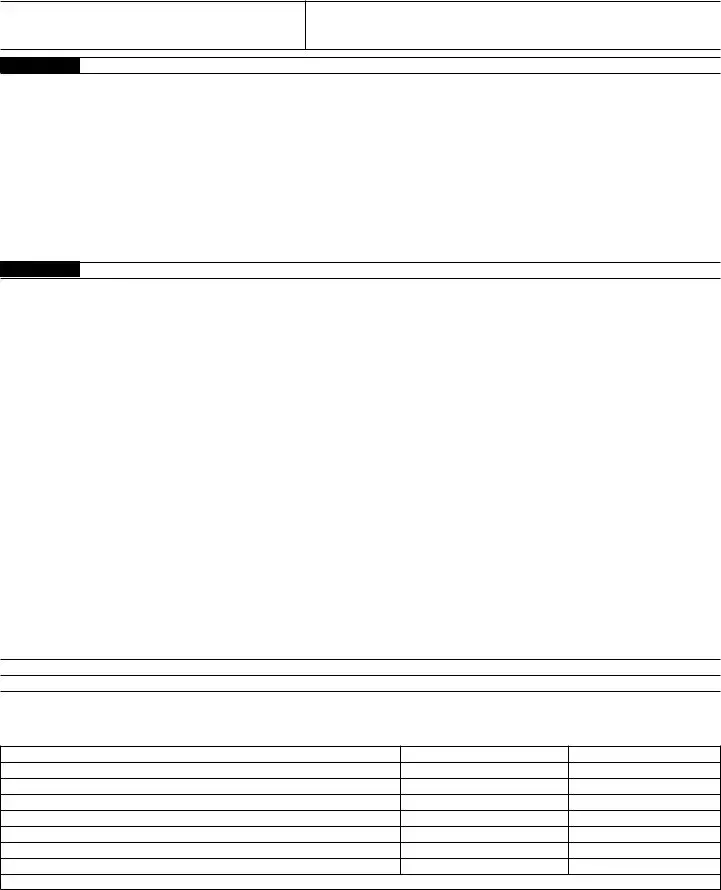
ADDITIONAL INFORMATION REQUIRED FOR FEDERALLY PREEMPTED AMOUNTS CLAIMED
If the amount claimed is exempt due to federal preemption, provide an explanation of the exemption and the federal statute (i.e., title and section of the United
States Code) under which the exemption is being claimed (If more space is needed, attach a statement):
ADDITIONAL INFORMATION REQUIRED FOR SUBCONTRACT DEDUCTIONS AMOUNTS CLAIMED
If you are claiming an deduction for payments made to a subcontractor or a specialty contractor, complete the required information below:
(If more space is needed, attach a statement. Include the total subcontract deductions claimed from any attachments in the total line below.)
SUBCONTRACTOR’S NAME AND/OR DBA NAME SUBCONTRACTOR’S HAWAII TAX I.D. NO. AMOUNT OF DEDUCTION
TOTAL SUBCONTRACT DEDUCTIONS CLAIMED .................................................................................................................$
SCHEDULE GE
(FORM G-45/G-49)
(REV. 2013) PAGE 2
SECTION III
SECTION IV
SECTION V
SECTION VII
SECTION VI
SCHEDULE GE
(Form G-45/G-49)
Name Hawaii Tax I.D. Number Period Ending (MM/YY) or
Tax Year Ending (MM/DD/YY)
SECTION II
*Additional information is required to claim these exemptions, complete Sections VI and VII.

Form Information

Fact Name Details
Purpose The G-45 Hawaii form is used to claim exemptions and deductions related to general excise/use tax.
Governing Law The form is governed by the Hawaii Revised Statutes (HRS), particularly sections 237 and 238.
Filing Requirement This form must be attached to Forms G-45 and G-49 to validate claimed exemptions/deductions.
Consequences of Non-Compliance If the form is not attached, exemptions and deductions will be disallowed, resulting in additional taxes.
Exemptions/Deductions Various exemptions are available, including those for out-of-state services and bad debts.
Section I Section I lists exemptions claimed at a rate of 0.5% for general excise/use tax.
Section II Section II includes exemptions at a rate of 4%, such as for affordable housing and mass transit.
Section III Section III addresses exemptions specifically for insurance commissions, taxed at 0.15%.
County Surcharge Section IV includes exemptions for the county surcharge tax, applicable at a rate of 0.5%.
Additional Information Sections VI and VII require further information for federally preempted amounts and subcontract deductions.

Detailed Guide for Filling Out G 45 Hawaii

Filling out the G-45 form for Hawaii requires careful attention to detail. This form is essential for claiming exemptions and deductions related to general excise and use taxes. Ensure that all necessary information is accurate and complete to avoid any issues with your tax return.

  1. Obtain the G-45 form from the Hawaii Department of Taxation website or your local tax office.
  2. Fill in your Hawaii Tax I.D. Number in the designated space.
  3. Enter your Name in the appropriate field.
  4. Indicate the period ending or tax year ending by entering the date in MM/YY or MM/DD/YY format.
  5. In Section I, check the boxes for the exemptions or deductions you are claiming. For each checked box, write the applicable amount in the space provided.
  6. Add up the amounts from Section I and enter the total in the designated space.
  7. Proceed to Section II and repeat the process: check the boxes for exemptions/deductions, enter amounts, and calculate the total.
  8. Continue to Section III and follow the same procedure for any applicable exemptions or deductions.
  9. In Section IV, select the county surcharge exemptions/deductions and record the amounts.
  10. Calculate the totals for all sections and enter them in Section V. Add the totals from Sections I, II, III, and IV to find the grand total.
  11. If applicable, provide additional information in Section VI and Section VII for federally preempted amounts or subcontract deductions.
  12. Review the completed form for accuracy before attaching it to your Forms G-45 and G-49.

Obtain Answers on G 45 Hawaii

  1. What is the G-45 Hawaii form used for?

    The G-45 form is a tax return used for reporting general excise and use taxes in Hawaii. It is typically filed by businesses operating in the state. The form helps businesses claim exemptions and deductions for certain activities or expenses that qualify under Hawaii tax laws. To ensure proper processing, the G-45 must be completed accurately and submitted on time.

  2. What happens if I do not attach the G-45 form when filing?

    If you fail to attach the G-45 form to your periodic or annual tax return (Forms G-45 and G-49), your claimed exemptions and deductions will be disallowed. This means that you may face additional taxes assessed by the Department of Taxation. It is crucial to include this form to validate your claims and avoid potential penalties.

  3. What types of exemptions or deductions can I claim on the G-45 form?

    The G-45 form allows you to claim various exemptions and deductions. Some common categories include:

    • Air Pollution Control Facilities
    • Out of State Services
    • Bad Debts
    • Enterprise Zones
    • Exported Services

    Each exemption has specific criteria, so it is essential to review the instructions carefully and ensure that you qualify for any deductions you claim.

  4. Is there a deadline for filing the G-45 form?

    Yes, the G-45 form must be filed periodically, typically on a quarterly basis, depending on your business's tax liability. The specific deadlines can vary, so it is advisable to check the latest guidelines from the Hawaii Department of Taxation to ensure timely submission and compliance.

Common mistakes

Filling out the G-45 Hawaii form can be a straightforward process, but many individuals make common mistakes that can lead to complications. One significant error is failing to attach the required Schedule GE. This schedule is essential for claiming exemptions and deductions. Without it, the tax authorities will disallow these claims, resulting in additional taxes owed. Always ensure that this form is completed and attached to your G-45 and G-49 submissions.

Another frequent mistake is neglecting to check the appropriate boxes for exemptions and deductions claimed. It's crucial to review the list carefully and ensure that all relevant boxes are marked. If you miss a box, you may miss out on potential savings. Additionally, entering the claimed amounts incorrectly can lead to discrepancies and further complications. Double-check the figures before submitting the form.

Many people also overlook the importance of including the correct Hawaii Tax I.D. number. This number is vital for identifying your business and ensuring that your tax return is processed accurately. If this number is missing or incorrect, it can delay your return and lead to unnecessary confusion. Always verify that your Hawaii Tax I.D. is accurate and clearly written on the form.

Lastly, failing to provide additional information when claiming federally preempted amounts or subcontract deductions is a common oversight. Specific details are required for these claims, and not providing them can result in disqualification of the deductions. Make sure to complete Sections VI and VII thoroughly if these situations apply to you. Taking the time to avoid these mistakes can save you from future headaches and ensure a smoother filing process.

Documents used along the form

The G-45 form is an essential document for businesses in Hawaii to report their general excise and use taxes. When completing this form, several other documents may also be required to ensure accurate reporting and compliance with tax regulations. Below is a list of forms and documents that are commonly used alongside the G-45 form.

  • Form G-49: This form is the annual return for general excise and use tax. It is typically filed at the end of the tax year and summarizes the total amounts reported on the G-45 forms submitted throughout the year. Businesses use it to reconcile their total tax obligations and claim any remaining exemptions or deductions.
  • Schedule GE: This schedule accompanies the G-45 and G-49 forms and provides a detailed list of exemptions and deductions claimed. It allows businesses to specify the nature and amount of each exemption, ensuring that the tax authorities have a clear understanding of the claims made.
  • Form N-11: This is the Hawaii Individual Income Tax Return form. While primarily for individual taxpayers, businesses may need to reference this form if they are structured as pass-through entities, such as partnerships or S corporations, where income is reported on individual tax returns.
  • Form N-30: This form is used for corporate income tax returns in Hawaii. Corporations that file their taxes separately from their owners may need to complete this form, especially if they are subject to the general excise tax as part of their business operations.

Using these forms in conjunction with the G-45 ensures that businesses maintain compliance with Hawaii's tax regulations. Proper documentation can help avoid penalties and ensure that all eligible deductions are accurately claimed.

Similar forms

The G-45 Hawaii form, used for reporting general excise and use tax exemptions and deductions, has several similar documents that serve related purposes in tax reporting and compliance. Below is a list of these documents, along with a brief explanation of how they are similar to the G-45 form:

  • Form G-49: This form is the annual counterpart to the G-45, used for reporting general excise and use tax on an annual basis rather than quarterly. Like the G-45, it requires the reporting of exemptions and deductions.
  • Form G-60: This form is for claiming a tax refund. It is similar to the G-45 in that it allows taxpayers to detail specific amounts and reasons for claiming a refund, including exemptions.
  • Form G-75: This form is used for reporting general excise tax for specific industries, such as construction. It shares similarities with the G-45 in terms of categorizing exemptions and deductions relevant to that industry.
  • Form N-11: This is the individual income tax return for Hawaii residents. While it serves a different purpose, it also requires reporting of certain exemptions and deductions, similar to how the G-45 does for business taxes.
  • Form N-30: This is the corporate income tax return for Hawaii. Like the G-45, it includes sections for reporting deductions and exemptions, particularly for businesses.
  • Form N-40: This form is used by partnerships to report income and deductions. It is similar to the G-45 in that it requires detailed reporting of various deductions applicable to the partnership.
  • Form N-15: This is for non-resident individuals filing a tax return in Hawaii. Similar to the G-45, it involves claiming deductions and exemptions related to income earned in Hawaii.
  • Form N-20: This is the tax return for S corporations in Hawaii. It parallels the G-45 in that it requires reporting of specific deductions and exemptions for tax purposes.
  • Form 1040: The federal individual income tax return includes sections for claiming deductions and credits. While it is federal, it shares the same foundational goal of tax compliance as the G-45.

Understanding these forms and their similarities can help ensure accurate reporting and compliance with Hawaii's tax regulations. Each document plays a crucial role in ensuring that taxpayers can appropriately claim their exemptions and deductions.

Dos and Don'ts

When filling out the G-45 Hawaii form, there are important guidelines to follow. Here are four things to keep in mind:

  • Do ensure all required information is complete, including your Hawaii Tax I.D. number and the period ending date.
  • Do attach the Schedule GE form to your G-45 and G-49 forms to avoid disallowance of your exemptions and deductions.
  • Don't claim deductions for ordinary business expenses, as they are generally not deductible on this form.
  • Don't forget to double-check the amounts entered for each exemption or deduction to ensure accuracy.

Misconceptions

The G-45 Hawaii form is an important document for businesses operating in Hawaii, but several misconceptions surround its use. Understanding these misconceptions can help ensure compliance and proper filing.

  • Misconception 1: All business expenses are deductible.
  • Many people believe that all business expenses can be deducted on the G-45 form. However, most ordinary business expenses, such as materials and supplies, are not deductible. Only specific exemptions and deductions listed in the form are allowed.

  • Misconception 2: The G-45 form can be submitted without attachments.
  • Some individuals think they can submit the G-45 form without attaching the necessary documentation for exemptions and deductions. In reality, if the required schedule of exemptions and deductions is not attached, those claims will be disallowed, leading to additional taxes.

  • Misconception 3: Filing the G-45 is optional for all businesses.
  • It is a common belief that filing the G-45 form is optional. In fact, businesses that earn income in Hawaii are required to file this form to report their general excise and use taxes. Failure to file can result in penalties and interest on unpaid taxes.

  • Misconception 4: Only large businesses need to file the G-45 form.
  • Many assume that only large businesses or corporations need to file the G-45. However, any business entity earning income in Hawaii, regardless of size, must file this form. This includes sole proprietors, partnerships, and small businesses.

Key takeaways

Filling out the G-45 Hawaii form accurately is essential for claiming exemptions and deductions on general excise and use taxes. Here are key takeaways to keep in mind:

  • Attach the G-45 Schedule GE: Always attach the G-45 Schedule GE to your Forms G-45 and G-49 when claiming exemptions or deductions. Failure to do so may result in disallowance of your claims.
  • Understand Non-Deductible Expenses: Most ordinary business expenses, such as materials and supplies, are not deductible on your general excise/use tax return.
  • Complete Sections I to IV: Fill out Sections I, II, III, and IV of the form to report different categories of exemptions and deductions accurately.
  • Use Correct Statute References: When claiming exemptions, ensure you reference the correct Hawaii Revised Statutes (HRS) sections associated with each exemption.
  • Keep Detailed Records: Maintain documentation supporting your claims, especially for exemptions requiring additional information, such as federally preempted amounts.
  • Calculate Totals Carefully: Be diligent in adding totals from Sections I through IV. The grand total is crucial for accurate reporting on Forms G-45 and G-49.
  • Check for Additional Requirements: Some exemptions may require additional information. Review Sections VI and VII if claiming federally preempted amounts or subcontract deductions.
  • Review Before Submission: Double-check all entries for accuracy and completeness before submitting your forms to avoid unnecessary complications.
  • Stay Informed: Regularly consult the General Instructions for Filing the General Excise/Use Tax Returns for any updates or changes in the tax law that may affect your claims.