Homepage Blank Fulton County Georgia Writ Of Form
Outline

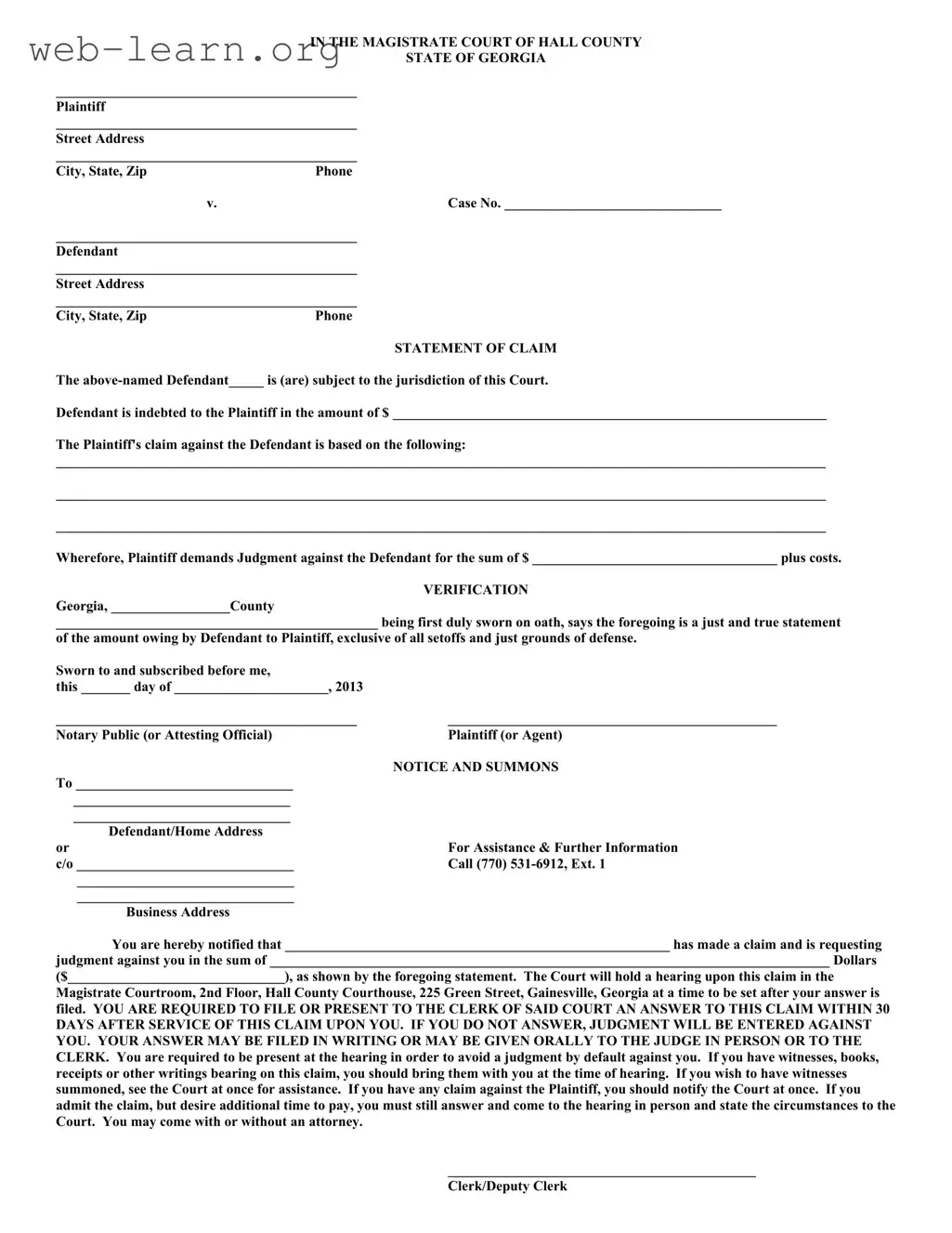
The Fulton County Georgia Writ of form serves as a crucial legal document in the process of resolving disputes between plaintiffs and defendants in the magistrate court. This form outlines the essential information regarding the parties involved, including their names, addresses, and contact details. It also specifies the nature of the claim, detailing the amount of money owed by the defendant to the plaintiff. The statement of claim section is particularly important, as it provides a clear basis for the plaintiff's assertion, allowing the court to understand the reasons behind the demand for judgment. Furthermore, the form includes a verification section, where the plaintiff affirms the accuracy of the information provided, ensuring that the claim is legitimate and free from deceit. A notice and summons section alerts the defendant of the claim made against them, emphasizing the need for a timely response within 30 days to avoid a default judgment. This comprehensive document not only facilitates communication between the parties and the court but also establishes a framework for a fair hearing, where both sides can present their cases and any relevant evidence. Understanding the components of the Fulton County Georgia Writ of form is essential for anyone navigating the legal system in this jurisdiction, as it lays the groundwork for the resolution of financial disputes.

Sample - Fulton County Georgia Writ Of Form

IN THE MAGISTRATE COURT OF HALL COUNTY
STATE OF GEORGIA
___________________________________________
Plaintiff
___________________________________________
Street Address
___________________________________________
City, State, Zip Phone
v. Case No. _______________________________
___________________________________________
Defendant
___________________________________________
Street Address
___________________________________________
City, State, Zip Phone
STATEMENT OF CLAIM
The above-named Defendant_____ is (are) subject to the jurisdiction of this Court.
Defendant is indebted to the Plaintiff in the amount of $ ______________________________________________________________
The Plaintiff's claim against the Defendant is based on the following:
______________________________________________________________________________________________________________
______________________________________________________________________________________________________________
______________________________________________________________________________________________________________
Wherefore, Plaintiff demands Judgment against the Defendant for the sum of $ ___________________________________ plus costs.
VERIFICATION
Georgia, _________________County
______________________________________________ being first duly sworn on oath, says the foregoing is a just and true statement
of the amount owing by Defendant to Plaintiff, exclusive of all setoffs and just grounds of defense.
Sworn to and subscribed before me,
this _______ day of ______________________, 2013
___________________________________________ _______________________________________________
Notary Public (or Attesting Official) Plaintiff (or Agent)
NOTICE AND SUMMONS
To _______________________________
_______________________________
_______________________________
Defendant/Home Address
or For Assistance & Further Information
c/o _______________________________ Call (770) 531-6912, Ext. 1
_______________________________
_______________________________
Business Address
You are hereby notified that _______________________________________________________ has made a claim and is requesting
judgment against you in the sum of ________________________________________________________________________________ Dollars
($_______________________________), as shown by the foregoing statement. The Court will hold a hearing upon this claim in the
Magistrate Courtroom, 2nd Floor, Hall County Courthouse, 225 Green Street, Gainesville, Georgia at a time to be set after your answer is
filed. YOU ARE REQUIRED TO FILE OR PRESENT TO THE CLERK OF SAID COURT AN ANSWER TO THIS CLAIM WITHIN 30
DAYS AFTER SERVICE OF THIS CLAIM UPON YOU. IF YOU DO NOT ANSWER, JUDGMENT WILL BE ENTERED AGAINST
YOU. YOUR ANSWER MAY BE FILED IN WRITING OR MAY BE GIVEN ORALLY TO THE JUDGE IN PERSON OR TO THE
CLERK. You are required to be present at the hearing in order to avoid a judgment by default against you. If you have witnesses, books,
receipts or other writings bearing on this claim, you should bring them with you at the time of hearing. If you wish to have witnesses
summoned, see the Court at once for assistance. If you have any claim against the Plaintiff, you should notify the Court at once. If you
admit the claim, but desire additional time to pay, you must still answer and come to the hearing in person and state the circumstances to the
Court. You may come with or without an attorney.
____________________________________________
Clerk/Deputy Clerk

Form Information

Fact Name Description
Jurisdiction The Magistrate Court of Hall County has jurisdiction over small claims disputes in Georgia.
Parties Involved The form includes sections for the Plaintiff and Defendant, detailing their names and contact information.
Statement of Claim The Plaintiff must clearly state the amount owed by the Defendant and the basis for the claim.
Verification Requirement The Plaintiff must verify the truthfulness of the claim through a sworn statement.
Notary Public A Notary Public or Attesting Official must witness the verification to validate the document.
Notice and Summons The Defendant receives a notice informing them of the claim and the requirement to respond.
Response Time The Defendant has 30 days to file an answer after being served with the claim.
Hearing Location The hearing takes place at the Hall County Courthouse, specifically in the Magistrate Courtroom.
Default Judgment If the Defendant fails to respond, a judgment may be entered against them automatically.
Legal Representation Defendants can attend the hearing with or without an attorney, depending on their preference.

Detailed Guide for Filling Out Fulton County Georgia Writ Of

Filling out the Fulton County Georgia Writ Of form is an important step in initiating your legal claim. This process requires careful attention to detail to ensure that all necessary information is accurately provided. Once you have completed the form, you will need to file it with the court and follow up as required.

  1. Begin by entering the name of the Plaintiff in the designated space at the top of the form.
  2. Fill in the Plaintiff's street address, city, state, and zip code.
  3. Provide a contact phone number for the Plaintiff.
  4. Next, enter the name of the Defendant in the appropriate section.
  5. Complete the Defendant's street address, city, state, and zip code.
  6. Include a contact phone number for the Defendant.
  7. In the "Case No." section, leave this blank for the court to fill in later.
  8. State the amount the Defendant owes the Plaintiff in the "Statement of Claim" section.
  9. Clearly describe the basis for the Plaintiff's claim against the Defendant in the provided space. Be specific and concise.
  10. In the "Wherefore" section, repeat the amount the Plaintiff is demanding from the Defendant, including any additional costs.
  11. Proceed to the "Verification" section. Fill in the county and date, then sign the document to affirm that the information is true.
  12. Have the form notarized by a Notary Public or an Attesting Official.
  13. In the "Notice and Summons" section, fill in the Defendant's name and address again.
  14. Clearly state the claim being made against the Defendant, including the total amount owed.
  15. Provide the date and location of the hearing, which will be set after the Defendant files their answer.
  16. Finally, sign the form as the Clerk or Deputy Clerk at the bottom.

Obtain Answers on Fulton County Georgia Writ Of

  1. What is a Writ of Claim in Fulton County, Georgia?

    A Writ of Claim is a legal document filed by a plaintiff in the Magistrate Court of Fulton County to initiate a claim against a defendant. It outlines the plaintiff's assertion that the defendant owes a specific amount of money. This document serves as a formal request for the court to hear the case and potentially issue a judgment in favor of the plaintiff.

  2. How do I fill out the Writ of Claim form?

    To complete the Writ of Claim form, follow these steps:

    • Provide the names and addresses of both the plaintiff and defendant.
    • State the amount owed by the defendant to the plaintiff.
    • Detail the basis of the claim in the designated section, explaining why the defendant is indebted.
    • Include a verification statement, which must be sworn before a notary public or an attesting official.
    • Finally, ensure that all information is accurate and complete before submitting the form to the court.
  3. What happens after I file the Writ of Claim?

    Once the Writ of Claim is filed, the court will schedule a hearing. The defendant will be notified of the claim and is required to respond within 30 days. If the defendant fails to respond, a judgment may be entered against them. It is crucial for the defendant to attend the hearing, as this is their opportunity to present evidence or arguments related to the claim.

  4. Can the defendant bring evidence to the hearing?

    Yes, the defendant is encouraged to bring any relevant evidence to the hearing. This may include witnesses, documents, receipts, or any other materials that could support their case. If the defendant wishes to have witnesses summoned, they should contact the court for assistance prior to the hearing.

Common mistakes

Filling out the Fulton County Georgia Writ Of form can be straightforward, but many people make common mistakes that can delay their case or lead to complications. One frequent error is failing to provide complete and accurate information about the parties involved. Both the plaintiff and defendant must be clearly identified, including their full names, addresses, and phone numbers. Omitting any of this information can result in the court rejecting the form.

Another mistake is leaving the amount of the claim blank or incorrectly stated. The form requires a specific dollar amount that the plaintiff is claiming. If this section is not filled out properly, the court may not process the claim. It is essential to double-check the numbers to ensure they reflect the actual debt owed.

People often neglect to explain the basis of their claim thoroughly. The section that asks for details about why the defendant owes money should be filled out with clear and concise information. Vague or incomplete explanations can lead to confusion and may weaken the plaintiff's case during the hearing.

Additionally, some individuals forget to sign the verification section. This part confirms that the information provided is true and accurate. Not having a signature can lead to the form being deemed invalid, causing unnecessary delays in the legal process.

Another common oversight is failing to include the correct date and location for the hearing. This information is crucial for notifying the defendant. If the details are incorrect, the defendant may not receive proper notice, which could complicate the proceedings.

Lastly, many people do not keep a copy of the completed form for their records. Having a copy is essential for tracking the case and for reference during the hearing. Without it, the plaintiff may find themselves unprepared to discuss their claim or respond to the defendant's arguments.

Documents used along the form

When filing a Writ of Possession in Fulton County, Georgia, several other documents may be necessary to support your case. Each of these forms plays a crucial role in the legal process. Below is a list of commonly used documents that accompany the Writ of Possession.

  • Notice of Eviction: This document informs the tenant of the impending eviction. It outlines the reasons for the eviction and the timeline for vacating the property. Proper delivery of this notice is essential to ensure the tenant is aware of the situation.
  • Answer to Complaint: The defendant must file this document in response to the plaintiff's claims. It allows the defendant to present their side of the story and any defenses they may have against the eviction. Timely filing is critical to avoid a default judgment.
  • Affidavit of Service: This document serves as proof that the defendant was properly served with the Notice of Eviction and any other relevant documents. It includes details about how and when the documents were delivered, which can be vital for the court's records.
  • Motion for Stay of Eviction: If the defendant seeks to delay the eviction process, they may file this motion. It requests the court to postpone the eviction for a specific period, often to allow time for an appeal or to resolve the underlying issues.

Understanding these documents and their purposes can help streamline the legal process. Each form serves a distinct role, and having them in order is essential for a successful outcome in court.

Similar forms

  • Complaint: A Complaint is a legal document that initiates a lawsuit. Like the Writ of Form, it outlines the plaintiff's claims against the defendant and requests a remedy from the court.
  • Summons: A Summons notifies the defendant of the legal action and compels them to respond. Similar to the notice in the Writ of Form, it informs the defendant about the claim and the requirement to appear in court.
  • Answer: An Answer is the defendant's formal response to the Complaint. This document addresses the claims made by the plaintiff, akin to how the Writ of Form demands a response from the defendant.
  • Affidavit: An Affidavit is a sworn statement used to support claims in court. It resembles the Verification section of the Writ of Form, where the plaintiff affirms the truth of their claims under oath.
  • Judgment: A Judgment is the court's final decision on a case. It follows the process initiated by the Writ of Form, where the plaintiff seeks a ruling in their favor.
  • Motion: A Motion is a request made to the court for a specific ruling or order. Similar to the demands in the Writ of Form, it seeks action from the court regarding a legal issue.
  • Subpoena: A Subpoena orders an individual to appear in court or produce evidence. Like the Writ of Form, it compels participation in the legal process, ensuring that all relevant parties are present.
  • Notice of Default: A Notice of Default is issued when a defendant fails to respond to a claim. This is similar to the warning in the Writ of Form about the consequences of not answering, which can lead to a default judgment.

Dos and Don'ts

When filling out the Fulton County Georgia Writ Of form, it is essential to approach the task with care. Here are six things to keep in mind:

  • Do ensure that all information is accurate and complete. Double-check names, addresses, and amounts owed.
  • Do clearly state the basis for your claim. Provide detailed information about the circumstances surrounding the debt.
  • Do file your answer within the required 30 days. This is crucial to avoid a default judgment against you.
  • Do attend the hearing. Being present allows you to present your case and defend your position.
  • Don't leave any sections of the form blank. Incomplete forms may lead to delays or rejections.
  • Don't ignore the instructions provided on the form. Following them carefully can prevent mistakes that might affect your case.

By adhering to these guidelines, you can navigate the process more effectively and increase your chances of a favorable outcome.

Misconceptions

Misconceptions about the Fulton County Georgia Writ Of form can lead to confusion and missteps in legal proceedings. Here are five common misconceptions:

  • It is only for large claims. Many believe that the Writ Of form is reserved for significant financial disputes. In reality, it can be used for claims of various amounts, making it accessible for smaller claims as well.
  • A response is not necessary if you disagree with the claim. Some individuals think that voicing disagreement verbally is enough. However, it is essential to file a written response or appear in court to avoid a default judgment.
  • You can ignore the notice if you don’t recognize the plaintiff. Ignoring the notice will not make the claim disappear. It is crucial to respond to the notice, regardless of your familiarity with the plaintiff.
  • The court will automatically rule in your favor if you do not attend the hearing. This is a misconception. Failing to attend the hearing can lead to a judgment against you, even if you believe the claim is unjust.
  • You need a lawyer to navigate the process. While legal representation can be helpful, it is not mandatory. Individuals can represent themselves and still effectively present their case in court.

Understanding these misconceptions can help individuals better navigate the legal process and protect their rights.

Key takeaways

Filling out and using the Fulton County Georgia Writ Of form requires careful attention to detail. Here are five key takeaways:

  • Jurisdiction is Essential: Ensure that the defendant is subject to the jurisdiction of the court. This is a critical requirement for the case to proceed.
  • Complete Financial Details: Clearly state the amount owed by the defendant. Provide a detailed explanation of the claim to support your request for judgment.
  • Timely Response Required: The defendant must file an answer within 30 days of receiving the claim. Failure to respond may result in a default judgment against them.
  • Attendance at Hearing: Both parties must attend the scheduled hearing. This is necessary to present evidence and avoid a judgment by default.
  • Documentation is Important: Bring any relevant documents, such as receipts or witness statements, to the hearing. This can strengthen your position in court.