Homepage Blank Fmla Leave Form
Outline

The Family and Medical Leave Act (FMLA) Leave Request Form serves as a vital tool for employees seeking time away from work for specific family or medical reasons. This form is designed to facilitate a smooth process by allowing employees to formally request leave from their jobs. It covers various situations, including the birth of a child, adoption, or caring for a family member with a serious health condition. Employees must provide their name, department, and the dates for which they are requesting leave. Additionally, the form accommodates requests for intermittent or reduced-schedule leave, enabling employees to outline specific times and reasons for their absence. Another important aspect is the option to substitute paid leave, where employees can indicate if they wish to use vacation or sick hours during their time off. Finally, it includes a section for employees to provide their contact information during the leave, ensuring that communication remains open. By completing this form, employees take an essential step in securing their rights under the FMLA while ensuring that their employers are informed of their needs.
Sample - Fmla Leave Form

© The Personnel Advisor 907
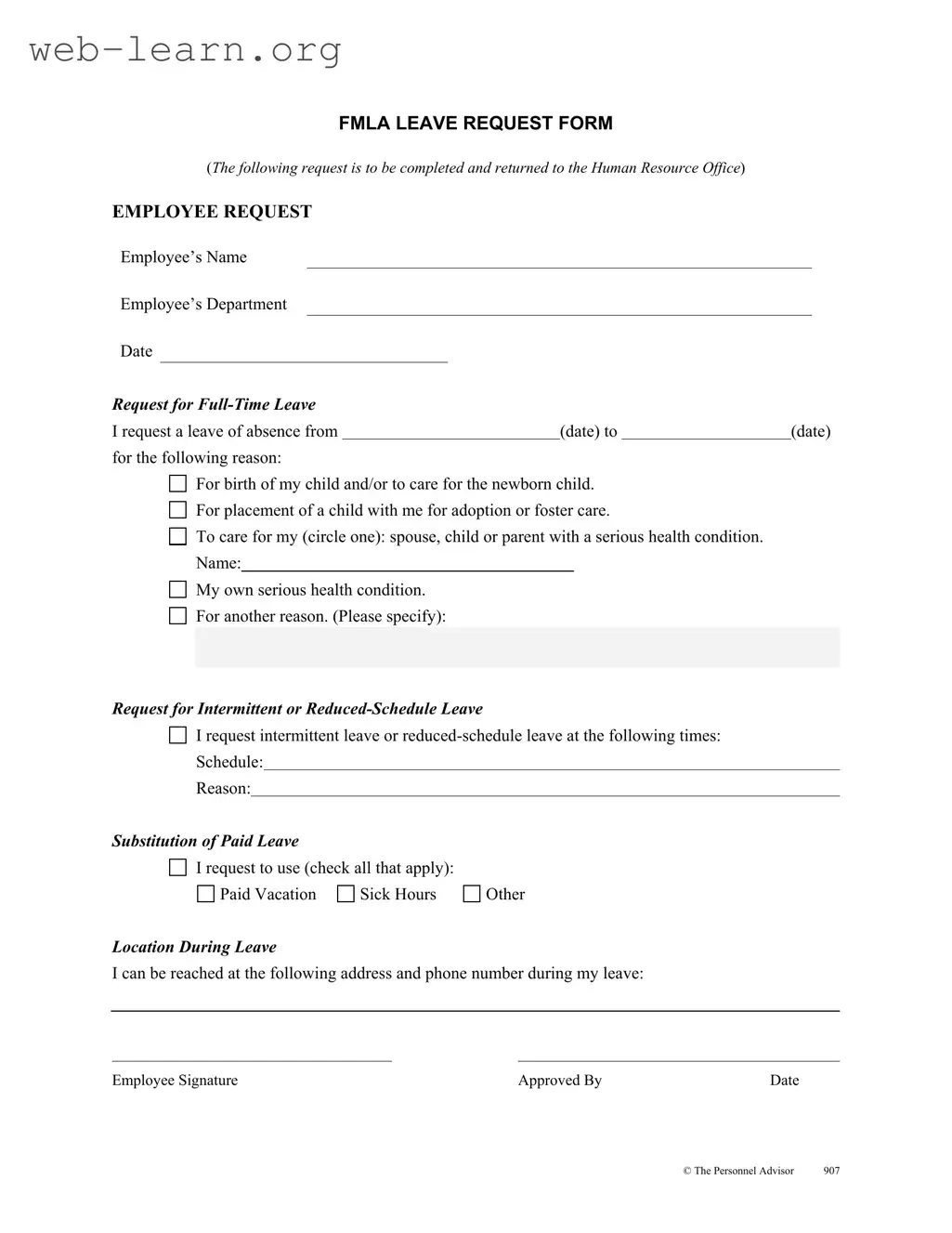
FMLA LEAVE REQUEST FORM
(The following request is to be completed and returned to the Human Resource Office)
EMPLOYEE REQUEST
Employee’s Name
Employee’s Department
Date
Request for Full-Time Leave
I request a leave of absence from
(date) to (date)
for the following reason:
For birth of my child and/or to care for the newborn child.
For placement of a child with me for adoption or foster care.
To care for my (circle one): spouse, child or parent with a serious health condition.
Name:
My own serious health condition.
For another reason. (Please specify):
Request for Intermittent or Reduced-Schedule Leave
I request intermittent leave or reduced-schedule leave at the following times:
Schedule:
Reason:
Substitution of Paid Leave
I request to use (check all that apply):
Paid Vacation Sick Hours Other
Location During Leave
I can be reached at the following address and phone number during my leave:
Employee Signature Approved By Date

Form Information

Fact Name Details
Purpose of the Form The FMLA Leave Request Form is used by employees to formally request leave under the Family and Medical Leave Act for specific reasons such as the birth of a child, adoption, or to care for a family member with a serious health condition.
Intermittent Leave Employees may request intermittent or reduced-schedule leave, allowing them to take leave in smaller increments rather than a continuous block of time.
Paid Leave Substitution The form allows employees to indicate if they wish to use paid vacation, sick hours, or other paid leave during their FMLA leave.
Employee Contact Information Employees must provide a contact address and phone number where they can be reached during their leave, ensuring communication remains open.
Governing Law The FMLA Leave Request Form is governed by the Family and Medical Leave Act (29 U.S.C. § 2601 et seq.) and may also be subject to state-specific laws regarding family and medical leave.

Detailed Guide for Filling Out Fmla Leave

Completing the FMLA Leave form is an important step in requesting time off for specific family and medical reasons. To ensure your request is processed smoothly, follow these steps carefully. Gather the necessary information before you start, as this will help streamline the process.

  1. Begin by filling in your Employee’s Name at the top of the form.
  2. Next, indicate your Employee’s Department.
  3. Write the Date you are submitting the request.
  4. Choose whether you are requesting a Full-Time Leave or Intermittent or Reduced-Schedule Leave.
  5. If requesting Full-Time Leave, specify the dates you are requesting leave from and to.
  6. State the reason for your leave. Options include:
    • For birth of my child and/or to care for the newborn child.
    • For placement of a child with me for adoption or foster care.
    • To care for my (circle one): spouse, child, or parent with a serious health condition.
    • My own serious health condition.
    • For another reason (please specify).
  7. If you are requesting Intermittent or Reduced-Schedule Leave, provide the schedule and reason for the leave.
  8. Indicate any Paid Leave you wish to substitute by checking all that apply:
    • Paid Vacation
    • Sick Hours
    • Location During Leave
    • Other
  9. Provide your contact address and phone number where you can be reached during your leave.
  10. Sign the form in the Employee Signature section.
  11. Leave the Approved By and Date sections blank for your supervisor to complete.

After completing the form, submit it to your Human Resource Office. They will review your request and provide you with further instructions or confirmations as needed.

Obtain Answers on Fmla Leave

  1. What is the FMLA Leave Form?

    The FMLA Leave Form is a document that employees must complete to formally request leave under the Family and Medical Leave Act (FMLA). This form is submitted to the Human Resource Office and outlines the reason for the leave, the duration, and any requests for paid leave substitution.

  2. Who is eligible to use the FMLA Leave Form?

    Employees are eligible for FMLA leave if they have worked for their employer for at least 12 months, have completed at least 1,250 hours of service during the past 12 months, and work at a location where the employer has at least 50 employees within a 75-mile radius. Eligibility may vary based on individual circumstances.

  3. What reasons can I provide for requesting FMLA leave?

    There are several valid reasons for requesting FMLA leave, including:

    • Birth of a child and to care for the newborn
    • Placement of a child for adoption or foster care
    • To care for a spouse, child, or parent with a serious health condition
    • Your own serious health condition
    • Other reasons (which should be specified on the form)
  4. Can I request intermittent leave?

    Yes, you can request intermittent leave or a reduced schedule. This means you can take leave in separate blocks of time rather than a continuous period. The form allows you to specify the schedule and reason for this type of leave.

  5. How do I substitute paid leave during my FMLA leave?

    On the FMLA Leave Form, you can indicate your preference to use paid leave such as vacation or sick hours. Check the boxes for the types of paid leave you wish to substitute. This can help you maintain some income during your time away from work.

  6. What information do I need to provide on the form?

    You will need to fill out your name, department, and the dates you are requesting leave. Additionally, specify the reason for your leave and provide contact information where you can be reached during your absence. Your signature is also required to validate the request.

  7. What happens after I submit my FMLA Leave Form?

    Once you submit your FMLA Leave Form, the Human Resource Office will review your request. They may contact you for additional information or clarification. You will receive a response regarding the approval or denial of your leave request, along with any next steps.

Common mistakes

Filling out the FMLA Leave Request Form can seem straightforward, but many individuals make common mistakes that can delay the approval process. Understanding these mistakes can help ensure a smoother experience when requesting leave.

One frequent error is failing to provide complete information. Employees often leave out their name, department, or the specific dates for the leave. Incomplete forms can lead to confusion and may result in a denial of the request.

Another mistake is not clearly stating the reason for the leave. The form includes options like caring for a newborn or addressing a serious health condition. If an employee selects "another reason" but does not specify, it can create ambiguity and hinder the approval process.

Many individuals overlook the section for intermittent or reduced-schedule leave. This part is crucial for those who may need flexible time off rather than a continuous leave. Not filling it out correctly can lead to misunderstandings about the type of leave being requested.

Some employees fail to check the boxes for the substitution of paid leave. If paid vacation or sick hours are available and not indicated, it may result in unpaid leave, which can be financially burdensome.

Additionally, employees sometimes neglect to provide their contact information during the leave period. This information is vital for HR to communicate any updates or requests for further information. Without it, the process can stall.

Another common oversight is not signing the form. An unsigned request is typically considered invalid. Employees should ensure that they have signed the form before submitting it to avoid unnecessary delays.

People also frequently miss the deadline for submitting the leave request. It is important to be aware of the timeline for submitting the form, as late submissions can lead to denial of the leave.

Lastly, some individuals do not follow up on their request. After submission, it is wise to confirm that HR has received the form and to check on the status of the approval. This proactive approach can help clarify any issues early on.

By being aware of these common mistakes, employees can improve their chances of having their FMLA leave requests approved in a timely manner.

Documents used along the form

The Family and Medical Leave Act (FMLA) Leave Form is just one part of the process for taking leave. Several other documents may be required to ensure that both the employee's needs and the employer's policies are met. Here is a list of commonly used forms and documents that often accompany the FMLA Leave Form:

  • Certification of Health Care Provider: This form is used to verify the medical necessity of the leave. It must be completed by a healthcare provider and includes details about the employee's condition and the expected duration of the leave.
  • Employee Rights and Responsibilities Under FMLA: This document outlines the rights of employees under the FMLA, including eligibility requirements and the responsibilities of both the employee and employer during the leave process.
  • Notice of Eligibility and Rights & Responsibilities: Employers must provide this notice to employees when they request FMLA leave. It informs them of their eligibility and details their rights and responsibilities regarding the leave.
  • Return to Work Form: After the leave period, employees may need to submit this form to confirm their readiness to return to work. It may also require a healthcare provider's signature to ensure that the employee is fit for duty.
  • Intermittent Leave Schedule: If an employee is taking intermittent leave, this form helps outline the specific dates and times the leave will be taken. This ensures clear communication and planning for both the employee and employer.
  • Paid Leave Request Form: If an employee wishes to use accrued paid leave during their FMLA leave, this form is necessary. It specifies which type of paid leave will be used and for what duration.
  • Family Medical Leave Act Notice: This document serves as a formal notification to employees about their rights under the FMLA. It includes important information about how to file a complaint if their rights are violated.
  • Leave of Absence Policy: This internal policy document outlines the company’s specific procedures and guidelines for taking a leave of absence, including FMLA leave, and may provide additional context on benefits and eligibility.
  • Medical Release Form: In some cases, employers may require a medical release form before allowing an employee to return to work. This ensures that the employee is medically cleared to perform their job duties.
  • Job Description: Providing a current job description can help healthcare providers understand the employee's role and the demands of their position, which may be relevant when assessing their ability to return to work.

These documents collectively support the FMLA process, ensuring that employees can take the necessary time off while maintaining compliance with employer policies. It is essential to complete each form accurately and submit them promptly to facilitate a smooth leave experience.

Similar forms

The Family and Medical Leave Act (FMLA) Leave Form is an essential document for employees seeking time off for specific family and medical reasons. Several other documents share similarities with the FMLA Leave Form in terms of purpose, structure, and content. Here’s a look at seven such documents:

  • Short-Term Disability Claim Form: This form allows employees to request benefits when they are temporarily unable to work due to medical reasons. Like the FMLA Leave Form, it requires details about the employee's condition and the duration of leave needed.
  • Workers' Compensation Claim Form: When an employee is injured on the job, this form is used to seek compensation for medical expenses and lost wages. Similar to the FMLA form, it requires information about the injury and the time away from work.
  • Leave of Absence Request Form: This general form is used for various types of leave, including personal, medical, or family-related reasons. It shares the same structure of providing personal details and the reason for the leave.
  • Parental Leave Request Form: Specifically designed for new parents, this form requests time off for childbirth or adoption. It parallels the FMLA form by addressing the need for leave to care for a newborn or newly adopted child.
  • Medical Leave Request Form: This document is used when an employee needs to take leave for their own health issues. Like the FMLA form, it requires the employee to specify the nature of the medical condition and the expected leave duration.
  • Intermittent Leave Request Form: This form is specifically for employees who need to take leave in smaller increments rather than all at once. It resembles the FMLA form in that it requires a schedule and reason for the intermittent leave.
  • Bereavement Leave Request Form: When an employee experiences the loss of a loved one, this form is used to request time off for mourning. It is similar to the FMLA form as it addresses the need for personal time away from work due to significant life events.

Understanding these documents can help employees navigate their rights and responsibilities when it comes to taking leave. Each form serves a specific purpose but often shares common elements, making it easier for employees to manage their time away from work.

Dos and Don'ts

When filling out the FMLA Leave form, it’s essential to be thorough and accurate. Here’s a list of things to do and avoid to ensure your request is processed smoothly.

Things You Should Do:

  • Provide your full name and department clearly at the top of the form.
  • Specify the exact dates for your leave request.
  • Choose the appropriate reason for your leave, making sure to circle the correct option.
  • If applicable, fill out the section for intermittent or reduced-schedule leave with specific times.
  • Indicate any paid leave options you wish to use by checking the appropriate boxes.
  • Include your contact information so you can be reached during your leave.
  • Sign the form to confirm that all information is accurate.
  • Submit the form to the Human Resource Office promptly.
  • Keep a copy of the completed form for your records.

Things You Shouldn't Do:

  • Don’t leave any sections blank that are required.
  • Avoid using vague language; be specific about your reason for leave.
  • Do not forget to circle your relationship to the person you are caring for.
  • Don’t submit the form without your signature.
  • Refrain from providing inaccurate or misleading information.
  • Do not wait until the last minute to submit your request.
  • Don’t ignore any deadlines set by your employer for submitting the form.
  • Avoid discussing your leave with colleagues before it is approved.
  • Do not assume that your leave will be automatically approved without proper documentation.

Misconceptions

Understanding the Family and Medical Leave Act (FMLA) can be challenging, and misconceptions about the FMLA Leave form can lead to confusion. Here are ten common misconceptions:

  1. FMLA leave is only for maternity leave. Many people believe that FMLA leave is solely for childbirth. In reality, it covers a variety of situations, including caring for a newborn, adopting a child, or caring for a seriously ill family member.
  2. All employers are required to provide FMLA leave. Not all employers are subject to FMLA. Only those with 50 or more employees within a 75-mile radius are required to comply with the law.
  3. You can take FMLA leave without notice. Employees must provide their employers with at least 30 days' notice when the leave is foreseeable. If the leave is not foreseeable, notice should be given as soon as possible.
  4. FMLA leave is paid leave. FMLA leave is generally unpaid. However, employees may use accrued paid leave (like vacation or sick days) during their FMLA leave if they choose.
  5. You can take FMLA leave for any reason. FMLA leave must be taken for specific qualifying reasons, such as a serious health condition or to care for a family member with a serious health condition.
  6. FMLA leave is unlimited. Employees are entitled to a maximum of 12 weeks of leave in a 12-month period under FMLA, not unlimited time off.
  7. Employers can deny FMLA leave for any reason. Employers cannot deny FMLA leave if the employee qualifies and follows the proper procedures. Denial must be based on legitimate reasons outlined in the law.
  8. You lose your job if you take FMLA leave. The law protects employees from losing their job for taking FMLA leave. Upon return, employees should be reinstated to their original position or an equivalent one.
  9. You cannot use FMLA leave intermittently. Employees can request intermittent leave or a reduced schedule under FMLA, as long as it is medically necessary.
  10. The FMLA Leave form is optional. Completing the FMLA Leave form is not optional if you want to formally request leave. It is a necessary step to ensure your request is processed properly.

It is crucial to understand these misconceptions to navigate the FMLA process effectively. If you have questions or need assistance, consider reaching out to your HR department or a legal professional for guidance.

Key takeaways

When filling out and using the FMLA Leave form, consider the following key takeaways:

  • Ensure all sections of the form are completed accurately.
  • Clearly state the reason for your leave, such as the birth of a child or caring for a family member.
  • Specify the dates for your full-time leave request.
  • If requesting intermittent or reduced-schedule leave, outline the specific times you will need leave.
  • Indicate any paid leave you wish to use, such as vacation or sick hours.
  • Provide your contact information so that you can be reached during your leave.
  • Sign the form to confirm your request.
  • Submit the completed form to the Human Resource Office promptly.
  • Keep a copy of the form for your records.
  • Follow up with HR to ensure your request has been received and approved.

Understanding these points can help streamline the process and ensure that your leave is handled smoothly.