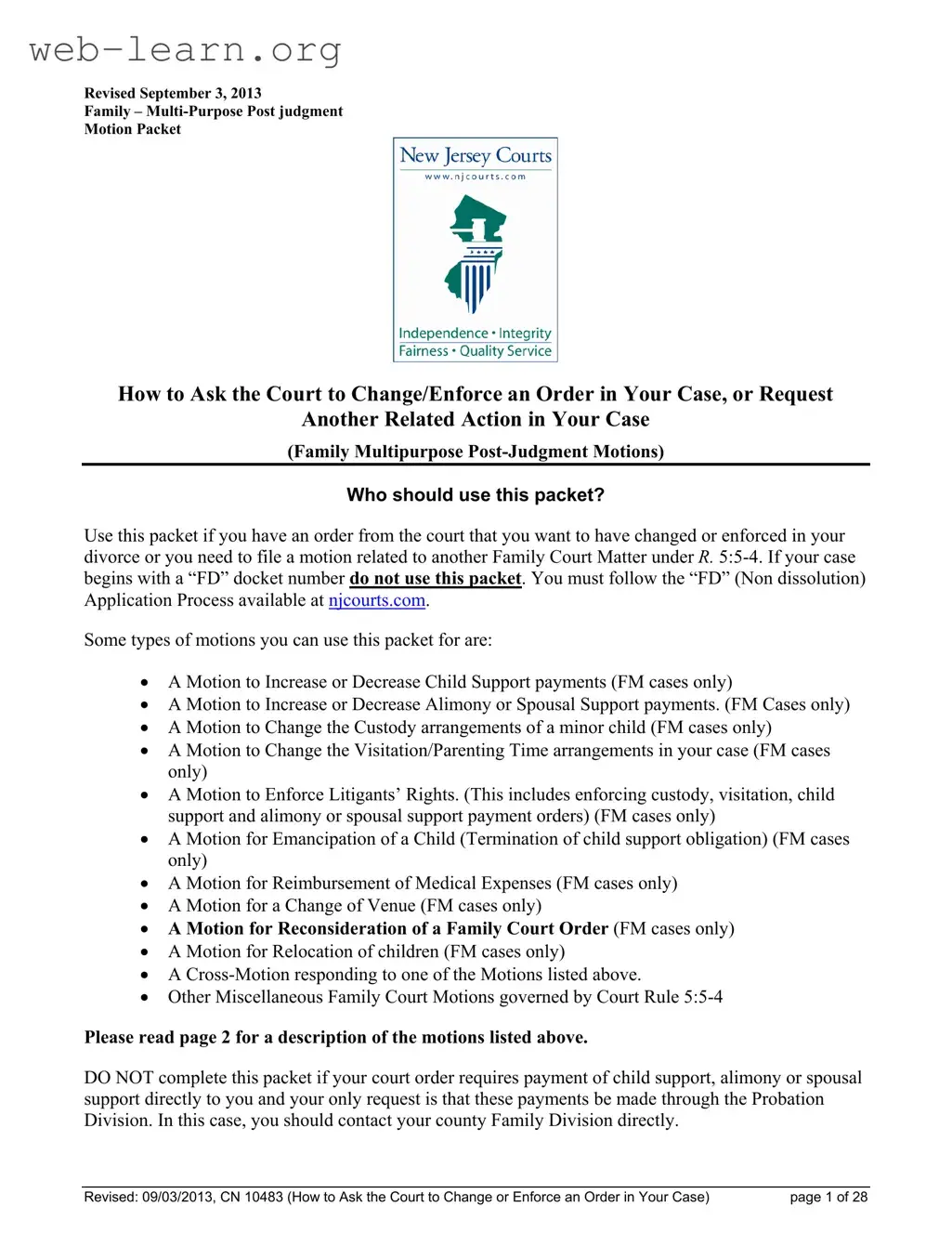
Homepage Blank Fm Motion Nj Family Court Form
Outline

The FM Motion NJ Family Court form is a vital tool for individuals navigating the complexities of family law in New Jersey. This multi-purpose post-judgment motion packet allows parties to request changes or enforcement of existing court orders related to divorce and other family matters. It is specifically designed for cases with an "FM" docket number, enabling users to file motions such as requests to modify child support, alimony, or custody arrangements. Additionally, it covers motions for enforcing litigants' rights, reimbursement of medical expenses, and even cross-motions in response to existing requests. Understanding the various types of motions available is crucial, as this packet can also facilitate requests for child emancipation, changes of venue, and reconsideration of previous court orders. Before completing the forms, users must gather relevant documentation and adhere to strict deadlines for notifying the other party about the motion hearing. The instructions within the packet guide users through the process, ensuring they are well-prepared to represent their interests effectively in court.


Sample - Fm Motion Nj Family Court Form

Revised: 09/03/2013, CN 10483 (How to Ask the Court to Change or Enforce an Order in Your Case) page 1 of 28
Revised September 3, 2013
Family – Multi-Purpose Post judgment
Motion Packet
How to Ask the Court to Change/Enforce an Order in Your Case, or Request
Another Related Action in Your Case
(Family Multipurpose Post-Judgment Motions)
Who should use this packet?
Use this packet if you have an order from the court that you want to have changed or enforced in your
divorce or you need to file a motion related to another Family Court Matter under R. 5:5-4. If your case
begins with a “FD” docket number do not use this packet. You must follow the “FD” (Non dissolution)
Application Process available at njcourts.com.
Some types of motions you can use this packet for are:
A Motion to Increase or Decrease Child Support payments (FM cases only)
A Motion to Increase or Decrease Alimony or Spousal Support payments. (FM Cases only)
A Motion to Change the Custody arrangements of a minor child (FM cases only)
A Motion to Change the Visitation/Parenting Time arrangements in your case (FM cases
only)
A Motion to Enforce Litigants’ Rights. (This includes enforcing custody, visitation, child
support and alimony or spousal support payment orders) (FM cases only)
A Motion for Emancipation of a Child (Termination of child support obligation) (FM cases
only)
A Motion for Reimbursement of Medical Expenses (FM cases only)
A Motion for a Change of Venue (FM cases only)
A Motion for Reconsideration of a Family Court Order (FM cases only)
A Motion for Relocation of children (FM cases only)
A Cross-Motion responding to one of the Motions listed above.
Other Miscellaneous Family Court Motions governed by Court Rule 5:5-4
Please read page 2 for a description of the motions listed above.
DO NOT complete this packet if your court order requires payment of child support, alimony or spousal
support directly to you and your only request is that these payments be made through the Probation
Division. In this case, you should contact your county Family Division directly.
Revised: 09/03/2013, CN 10483 (How to Ask the Court to Change or Enforce an Order in Your Case) page 2 of 28
What do you need to complete this packet?
Read all instructions on pages 7-15 before starting to complete the forms. Read the definition of terms
on page 6 to help you understand the words used in this packet. Gather copies of any signed orders,
written agreements, Judgments of Divorce, Case Information Statements, and papers that relate to your
case, before starting to fill out the packet. This information is needed to complete the attached forms.
Note: Complaints, motions and other papers submitted to the court must be in English
Revised: 09/03/2013, CN 10483 (How to Ask the Court to Change or Enforce an Order in Your Case) page 3 of 28
Descriptions of Motions That You Can File With This Packet
Motion to Increase or Decrease Child Support payments (FM only):
If you are receiving child support payments, you can file this motion to ask the court to increase the
amount of child support you are receiving. If you are paying child support, you can use this packet to
file a motion to ask the court to decrease the amount of child support you have to pay.
Motion to Increase or Decrease Alimony payments (FM only):
If you are receiving alimony, you can file this motion to ask the court to increase the amount of alimony
payments you are receiving. If you are paying alimony, you can use this packet to file a motion to ask
the court to decrease the amount of alimony you have to pay.
Motion to Change the Custody Arrangements of a minor child (FM only):
If a judge in your case has issued a custody order which outlines the custody arrangements between you
and the other party, and you wish to change that arrangement, you can use this packet to ask the court to
change its custody order.
Motion to Change Visitation/Parenting Time arrangements (FM only):
If a visitation and/or parenting time arrangement has been previously established in your case and you
wish to change this arrangement, you can use this packet to ask the court to make a minor or major
change to that arrangement.
Motion to Enforce Litigants’ Rights (FM only):
If you have obtained a court order in your case directing the other party to do something or not do
something and the other party is not following the court’s order, you can use this motion to ask the court
to ensure that the other party does so.
Motion for Emancipation of a Child (FM only):
If you have been paying child support for your child and you think that your child is no longer entitled to
receive child support, you can use this packet to request the court to end your support obligation. This
motion is usually filed when the child turns 18 or is no longer a full time student, whichever is the last to
occur.
Motion for Reimbursement of Medical Expenses (FM only):
If you have paid certain medical expenses for your child and you wish to seek reimbursement from the
other party for these expenses, you can use this packet to ask the court to order the other party to
reimburse you for these medical expenses.
Motion for a Change of Venue (FM only):
If you want to request the court to change the county in which all future filings pertaining to your
divorce will be heard, you must request a change of venue.
Cross-Motion responding to one of the Motions listed above (All Cases):
A cross-motion is a motion filed by the party responding to the original motion. A motion may be filed
in addition to the opposition to the original motion. The cross-motion asks the court to order something
be done for the party responding to the original motion.
Motion for Reconsideration of a Previous Court Order (All Cases):
A motion for reconsideration is used to request the court to reconsider a decision it has rendered within
20 days of a signed court order issued to you. A motion for reconsideration is filed in court and reviewed
by the same judge that made the decision you are requesting to be changed. You may also file an appeal
Revised: 09/03/2013, CN 10483 (How to Ask the Court to Change or Enforce an Order in Your Case) page 4 of 28
in the Appellate Court within 45 days after the court has issued an order. That is a different process.
Read the instructions about an appeal in the contained in this packet
Miscellaneous Motions Governed by Court Rule 5:5-4 (Other Family Motions)
This packet may be used for motions not listed above but require court consideration and a Family Court
Judge’s decision.
What deadlines do you need to meet?
You must tell the other party in writing when you are requesting the motion be heard by the court. That
notice must include the time and date of the scheduled motion hearing. Refer to the motion date on your
Notice of Motion (Form A) to understand your deadlines.
You must get the papers to the other person in the case or to his/her lawyer at least 24 calendar days
before the motion is scheduled to be heard by the court. NOTE: If you are sending your motion by mail,
you must mail it at least 27 calendar days before the motion is scheduled to be heard by the court. This
allows 3 calendar days for mailing and delivery.
These materials have been prepared by the New Jersey Administrative Office of the Courts for use by
self-represented litigants. The guides, instructions, and forms will be periodically updated as necessary
to reflect the current New Jersey statutes and court rules. The most recent version of the forms will be
available at your county courthouse or on the Judiciary’s Internet site (njcourts.com). However, you
ultimately are responsible for the content of your court papers.
Send completed forms to the Family Court that issued the order you are trying to
change or that last heard case. You will find all Family Court addresses on
njcourts.com.
Revised: 09/03/2013, CN 10483 (How to Ask the Court to Change or Enforce an Order in Your Case) page 5 of 28
Things to Think About Before You Try to Represent Yourself in Court
Try to Get a Lawyer
The court system can be confusing and it is a
good idea to get a lawyer if you can. If you
cannot afford a lawyer, you may contact the
legal services program in your county to see if
you qualify for free legal services. Their
telephone number can be found in your local
yellow pages under “Legal Aid” or “Legal
Services.”
If you do not qualify for free legal services and
need help in locating an attorney, you can
contact the bar association in your county. The
telephone number can also be found in your
local yellow pages. Most county bar
associations have a Lawyer Referral Service.
The county bar association Lawyer Referral
Service can supply you with the names of
attorneys in your area willing to handle your
particular type of case and sometimes consult
with you for a reduced fee.
There are a variety of organizations of minority
lawyers throughout New Jersey, as well as
organizations of lawyers who handle specialized
types of cases. Ask the Family court staff in
your county for a list of lawyer referral services
that include these organizations.
What You Should Expect If You
Represent Yourself
While you have the right to represent yourself in
court, you should not expect special treatment,
help, or attention from the court. The following
is a list of things court staff can and cannot do
for you.
We can explain and answer questions
about how the court works.
We can tell you what the requirements
are to have your case considered by the
court.
We can give you some information from
your case file.
We can provide you with samples of
court forms that are available.
We can provide you with guidance on
how to fill out forms.
We can usually answer questions about
court deadlines.
We cannot give you legal advice. Only
your lawyer can give you legal advice.
We cannot give you an opinion about
what will happen if you bring your case
to court.
We cannot recommend a lawyer, but we
can provide you with the telephone
number of a local lawyer referral
service.
We cannot talk to the judge for you
about what will happen in your case.
We cannot let you talk to the judge
outside of court.
We cannot change an order issued by a
judge.
Keep Copies of All Papers
Make and keep for yourself copies of any signed
orders, written agreements, Judgments of
Divorce, Case Information Statements, and
other important papers that relate to your case.
Delivering Papers to the Correct People
The instructions in this packet will tell you to
mail or deliver copies of all letters, motions,
certifications, orders or other papers to the
lawyer representing the other person in the case.
However, if the other person in the case does
not have a lawyer and is representing himself or
herself, then you must send those copies to that
person.
If you mail your papers, we strongly
recommend that you send them both
simultaneously by both certified and regular
mail, with return receipt requested, to the other
party. This will provide you with a post office
receipt and green card that can serve as proof of
service. Your post office can tell you how to
Revised: 09/03/2013, CN 10483 (How to Ask the Court to Change or Enforce an Order in Your Case) page 6 of 28
send things by certified mail, return receipt
requested.
These Papers Are for Filing a Motion
The word motion used in this packet means a
written request in which you ask the court to
change or enforce an order it has already made.
The court will change an order only if important
facts or circumstances have changed from the
time the order was issued. This is different from
an appeal. This packet can also be used to
request other case related actions by the court.
These requests must be specific to your
individual case governed by Court Rule 5:5-4.
If You Want to File an Appeal, Not a
Motion
An appeal is a written request asking a higher
court to look at the decision of the judge and
change that judge's decision. You must make
that written request for an appeal within 45 days
after the judge decided the case and signed a
judgment in the Superior Court.
If you want to file an appeal of a court order, do
not use this packet of materials. Instead you
should contact the Appellate Division in writing
or by phone at:
Appellate Division, Superior Court,
Hughes Justice Complex
P.O. Box 006,
Trenton, NJ 08625-0006
Their telephone number is (609) 292-4822. The
Appellate Division staff will provide you with
information on how to file an appeal.
Revised: 09/03/2013, CN 10483 (How to Ask the Court to Change or Enforce an Order in Your Case) page 7 of 28
Definitions of Some Words Used in This Packet
Affidavit: An affidavit is a notarized written statement made to the court when you file papers with the
court swearing that the information contained in the filed papers is true.
Appeal: An appeal is a written request asking a higher court to look at the decision of the judge and
change that judge’s decision.
Arrears: The word arrears means unpaid or overdue child support, alimony or spousal support
payments.
Caption: The caption is how the parties’ names were written in the original papers filed for your
divorce. If you were the plaintiff or defendant you are still the plaintiff or defendant for all subsequent
filings
Certification: A certification is a written statement made to the court when you file papers with the
court, swearing that the information contained in the filed papers is true.
Defendant: The defendant is the person against whom the court action was originally filed.
Exhibits: Exhibits are papers and information you provide to support what is in your motion.
File: To file means to give the appropriate forms to the court to begin the court’s consideration of your
request.
Motion: A motion is a written request in which you ask the court to issue an order, change an order it
has already issued, enforce an order it has already issued, or ask the court to take some other action
related to your case.
Order: An order is a signed paper from the judge telling someone they must do something.
Party: A party is a person, business or governmental agency involved in a court action.
Pro Se: The term Pro Se means that you are representing yourself in court without a lawyer.
Plaintiff: The plaintiff is the person who filed the original court action.
Relief: To ask for relief is to ask the court for something.
Substantial Change: A substantial change, as used in this packet, means a significant change in your
situation or circumstances affecting your case.
Warrant: A warrant is a notification to law enforcement that a person should be arrested when found.
Revised: 09/03/2013, CN 10483 (How to Ask the Court to Change or Enforce an Order in Your Case) page 8 of 28
What You Need to Submit to the Court for Review and Decision
The numbered steps below tell you what forms you
will need to fill out, and what to do with them.
Each form should be typed or clearly printed on 8
1/2" x 11" white paper only. Forms should not be
filed on different size or color paper. Use only the
forms included in this packet. Be sure to keep a
copy for your records.
If you are filing a Motion to Increase / Decrease
child support payments, you need to know that Child
Support Guidelines are used in New Jersey to
determine child support awards (N.J. Court Rule
5:6A). A copy of the New Jersey Court Rules is
available in all county law libraries.
Step 1: Fill out the Notice of Motion
(Form A)
The Notice of Motion form tells the court and the
other party the things you want the court to do. It
also tells the other person in the case and the court
the date the motion will be heard.
Step 2: Get a court date for your motion.
You must locate a date you want your motion to be
heard by the court. Go to
njcourts.com. Look for
“Calendar & Schedules”; look for miscellaneous;
civil motion calendar; motion day schedule. Pick a
Friday date that allows sufficient time to meet the
required service and answer timeframes. Fill in that
date on your Notice of Motion form.
NOTE: The date you are initially assigned may
change depending on the judge's schedule. If that
happens, the court will contact you and all parties
listed in your papers.
Step 3 : Fill out the Confidential Litigant
Information Sheet (Form 10486)
The purpose of this form is to endure accuracy of
court records. You must complete this form any
time you file a pleading (not just the first pleading)
involving alimony, maintenance, child support,
custody, parenting time visitation or paternity.
Please complete the entire form, leaving no blank
spaces. If something does not apply to you, enter
“N/A”.
Step 4: Fill out the Certification (Form B)
On the Certification form, type or print the specific
reasons you think the court should agree to the
things you are asking for in your Notice of Motion.
The reasons you give to the court must be based on
the facts that you know are true. Type or print the
details about the events that led up to your filing this
motion.
You must include with the completed Certification
form a copy of all previous orders. You should also
attach copies of any other papers that will prove that
the things you say in your Certification are true, such
as pay stubs or federal or state tax returns. These
other papers are also called exhibits.
Step 5: Fill out the Proposed Order
(Form C)
You should include in the Proposed Order all the
things that you are asking the court for in your
Notice of Motion. If the judge grants your motion
after the hearing, the Proposed Order is the form the
judge will sign. If the judge does not agree with
everything you asked for, he or she may change your
Proposed Order. The original and two copies of the
Proposed Order must be attached to your Notice of
Motion when you deliver it to the court, along with a
stamped self-addressed envelope.
Step 6: Fill out the Certification of Filing
and Service (Form D)
This step tells the court:
That you delivered or mailed by regular and
certified mail, return receipt requested all
the papers in your motion to the other party
within the time required by the court rules
for your motion; or
That you delivered or mailed by regular and
certified mail, return receipt requested, all
the papers in your motion to the other party's
current lawyer, (if you know who the lawyer
is), within the time required by the court
rules for your motion; and
How you got the papers to the other party or
to his or her current lawyer (if you know
who the lawyer is). You must tell the court
whether the papers were delivered in person
or sent by regular and certified mail, return
receipt requested.
Revised: 09/03/2013, CN 10483 (How to Ask the Court to Change or Enforce an Order in Your Case) page 9 of 28
Step 7: Fill out the Notice to Litigants
(Form E)
The Notice to Litigants form lets the other party
know how to respond to your Notice of Motion.
Your motion could be dismissed if your motion
papers do not include the Notice to Litigants.
Step 8: (Only complete this step if your
child support order is being
administered through the Probation
Division and you want to change that
order.) Fill out the Statement for the
Probation Division (Form F)
You must fill out this form if you are filing a Motion
to Increase or Decrease Child Support payments that
are paid to or received through the Probation
Division. The form helps Probation know what the
court has ordered so that it can keep track of child
support payments in the case. If you are not paying
or receiving child support through the Probation
Division, but are filing a Motion to Increase or
Decrease Child Support payments, do not complete
this form, instead go directly to Step 8.
Step 9: Fill out the Case Information
Statement (CIS)
If you are filing an FM/matrimonial motion and
asking for any type of monetary relief such as an
increase or decrease in support, you must complete
and file a copy of the last CIS submitted to the
court and complete a new and current CIS. This
means you will be attaching two CIS forms to your
current motion. The two CISs tell the court your
past financial status as well as your current status,
and both must be attached to your Notice of Motion.
The
Case Information Statement form can be
obtained at njcourts.com. Download a copy of the
Case Information Statement from the Judiciary
website and submit it with this packet if you are
requesting any change in the financial status of your
case. Don’t forget to attach proof of your income
(i.e., pay stubs, tax returns, etc.)
You need to make an extra blank copy of the CIS
before filling it out, so you can include it in the
packet of papers you mail or deliver to the other
party. The other party must also complete a CIS and
mail or deliver one completed copy back to you and
one completed copy to the court.
If you have completed a CIS before in this case,
attach a copy of it to the CIS you just completed,
and include it with your papers you are filing with
the court.
Step 10: Fill out the Letter to the Clerk
(Form G)
Complete the form letter addressed to the Clerk of
the Superior Court, Attn: Family Division Manager
(or the name of the county). You must include with
this letter a $30 check or money order (FM cases
only) payable to the Treasurer, State of New Jersey,
and a stamped return envelope addressed to yourself.
Do not send cash. All other case types (FD, FV,
etc.) do not require a filing fee. You must include a
stamped, return envelope addressed to yourself.
This letter must be the first page of the packet of
papers that you file with the court.
Step 11: Check your completed forms.
Check your forms and make sure they are complete.
Remove all instruction sheets before submitting
to the court. Make sure you have signed the forms
wherever necessary.
Step 11: Mail or deliver your package of
completed papers to the court and the
other party in the case.
Keep one copy of the entire packet for your own
records. Follow the guidelines below on how to mail
or deliver your completed forms. You must prove to
the court that the other non-filing party has been
served with your papers.
Checklist
Make sure you have all of the following items and
that they are in this order:
Letter to the Clerk of the Superior Court.
$30 check or money order (FM cases only).
Make the check or money order payable to,
Treasurer, State of New Jersey.
Do not send cash. If you pay in person, keep the
receipt for your records.
Stamped return envelope addressed to yourself
for the court order that will be mailed to you (if
you did not select oral argument)
Notice of Motion.
Certification.
Any papers to support your motion (called
exhibits), including all prior orders.
Proposed Order.
Revised: 09/03/2013, CN 10483 (How to Ask the Court to Change or Enforce an Order in Your Case) page 10 of 28
Certification of Filing and Service.
Notice to Litigants.
Statement to the Probation Division, if required
(See Step 7).
Previous Case Information Statement (CIS) and
a current CIS, if applicable.
Final Steps
Make 3 copies of the entire packet of the
completed forms, and 2 extra copies of the
proposed order.
Mail or deliver the following items to the court:
The original and one copy of all the forms;
and
Two extra copies of the proposed order.
Mail or deliver one copy of the entire packet of
completed forms to the other party or his/her
current lawyer, if known.
REMINDER: Keep one copy of the entire packet
for your own records.
You can deliver the forms to court in person or you
can mail them. If you are mailing the papers, use
regular and certified mail with return receipt
requested. This will provide you with a post office
receipt and green card. Return of a signed green card
is proof of service to the other party. Your post
office can tell you how to send certified mail with
return receipt requested.
Attention: If any person named in the Notice of
Motion is receiving public assistance and this
motion involves child support, you must also send a
copy of the packet to the Social Services agency in
the county that is providing assistance to that person
and/or child(ren). If this applies to you, then you
must make an extra copy of the entire packet of
completed forms, and an extra copy of the Proposed
Order.
Mail or deliver one copy of the entire packet to
the Social Services agency providing public
assistance.
Mail or deliver one copy of the Probation
Statement to the county Probation Division if
you are filing a Motion to Increase or Decrease
Child Support and/or Alimony or Spousal
Support payments and those payments are
monitored through the county Probation
Division.
Deadlines
You must get the motion papers to the other
person in the case or to his or her lawyer at least
24 calendar days before the motion is
scheduled to be heard by the court.
If you are sending your motion by mail, you
must mail it no later than 27 calendar days
before the motion is scheduled to be heard by
the court. This allows three days for mailing and
delivery.

Form Information

Fact Name Details
Form Purpose This packet is designed for individuals seeking to change or enforce a court order related to family matters.
Applicable Cases Use this form only for cases with an "FM" docket number, primarily involving divorce and family law issues.
Governing Law The form is governed by New Jersey Court Rule 5:5-4, which outlines procedures for family court motions.
Types of Motions Includes motions for child support adjustments, alimony changes, custody modifications, and more.
Notification Requirement Parties must notify the other party in writing at least 24 days before the motion hearing date.
Filing Deadline If mailing the motion, it must be sent 27 days before the hearing to allow for delivery time.
Self-Representation Advice While self-representation is allowed, seeking legal advice is recommended for clarity and support.
Document Preparation Gather all relevant documents, such as signed orders and agreements, before completing the forms.

Detailed Guide for Filling Out Fm Motion Nj Family Court

Filling out the FM Motion NJ Family Court form is an important step if you need to change or enforce a court order related to your family law case. This process may seem daunting, but following these steps can make it manageable. Ensure you have all necessary documents on hand as you complete the form.

  1. Read all instructions carefully on pages 7-15 of the packet.
  2. Gather copies of any signed orders, written agreements, Judgments of Divorce, and Case Information Statements that relate to your case.
  3. Complete the form by filling in your personal information, including your name, address, and contact details.
  4. Indicate the type of motion you are filing by checking the appropriate box. Be specific about what you are asking the court to do.
  5. Provide details about the existing court order you wish to change or enforce. Include the date of the order and any relevant case numbers.
  6. Attach any supporting documents that are relevant to your motion. This may include financial statements or other evidence.
  7. Sign and date the form to certify that all information is accurate and complete.
  8. Make copies of the completed form and all attachments for your records.
  9. Deliver the completed form to the Family Court that issued the order you are trying to change or that last heard your case.
  10. Notify the other party in writing about your motion, including the date and time of the scheduled hearing. Ensure you do this at least 24 days before the hearing.

After submitting the form, you will wait for the court to schedule a hearing. Be prepared to present your case clearly and concisely. Gathering all necessary documents and being organized will help you during this process.

Obtain Answers on Fm Motion Nj Family Court

  1. What is the FM Motion NJ Family Court form used for?

    The FM Motion NJ Family Court form is designed for individuals who wish to request changes or enforcement of existing court orders related to family matters. This includes motions for child support adjustments, changes in custody or visitation arrangements, and other related actions. It is specifically for cases that begin with an "FM" docket number and cannot be used for "FD" (Non-dissolution) cases.

  2. Who should use this packet?

    This packet is intended for individuals who have a court order they wish to modify or enforce. Examples of applicable motions include requests to change child support, alimony, or custody arrangements. If your case starts with an "FD" docket number, you should not use this packet and should instead follow the "FD" application process available on njcourts.com.

  3. What types of motions can be filed using this packet?

    The packet allows for various motions, including:

    • Motion to increase or decrease child support
    • Motion to modify alimony payments
    • Motion to change custody arrangements
    • Motion to enforce litigants' rights
    • Motion for emancipation of a child
    • Motion for reimbursement of medical expenses
    • Motion for a change of venue
    • Motion for reconsideration of a previous court order
    • Cross-motion responding to another motion
  4. What documents do I need to complete this packet?

    Before starting, gather all relevant documents, such as signed orders, written agreements, Judgments of Divorce, and Case Information Statements. Reviewing the definitions of terms and instructions provided in the packet is crucial for understanding the required information.

  5. What deadlines must I meet when filing a motion?

    You must notify the other party in writing about the motion hearing at least 24 calendar days before the scheduled date. If you are mailing the motion, it should be sent at least 27 calendar days prior to the hearing to account for mailing time. Ensure that you include the date and time of the hearing in your notice.

  6. What should I do if I cannot afford a lawyer?

    If you cannot afford legal representation, consider contacting the legal services program in your county to check if you qualify for free legal aid. The local bar association can also assist in finding an attorney or provide a lawyer referral service.

  7. What should I expect if I choose to represent myself?

    While you have the right to represent yourself, it is important to understand that court staff cannot provide legal advice or predict the outcome of your case. They can explain court procedures, requirements, and deadlines, but they cannot advocate for you or change any court orders.

Common mistakes

When filling out the FM Motion NJ Family Court form, individuals often make several common mistakes that can hinder their case. Understanding these pitfalls can help ensure a smoother process. One frequent error is not reading the instructions thoroughly. The packet contains essential guidelines on how to complete the forms correctly. Skipping this step can lead to incomplete or incorrect submissions.

Another mistake is failing to gather necessary documentation before starting the form. Individuals should collect copies of signed orders, written agreements, and other relevant papers related to their case. Without these documents, it becomes challenging to provide accurate information, which can affect the outcome of the motion.

Many people also overlook the importance of proper notice to the other party. The court requires that the other person involved in the case be informed in writing about the motion hearing, including the date and time. Not adhering to the 24-day notice requirement can result in delays or dismissals of the motion.

In addition, some individuals mistakenly assume that they can submit their papers in any language. However, all complaints and motions must be in English. This requirement is crucial for the court to understand and process the documents effectively.

Another common error is not providing sufficient detail in the motion itself. A motion should clearly outline the request and the reasons behind it. Vague or unclear statements can lead to confusion and may not convince the court to grant the request.

People often neglect to keep copies of all submitted documents. It is essential to maintain personal copies of all signed orders, agreements, and motions for future reference. This practice can be invaluable if any issues arise later in the process.

Additionally, some individuals fail to follow the correct procedure for delivering papers. If the other party has legal representation, all documents must be sent to their lawyer. If the other party is self-represented, then the documents should be sent directly to them. Incorrect delivery can lead to complications and delays.

Another oversight is not being aware of the deadlines associated with the motion. Each motion has specific timelines that must be adhered to, and missing these deadlines can jeopardize the case. Individuals should carefully note these dates and plan accordingly.

Lastly, some people underestimate the complexity of the legal process. While self-representation is an option, it is often beneficial to seek legal advice. Engaging with a lawyer can provide clarity and guidance throughout the process, ensuring that all necessary steps are taken correctly.

Documents used along the form

When navigating family court matters, you may find yourself needing various forms and documents in addition to the FM Motion NJ Family Court form. Each of these documents serves a specific purpose, helping you communicate effectively with the court and manage your case efficiently. Below is a list of commonly used forms that can accompany your motion packet.

  • Notice of Motion: This document informs the other party of your intention to request a motion hearing. It includes details such as the time and date of the hearing.
  • Case Information Statement: This form provides the court with essential information about your case, including financial details and the parties involved.
  • Certification in Support of Motion: This document outlines the reasons for your motion and provides evidence or arguments supporting your request.
  • Order to Show Cause: This form requests an expedited hearing on your motion, usually in urgent situations where immediate action is necessary.
  • Affidavit of Service: This document proves that you have properly served the other party with your motion and any related documents.
  • Proposed Order: This is a draft of the order you are requesting the court to sign if your motion is granted. It outlines the specific relief you seek.
  • Financial Disclosure Statement: This form requires you to disclose your financial situation, which is often necessary in cases involving support or custody.
  • Motion for Temporary Relief: If you need immediate assistance while your case is ongoing, this motion requests temporary orders regarding custody, support, or other matters.
  • Response to Motion: If you are the party responding to a motion, this document allows you to present your arguments against the motion filed by the other party.
  • Motion for Reconsideration: This form is used to ask the court to revisit a previous decision, typically within a specific timeframe after the order was issued.

Understanding these forms can greatly enhance your ability to navigate the family court system. Each document plays a vital role in ensuring that your case is presented clearly and effectively. Be sure to complete them accurately and keep copies for your records as you proceed.

Similar forms

The FM Motion NJ Family Court form is designed for various family court matters. Several other documents serve similar purposes within the family law context. Below is a list of these documents and their similarities to the FM Motion form:

  • Motion for Child Support Modification: This document allows a party to request changes to existing child support orders, similar to the FM Motion's provisions for increasing or decreasing child support payments.
  • Motion for Alimony Modification: Like the FM Motion, this document is used to request changes to alimony payments, whether to increase or decrease the amount.
  • Motion for Custody Modification: This document serves to request changes to custody arrangements, paralleling the FM Motion's purpose of altering existing custody orders.
  • Motion for Visitation Modification: Similar to the FM Motion, this document is utilized to request changes to established visitation or parenting time arrangements.
  • Motion to Enforce Court Orders: This document is used to compel compliance with existing court orders, akin to the FM Motion's function of enforcing litigants' rights.
  • Motion for Emancipation: This document allows for the termination of child support obligations when a child reaches a certain age or status, similar to the FM Motion's provisions for emancipation requests.
  • Motion for Medical Expense Reimbursement: This document seeks reimbursement for medical expenses related to a child, reflecting the FM Motion's similar request for reimbursement of medical costs.
  • Motion for Change of Venue: This document requests a change in the location where a case is heard, similar to the FM Motion's provision for changing the venue of family court matters.
  • Motion for Reconsideration: This document is used to ask the court to review a prior decision, paralleling the FM Motion's option for reconsideration of previous orders.
  • Cross-Motion: This document responds to an original motion and requests a separate order, similar to the FM Motion's allowance for filing a cross-motion in response to related motions.

Dos and Don'ts

When filling out the Fm Motion NJ Family Court form, it is essential to approach the process thoughtfully. Here are some important guidelines to follow, as well as some pitfalls to avoid.

  • Do read all instructions carefully. Understanding the guidelines will help ensure that you fill out the forms correctly.
  • Do gather all necessary documents. Collect any signed orders, agreements, and relevant papers before starting to fill out the form.
  • Do notify the other party in writing. Make sure to inform the other person about the motion hearing at least 24 days in advance.
  • Do keep copies of everything. Retain copies of all documents you submit, as these may be important for future reference.
  • Don't skip the definition of terms. Familiarizing yourself with the terminology used in the packet can prevent misunderstandings.
  • Don't forget to check deadlines. Missing a deadline can affect the outcome of your motion.
  • Don't submit incomplete forms. Ensure that all sections are filled out completely to avoid delays.
  • Don't rely solely on court staff for legal advice. While they can assist with procedural questions, they cannot provide legal guidance.

Misconceptions

  • Misconception 1: The Fm Motion Nj Family Court form can be used for any type of family court case.
  • This form is specifically designed for post-judgment motions in FM cases. If your case has an "FD" docket number, you must follow a different application process.

  • Misconception 2: You can file this form for any request related to child support, alimony, or custody.
  • While this form covers various motions, it is limited to those specified in the packet. Ensure your request aligns with the motions listed to avoid delays.

  • Misconception 3: You do not need to notify the other party before filing a motion.
  • You must provide written notice to the other party at least 24 calendar days before the hearing date. This is crucial for due process.

  • Misconception 4: Completing the form is straightforward, and you don’t need any supporting documents.
  • Gather all relevant documents, such as signed orders and agreements, before filling out the forms. This information is necessary for a complete submission.

  • Misconception 5: The court will help you fill out the forms if you have questions.
  • While court staff can provide general information, they cannot offer legal advice or assist with filling out forms. It’s best to seek guidance beforehand.

  • Misconception 6: You can expect special treatment if you represent yourself.
  • All parties in court are treated equally. Do not expect additional help or leniency simply because you are self-represented.

  • Misconception 7: Once you file the motion, the court will automatically take action.

Key takeaways

  • Use the Fm Motion NJ Family Court form if you want to change or enforce a court order related to family matters.

  • This packet is specifically for cases with an FM docket number. Do not use it for cases starting with “FD”.

  • Gather all necessary documents before starting. This includes signed orders, written agreements, and Judgments of Divorce.

  • Ensure all complaints and motions are submitted in English.

  • Filing motions for child support, alimony, custody, visitation, and other family matters is permitted with this packet.

  • Notify the other party in writing about the motion hearing date at least 24 calendar days before the hearing.

  • If mailing the motion, send it at least 27 calendar days before the hearing to account for mailing time.

  • Keep copies of all documents related to your case for your records.

  • Consider hiring a lawyer for assistance, especially if you are unfamiliar with court procedures.

  • Understand that court staff can provide guidance but cannot give legal advice or opinions on your case.