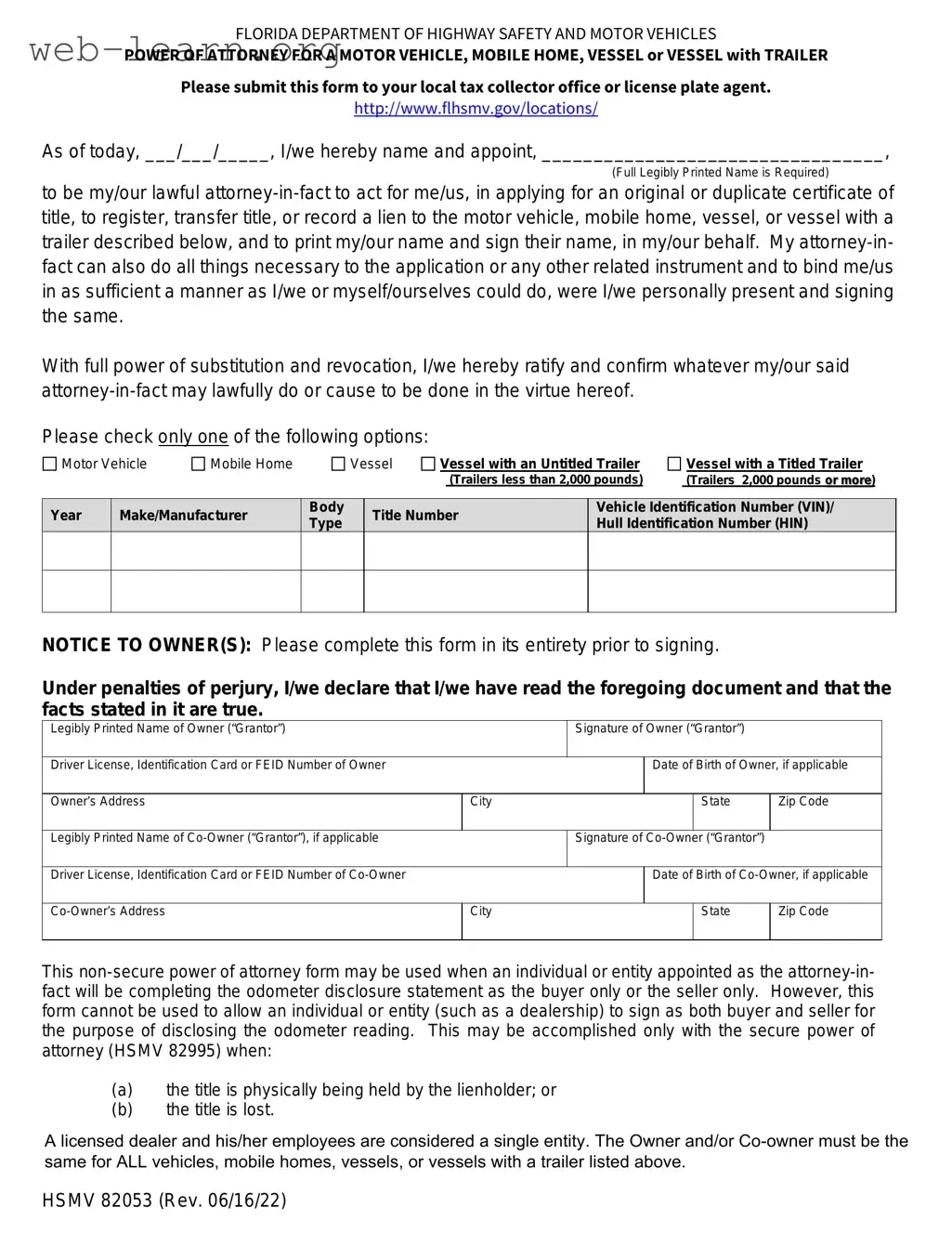
Homepage Blank Florida Vehicle POA form 82053 Form
Outline

The Florida Vehicle Power of Attorney (POA) Form 82053 serves as a vital tool for vehicle owners seeking to delegate specific authority to another individual regarding their vehicle-related transactions. This form allows the designated agent to perform a variety of tasks on behalf of the vehicle owner, including the ability to sign documents, register or title the vehicle, and even handle the sale or transfer of ownership. By utilizing this form, vehicle owners can ensure that their interests are represented while they may be unavailable or unable to manage these responsibilities personally. The POA is particularly useful in situations where the owner is out of state, incapacitated, or simply prefers to appoint someone else to handle these matters. Additionally, the form requires specific information, such as the names and addresses of both the principal and the agent, as well as details about the vehicle in question. Overall, the Florida Vehicle POA Form 82053 simplifies the process of vehicle management, providing peace of mind for owners while enabling their chosen representatives to act effectively on their behalf.

Sample - Florida Vehicle POA form 82053 Form

FLORIDA DEPARTMENT OF HIGHWAY SAFETY AND MOTOR VEHICLES
POWER OF ATTORNEY FOR A MOTOR VEHICLE, MOBILE HOME, VESSEL or VESSEL with TRAILER
HSMV 82053 (Rev. 06/16/22)
Please submit this form to your local tax collector office or license plate agent.
http://www.flhsmv.gov/locations/
As of today, ___/___/_____, I/we hereby name and appoint, _________________________________,
(Full Legibly Printed Name is Required)
to be my/our lawful attorney-in-fact to act for me/us, in applying for an original or duplicate certificate of
title, to register, transfer title, or record a lien to the motor vehicle, mobile home, vessel, or vessel with a
trailer described below, and to print my/our name and sign their name, in my/our behalf. My attorney-in-
fact can also do all things necessary to the application or any other related instrument and to bind me/us
in as sufficient a manner as I/we or myself/ourselves could do, were I/we personally present and signing
the same.
With full power of substitution and revocation, I/we hereby ratify and confirm whatever my/our said
attorney-in-fact may lawfully do or cause to be done in the virtue hereof.
Please check only one of the following options:
Motor Vehicle
Mobile Home
Vessel
Vessel with an Untitled Trailer
(Trailers less than 2,000 pounds)
Vessel with a Titled Trailer
(Trailers 2,000 pounds or more)
Year Make/Manufacturer
Body
Type
Title Number
Vehicle Identification Number (VIN)/
Hull Identification Number (HIN)
NOTICE TO OWNER(S): Please complete this form in its entirety prior to signing.
Under penalties of perjury, I/we declare that I/we have read the foregoing document and that the
facts stated in it are true.
Legibly Printed Name of Owner (“Grantor”)
Signature of Owner (“Grantor”)
Date of Birth of Owner, if applicable
Owner’s Address
City
State
Zip Code
Legibly Printed Name of Co-Owner (“Grantor”), if applicable
Signature of Co-Owner (“Grantor”)
Date of Birth of Co-Owner, if applicable
Co-Owner’s Address
City
State
Zip Code
This non-secure power of attorney form may be used when an individual or entity appointed as the attorney-in-
fact will be completing the odometer disclosure statement as the buyer only or the seller only. However, this
form cannot be used to allow an individual or entity (such as a dealership) to sign as both buyer and seller for
the purpose of disclosing the odometer reading. This may be accomplished only with the secure power of
attorney (HSMV 82995) when:
(
a)
t
he title is physically being held by the lienholder; or
(b) the title is lost.
A licensed dealer and his/her employees are cons
idered a single entity. The Owner and/or Co-owner must be the
same for ALL vehicles, mobile homes, vessels, or vessels with a trailer listed above.

Form Information

Fact Name Description
Purpose The Florida Vehicle POA form 82053 allows an individual to designate another person to act on their behalf in matters related to vehicle transactions.
Governing Law This form is governed by Florida Statutes Chapter 709, which outlines the powers of attorney in the state.
Usage The form is typically used for tasks such as registering a vehicle, transferring ownership, or obtaining a title.
Requirements To be valid, the form must be signed by the principal (the person granting the authority) and may need to be notarized, depending on the specific transaction.

Detailed Guide for Filling Out Florida Vehicle POA form 82053

Completing the Florida Vehicle POA form 82053 is essential for delegating authority regarding vehicle-related matters. Once filled out, the form will need to be submitted to the appropriate agency or individual to ensure the designated person can act on behalf of the vehicle owner.

  1. Obtain a copy of the Florida Vehicle POA form 82053. This can be downloaded from the Florida Department of Highway Safety and Motor Vehicles website or obtained at a local tax collector's office.
  2. Begin by filling in the owner's information. Provide the full name, address, and contact information of the vehicle owner.
  3. Next, enter the vehicle information. This includes the vehicle identification number (VIN), make, model, and year of the vehicle.
  4. Designate the agent by entering their full name and contact information. This person will have the authority to act on behalf of the owner.
  5. Specify the scope of authority granted to the agent. Clearly outline what actions the agent can take regarding the vehicle.
  6. Sign and date the form. The owner must sign to validate the document, indicating consent for the agent to act on their behalf.
  7. Have the form witnessed or notarized. Depending on the requirements, a witness signature or notarization may be necessary for the form to be legally binding.
  8. Submit the completed form to the appropriate agency or individual as required. Keep a copy for personal records.

Obtain Answers on Florida Vehicle POA form 82053

  1. What is the Florida Vehicle POA form 82053?

    The Florida Vehicle Power of Attorney (POA) form 82053 is a legal document that allows an individual (the principal) to authorize another person (the agent) to act on their behalf regarding vehicle-related matters. This includes tasks such as transferring ownership, registering a vehicle, or obtaining a duplicate title. It is particularly useful when the principal is unable to attend to these matters in person.

  2. Who can be appointed as an agent using this form?

    Any competent adult can be appointed as an agent through the Florida Vehicle POA form 82053. This means the person must be at least 18 years old and capable of understanding the responsibilities involved. Common choices for agents include family members, friends, or trusted professionals who can handle vehicle transactions effectively.

  3. How do I complete the Florida Vehicle POA form 82053?

    Completing the form is straightforward. First, ensure you have the correct version of the form, which can typically be obtained from the Florida Department of Highway Safety and Motor Vehicles website or local tax collector's office. Fill in the required information, including the names and addresses of both the principal and the agent, as well as details about the vehicle in question. After completing the form, both parties must sign it. It's advisable to have the signatures notarized to enhance the document's validity.

  4. Is the Florida Vehicle POA form 82053 valid indefinitely?

    No, the Florida Vehicle POA form 82053 is not valid indefinitely. The power of attorney can be revoked at any time by the principal, as long as they are mentally competent. Additionally, the authority granted in the form may also expire after a specific transaction is completed or if a specified time period is indicated in the document. Always keep a copy of the revocation notice if you decide to cancel the POA to prevent any future misunderstandings.

Common mistakes

When filling out the Florida Vehicle Power of Attorney (POA) form 82053, many individuals make common mistakes that can lead to delays or complications. One frequent error is not including all required information. The form requires specific details about the vehicle, the principal (the person granting authority), and the agent (the person receiving authority). Omitting any of this information can render the form invalid.

Another mistake involves failing to sign the form. Both the principal and the agent must provide their signatures. Without these signatures, the document cannot be executed properly. It's essential to ensure that all required parties sign the form in the designated areas to avoid any issues.

People often overlook the notarization requirement. In Florida, the POA form typically needs to be notarized to be legally binding. Skipping this step can result in the form being rejected by the Department of Highway Safety and Motor Vehicles. Always check that a notary public has signed and stamped the document.

Inaccurate or unclear information is another common issue. Individuals sometimes provide incorrect vehicle identification numbers (VINs) or misspell names. This can create confusion and may lead to legal challenges later on. Double-checking all entries for accuracy is crucial before submitting the form.

Lastly, people often forget to keep copies of the completed form. After filling out the POA, it is important to retain a copy for personal records. This ensures that both the principal and the agent have access to the document if any questions arise in the future. Keeping a record can save time and effort should any disputes occur.

Documents used along the form

When dealing with vehicle transactions in Florida, the Florida Vehicle Power of Attorney (POA) form 82053 is a critical document. However, it is often accompanied by various other forms and documents that help facilitate the process. Understanding these additional documents can streamline your experience and ensure that everything proceeds smoothly.

  • Florida Vehicle Registration Application (HSMV 82040): This form is used to apply for the registration of a vehicle in Florida. It collects essential information about the vehicle and the owner, ensuring that the vehicle is properly registered with the state.
  • Title Application (HSMV 82042): When buying or selling a vehicle, this application is necessary to transfer the title. It includes details about the buyer, seller, and the vehicle, ensuring that ownership is legally transferred.
  • Bill of Sale: This document serves as proof of the sale of a vehicle. It outlines the terms of the sale, including the purchase price and the date of the transaction, and is essential for both the buyer and seller.
  • Odometer Disclosure Statement: Required for most vehicle sales, this statement verifies the vehicle's mileage at the time of sale. It helps prevent fraud and ensures transparency in the transaction.
  • Application for Duplicate Title (HSMV 82101): If the original title is lost or damaged, this application allows the owner to request a duplicate title. It is crucial for maintaining ownership records.
  • Notice of Sale (HSMV 82050): This form notifies the Florida Department of Highway Safety and Motor Vehicles of the sale of a vehicle. It helps to update state records and protect the seller from future liabilities.
  • Insurance Verification: Proof of insurance is often required when registering a vehicle or transferring ownership. This document confirms that the vehicle is covered under an active insurance policy.
  • Identification Documents: A valid driver's license or state ID is typically required to complete vehicle transactions. This helps verify the identity of the individuals involved in the process.

Each of these documents plays a significant role in ensuring that vehicle transactions are conducted legally and efficiently in Florida. Familiarizing yourself with them can save you time and prevent potential issues down the road. Always ensure that you have the necessary paperwork ready when engaging in vehicle-related activities.

Similar forms

  • General Power of Attorney: This document allows an individual to grant another person broad authority to act on their behalf in various matters, including financial and legal decisions. Like the Vehicle POA, it empowers an agent to manage specific tasks, but it covers a wider range of issues.
  • Limited Power of Attorney: Similar to the Vehicle POA, this document restricts the agent's authority to specific tasks or timeframes. It is often used for particular transactions, such as selling a property or handling vehicle registration.
  • Durable Power of Attorney: This document remains effective even if the principal becomes incapacitated. The Vehicle POA is also durable, allowing the agent to continue handling vehicle-related matters when the principal is unable to do so.
  • Health Care Power of Attorney: While focused on medical decisions, this document allows an individual to designate someone to make health care choices on their behalf. Like the Vehicle POA, it involves appointing an agent to act in specific situations.
  • Financial Power of Attorney: This document grants authority specifically for financial matters. It is similar to the Vehicle POA in that it allows the agent to manage financial transactions, but it encompasses a broader range of financial responsibilities.
  • Real Estate Power of Attorney: This document permits an agent to handle real estate transactions on behalf of the principal. Like the Vehicle POA, it focuses on a specific type of property and empowers the agent to act in the principal's best interest.
  • Business Power of Attorney: This document enables an agent to manage business affairs for the principal. Similar to the Vehicle POA, it allows the agent to take actions necessary for the operation of a business or transaction.
  • Vehicle Title Transfer Form: While not a power of attorney, this form is used to officially transfer ownership of a vehicle. The Vehicle POA may be required alongside this form to authorize someone else to complete the transfer.
  • Release of Liability Form: This document protects the seller from future claims after selling a vehicle. Similar to the Vehicle POA, it involves the transfer of responsibilities from one party to another.
  • Affidavit of Heirship: This document is used to establish the heirs of a deceased person and can be relevant in transferring vehicle ownership. Like the Vehicle POA, it facilitates the transfer of rights and responsibilities.

Dos and Don'ts

When filling out the Florida Vehicle POA form 82053, it's essential to approach the task with care. Here are some important dos and don'ts to keep in mind:

  • Do read the entire form thoroughly before starting to fill it out.
  • Do provide accurate and complete information to avoid delays.
  • Do sign and date the form where indicated to validate your authorization.
  • Do keep a copy of the completed form for your records.
  • Don't leave any required fields blank; this could lead to processing issues.
  • Don't forget to check for any specific instructions related to your situation.

By following these guidelines, you can help ensure that your submission is processed smoothly and efficiently.

Misconceptions

The Florida Vehicle Power of Attorney (POA) form 82053 is often misunderstood. Below are seven common misconceptions about this form, along with clarifications.

  • Misconception 1: The form can only be used for transferring ownership of a vehicle.
  • This is incorrect. The Florida Vehicle POA form can also authorize someone to perform various tasks related to vehicle registration, title transfers, and more, not just ownership transfers.

  • Misconception 2: Only the vehicle owner can fill out the form.
  • While the vehicle owner must sign the form, a representative can assist in filling it out, ensuring that all necessary information is included.

  • Misconception 3: The POA is permanent and cannot be revoked.
  • This is false. The vehicle owner can revoke the POA at any time, provided they follow the proper procedures to do so.

  • Misconception 4: The form needs to be notarized to be valid.
  • Notarization is not required for the Florida Vehicle POA form. However, having it notarized can provide an additional layer of verification.

  • Misconception 5: The form is only valid in Florida.
  • While the form is specific to Florida laws, it may be accepted in other states for vehicle-related transactions, depending on local regulations.

  • Misconception 6: There is a fee to file the POA form.
  • Generally, there is no fee associated with completing the POA form itself. However, fees may apply for the transactions conducted using the POA.

  • Misconception 7: The POA can be used for any type of vehicle.
  • The Florida Vehicle POA form is specifically designed for motor vehicles. It may not be applicable for other types of vehicles, such as boats or trailers.

Key takeaways

The Florida Vehicle Power of Attorney (POA) form 82053 is a crucial document for vehicle owners in Florida. Here are key takeaways to consider when filling out and using this form:

  • The form allows you to designate an individual to act on your behalf regarding vehicle-related transactions.
  • Ensure that the person you choose as your agent is trustworthy and reliable, as they will have significant authority over your vehicle.
  • Complete all required fields accurately, including the vehicle identification number (VIN) and your personal information.
  • The form must be signed in the presence of a notary public to be legally binding.
  • Once completed, provide a copy of the signed form to your agent for their records.
  • This POA can be used for various tasks, such as transferring ownership, registering the vehicle, or obtaining a title.
  • Keep a copy of the form for your records in case any disputes arise regarding the authority granted.
  • Understand that the authority granted through this form can be revoked at any time by submitting a written notice to your agent.
  • Consult with a legal professional if you have questions about the implications of granting power of attorney for your vehicle.