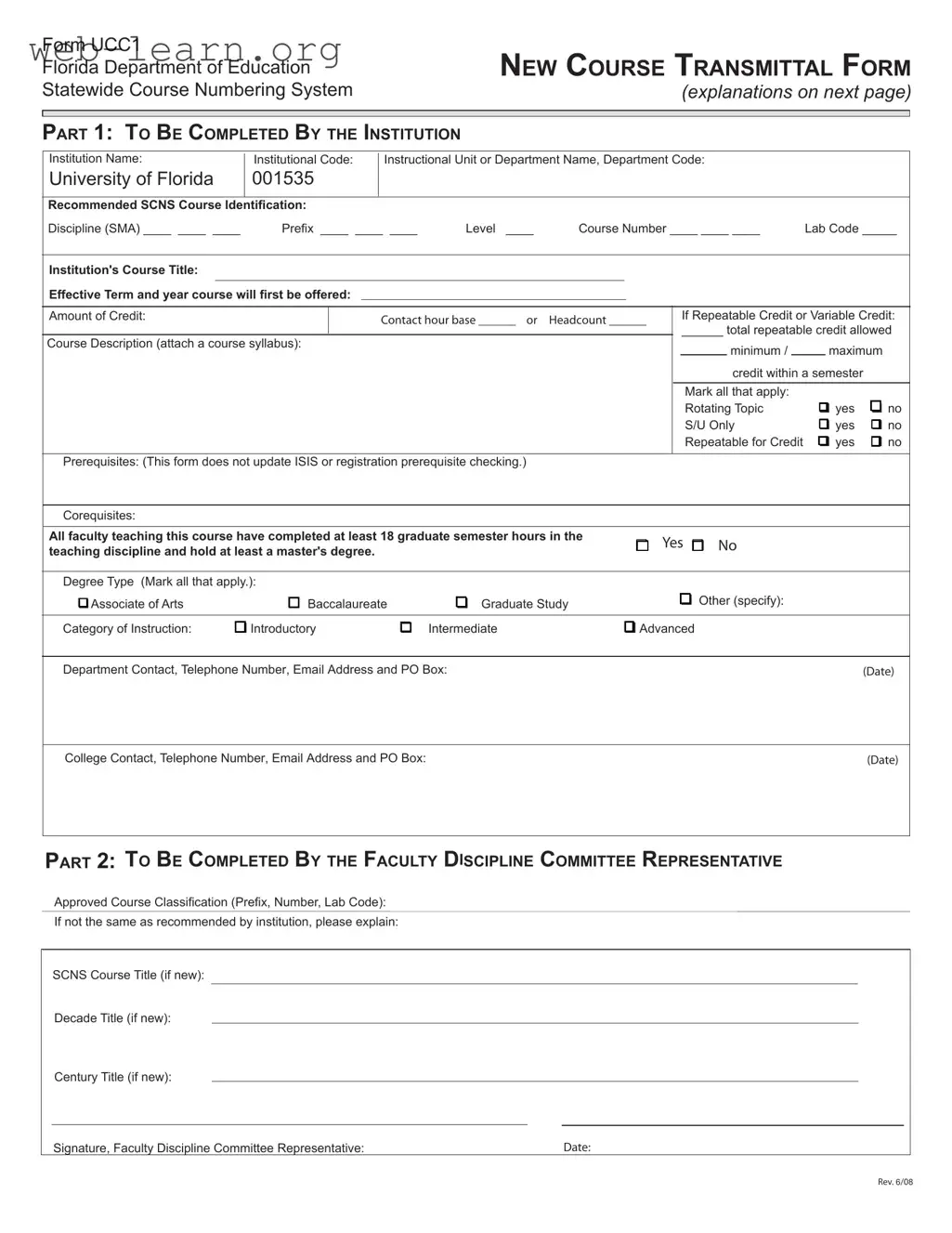
Homepage Blank Florida Ucc1 Form
Outline

The Florida UCC1 form plays a crucial role in the process of introducing new courses within the state's education system. This form is used to communicate essential information about a proposed course to the Statewide Course Numbering System (SCNS). It captures a variety of details, including the institution's name, the course title, the amount of credit, and the effective term when the course will first be offered. Additionally, it requires information about prerequisites, corequisites, and the qualifications of faculty teaching the course. The form also includes sections for departmental approvals, ensuring that all necessary parties have reviewed and agreed upon the course details. Completing the UCC1 form accurately is vital, as it not only aids in maintaining an organized inventory of courses but also supports the academic integrity and quality of education in Florida. By following the specific guidelines outlined in the form, institutions can streamline the process of adding new courses, making it easier for students to access a diverse range of learning opportunities.


Sample - Florida Ucc1 Form

Prerequisites: (This form does not update ISIS or registration prerequisite checking.)
Corequisites:
Degree Type (Mark all that apply.):
Associate of Arts Baccalaureate Graduate Study
Category of Instruction: Introductory Intermediate Advanced
Institution Name:
University of Florida
Rev. 6/08
001535
NEW COURSE TRANSMITTAL FORM
(explanations on next page)
(Date)
minimum / maximum
credit within a semester
Institution's Course Title:
Department Contact, Telephone Number, Email Address and PO Box:
(Date)
College Contact, Telephone Number, Email Address and PO Box:
Signature, Faculty Discipline Committee Representative:
Date:
Form UCC1
Florida Department of Education
Statewide Course Numbering System
PART 1: TO BE COMPLETED BY THE INSTITUTION
Institutional Code: Instructional Unit or Department Name, Department Code:


Amount of Credit:
If Repeatable Credit or Variable Credit:
______ total repeatable credit allowed
Contact hour base ______ or Headcount ______
Mark all that apply:
Rotating Topic yes no
S/U Only yes no
Repeatable for Credit yes no
Course Description (attach a course syllabus):


Yes
No
PART 2:
TO BE COMPLETED BY THE FACULTY D
I
SCIPLINE COMMITTEE REPRESENTATIVE

If not the same as recommended by institution, please explain:
SCNS Course Title (if new):
Decade Title (if new):
Century Title (if new):

Other (specify):
NEW COURSE UCC-1 FORM INSTRUCTIONS FOR COMPLETION OF PART 1
The New Course Transmittal form is used for transmitting new course information to the Statewide Course Numbering System (SCNS):
1. Institutional RECOMMENDATIONS 
2. Additional course information to be recorded in the SCNS inventory.


must be completed and the course syllabus attached before it is forwarded to the Florida Department of Education (DOE).

 Academic unit and code number of department code responsible for teaching the course. Use
complete name, not abbreviations or acronyms.


 A three-digit code representing a broad Subject Matter Area. This code can be obtained from the SCNS handbook.
 A three-letter code indicating placement of a course within the discipline.
Level: A one-digit code preceding the course number that indicates the level (e.g., freshman, sophomore, etc.) at which the
course is to be taught. This number is to be recommended by the institution according to state and institutional policy.


 This code is left blank if the course is a lecture course (has no laboratory component). The letter "C" may be used

associated lecture course.
Institution's Course Title: The title of the course as it is to appear in the catalog.

 The amount of credit is regulated by Rule 6A-10.033, FAC.

"Base" contact hours are determined by dividing the total number of classroom meeting hours per semester by the
number of weeks in the semester. For example,
8 (hours class meets per week) x 4 (number of weeks class meets) = 32 = 2 Base Contact Hours
16 (number of weeks in semester)
"Headcount" contact hours are determined by dividing the average number of hours the instructor meets with one student during
the semester by 3 times the number of weeks in the semester. For example,
1 (average number hours per student) x 16 (number weeks in semester) = 16 = .33 Headcount Contact Hours
3 x 16 (number of weeks in semester)
 Provide a brief narrative description of the course content. Attach a course syllabus and outline of major topics,
readings and grading criteria.
Mark 'yes' or 'no' if a course is to be rotating topic, S/U grading only or is repeatable for credit.
Prerequisites:
course.
Corequisites: 
Indicate yes or no if the faculty teaching this course have completed at least 18 graduate semester hours in the
teaching discipline and hold at least a master's degree.

registered nurses, retail merchants, etc.
 Introductory courses are those that require no prerequisites and are general in nature. Intermediate courses

enrollment.


Approvals
Submit the completed form using the online tracking system at approval.ufl.edu. Appropriate approvals and notifications will be made
through the online tracking system.

 Approval of the college-level curriculum committee or, if no such committee exists, approval of the college.
 All graduate level courses must be approved by the Graduate Curriculum Committee.

Part II.
the Office of the University Registrar at 
3Cthe Graduate School at  Questions concerning the online
system should be emailed to [email protected].
16
48

Form Information

Fact Name Details
Purpose The Florida UCC1 form is used to transmit new course information to the Statewide Course Numbering System (SCNS).
Institutional Recommendations Institutions must provide recommendations regarding prefixes and course numbers for new courses on the form.
Required Attachments A course syllabus must be attached to the UCC1 form before submission to ensure proper review.
Contact Hours Calculation Contact hours can be calculated as "base" or "headcount," depending on the method used to determine student engagement.
Faculty Credentials Faculty teaching the course must hold at least a master's degree and have completed 18 graduate semester hours in the teaching discipline.
Approval Process The completed form must be submitted through an online tracking system for approval by the department chair and college dean.
Effective Term The form requires the effective term and year when the course will first be offered.
Governing Law The Florida UCC1 form is governed by Florida Administrative Code Rule 6A-10.033.

Detailed Guide for Filling Out Florida Ucc1

Filling out the Florida UCC1 form requires careful attention to detail. Each section must be completed accurately to ensure the form is processed without delays. Below are the steps to guide you through the completion of the form.

  1. Institution Name: Enter the full name of your institution.
  2. Institutional Code: Input the unique code assigned to your institution.
  3. Instructional Unit or Department Name: Provide the complete name of the department responsible for the course.
  4. Department Code: Enter the corresponding code for the department.
  5. Recommended SCNS Course Identification: Fill in the following:
    • Discipline (SMA): A three-digit code representing the subject area.
    • Prefix: A three-letter code for the course placement.
    • Level: A one-digit code indicating the course level.
    • Course Number: A three-digit code for the specific course content.
    • Lab Code: Leave blank for lecture courses or use "C" for combined courses and "L" for lab courses.
  6. Institution's Course Title: Write the title as it will appear in the catalog.
  7. Effective Term and Year: Specify when the course will first be offered.
  8. Amount of Credit: Indicate the credit amount.
  9. Contact Hour Base: Choose between "Base" or "Headcount" contact hours.
  10. If Repeatable Credit or Variable Credit: Specify the total repeatable credit allowed.
  11. Course Description: Attach a syllabus outlining the course content.
  12. Mark All That Apply: Indicate if the course has rotating topics, S/U grading, or is repeatable for credit.
  13. Prerequisites: List any required courses or conditions for enrollment.
  14. Corequisites: Mention any courses that must be taken concurrently.
  15. Faculty Credentials: Indicate if faculty meet the required qualifications.
  16. Degree Type: Check all applicable categories for the course.
  17. Category of Instruction: Select the appropriate level of the course (Introductory, Intermediate, Advanced).
  18. Department Contact Information: Provide the name, phone number, email address, and PO Box.
  19. College Contact Information: Include the college's contact details.
  20. Part 2: Do not complete this section.
  21. Submit the form: Use the online tracking system at approval.ufl.edu for submission.

Once you have completed the form, ensure all required attachments are included before submitting. This will help facilitate a smooth review process. If you have any questions, reach out to the appropriate office for assistance.

Obtain Answers on Florida Ucc1

  1. What is the purpose of the Florida UCC1 form?

    The Florida UCC1 form, also known as the New Course Transmittal form, serves as a means for educational institutions to submit information about new courses to the Statewide Course Numbering System (SCNS). This form ensures that all necessary details regarding a course, including its title, credit hours, and prerequisites, are documented and approved. It helps maintain a comprehensive inventory of courses offered across institutions in Florida.

  2. What information is required to complete the UCC1 form?

    To properly complete the UCC1 form, several key pieces of information must be provided:

    • Institution Name and Code: The full name of the institution and its corresponding code.
    • Course Details: This includes the course title, effective term, credit amount, and a brief description.
    • Prerequisites and Corequisites: Any required courses or concurrent enrollment details must be indicated.
    • Faculty Credentials: Information about the qualifications of faculty teaching the course is also necessary.

    All sections of Part 1 must be completed, and a course syllabus should be attached before submission to ensure efficient processing.

  3. How does the approval process work for the UCC1 form?

    Once the UCC1 form is completed, it must be submitted through the online tracking system at approval.ufl.edu. The approval process involves several levels:

    • The Department Chair must review and approve the form.
    • The College Dean or the college-level curriculum committee must also provide approval.
    • If the course is graduate-level, the Graduate Dean must approve it through the Graduate Curriculum Committee.

    Notifications regarding the status of the submission will be communicated through the online system, ensuring that all parties are informed throughout the process.

  4. What should I do if I have questions about the UCC1 form?

    If you have questions or need assistance while completing the UCC1 form, there are resources available to help. For general inquiries, you may contact the Office of the University Registrar at 352-392-1374, extension 7237. If your questions pertain specifically to graduate courses, the Graduate School can be reached at 352-392-1282. Additionally, for issues related to the online submission system, you can email [email protected] for further guidance.

Common mistakes

Filling out the Florida UCC1 form can be a straightforward process, but there are common mistakes that individuals often make. Understanding these pitfalls can help ensure that your submission is complete and accurate, which is crucial for a smooth approval process.

One frequent error is not providing the full name of the institution. Instead of abbreviations or acronyms, the complete name should be used. This helps avoid confusion and ensures that the form is processed correctly. Additionally, omitting the Institutional Code can lead to delays. This unique identifier is essential for tracking and managing the course information within the system.

Another mistake involves the course title. It is important to enter the title exactly as it should appear in the catalog. Any discrepancies can cause issues during the review process. Furthermore, failing to specify the effective term and year when the course will first be offered can also result in complications. This information is critical for the scheduling and planning of courses.

Many people overlook the importance of including a course syllabus and description. This documentation provides context and detail about the course content. Without it, the faculty discipline coordinator may not have enough information to make an informed decision regarding course classification. Similarly, marking the appropriate boxes for repeatable credit or S/U grading is essential. Misrepresenting these aspects can lead to misunderstandings about course expectations.

Additionally, when indicating prerequisites and corequisites, it is crucial to be precise. Clearly listing the course codes or content ensures that students understand what they need to complete before enrolling. Failing to do this can result in students being unprepared for the course.

Another common error is not providing accurate contact information. This includes the department and college contacts, along with their phone numbers and email addresses. If questions arise during the review process, having correct contact details allows for timely communication. Lastly, neglecting to obtain the necessary approvals can halt the process entirely. Make sure that all required signatures are collected before submitting the form.

By being aware of these common mistakes and taking the time to double-check your entries, you can facilitate a smoother submission process for your Florida UCC1 form. A well-prepared form not only saves time but also helps in getting your course approved without unnecessary delays.

Documents used along the form

The Florida UCC1 form is essential for transmitting new course information to the Statewide Course Numbering System. However, several other documents often accompany it to ensure thoroughness and compliance. Below is a list of these forms and documents, each serving a specific purpose in the process.

  • Course Syllabus: This document outlines the course objectives, topics, readings, and grading criteria. It provides students with a clear understanding of what to expect from the course.
  • Faculty Credentials Form: This form verifies that the faculty teaching the course meet the educational qualifications. It confirms that they hold at least a master's degree and have completed the necessary graduate coursework.
  • Department Approval Form: This document shows that the department has reviewed and approved the course proposal. It typically requires signatures from the department chair and other relevant faculty members.
  • Course Classification Form: This form categorizes the course within the Statewide Course Numbering System. It includes details like the course prefix and number, which help in maintaining consistency across institutions.
  • Prerequisite and Corequisite Form: This document outlines any courses that students must complete before enrolling in the new course, as well as any courses that must be taken concurrently.
  • Credit Hour Calculation Worksheet: This worksheet helps determine the appropriate amount of credit hours based on contact hours and instructional time, ensuring compliance with educational standards.
  • Online Submission Confirmation: After submitting the UCC1 form and accompanying documents online, this confirmation serves as proof of submission and tracks the approval process.

Each of these documents plays a crucial role in the course approval process. Together, they help maintain the integrity and quality of educational offerings in Florida. Proper documentation ensures that all stakeholders are informed and that the new course aligns with state regulations and institutional standards.

Similar forms

  • UCC3 Form: Similar to the UCC1, the UCC3 form is used to amend or terminate a UCC filing. It allows parties to update information or remove a lien, just like the UCC1 establishes initial claims on collateral.
  • UCC Financing Statement Addendum: This document supplements the UCC1 filing. It provides additional information about the secured party or collateral, ensuring that all relevant details are captured, similar to how the UCC1 outlines the initial terms.
  • Security Agreement: A security agreement outlines the terms of a loan and describes the collateral. While the UCC1 is a public notice of a security interest, the security agreement contains the specifics of the agreement between the parties.
  • UCC1-AD Form: The UCC1-AD form is used to amend an existing UCC1 filing. It allows for corrections or updates to the original filing, maintaining the integrity of the information, much like the UCC1 serves to establish a claim.

Dos and Don'ts

When filling out the Florida UCC1 form, consider the following dos and don'ts:

  • Do use the complete name of the institution and department without abbreviations.
  • Do ensure all sections of Part 1 are fully completed before submission.
  • Do attach a course syllabus that includes a description and grading criteria.
  • Do verify that faculty credentials meet the requirements specified.
  • Don't leave any required fields blank; this may delay processing.
  • Don't use acronyms or shorthand for course titles or department names.
  • Don't forget to mark whether the course is repeatable or has prerequisites.
  • Don't submit Part II; it is not for completion by the applicant.

Misconceptions

Understanding the Florida UCC1 form can be challenging, leading to several misconceptions. Here are six common misunderstandings about this important document:

  • 1. The UCC1 form is only for new courses. Many believe that the UCC1 form is solely for introducing new courses. In reality, it can also be used to update existing course information, ensuring that all course details are current and accurate.
  • 2. The form does not require a syllabus. Some assume that a syllabus is optional when submitting the UCC1 form. However, attaching a course syllabus is a requirement, as it provides essential information about the course content and structure.
  • 3. Any department can submit the form. There is a misconception that any department can submit the UCC1 form without approval. In fact, the form must be completed and approved by the appropriate Faculty Discipline Committee representative to ensure compliance with institutional policies.
  • 4. The contact hours are the same for all courses. Many people think that contact hours are standardized across all courses. However, contact hours can vary significantly based on the course format, such as lecture versus laboratory, and must be calculated based on specific guidelines.
  • 5. The form is only relevant for undergraduate courses. Some individuals believe that the UCC1 form is exclusively for undergraduate courses. This is incorrect, as it applies to both undergraduate and graduate courses, each requiring different levels of approval.
  • 6. Once submitted, the UCC1 form cannot be changed. A common myth is that submitted forms are final and cannot be amended. In truth, if changes are necessary after submission, institutions can follow specific procedures to update the course information as needed.

Clarifying these misconceptions can help institutions navigate the complexities of the Florida UCC1 form more effectively, ensuring that all course offerings meet the required standards.

Key takeaways

When filling out and using the Florida UCC1 form, it is essential to understand the following key points:

  • Complete All Sections: Ensure that every part of the form is filled out accurately. Missing information can lead to delays in processing.
  • Attach Required Documentation: A course syllabus and any necessary supporting documents must accompany the form. This is crucial for a complete submission.
  • Understand Course Classification: Familiarize yourself with the SCNS taxonomy and course classification system to recommend appropriate prefixes and course numbers.
  • Contact Hours Calculation: Be clear about how contact hours are determined. This will impact the credit allocation for the course.
  • Faculty Credentials: Confirm that faculty teaching the course meet the educational requirements. This includes holding a master’s degree and completing at least 18 graduate semester hours in the teaching discipline.
  • Online Submission: Submit the completed form through the online tracking system at approval.ufl.edu. Ensure you have the necessary approvals before submission.