Homepage Blank Florida Form
Outline

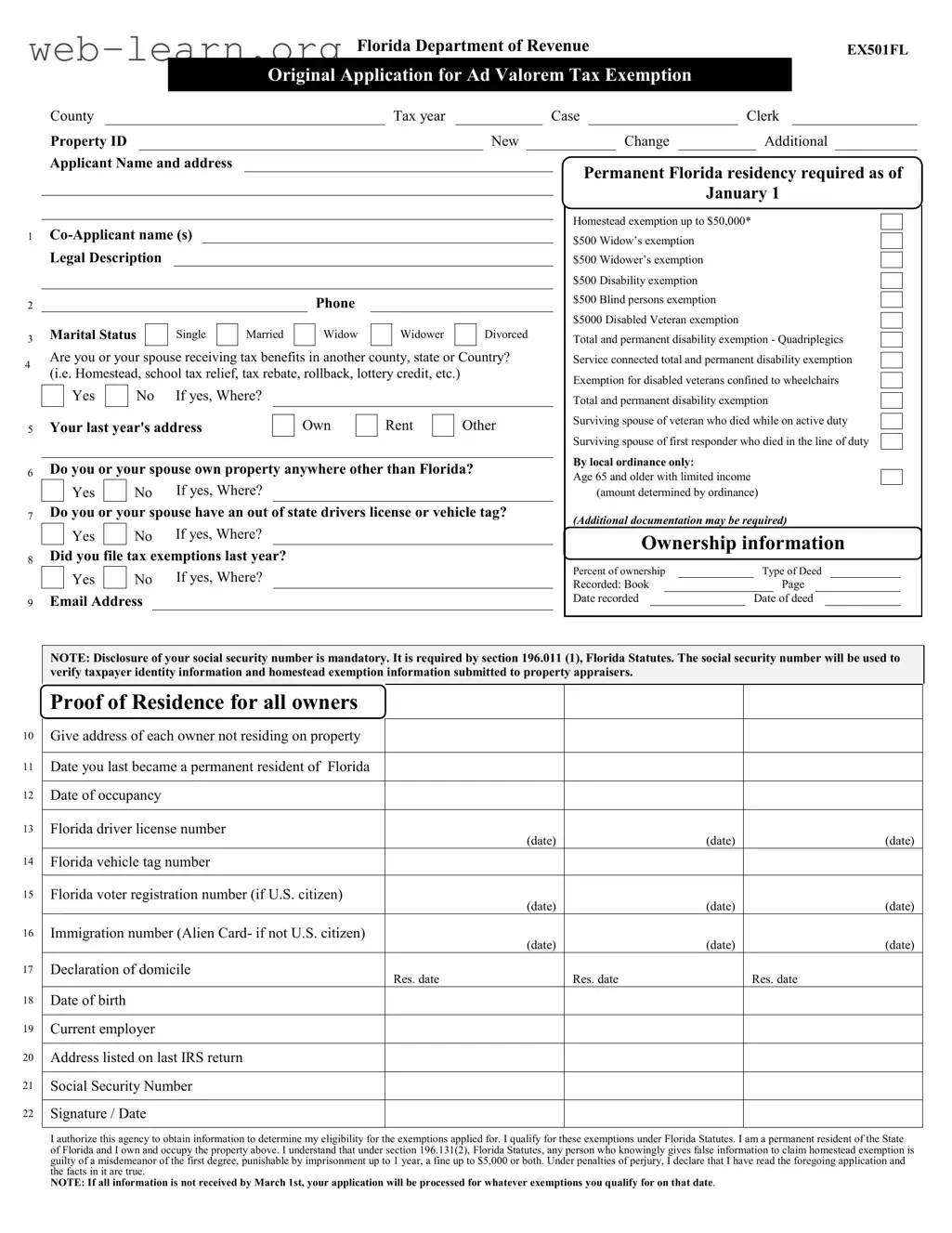
The Florida Department of Revenue's EX501FL form serves as the original application for Ad Valorem Tax Exemption, a crucial document for property owners seeking tax relief in the state. This form requires essential information, including the applicant's name, address, and property identification details. It also prompts applicants to disclose their marital status and whether they or their spouse receive tax benefits in other jurisdictions. A section dedicated to ownership information demands clarity on property ownership percentages and deed details, while additional inquiries cover previous tax exemption filings and residency status. The form outlines various exemptions available, such as the homestead exemption, widow and widower exemptions, and disability exemptions, each with specific eligibility criteria. Furthermore, applicants must provide personal identification information, including Social Security numbers, to verify their identity and confirm residency. The form emphasizes the importance of accurate information, as any false statements can lead to serious legal consequences. Timeliness is also a factor; applications must be submitted by March 1st to ensure consideration for the applicable exemptions. This comprehensive approach aims to assist property owners in navigating the tax exemption process effectively.
Sample - Florida Form

Florida Department of Revenue
EX501FL
Original Application for Ad Valorem Tax Exemption
County
Tax year
Case
Clerk
Property ID
New
Change
Additional
Applicant Name and address
1
Co-Applicant name (s)
Legal Description
2
Phone
3
Marital Status
Single Married Widow Widower Divorced
4
Are you or your spouse receiving tax benefits in another county, state or Country?
(i.e. Homestead, school tax relief, tax rebate, rollback, lottery credit, etc.)
Yes
No
If yes, Where?
5
Your last year's address
Own
Rent
Other
6
Do you or your spouse own property anywhere other than Florida?
Yes
No
If yes, Where?
7
Do you or your spouse have an out of state drivers license or vehicle tag?
Yes
No
If yes, Where?
8
Did you file tax exemptions last year?
Yes
No
If yes, Where?
9
Email Address
NOTE: Disclosure of your social security number is mandatory. It is required by section 196.011 (1), Florida Statutes. The social security number will be used to
verify taxpayer identity information and homestead exemption information submitted to property appraisers.
Proof of Residence for all owners
10
Give address of each owner not residing on property
11
Date you last became a permanent resident of Florida
12
Date of occupancy
13
Florida driver license number
(date)
(date)
(date)
14
Florida vehicle tag number
15
Florida voter registration number (if U.S. citizen)
(date)
(date)
(date)
16
Immigration number (Alien Card- if not U.S. citizen)
(date)
(date)
(date)
17
Declaration of domicile
Res. date
Res. date
Res. date
18
Date of birth
19
Current employer
20
Address listed on last IRS return
21
Social Security Number
22
Signature / Date
I authorize this agency to obtain information to determine my eligibility for the exemptions applied for. I qualify for these exemptions under Florida Statutes. I am a permanent resident of the State
of Florida and I own and occupy the property above. I understand that under section 196.131(2), Florida Statutes, any person who knowingly gives false information to claim homestead exemption is
guilty of a misdemeanor of the first degree, punishable by imprisonment up to 1 year, a fine up to $5,000 or both. Under penalties of perjury, I declare that I have read the foregoing application and
the facts in it are true.
NOTE: If all information is not received by March 1st, your application will be processed for whatever exemptions you qualify for on that date.
Permanent Florida residency required as of
January 1
Homestead exemption up to $50,000*
$500 Widow’s exemption
$500 Widower’s exemption
$500 Disability exemption
$500 Blind persons exemption
$5000 Disabled Veteran exemption
Total and permanent disability exemption - Quadriplegics
Service connected total and permanent disability exemption
Exemption for disabled veterans confined to wheelchairs
Total and permanent disability exemption
Surviving spouse of veteran who died while on active duty
Surviving spouse of first responder who died in the line of duty
By local ordinance only:
Age 65 and older with limited income
(amount determined by ordinance)
(Additional documentation may be required)
Ownership information
Percent of ownership
Type of Deed
Recorded: Book
Page
Date recorded
Date of deed

Form Information

Fact Name Details
Governing Law This form is governed by Florida Statutes, specifically section 196.011 (1) and section 196.131(2).
Purpose The EX501FL form is used to apply for ad valorem tax exemptions in Florida.
Eligibility To qualify, applicants must be permanent residents of Florida and own and occupy the property for which they seek exemption.
Deadline Applications must be submitted by March 1st to be considered for the current tax year.
Types of Exemptions Exemptions include Homestead, Widow's, Widower's, Disability, and Disabled Veteran exemptions, among others.
Social Security Number Disclosure of the applicant's Social Security number is mandatory for identity verification purposes.
Marital Status Applicants must indicate their marital status, which can affect eligibility for certain exemptions.
Out-of-State Property Applicants must disclose if they or their spouse own property outside of Florida.
Tax Benefits in Other Locations Applicants need to disclose if they or their spouse receive tax benefits in another county, state, or country.
Penalties for False Information Providing false information on the application can lead to serious penalties, including fines and imprisonment.

Detailed Guide for Filling Out Florida

Completing the Florida form is an important step in securing your tax exemptions. By providing accurate and thorough information, you ensure that your application is processed smoothly. Below are the steps to guide you through filling out the form effectively.

  1. Begin by entering the County and Tax Year at the top of the form.
  2. Fill in the Property ID associated with your property.
  3. Provide your Name and Address as the primary applicant.
  4. If applicable, include the Co-Applicant Name(s).
  5. Write the Legal Description of your property.
  6. Enter your Phone Number.
  7. Select your Marital Status from the options provided.
  8. Indicate whether you or your spouse are receiving tax benefits in another county, state, or country. Mark Yes or No.
  9. If you answered Yes, specify where you are receiving those benefits.
  10. State whether you Own, Rent, or have Other arrangements.
  11. Provide your last year's address.
  12. Indicate if you or your spouse own property outside of Florida by marking Yes or No.
  13. If you answered Yes, list the location of that property.
  14. Answer whether you or your spouse have an out-of-state driver’s license or vehicle tag by marking Yes or No.
  15. If applicable, provide the location of the out-of-state driver’s license or vehicle tag.
  16. State whether you filed tax exemptions last year by marking Yes or No.
  17. If you answered Yes, specify where you filed those exemptions.
  18. Enter your Email Address.
  19. Fill out the Ownership Information, including percent of ownership and type of deed.
  20. Provide the Date Recorded, Book, and Page for the deed.
  21. List the Proof of Residence for all owners.
  22. Provide the address of each owner not residing on the property.
  23. State the Date you last became a permanent resident of Florida.
  24. Indicate the Date of Occupancy.
  25. Fill in your Florida Driver License Number.
  26. Provide your Florida Vehicle Tag Number.
  27. Enter your Florida Voter Registration Number if you are a U.S. citizen.
  28. If applicable, provide your Immigration Number (Alien Card).
  29. Fill out the Declaration of Domicile with the relevant dates.
  30. Provide your Date of Birth.
  31. List your Current Employer.
  32. Provide the Address listed on your last IRS return.
  33. Enter your Social Security Number.
  34. Sign and date the form at the bottom, acknowledging your eligibility for the exemptions.

Obtain Answers on Florida

  1. What is the purpose of the Florida EX501FL form?

    The Florida EX501FL form is an application for Ad Valorem Tax Exemption. It allows eligible property owners in Florida to apply for various tax exemptions, such as the Homestead Exemption, which can significantly reduce property taxes. Completing this form accurately is essential for receiving the tax benefits available under Florida law.

  2. Who is eligible to apply for these tax exemptions?

    Eligibility typically includes permanent residents of Florida who own and occupy their property. Specific exemptions may have additional criteria, such as age or disability status. For example, individuals aged 65 or older with limited income may qualify for local exemptions determined by ordinance. It is important to review the specific requirements for each exemption to ensure eligibility.

  3. What information is required on the form?

    The form requests detailed information, including:

    • Applicant's name and address
    • Property ID and legal description
    • Marital status
    • Social Security number
    • Proof of residency
    • Details about any other properties owned
    • Previous tax exemption filings

    Providing accurate and complete information is crucial for processing the application.

  4. What happens if the application is incomplete?

    If the application is not fully completed by the March 1st deadline, it will be processed for whatever exemptions are qualified for on that date. Missing information may result in the denial of certain exemptions, so it is vital to ensure all required details are provided.

  5. Is there a deadline for submitting the application?

    Yes, the application must be submitted by March 1st of the tax year for which you are applying. Late submissions may not be considered for the exemptions you are seeking, so timely submission is essential.

  6. What types of exemptions can be applied for?

    The form allows for various exemptions, including:

    • Homestead exemption (up to $50,000)
    • Widow’s and widower’s exemptions ($500 each)
    • Disability exemptions ($500 each)
    • Blind persons exemption ($500)
    • Disabled veteran exemption ($5,000)
    • Exemptions for total and permanent disability

    Each exemption has its own eligibility criteria, so applicants should review these carefully.

  7. What is the significance of the Social Security number on the form?

    The disclosure of your Social Security number is mandatory. It is used to verify your identity and the information provided in the application. Failure to provide this information may lead to delays or denial of the application.

  8. Can I apply for tax exemptions if I own property in another state?

    Yes, you can apply for tax exemptions in Florida even if you own property in another state. However, you must indicate this on the application. It is essential to disclose all relevant information regarding property ownership to ensure compliance with Florida tax laws.

  9. What are the consequences of providing false information on the application?

    Providing false information can lead to serious consequences. Under Florida law, it is considered a misdemeanor of the first degree, which may result in imprisonment for up to one year, a fine of up to $5,000, or both. It is crucial to provide accurate and truthful information when completing the application.

Common mistakes

Completing the Florida form for Ad Valorem Tax Exemption can be a straightforward process, but several common mistakes can lead to complications. One significant error occurs when applicants fail to provide accurate personal information. This includes the correct names, addresses, and social security numbers. Inaccurate details can delay the processing of the application and may even result in denial of the requested exemptions.

Another frequent mistake involves neglecting to disclose other tax benefits received in different counties or states. Applicants must answer this question truthfully, as failing to do so can lead to legal consequences. If an individual or their spouse is receiving tax benefits elsewhere, it is crucial to provide that information. This transparency is essential for the proper evaluation of eligibility for exemptions.

Additionally, many individuals overlook the importance of submitting all required documentation. The application may require proof of residency, ownership information, and other supporting documents. Incomplete submissions can cause delays and may prevent the application from being processed by the March 1st deadline. It is advisable to double-check the checklist of required documents before submission.

Finally, some applicants do not pay close attention to the deadlines associated with the application process. Submitting the form after the deadline can result in automatic disqualification from receiving the exemptions for that tax year. It is essential to be aware of the timelines and to ensure that the application is submitted in a timely manner to avoid missing out on potential benefits.

Documents used along the form

When applying for property tax exemptions in Florida, several additional forms and documents may be required alongside the Florida Department of Revenue EX501FL application. Each of these documents serves a specific purpose in verifying eligibility and ensuring compliance with state laws. Below is a list of commonly used forms and documents that applicants should be aware of.

  • Proof of Residence: This document verifies the applicant's primary residence in Florida. It may include utility bills, bank statements, or lease agreements that display the applicant's name and address.
  • Declaration of Domicile: This form establishes the applicant's intent to make Florida their permanent residence. It is typically filed with the county clerk's office and may be required to support claims for homestead exemptions.
  • Social Security Number Verification: As mandated by Florida law, applicants must provide their Social Security number. This document helps confirm identity and eligibility for tax exemptions.
  • Income Verification: Applicants may need to submit documentation that demonstrates their income level, especially for exemptions based on limited income criteria, such as the age 65 and older exemption.
  • Military Service Documentation: For veterans seeking exemptions, proof of military service may be required. This can include discharge papers or other official documentation verifying service and disability status.
  • Driver's License or ID Verification: A copy of the Florida driver’s license or state ID may be necessary to confirm residency and identity. This is particularly important for applicants who are not U.S. citizens.
  • Previous Tax Exemption Applications: If the applicant has filed for tax exemptions in prior years, providing copies of those applications can help streamline the current application process.

Understanding these additional forms and documents can facilitate a smoother application experience for property tax exemptions in Florida. Ensuring that all required information is submitted accurately and on time will help applicants maximize their benefits and avoid potential delays.

Similar forms

  • Homestead Exemption Application (Florida) - This document serves a similar purpose as the Florida form by allowing homeowners to apply for property tax exemptions. Both require personal information and details about property ownership to determine eligibility for tax relief.
  • Property Tax Exemption Application (California) - Like the Florida form, this application is used to request property tax exemptions. It collects information about the applicant's residency status and any other properties owned, ensuring that only eligible individuals receive the benefits.
  • Application for Property Tax Exemption (New York) - This document is comparable to the Florida form in that it allows residents to apply for tax exemptions based on specific criteria, such as age or disability. Both forms require proof of residency and ownership details.
  • Veteran's Property Tax Exemption Application (Texas) - Similar to the Florida form, this application is specifically designed for veterans seeking tax exemptions. It requires documentation of military service and residency, paralleling the requirements found in the Florida application.
  • Senior Citizen Property Tax Exemption Application (Illinois) - This document shares similarities with the Florida form as it provides a way for senior citizens to apply for tax exemptions based on age and income. Both forms focus on residency and ownership to ensure fair tax relief for eligible applicants.

Dos and Don'ts

When filling out the Florida form for Ad Valorem Tax Exemption, it's important to follow certain guidelines to ensure your application is successful. Here’s a list of things you should and shouldn’t do:

  • Do double-check all personal information for accuracy.
  • Do provide your Social Security number as required.
  • Do ensure you meet the eligibility requirements for the exemptions you are applying for.
  • Do submit your application before the March 1st deadline.
  • Don't leave any sections blank; fill out every part of the form.
  • Don't provide false information; this can lead to serious penalties.
  • Don't forget to include any additional documentation that may be required.

Following these guidelines can help streamline the process and improve your chances of receiving the tax exemptions you seek.

Misconceptions

Here are 10 common misconceptions about the Florida form for Ad Valorem Tax Exemption:

  1. Only homeowners can apply for exemptions. Many believe that only property owners qualify, but renters may also be eligible for certain exemptions.
  2. You must have a Florida driver's license to apply. While having a Florida driver's license is helpful, it's not a strict requirement for submitting the application.
  3. Filing for exemptions is a one-time process. Some think that once they apply, they never have to do it again. However, annual renewal may be necessary to maintain eligibility.
  4. All exemptions are the same. There are various exemptions available, such as for widows, veterans, and the disabled, each with different eligibility criteria.
  5. Exemptions apply automatically. Many assume that exemptions will be automatically applied once they qualify. In reality, you must submit an application to receive them.
  6. Income level does not affect eligibility. Some people think that income is irrelevant, but certain exemptions may have income limits that affect eligibility.
  7. Proof of residency is optional. This is a misconception. Proof of residency is mandatory for all owners applying for exemptions.
  8. All counties have the same rules. Different counties may have varying rules and additional requirements for exemptions, so it’s important to check local regulations.
  9. Only U.S. citizens can apply. Non-citizens may also qualify for exemptions, depending on their residency status and other factors.
  10. Social security numbers are not needed. Some believe that providing a social security number is optional, but it is required for identity verification purposes.

Understanding these misconceptions can help ensure a smoother application process and better access to potential tax benefits.

Key takeaways

Filling out the Florida form for Ad Valorem Tax Exemption requires careful attention to detail. Here are some key takeaways:

  • Eligibility Requirements: Ensure that you meet the criteria for the exemptions you are applying for, such as being a permanent resident of Florida and owning the property in question.
  • Complete All Sections: Fill out every section of the form accurately. Missing information can delay processing and may result in losing potential exemptions.
  • Deadlines Matter: Submit your application by March 1st to be considered for the exemptions you qualify for on that date. Late submissions may not be processed.
  • Disclosure of Information: Providing your social security number is mandatory. This information will be used to verify your identity and eligibility for the exemptions.