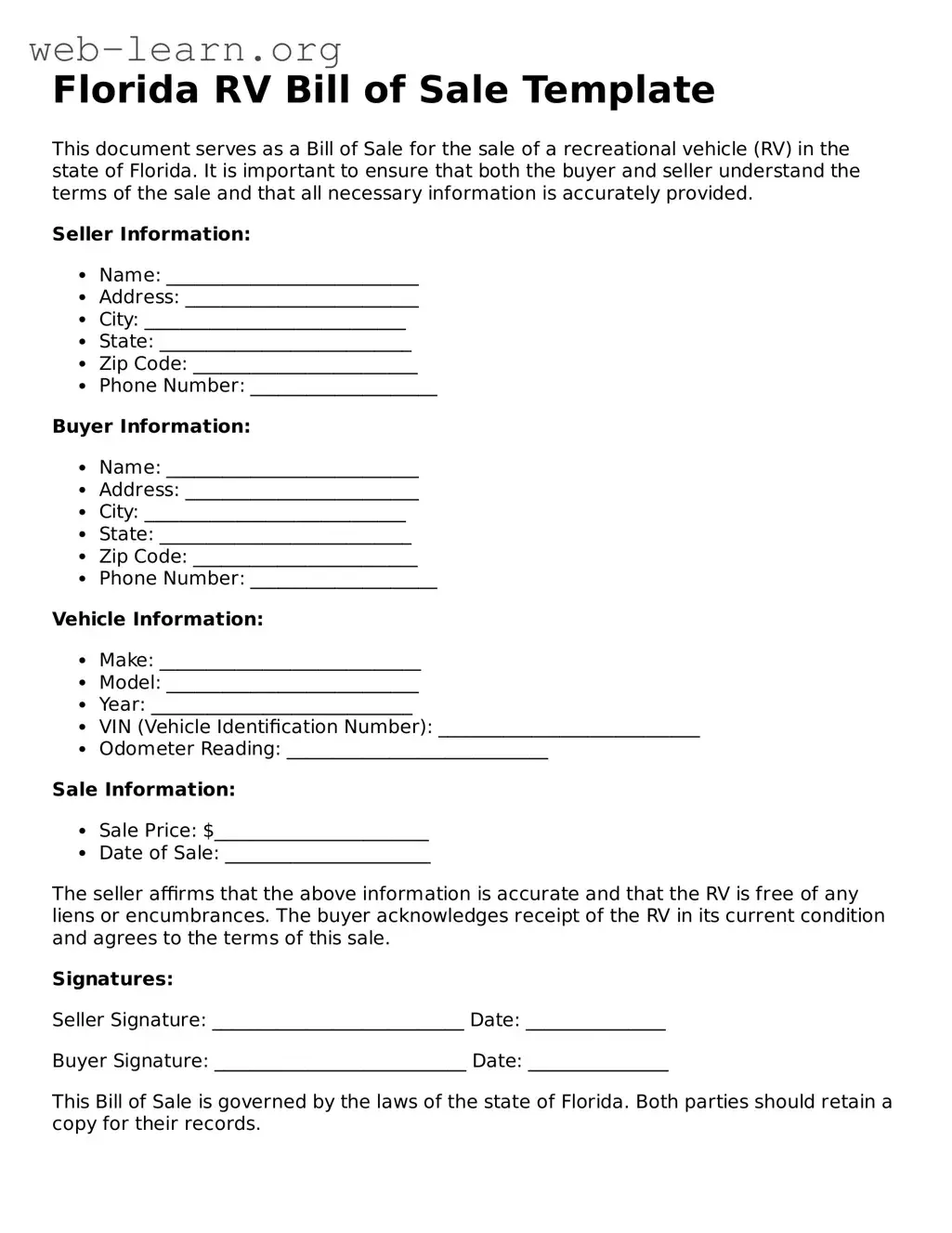
When it comes to purchasing or selling a recreational vehicle (RV) in Florida, having the right documentation is crucial for a smooth transaction. The Florida RV Bill of Sale form serves as an essential record that outlines the details of the sale, ensuring that both the buyer and seller are protected throughout the process. This form typically includes key information such as the names and addresses of both parties involved, a detailed description of the RV—including its make, model, year, and Vehicle Identification Number (VIN)—as well as the sale price and date of the transaction. Additionally, it may contain sections for the seller's disclosures regarding the vehicle's condition, any liens on the RV, and the signatures of both parties, which signify their agreement to the terms laid out in the document. By utilizing this form, individuals can create a clear and legally binding record that not only facilitates the transfer of ownership but also helps prevent potential disputes in the future.
Florida RV Bill of Sale Template
This document serves as a Bill of Sale for the sale of a recreational vehicle (RV) in the state of Florida. It is important to ensure that both the buyer and seller understand the terms of the sale and that all necessary information is accurately provided.
Seller Information:
Buyer Information:
Vehicle Information:
Sale Information:
The seller affirms that the above information is accurate and that the RV is free of any liens or encumbrances. The buyer acknowledges receipt of the RV in its current condition and agrees to the terms of this sale.
Signatures:
Seller Signature: ___________________________ Date: _______________
Buyer Signature: ___________________________ Date: _______________
This Bill of Sale is governed by the laws of the state of Florida. Both parties should retain a copy for their records.
| Fact Name | Description |
|---|---|
| Purpose | The Florida RV Bill of Sale form is used to document the sale or transfer of ownership of a recreational vehicle in Florida. |
| Governing Law | This form is governed by Florida Statutes, specifically Chapter 319, which pertains to the registration and title of vehicles. |
| Requirements | The form must include the seller's and buyer's names, addresses, and signatures, as well as a description of the RV, including its VIN. |
| Notarization | While notarization is not mandatory for all transactions, it is recommended to ensure authenticity and avoid disputes. |
| Tax Implications | Sales tax may be applicable on the sale price of the RV, and both parties should be aware of their tax obligations following the sale. |
| Record Keeping | Both the buyer and seller should keep a copy of the completed Bill of Sale for their records, as it serves as proof of the transaction. |
After obtaining the Florida RV Bill of Sale form, you will need to fill it out carefully. This document is essential for the transfer of ownership of a recreational vehicle in Florida. Ensuring that all information is accurate will help facilitate a smooth transaction.
An RV Bill of Sale is a legal document that records the sale of a recreational vehicle (RV) from one party to another. This document serves as proof of the transaction and includes important details about the RV and the parties involved.
The RV Bill of Sale is important for several reasons:
The RV Bill of Sale typically includes:
In Florida, notarization is not required for an RV Bill of Sale. However, having it notarized can add an extra layer of security and authenticity to the document.
Yes, you can create your own RV Bill of Sale. It is important to include all necessary information to ensure that the document is complete and legally binding. Templates are also available online to help guide you.
Yes, the RV Bill of Sale is typically required when registering the vehicle with the Florida Department of Highway Safety and Motor Vehicles. It serves as proof of ownership and the sale transaction.
If there is a loan or lien on the RV, it is important to resolve this before completing the sale. The seller should pay off the loan, or the buyer should be aware of the lien and agree to take responsibility for it.
After completing the RV Bill of Sale, both the buyer and seller should keep a copy for their records. The buyer should then proceed to register the RV with the state and transfer the title.
While you can use a Bill of Sale from another state, it is advisable to use a Florida-specific RV Bill of Sale. This ensures compliance with state laws and requirements.
You can obtain a Florida RV Bill of Sale form from various sources, including:
When filling out the Florida RV Bill of Sale form, individuals often make several common mistakes that can lead to complications down the line. One frequent error is not providing complete information about the RV. This includes details such as the Vehicle Identification Number (VIN), make, model, year, and odometer reading. Omitting any of these details can create confusion regarding the ownership and history of the vehicle.
Another mistake is failing to accurately identify the buyer and seller. It is essential to include full names, addresses, and contact information for both parties. Incomplete or incorrect information can lead to disputes about ownership or responsibility, making it difficult to resolve issues if they arise.
People also tend to overlook the importance of signatures. Both the seller and the buyer must sign the document to validate the sale. If either party neglects to sign, the bill of sale may not be recognized as a legal document. This could result in problems when trying to register the RV or if any legal disputes occur in the future.
Additionally, some individuals forget to include the sale price. While it may seem straightforward, documenting the agreed-upon amount is crucial for tax purposes and establishing the value of the RV. Leaving this section blank can lead to misunderstandings between the buyer and seller.
Another common error is not providing the date of the sale. This information is vital for record-keeping and can impact the transfer of ownership. Without a clear date, it may be challenging to establish when the transaction occurred, which can complicate matters if any issues arise later.
People sometimes fail to check for errors after completing the form. Simple typos or inaccuracies can cause significant problems. It is advisable to review the document thoroughly to ensure that all information is correct and complete before submitting it.
Lastly, individuals may not be aware of the necessity to keep a copy of the bill of sale. After the transaction, both the buyer and seller should retain a copy for their records. This serves as proof of the transaction and can be helpful if questions about ownership or the sale arise in the future.
When purchasing or selling a recreational vehicle (RV) in Florida, it's important to have the right documents in place. Along with the Florida RV Bill of Sale form, several other forms and documents may be necessary to ensure a smooth transaction. Here’s a list of commonly used documents.
Having these documents prepared and organized can simplify the process of buying or selling an RV in Florida. Each document serves a specific purpose and helps protect the interests of both parties involved in the transaction.
When filling out the Florida RV Bill of Sale form, attention to detail is crucial. Here are seven important things to keep in mind:
Following these guidelines will help ensure a smooth and legally sound transaction.
When it comes to buying or selling an RV in Florida, the RV Bill of Sale form is an essential document. However, several misconceptions can lead to confusion. Here are seven common myths about the Florida RV Bill of Sale form, along with clarifications to set the record straight.
Many people believe that a Bill of Sale is optional. In reality, having this document protects both the buyer and the seller by providing proof of the transaction.
This is not true. Whether the RV is new or used, a Bill of Sale is important for any sale. It helps establish ownership and can be crucial for registration purposes.
While a verbal agreement may seem sufficient, it lacks the legal weight of a written Bill of Sale. Having a documented agreement minimizes disputes and provides clarity.
In Florida, notarization is not a requirement for the RV Bill of Sale. However, having it notarized can add an extra layer of security and credibility.
Both the buyer and seller share the responsibility for ensuring all paperwork is completed correctly. The buyer should also verify that the RV’s title is clear and that there are no outstanding liens.
While various templates exist, it’s best to use a Florida-specific RV Bill of Sale form. This ensures compliance with state laws and includes all necessary information.
Some individuals think that the Bill of Sale is irrelevant for registration purposes. However, it is often required by the Florida Department of Highway Safety and Motor Vehicles when registering the RV.
Understanding these misconceptions can help you navigate the process of buying or selling an RV in Florida more smoothly. Always ensure you have the right documentation to protect your interests.
Filling out and using the Florida RV Bill of Sale form is an essential step in the process of buying or selling a recreational vehicle. Here are some key takeaways to consider:
How to Write a Bill of Sale for a Car in Alabama - Facilitates a smooth transfer of title and registration.
Trailer Bill of Sale Colorado - Buyers use this form to establish ownership of the RV they purchase.