Homepage Blank Florida Realtors Residential Lease Form
Outline

The Florida Realtors Residential Lease form is a comprehensive document designed to facilitate the rental process for both landlords and tenants in multi-family housing situations, including apartments, mobile homes, and condominiums. This form outlines essential details such as the lease term, rental payments, and the responsibilities of both parties. It includes sections that clarify the property being rented, common areas accessible to tenants, and the specifics of rent payments, including any security deposits or advance rent. Additionally, it addresses maintenance responsibilities, utility provisions, and the conditions under which landlords may access the premises. Importantly, the lease also highlights the legal obligations of both landlords and tenants, ensuring that all parties are aware of their rights and responsibilities. This form is not just a template; it serves as a crucial tool for fostering clear communication and understanding between landlords and tenants, ultimately contributing to a smoother rental experience.
Sample - Florida Realtors Residential Lease Form

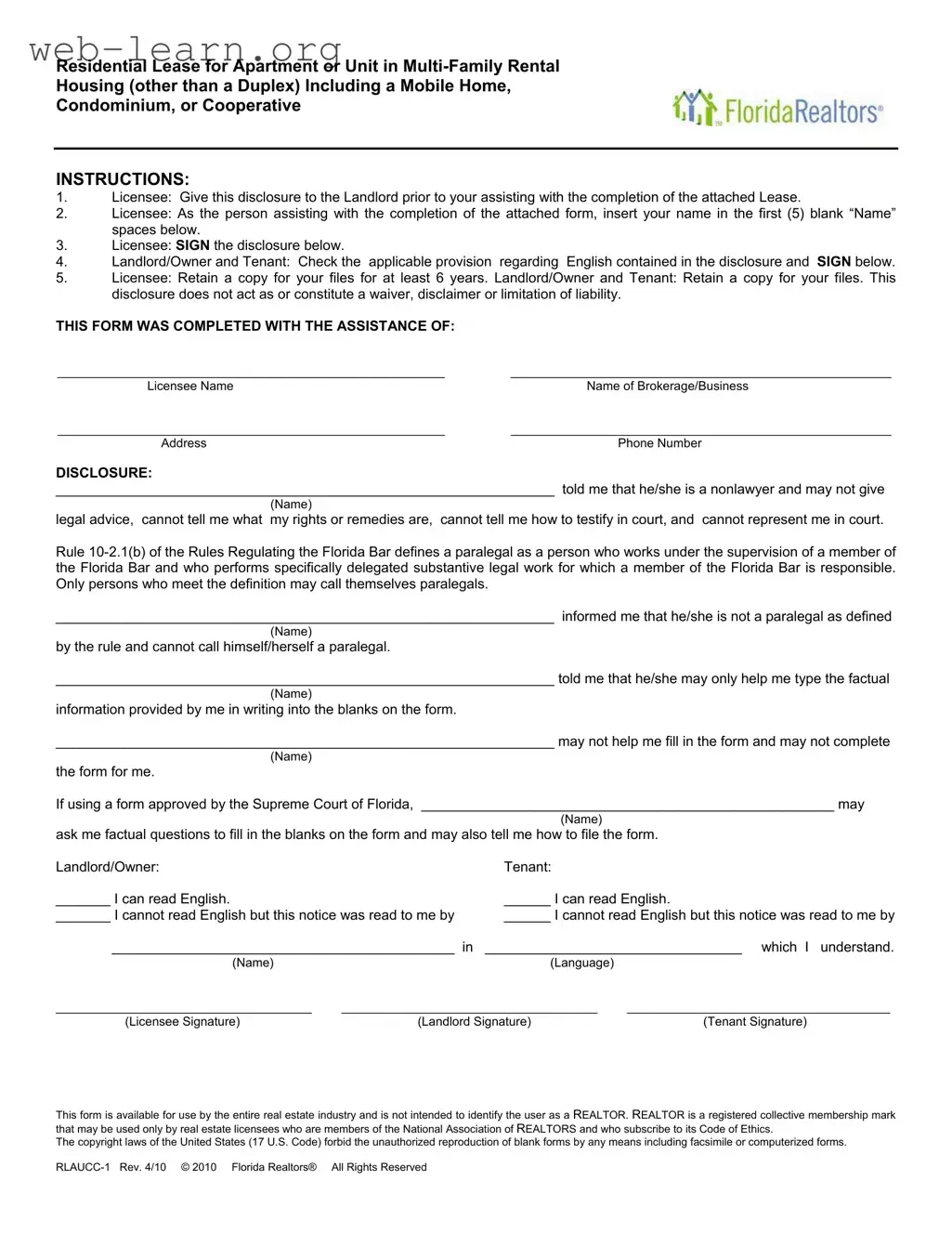
Residential Lease for Apartment or Unit in Multi-Family Rental
Housing (other than a Duplex) Including a Mobile Home,
Condominium, or Cooperative
INSTRUCTIONS:
1. Licensee: Give this disclosure to the Landlord prior to your assisting with the completion of the attached Lease.
2. Licensee: As the person assisting with the completion of the attached form, insert your name in the first (5) blank “Name”
spaces below.
3. Licensee: SIGN the disclosure below.
4. Landlord/Owner and Tenant: Check the applicable provision regarding English contained in the disclosure and SIGN below.
5. Licensee: Retain a copy for your files for at least 6 years. Landlord/Owner and Tenant: Retain a copy for your files. This
disclosure does not act as or constitute a waiver, disclaimer or limitation of liability.
THIS FORM WAS COMPLETED WITH THE ASSISTANCE OF:
________________________________________________________
Licensee Name
_______________________________________________________
Name of Brokerage/Business
________________________________________________________
Address
_______________________________________________________
Phone Number
DISCLOSURE:
________________________________________________________________ told me that he/she is a nonlawyer and may not give
(Name)
legal advice, cannot tell me what my rights or remedies are, cannot tell me how to testify in court, and cannot represent me in court.
Rule 10-2.1(b) of the Rules Regulating the Florida Bar defines a paralegal as a person who works under the supervision of a member of
the Florida Bar and who performs specifically delegated substantive legal work for which a member of the Florida Bar is responsible.
Only persons who meet the definition may call themselves paralegals.
________________________________________________________________ informed me that he/she is not a paralegal as defined
(Name)
by the rule and cannot call himself/herself a paralegal.
________________________________________________________________ told me that he/she may only help me type the factual
(Name)
information provided by me in writing into the blanks on the form.
________________________________________________________________ may not help me fill in the form and may not complete
(Name)
the form for me.
If using a form approved by the Supreme Court of Florida, _____________________________________________________ may
(Name)
ask me factual questions to fill in the blanks on the form and may also tell me how to file the form.
Landlord/Owner: Tenant:
_______ I can read English. ______ I can read English.
_______ I cannot read English but this notice was read to me by ______ I cannot read English but this notice was read to me by
____________________________________________ in _________________________________ which I understand.
(Name) (Language)
_____________________________________
(Licensee Signature)
_____________________________________
(Landlord Signature)
______________________________________
(Tenant Signature)
This form is available for use by the entire real estate industry and is not intended to identify the user as a REALTOR. REALTOR is a registered collective membership mark
that may be used only by real estate licensees who are members of the National Association of REALTORS and who subscribe to its Code of Ethics.
The copyright laws of the United States (17 U.S. Code) forbid the unauthorized reproduction of blank forms by any means including facsimile or computerized forms.
RLAUCC-1 Rev. 4/10 © 2010 Florida Realtors® All Rights Reserved
Residential Lease for Apartment or Unit in Multi-Family Rental
Housing (other than a Duplex) Including a Mobile Home,
Condominium, or Cooperative
________________________________________________________________________________
(FOR A TERM NOT TO EXCEED ONE YEAR)
(Not To Be Used For Commercial, Agricultural, or Other Residential Property)
WARNING: IT IS VERY IMPORTANT TO READ ALL OF THE LEASE CAREFULLY. THE LEASE IMPOSES IMPORTANT LEGAL
OBLIGATIONS.
AN ASTERISK (*) OR A BLANK SPACE (__________) INDICATES A PROVISION WHERE A CHOICE OR A DECISION MUST BE MADE
BY THE PARTIES.
NO CHANGES OR ADDITIONS TO THIS FORM MAY BE MADE UNLESS A LAWYER IS CONSULTED.
1. TERMS AND PARTIES. This is a lease ("the Lease") for a period of __________ months (the "Lease Term"), beginning
(number)
____________________________________________and ending ____________________________________________,between
(month, day, year) (month, day, year)
________________________________________________________ and _______________________________________________
(name of owner of the property) (name(s) of person(s) to whom the property is leased)
(In the Lease, the owner, whether one or more, of the property is called "Landlord." All persons to whom the property is leased are
called "Tenant.")
Landlord's E-mail Address: _____________________________________
Landlord's Telephone Number: _____________________________________
Tenant's E-mail Address: _____________________________________
Tenant's Telephone Number: _____________________________________
II. PROPERTY RENTED. Landlord leases to Tenant apartment or unit no. ___________ in the building located at
_____________________________________________________________________________________________ known as
(street address)
______________________________________________________________________, ___________________________________,
(name of apartment or condominium) (city)
Florida ________________, together with the following furniture and appliances:
(zip code)
_________________________________________________________________________________________________
_________________________________________________________________________________________________
_________________________________________________________________________________________________
[List all furniture and appliances. If none, write "none."] (In the Lease, the property leased, including furniture and appliances, if any, is
called "the Premises.")
III. COMMON AREAS. Landlord grants to Tenant permission to use, during the Lease Term, along with others, the common areas of
the building and the development of which the Premises are a part.
IV. RENT PAYMENTS AND CHARGES. Tenant shall pay rent for the Premises in installments of $______________ each on
the________________________ day of each _________________________ [month, week]
(a "Rental Installment Period," as used in the Lease, shall be a month if rent is paid monthly, and a week if rent is paid weekly.)
Tenant shall pay with each rent payment all taxes imposed on the rent by taxing authorities. The amount of taxes payable on the beginning
date of the Lease is $__________ for each installment. The amount of each installment of rent plus taxes ("the Lease Payment"), as of the
date the Lease begins, is $_____________. Landlord will notify Tenant if the amount of the tax changes. Tenant shall pay the rent and all
other charges required to be paid under the Lease by cash, valid check, or money order. Landlord may appoint an agent to collect the Lease
Payment and to perform Landlord's obligations.
Landlord (____)
(____) and Tenant (____) (____) acknowledge receipt of a copy of this page which is Page 1 of 7
RLAUCC-1 Rev. 4/10 ©2010 Approved for use under rule 10-2.1(a) of The Rules Regulating the Florida Bar
Unless this box is checked, the Lease Payments must be paid in advance beginning ____________________________________.
(date)
If the tenancy starts on a day other than the first day of the month or week as designated above, the rent shall be prorated from
____________________________ through ____________________________ in the amount of $____________ and shall be due
(date) (date)
on ____________________________. (If rent paid monthly, prorate on a 30-day month.)
(date)
V. DEPOSITS, ADVANCE RENT, AND LATE CHARGES. In addition to the Lease Payments described above, Tenant shall pay the
following: (check only those items that apply)
___________ a security deposit of $ _________________ to be paid upon signing the Lease.
___________
advance rent in the amount of $ _________________ for the Rental Installment Periods of ___________________
to be paid upon signing the Lease.
___________ a pet deposit in the amount of $_________________ to be paid upon signing the Lease.
___________
a late charge in the amount of $ _________________ for each Lease Payment made more than _______________
days after the date it is due.
___________
a bad check fee in the amount $ _________________ (not to exceed $20.00 or 5% of the Lease Payment,
whichever is greater) if Tenant makes any Lease Payment with a bad check. It Tenant makes any Lease Payment
with a bad check, Landlord can require Tenant to pay all future Lease Payments in cash or by money order.
___________ Other:_______________________________________________________________________________________
VI. SECURITY DEPOSITS AND ADVANCE RENT. If Tenant has paid a security deposit or advance rent the following provisions apply:
A. Landlord shall hold the money in a separate interest-bearing or non-interest-bearing account in a Florida banking
institution for the benefit of Tenant. If Landlord deposits the money in an interest-bearing account, Landlord must pay Tenant interest of
at least 75% of the annualized average interest paid by the bank or 5% per year simple interest, whichever Landlord chooses. Landlord
cannot mix such money with any other funds of Landlord or pledge, mortgage, or make any other use of such money until the money is
actually due to Landlord; or
B. Landlord must post a surety bond in the manner allowed by law. If Landlord posts the bond, Landlord shall pay
Tenant 5% interest per year.
At the end of the Lease, Landlord will pay Tenant, or credit against rent, the interest due to Tenant. No interest will be
due Tenant if Tenant wrongfully terminates the Lease before the end of the Lease Term.
If Landlord rents 5 or more dwelling units, then within 30 days of Tenant’s payment of the advance rent or any security
deposit, Landlord must notify Tenant in writing of the manner in which Landlord is holding such money, the interest rate, if any, that Tenant
will receive, and when such payments will be made.
VII. NOTICES. ______________________________________________________ is Landlord’s Agent. All notices to Landlord and all
(name)
Lease Payments must be sent to Landlord's Agent at ________________________________________________________________
(address)
unless Landlord gives Tenant written notice of a change. Landlord’s Agent may perform inspections on behalf of Landlord, subject to Article
XII below. All notices to Landlord shall be given by certified mail, return receipt requested, or by hand delivery to Landlord or Landlord’s
Agent.
Any notice to Tenant shall be given by certified mail, return receipt requested, or delivered to Tenant at the Premises. If Tenant is
absent from the Premises, a notice to Tenant may be given by leaving a copy of the notice at the Premises.
VIII. USE OF PREMISES. Tenant shall use the Premises only for residential purposes. Tenant also shall obey, and require anyone on
the Premises to obey, all laws and any restrictions that apply to the Premises. Landlord will give Tenant notice of any restrictions that
apply to the Premises.
If the Premises are located in a condominium or cooperative development, the Lease and Tenant’s rights under it, including as to the
common areas, are subject to all terms of the governing documents for the project, including, without limitation, any Declaration of
Condominium or proprietary lease, and any restrictions, rules, and regulations now existing or hereafter adopted, amended, or
repealed.
Landlord (____)
(____) and Tenant (____) (____) acknowledge receipt of a copy of this page which is Page 2 of 7
RLAUCC-1 Rev. 4/10 ©2010 Approved for use under rule 10-2.1(a) of The Rules Regulating the Florida Bar
Unless this box is checked, Landlord may adopt, modify, or repeal rules and regulations for the use of common areas and conduct
on the Premises during the Lease Term. All rules and regulations must be reasonable and in the best interest of the development in
which the Premises are located.
Occasional overnight guests are permitted. An occasional overnight guest is one who does not stay more than _______ nights in any
calendar month (If left blank, 7). Landlord’s written approval is required to allow anyone else to occupy the Premises.
Unless this box
is checked or a pet deposit has been paid, Tenant may not keep or allow pets or animals on the Premises without
Landlord’s approval of the pet or animal in writing.
Unless this box
is checked, no smoking is permitted in the Premises.
Tenant shall not keep any dangerous or flammable items that might increase the danger of fire or damage on the Premises without
Landlord’s consent.
Tenant shall not create any environmental hazards on or about the Premises.
Tenant shall not destroy, deface, damage, impair, or remove any part of the Premises belonging to Landlord, nor permit any person to do
so.
Tenant may not make any alterations or improvements to the Premises without first obtaining Landlord’s written consent to the
alteration or improvement. However, unless this box
is checked, Tenant may hang pictures and install window treatments in the
Premises without Landlord’s consent, provided Tenant removes all such items before the end of the Lease Term and repairs all
damage resulting from the removal.
Tenant must act, and require all other persons on the Premises to act, in a manner that does not unreasonably disturb any neighbors or
constitute a breach of the peace.
IX. MAINTENANCE. Landlord and Tenant agree that the maintenance of the Premises must be performed by the person indicated
below:
A. Landlord's Required Maintenance. Landlord will comply with applicable building, housing, and health codes relating to
the Premises. If there are no applicable building, housing, or health codes, Landlord shall maintain and repair the roofs, porches, windows,
exterior walls, screens, foundations, floors, structural components, and steps, and keep the plumbing in reasonable working order. If the
Premises are located in a condominium, Landlord and Tenant acknowledge that the maintenance of the structural elements and common
areas is performed by the condominium association as part of the common area maintenance. Landlord shall assure that the association
complies with applicable building, housing, and health codes relating to the Premises. If there are no applicable building, housing, or
health codes, Landlord shall assure that the association maintains and repairs roofs, porches, windows, exterior walls, screens,
foundations, floors, structural components, and steps, and keeps the plumbing in reasonable working order. Landlord will be responsible
for the maintenance of any items listed above for which the association is not responsible.
B. Elective Maintenance. Fill in each blank space in this section with Landlord or Tenant to show who will take care of
the item noted. If a space is left blank, Landlord will be required to take care of that item (or assure that the association takes care of
the items if the Premises are located in a condominium).
___________ Smoke Detectors
___________ Extermination of rats, mice, roaches, ants, woo-destroying organisms, and bedbugs
___________ Locks and keys
___________ Clean and safe condition of outside areas
___________ Garbage removal and outside garbage receptacles
___________ Running water
___________ Hot water
___________ Lawn
___________ Heat
___________ Air conditioning
___________ Furniture
___________ Appliances
___________ Fixtures
___________ Pool (including filters, machinery, and equipment)
___________ Heating and air conditioning filters
___________ Other: ________________________________________________________________________________________
Tenant's responsibility, if any, indicated above, shall not include major maintenance or major replacement of equipment.
Landlord shall be responsible for major maintenance or major replacement of equipment, except for equipment for which Tenant has
accepted responsibility for major maintenance or major replacement in the previous paragraph.
Major maintenance or major replacement means a repair or replacement that costs more than $ _________________.
Landlord (____)
(____) and Tenant (____) (____) acknowledge receipt of a copy of this page which is Page 3 of 7
RLAUCC-1 Rev. 4/10 ©2010 Approved for use under rule 10-2.1(a) of The Rules Regulating the Florida Bar
Tenant shall be required to vacate the Premises on 7 days' written notice, if necessary, for extermination pursuant to this subparagraph.
When vacation of the Premises is required for extermination, Landlord shall not be liable for damages but shall abate the rent.
Nothing in this section makes Landlord responsible for any condition created or caused by the negligent or wrongful act or omission of
Tenant, any member of Tenant's family, or any other person on the Premises with Tenant's consent.
C. Tenant's Required Maintenance. At all times during the Lease Term, Tenant shall:
1. comply with all obligations imposed upon tenants by applicable provisions of building, housing, and health codes;
2. keep the Premises clean and sanitary;
3. remove all garbage from the dwelling unit in a clean and sanitary manner;
4. keep all plumbing fixtures in the dwelling unit clean, sanitary, and in repair; and
5. use and operate in a reasonable manner all electrical, plumbing, sanitary, heating, ventilating, air conditioning, and
other facilities and appliances, including elevators.
X. UTILITIES. Tenant shall pay all charges for hook-up, connection, and deposit for providing all utilities and utility services to the
Premises during the Lease Term except _______________________________________________________________________,
which Landlord agrees to provide at Landlord’s expense. (Specify any utilities to be provided and paid for by Landlord such as water,
sewer, oil, gas, electricity, telephone, garbage removal, etc.).
XI. SERVICEMEMBER. If Tenant is a member of the United States Armed Forces on active duty or state active duty or a member of
the Florida National Guard or United States Reserve Forces, the Tenant has rights to terminate the Lease as provided in Section
83.682, Florida Statutes, the provisions of which can be found in the attachment to this Lease.
XII. LANDLORD'S ACCESS TO PREMISES. Landlord or Landlord's Agent may enter the Premises in the following circumstances:
A. At any time for the protection or preservation of the Premises.
B. After reasonable notice to Tenant at reasonable times for the purpose of repairing the Premises.
C. To inspect the Premises; make necessary or agreed-upon repairs, decorations, alterations, or improvements; supply
agreed services; or exhibit the Premises to prospective or actual purchasers, mortgagees, tenants, workers, or contractors
under any of the following circumstances:
1. with Tenant's consent;
2. in case of emergency;
3. when Tenant unreasonably withholds consent; or
4. if Tenant is absent from the Premises for a period of at least one-half a Rental Installment Period. (If the rent is
current and Tenant notifies Landlord of an intended absence, then Landlord may enter only with Tenant’s consent or
for the protection or preservation of the Premises.)
XIII. PROHIBITED ACTS BY LANDLORD. Landlord is prohibited from taking certain actions as described in Section 83.67, Florida
Statutes, the provisions of which can be found in the attachment to this Lease.
XIV. CASUALTY DAMAGE. If the Premises are damaged or destroyed other than by wrongful or negligent acts of Tenant or persons
on the Premises with Tenant’s consent, so that the use of the Premises is substantially impaired, Tenant may terminate the Lease within
30 days after the damage or destruction and Tenant will immediately vacate the Premises. If Tenant vacates, Tenant is not liable for
rent that would have been due after the date of termination. Tenant may vacate the part of the Premises rendered unusable by the
damage or destruction, in which case Tenant’s liability for rent shall be reduced by the fair rental value of the part of the Premises that
was damaged or destroyed.
XV. DEFAULTS/REMEDIES. Should a party to the Lease fail to fulfill their responsibilities under the Lease or need to determine
whether there has been a default of the Lease, refer to Part II, Chapter 83, entitled Florida Residential Landlord and Tenant A
ct which
contains information on defaults and remedies. A copy of the current version of this Act is attached to the Lease.
XVI. ASSIGNMENT AND SUBLEASING. Unless this box
is checked, Tenant may not assign the Lease or sublease all or any
part of the Premises without first obtaining Landlord’s written approval and consent to the assignment or sublease.
XVII. RISK OF LOSS. Subject to the next sentence, Landlord shall not be liable for any loss by reason of damage, theft, or otherwise
to the contents, belongings, and personal effects of the Tenant, or Tenant’s family, agents, employees, guests, or visitors located in or
about the Premises, or for damage or injury to Tenant or Tenant’s family, agents, employees, guests, or visitors. Nothing contained in this
provision shall relieve Landlord or Tenant from responsibility for loss, damage, or injury caused by its own negligence or willful conduct.
XVIII. SUBORDINATION. The Lease is automatically subordinate to the lien of any mortgage encumbering the fee title to the Premises
from time to time.
XIX. LIENS. The interest of the Landlord shall not be subject to liens for improvements by the Tenant as provided in Section 713.10,
Florida Statutes. Tenant shall notify all parties performing work on the Premises at Tenant’s request that the Lease does not allow any liens
to attach to Landlord’s interest.
Landlord (____) (____) and Tenant (____) (____) acknowledge receipt of a copy of this page which is Page 4 of 7
RLAUCC-1 Rev. 4/10 ©2010 Approved for use under rule 10-2.1(a) of The Rules Regulating the Florida Bar
XX. APPROVAL CONTINGENCY. If applicable, the Lease is conditioned upon approval of Tenant by the association that governs the
Premises. Any application fee required by an association shall be paid by
Landlord
Tenant. If such approval is not obtained
prior to commencement of Lease Term, either party may terminate the Lease by written notice to the other given at any time prior to
approval by the association, and if the Lease is terminated, Tenant shall receive return of deposits specified in Article V, if made. If the
Lease is not terminated, rent shall abate until the approval is obtained from the association. Tenant agrees to use due diligence in
applying for association approval and to comply with the requirements for obtaining approval.
Landlord Tenant shall pay the
security deposit required by the association, if applicable.
XXI. RENEWAL/EXTENSION. The Lease can be renewed or extended only by a written agreement signed by both Landlord and
Tenant, but in no event may the total Lease Term exceed one year. A new lease is required for each year.
XXII. LEAD-BASED PAINT.
Check and complete if the dwelling was built before January 1, 1978. Lead Warning Statement
(when used in this article, the term Lessor refers to Landlord and the term Lessee refers to Tenant)
Housing built before 1978 may contain lead-based paint. Lead from paint, paint chips, and dust can pose health hazards if not managed
properly. Lead exposure is especially harmful to young children and pregnant women. Before renting pre-1978 housing, Lessors must
disclose the presence of known lead-based paint and/or lead-based paint hazards in the dwelling. Lessees must also receive a
federally approved pamphlet on lead poisoning prevention.
Lessor's Disclosure (initial)
_________(a) Presence of lead-based paint or lead-based paint hazards (check (i) or (ii) below):
(i) _____ Known lead-based paint and/or lead-based paint hazards are present in the housing (explain).
___________________________________________________________________________________________________________
___________________________________________________________________________________________________________
(ii) _____ Lessor has no knowledge of lead-based paint and/or lead-based paint hazards in the housing.
_________(b) Records and reports available to the Lessor (check (i) or (ii) below):
(i) _____ Lessor has provided the Lessee with all available records and reports pertaining to lead-based paint and/or
lead-based paint hazards in the housing (list documents below).
___________________________________________________________________________________________________________
___________________________________________________________________________________________________________
(ii) _____ Lessor has no reports or records pertaining to lead-based paint and/or lead-based paint hazards in the
housing.
Lessor's Acknowledgment (initial)
_________(c) Lessee has received copies of all information listed above.
_________(d) Lessee has received the pamphlet Protect Your Family From Lead in Your Home.
Agent's Acknowledgment (initial)
_________(e) Agent has informed the Lessor of the Lessor's obligations under 42 U.S.C. 4852d and is aware of his/her responsibility
to ensure compliance.
Certification of Accuracy
The following parties have reviewed the information above and certify, to the best of their knowledge, that the information provided by
the signatory is true and accurate.
_____________________________ ____________ _____________________________ ____________
Lessor's signature Date Lessor's signature Date
_____________________________ ____________ _____________________________ ____________
Lessee's signature Date Lessee's signature Date
_____________________________ ____________ _____________________________ ____________
Agent's signature Date Agent's signature Date
Landlord (____)
(____) and Tenant (____) (____) acknowledge receipt of a copy of this page which is Page 5 of 7
RLAUCC-1 Rev. 4/10 ©2010 Approved for use under rule 10-2.1(a) of The Rules Regulating the Florida Bar
XXIII. ATTORNEYS' FEES. In any lawsuit brought to enforce the Lease or under applicable law, the party in whose favor a judgment or
decree has been rendered may recover reasonable court costs, including attorneys’ fees, from the non-prevailing party.
XXIV. MISCELLANEOUS.
A. Time is of the essence of the performance of each party's obligations under the Lease.
B. The Lease shall be binding upon and for the benefit of the heirs, personal representatives, successors, and permitted
assigns of Landlord and Tenant, subject to the requirements specifically mentioned in the Lease. Whenever used, the singular
number shall include the plural or singular and the use of any gender shall include all appropriate genders.
C. The agreements contained in the Lease set forth the complete understanding of the parties and may not be changed or
terminated orally.
D. No agreement to accept surrender of the Premises from Tenant will be valid unless in writing and signed by Landlord.
E. All questions concerning the meaning, execution, construction, effect, validity, and enforcement of the Lease shall be
determined pursuant to the laws of Florida.
F. The place for filing any suits or other proceedings with respect to the Lease shall be the county in which the Premises is
located.
G. Landlord and Tenant will use good faith in performing their obligations under the Lease.
H. As required by law, Landlord makes the following disclosure: “RADON GAS.” Radon is a naturally occurring radioactive gas
that, when it has accumulated in a building in sufficient quantities, may present health risks to persons who are exposed to it over
time. Levels of radon that exceed federal and state guidelines have been found in buildings in Florida. Additional information
regarding radon and radon testing may be obtained from your county health department.
XXV. TENANT'S PERSONAL PROPERTY. TENANT MUST INITIAL IN THIS BOX
FOR THE FOLLOWING PROVISION TO
APPLY. BY SIGNING THIS RENTAL AGREEMENT, THE TENANT AGREES THAT UPON SURRENDER, ABANDONMENT, OR
RECOVERY OF POSSESSION OF THE DWELLING UNIT DUE TO THE DEATH OF THE LAST REMAINING TENANT, AS PROVIDED
BY CHAPTER 83, FLORIDA STATUTES, THE LANDLORD SHALL NOT BE LIABLE OR RESPONSIBLE FOR STORAGE OR
DISPOSITION OF THE TENANT’S PERSONAL PROPERTY.
The Lease has been executed by the parties on the dates indicated below.
________________________________________________ ________________________________________________
Landlord's Signature Date
________________________________________________ ________________________________________________
Landlord's Signature Date
________________________________________________ ________________________________________________
Landlord's Signature Date
________________________________________________ ________________________________________________
Tenant's Signature Date
________________________________________________ ________________________________________________
Tenant's Signature Date
This form was completed with the assistance of:
Name of Individual:
Name of Business:
Address:
Telephone Number:
Landlord (____)
(____) and Tenant (____) (____) acknowledge receipt of a copy of this page which is Page 6 of 7
RLAUCC-1 Rev. 4/10 ©2010 Approved for use under rule 10-2.1(a) of The Rules Regulating the Florida Bar
Early Termination Fee/Liquidated Damages Addendum
[ ] I agree, as provided in the rental agreement, to pay $ __________ (an amount that does not exceed two months’ rent) as
liquidated damages or an early termination fee if I elect to terminate the rental agreement and the landlord waives the right to seek
additional rent beyond the month in which the landlord retakes possession.
[ ] I do not agree to liquidated damages or an early termination fee, and I acknowledge that the landlord may seek damages as
provided by law.
______________________________________________ _________________________
Landlord’s Signature Date
______________________________________________ _________________________
Landlord’s Signature Date
______________________________________________ _________________________
Landlord’s Signature Date
______________________________________________ _________________________
Tenant’s Signature Date
______________________________________________ _________________________
Tenant’s Signature Date
Landlord (____)
(____) and Tenant (____) (____) acknowledge receipt of a copy of this page which is Page 7 of 7
RLAUC-1 Rev. 4/10 ©2010 Approved for use under rule 10-2.1(a) of The Rules Regulating the Florida Bar
Florida Residential Landlord and Tenant Act
PART II
RESIDENTIAL TENANCIES
83.40 Short title.
83.41 Application.
83.42 Exclusions from application of part.
83.43 Definitions.
83.44 Obligation of good faith.
83.45 Unconscionable rental agreement or provision.
83.46 Rent; duration of tenancies.
83.47 Prohibited provisions in rental agreements.
83.48 Attorney's fees.
83.49 Deposit money or advance rent; duty of landlord and tenant.
83.50 Disclosure.
83.51 Landlord's obligation to maintain premises.
83.52 Tenant's obligation to maintain dwelling unit.
83.53 Landlord's access to dwelling unit.
83.535 Flotation bedding system; restrictions on use.
83.54 Enforcement of rights and duties; civil action.
83.55 Right of action for damages.
83.56 Termination of rental agreement.
83.57 Termination of tenancy without specific term.
83.575 Termination of tenancy with specific duration.
83.58 Remedies; tenant holding over.
83.59 Right of action for possession.
83.595 Choice of remedies upon breach or early termination by tenant.
83.60 Defenses to action for rent or possession; procedure.
83.61 Disbursement of funds in registry of court; prompt final hearing.
83.62 Restoration of possession to landlord.
83.625 Power to award possession and enter money judgment.
83.63 Casualty damage.
83.64 Retaliatory conduct.
83.67 Prohibited practices.
83.681 Orders to enjoin violations of this part.
83.682 Termination of rental agreement by a servicemember.
83.40 Short title. This part shall be known as the "Florida Residential Landlord and Tenant Act."
History.--s. 2, ch. 73-330.
83.41 Application. This part applies to the rental of a dwelling unit.
History.--s. 2, ch. 73-330; ss. 2, 20, ch. 82-66.
83.42 Exclusions from application of part. This part does not apply to:
(1) Residency or detention in a facility, whether public or private, when residence or detention is incidental to the
provision of medical, geriatric, educational, counseling, religious, or similar services.
(2) Occupancy under a contract of sale of a dwelling unit or the property of which it is a part.
(3) Transient occupancy in a hotel, condominium, motel, roominghouse, or similar public lodging, or transient occupancy
in a mobile home park.
(4) Occupancy by a holder of a proprietary lease in a cooperative apartment.
(5) Occupancy by an owner of a condominium unit.
History.--s. 2, ch. 73-330.
Page 1 of 11 of the Attachment to the Residential Lease for Apartment or Unit in Multi-Family Rental Housing (other than a
Duplex) Including a Mobile Home, Condominium, or Cooperative
83.43 Definitions. As used in this part, the following words and terms shall have the following meanings unless some
other meaning is plainly indicated:
(1) "Building, housing, and health codes" means any law, ordinance, or governmental regulation concerning health,
safety, sanitation or fitness for habitation, or the construction, maintenance, operation, occupancy, use, or appearance, of
any dwelling unit.
(2) "Dwelling unit" means:
(a) A structure or part of a structure that is rented for use as a home, residence, or sleeping place by one person or by
two or more persons who maintain a common household.
(b) A mobile home rented by a tenant.
(c) A structure or part of a structure that is furnished, with or without rent, as an incident of employment for use as a
home, residence, or sleeping place by one or more persons.
(3) "Landlord" means the owner or lessor of a dwelling unit.
(4) "Tenant" means any person entitled to occupy a dwelling unit under a rental agreement.
(5) "Premises" means a dwelling unit and the structure of which it is a part and a mobile home lot and the appurtenant
facilities and grounds, areas, facilities, and property held out for the use of tenants generally.
(6) "Rent" means the periodic payments due the landlord from the tenant for occupancy under a rental agreement and
any other payments due the landlord from the tenant as may be designated as rent in a written rental agreement.
(7) "Rental agreement" means any written agreement, including amendments or addenda, or oral agreement for a
duration of less than 1 year, providing for use and occupancy of premises.
(8) "Good faith" means honesty in fact in the conduct or transaction concerned.
(9) "Advance rent" means moneys paid to the landlord to be applied to future rent payment periods, but does not include
rent paid in advance for a current rent payment period.
(10) "Transient occupancy" means occupancy when it is the intention of the parties that the occupancy will be temporary.
(11) "Deposit money" means any money held by the landlord on behalf of the tenant, including, but not limited to, damage
deposits, security deposits, advance rent deposit, pet deposit, or any contractual deposit agreed to between landlord and
tenant either in writing or orally.
(12) "Security deposits" means any moneys held by the landlord as security for the performance of the rental agreement,
including, but not limited to, monetary damage to the landlord caused by the tenant's breach of lease prior to the
expiration thereof.
(13) "Legal holiday" means holidays observed by the clerk of the court.
(14) "Servicemember" shall have the same meaning as provided in s. 250.01.
(15) "Active duty" shall have the same meaning as provided in s. 250.01.
(16) "State active duty" shall have the same meaning as provided in s. 250.01.
(17) "Early termination fee" means any charge, fee, or forfeiture that is provided for in a written rental agreement and is
assessed to a tenant when a tenant elects to terminate the rental agreement, as provided in the agreement, and vacates
a dwelling unit before the end of the rental agreement. An early termination fee does not include:
(a) Unpaid rent and other accrued charges through the end of the month in which the landlord retakes possession of the
dwelling unit.
(b) Charges for damages to the dwelling unit.
(c) Charges associated with a rental agreement settlement, release, buy-out, or accord and satisfaction agreement.
History.--s. 2, ch. 73-330; s. 1, ch. 74-143; s. 1, ch. 81-190; s. 3, ch. 83-151; s. 17, ch. 94-170; s. 2, ch. 2003-72; s. 1, ch. 2008-131.
83.44 Obligation of good faith. Every rental agreement or duty within this part imposes an obligation of good faith in its
performance or enforcement.
History.--s. 2, ch. 73-330.
83.45 Unconscionable rental agreement or provision.
(1) If the court as a matter of law finds a rental agreement or any provision of a rental agreement to have been
unconscionable at the time it was made, the court may refuse to enforce the rental agreement, enforce the remainder of
the rental agreement without the unconscionable provision, or so limit the application of any unconscionable provision as
to avoid any unconscionable result.
(2) When it is claimed or appears to the court that the rental agreement or any provision thereof may be unconscionable,
the parties shall be afforded a reasonable opportunity to present evidence as to meaning, relationship of the parties,
purpose, and effect to aid the court in making the determination.
History.--s. 2, ch. 73-330.
83.46 Rent; duration of tenancies.
(1) Unless otherwise agreed, rent is payable without demand or notice; periodic rent is payable at the beginning of each
rent payment period; and rent is uniformly apportionable from day to day.
(2) If the rental agreement contains no provision as to duration of the tenancy, the duration is determined by the periods
Page 2 of 11 of the Attachment to the Residential Lease for Apartment or Unit in Multi-Family Rental Housing (other than a
Duplex) Including a Mobile Home, Condominium, or Cooperative

Form Information

Fact Name Fact Description
Purpose of the Form The Florida Realtors Residential Lease form is designed for leasing apartments or units in multi-family rental housing, including mobile homes, condominiums, or cooperatives.
Governing Law This lease form is governed by the Florida Residential Landlord and Tenant Act, found in Chapter 83 of the Florida Statutes.
Disclosure Requirements Licensees must provide a disclosure to the landlord before completing the lease, detailing their non-lawyer status and limitations on legal advice.
Retention of Copies Both landlords and tenants must retain copies of the lease and disclosure for at least six years.
Lease Term Limit The lease term cannot exceed one year, ensuring it is suitable for short-term residential arrangements.
Security Deposit Regulations Landlords must hold security deposits in a separate account and provide tenants with information about the account and interest earned.
Tenant's Maintenance Responsibilities Tenants are required to keep the premises clean and sanitary, as well as comply with health and safety codes.
Landlord's Access Rights Landlords or their agents can enter the premises under specific circumstances, such as emergencies or with tenant consent.
Prohibited Acts Landlords are prohibited from taking certain actions that may violate tenants' rights, as outlined in Section 83.67 of the Florida Statutes.

Detailed Guide for Filling Out Florida Realtors Residential Lease

Filling out the Florida Realtors Residential Lease form requires careful attention to detail. Each section must be completed accurately to ensure that both the landlord and tenant understand their rights and obligations. Below are the steps to guide you through the process of filling out this important document.

  1. Licensee Disclosure: Provide the disclosure to the landlord before assisting with the lease completion.
  2. Insert Licensee Name: Write your name in the first five blank “Name” spaces provided at the top of the form.
  3. Sign Disclosure: The licensee must sign the disclosure section at the bottom of the page.
  4. Check English Provision: The landlord and tenant should check the applicable box regarding their ability to read English and sign below.
  5. Retain Copies: The licensee should keep a copy for their records for at least six years, while the landlord and tenant should also retain a copy for their files.
  6. Fill in Lease Terms: Specify the lease term in months, starting and ending dates, and the names of the landlord and tenant.
  7. Provide Contact Information: Enter the email addresses and phone numbers for both the landlord and tenant.
  8. Detail the Property Rented: Indicate the apartment or unit number, street address, and any furniture or appliances included in the rental.
  9. Common Areas: Acknowledge the tenant's permission to use common areas during the lease term.
  10. Rent Payments: Specify the rental amount, due date, and any applicable taxes.
  11. Deposits and Charges: Check applicable boxes for security deposits, advance rent, pet deposits, late charges, and bad check fees.
  12. Security Deposits: Outline how the landlord will handle any security deposits or advance rent.
  13. Notices: Identify the landlord’s agent and provide the address for notices and lease payments.
  14. Use of Premises: State the permitted use of the premises and any restrictions on pets or smoking.
  15. Maintenance Responsibilities: Clearly indicate who is responsible for various maintenance tasks.
  16. Utilities: Specify which utilities the tenant will pay and which, if any, will be provided by the landlord.
  17. Servicemember Rights: Include information regarding the rights of servicemembers to terminate the lease if applicable.
  18. Landlord's Access: Outline the circumstances under which the landlord may enter the premises.
  19. Prohibited Acts: Acknowledge any prohibited acts by the landlord as specified in Florida Statutes.
  20. Signatures: Ensure that both the landlord and tenant sign the lease at the end of the document.

Obtain Answers on Florida Realtors Residential Lease

  1. What is the purpose of the Florida Realtors Residential Lease form?

    The Florida Realtors Residential Lease form is designed for use in leasing residential properties, such as apartments, mobile homes, and condominiums. It outlines the terms and conditions of the lease agreement between the landlord and tenant, ensuring that both parties understand their rights and responsibilities.

  2. Who can assist in completing the lease form?

    A licensed real estate professional, referred to as a licensee, can assist in completing the lease form. However, it is crucial to note that this individual cannot provide legal advice or represent either party in court. They can only help by entering factual information provided by the landlord or tenant into the form.

  3. What should tenants know about their security deposits?

    Tenants should understand that any security deposit paid must be held in a separate account by the landlord. This account may be interest-bearing, and the landlord is required to pay the tenant interest on the deposit. If the landlord manages five or more rental units, they must notify the tenant in writing about the deposit's handling within 30 days.

  4. Can tenants make changes to the lease agreement?

    Changes or additions to the lease form are not allowed unless a lawyer is consulted. This ensures that any modifications comply with legal standards and protect the interests of both parties. It is essential for tenants to read the lease carefully and seek legal advice if they wish to make any alterations.

  5. What are the responsibilities of the landlord regarding maintenance?

    The landlord is responsible for maintaining the property in accordance with applicable building, housing, and health codes. They must also ensure that essential services, such as plumbing and heating, are in good working order. If the property is part of a condominium association, the landlord must ensure that the association fulfills its maintenance obligations.

  6. What happens if the premises are damaged?

    If the premises are damaged due to no fault of the tenant, they have the right to terminate the lease within 30 days of the damage. The tenant can vacate the premises without being liable for rent after the termination date. If only part of the premises is damaged, the tenant's rent obligation may be reduced accordingly.

  7. Are there restrictions on subleasing the property?

    Generally, tenants cannot assign the lease or sublease the property without obtaining written approval from the landlord. This requirement protects the landlord's interests and ensures that any new occupants are acceptable to them. Tenants should check the lease for specific conditions related to subleasing.

Common mistakes

Filling out the Florida Realtors Residential Lease form can be straightforward, but many people make common mistakes that can lead to confusion or disputes later on. One frequent error is failing to include all required names and contact information. The lease requires the names of both the landlord and tenant, as well as their email addresses and phone numbers. Omitting any of this information can create issues in communication and accountability.

Another common mistake is neglecting to specify the lease term clearly. The form requires the start and end dates of the lease, as well as the duration in months. If this information is left blank or incorrectly filled out, it can lead to misunderstandings about when the lease begins and ends. It’s crucial to double-check these dates to ensure they align with the intended rental period.

People often overlook the importance of understanding the financial obligations outlined in the lease. This includes the amount of rent, any security deposits, and additional fees such as pet deposits or late charges. Failing to accurately fill out these sections can result in unexpected costs for tenants and confusion for landlords. It’s essential to read this section carefully and ensure all amounts are clearly stated.

Lastly, many individuals do not pay attention to the maintenance responsibilities assigned in the lease. The form allows for the specification of who is responsible for various maintenance tasks, but leaving these sections blank can lead to disputes later on. Both parties should clearly outline their responsibilities to avoid misunderstandings about who is in charge of repairs and upkeep during the lease term.

Documents used along the form

The Florida Realtors Residential Lease form is a crucial document in residential leasing, but it is often accompanied by other important forms and documents that help clarify the terms and responsibilities of both landlords and tenants. Understanding these additional documents can enhance the leasing experience and ensure compliance with legal requirements.

  • Lease Addendum: This document is used to modify or add specific terms to the original lease agreement. It may address issues such as pet policies, maintenance responsibilities, or any other unique conditions agreed upon by both parties.
  • Security Deposit Receipt: This receipt acknowledges the payment of a security deposit by the tenant. It outlines the amount paid and the conditions under which the deposit may be withheld or returned at the end of the lease term.
  • Move-In/Move-Out Checklist: This checklist is used to document the condition of the rental unit at the time of move-in and move-out. It helps prevent disputes over security deposits by providing a clear record of any existing damages or necessary repairs.
  • Tenant’s Rights and Responsibilities Disclosure: This document informs tenants of their rights and obligations under Florida law. It includes information on issues like eviction procedures, maintenance responsibilities, and the handling of security deposits.
  • Lead-Based Paint Disclosure: Required for properties built before 1978, this form informs tenants about the potential hazards of lead-based paint. It ensures that tenants are aware of the risks and the steps taken to mitigate them.

These documents, when used in conjunction with the Florida Realtors Residential Lease form, provide a comprehensive framework for managing the landlord-tenant relationship. They help clarify expectations and protect the rights of both parties, ultimately contributing to a smoother leasing process.

Similar forms

  • Residential Lease Agreement: This document outlines the terms of renting a residential property, similar to the Florida Realtors Residential Lease form. Both documents specify the responsibilities of landlords and tenants, including payment terms and maintenance obligations.
  • Commercial Lease Agreement: This agreement is used for leasing commercial properties. Like the Florida Realtors form, it includes details about rent, lease duration, and the rights and duties of both parties, though it focuses on business-related terms.
  • Lease for a Single-Family Home: This document is specifically for renting single-family residences. It shares similarities with the Florida Realtors form in terms of structure and essential clauses, but it may have unique provisions tailored to single-family living.
  • Month-to-Month Rental Agreement: This agreement allows for flexible rental terms that renew monthly. It includes similar provisions regarding rent and responsibilities, but it typically lacks a fixed lease term, offering more flexibility for both parties.
  • Roommate Agreement: This document outlines the terms of living with one or more roommates. While it is more informal than the Florida Realtors Residential Lease form, it addresses shared responsibilities and expectations, similar to how the lease defines landlord and tenant obligations.

Dos and Don'ts

When filling out the Florida Realtors Residential Lease form, it's essential to follow certain guidelines to ensure accuracy and compliance. Here’s a list of what you should and shouldn't do:

  • Do read the entire lease carefully before filling it out to understand your obligations.
  • Do provide accurate information in all blank spaces, especially regarding dates and amounts.
  • Do sign the disclosure section to confirm your understanding of the assistance provided.
  • Do keep a copy of the completed lease for your records.
  • Don't make any changes to the form without consulting a lawyer.
  • Don't leave any essential sections blank; ensure all necessary provisions are addressed.
  • Don't ignore the importance of understanding the implications of your signatures on the lease.

Misconceptions

  • Misconception 1: The form is only for traditional leases.
  • Many believe the Florida Realtors Residential Lease form is limited to standard apartment leases. In reality, it can be used for various types of residential properties, including mobile homes, condominiums, and cooperatives.

  • Misconception 2: Landlords can change the lease terms without consent.
  • Some think that landlords can modify lease terms at any time. However, any changes to the lease must be agreed upon by both parties and documented in writing.

  • Misconception 3: Tenants have no rights regarding security deposits.
  • A common belief is that tenants cannot dispute the handling of their security deposits. In fact, the lease outlines specific rights for tenants regarding the return and management of security deposits.

  • Misconception 4: The form is not legally binding.
  • Some may think that the lease is just a formality and not enforceable. However, the Florida Realtors Residential Lease form is a legally binding contract once signed by both parties.

  • Misconception 5: Only lawyers can assist with the lease.
  • It is often assumed that only legal professionals can help with lease agreements. In truth, real estate licensees can assist, but they must follow specific guidelines and cannot provide legal advice.

Key takeaways

  • Understand the Purpose: The Florida Realtors Residential Lease form is designed for leasing residential properties, including apartments, condominiums, and mobile homes. It outlines the rights and responsibilities of both landlords and tenants.

  • Complete All Sections: Ensure that every section of the lease is filled out completely. Missing information can lead to misunderstandings or disputes later on.

  • Signatures Matter: Both the landlord and tenant must sign the lease. This indicates agreement to the terms outlined in the document.

  • Keep Copies: After signing, both parties should retain a copy of the lease for their records. This is crucial for referencing terms and conditions in the future.

  • Read Carefully: It is essential to read the lease thoroughly before signing. The lease imposes legal obligations that both parties must adhere to.

  • Disclosure Requirements: Landlords must provide disclosures about their role and limitations, especially if a licensee is assisting in completing the lease.

  • Know Your Rights: Familiarize yourself with the rights and responsibilities outlined in the lease, as well as applicable Florida statutes. This knowledge can help prevent potential conflicts.