Homepage Blank Florida Proof Loss Form
Outline

The Florida Proof of Loss form is an essential document in the insurance claims process. It serves as a sworn statement that outlines the specifics of a loss, including the date, time, and cause of the incident. When filing a claim, the insured must provide details such as the policy number, claim number, and the total amount of insurance at the time of loss. This form requires the insured to declare their interest in the property and disclose any mortgages or lienholders. It also asks for information about any other insurance policies that may cover the same loss. Transparency is crucial; therefore, the form emphasizes that no misleading or false information should be included. The insured must certify that the details provided are accurate to the best of their knowledge. This not only helps in processing the claim efficiently but also protects against potential legal issues arising from fraudulent claims. Completing this form accurately is vital for ensuring that you receive the compensation you deserve.

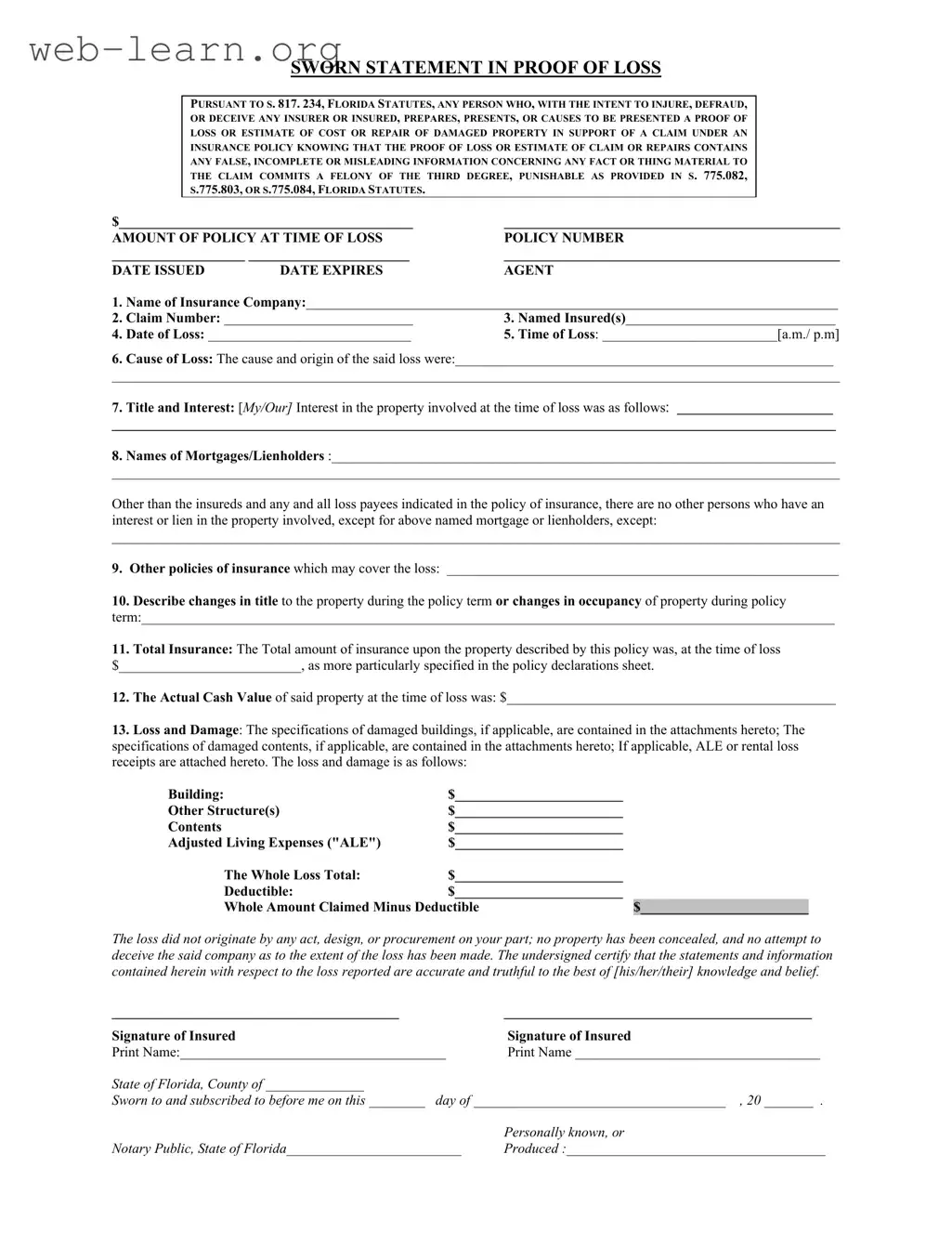
Sample - Florida Proof Loss Form

SWORN STATEMENT IN PROOF OF LOSS
PURSUANT TO S. 817. 234, FLORIDA STATUTES, ANY PERSON WHO, WITH THE INTENT TO INJURE, DEFRAUD,
OR DECEIVE ANY INSURER OR INSURED, PREPARES, PRESENTS, OR CAUSES TO BE PRESENTED A PROOF OF
LOSS OR ESTIMATE OF COST OR REPAIR OF DAMAGED PROPERTY IN SUPPORT OF A CLAIM UNDER AN
INSURANCE POLICY KNOWING THAT THE PROOF OF LOSS OR ESTIMATE OF CLAIM OR REPAIRS CONTAINS
ANY FALSE, INCOMPLETE OR MISLEADING INFORMATION CONCERNING ANY FACT OR THING MATERIAL TO
THE CLAIM COMMITS A FELONY OF THE THIRD DEGREE, PUNISHABLE AS PROVIDED IN S. 775.082,
S.775.803, OR S.775.084, FLORIDA STATUTES.
$__________________________________________ ________________________________________________
AMOUNT OF POLICY AT TIME OF LOSS POLICY NUMBER
___________________ _______________________ ________________________________________________
DATE ISSUED DATE EXPIRES AGENT
1. Name of Insurance Company:____________________________________________________________________________
2. Claim Number: ___________________________ 3. Named Insured(s)______________________________
4. Date of Loss: _____________________________ 5. Time of Loss: _________________________[a.m./ p.m]
6. Cause of Loss: The cause and origin of the said loss were:______________________________________________________
________________________________________________________________________________________________________
7. Title and Interest: [My/Our] Interest in the property involved at the time of loss was as follows: ____________________
_____________________________________________________________________________________________
8. Names of Mortgages/Lienholders :________________________________________________________________________
________________________________________________________________________________________________________
Other than the insureds and any and all loss payees indicated in the policy of insurance, there are no other persons who have an
interest or lien in the property involved, except for above named mortgage or lienholders, except:
________________________________________________________________________________________________________
9. Other policies of insurance which may cover the loss: ________________________________________________________
10. Describe changes in title to the property during the policy term or changes in occupancy of property during policy
term:___________________________________________________________________________________________________
11. Total Insurance: The Total amount of insurance upon the property described by this policy was, at the time of loss
$__________________________, as more particularly specified in the policy declarations sheet.
12. The Actual Cash Value of said property at the time of loss was: $_______________________________________________
13. Loss and Damage: The specifications of damaged buildings, if applicable, are contained in the attachments hereto; The
specifications of damaged contents, if applicable, are contained in the attachments hereto; If applicable, ALE or rental loss
receipts are attached hereto. The loss and damage is as follows:
Building: $________________________
Other Structure(s) $________________________
Contents $________________________
Adjusted Living Expenses ("ALE") $________________________
The Whole Loss Total: $________________________
Deductible: $________________________
Whole Amount Claimed Minus Deductible $________________________
The loss did not originate by any act, design, or procurement on your part; no property has been concealed, and no attempt to
deceive the said company as to the extent of the loss has been made. The undersigned certify that the statements and information
contained herein with respect to the loss reported are accurate and truthful to the best of [his/her/their] knowledge and belief.
_________________________________________ ____________________________________________
Signature of Insured Signature of Insured
Print Name:______________________________________ Print Name ___________________________________
State of Florida, County of ______________
Sworn to and subscribed to before me on this ________ day of ____________________________________ , 20 _______ .
Personally known, or
Notary Public, State of Florida_________________________ Produced :_____________________________________

Form Information

Fact Name Description
Governing Law The Florida Proof of Loss form is governed by Section 817.234 of the Florida Statutes.
Fraud Penalty Submitting a fraudulent Proof of Loss can result in a third-degree felony charge, punishable under Sections 775.082, 775.083, or 775.084 of Florida Statutes.
Insurance Company Details The form requires detailed information about the insurance company, including its name and the policy number.
Claim Information It is essential to provide the claim number, date of loss, time of loss, and the cause of loss in the form.
Interest in Property The form asks for the insured's interest in the property at the time of the loss, which must be clearly stated.
Supporting Documentation Attachments may be required to detail the specifications of damaged buildings and contents, as well as any additional living expenses incurred.

Detailed Guide for Filling Out Florida Proof Loss

After completing the Florida Proof of Loss form, the next step involves submitting it to your insurance company. Ensure that all information is accurate and truthful, as any discrepancies may delay the processing of your claim.

  1. Begin by entering the amount of policy at the time of loss in the designated space.
  2. Fill in your policy number and the date issued and date expires.
  3. Provide the name of the insurance company in the appropriate field.
  4. Enter your claim number.
  5. List the named insured(s).
  6. Specify the date of loss.
  7. Indicate the time of loss, including whether it was a.m. or p.m.
  8. Describe the cause of loss in detail.
  9. State your interest in the property at the time of loss.
  10. List the names of any mortgage or lienholders.
  11. Disclose any other policies of insurance that may cover the loss.
  12. Describe any changes in title or occupancy of the property during the policy term.
  13. Enter the total amount of insurance on the property at the time of loss.
  14. Provide the actual cash value of the property at the time of loss.
  15. Detail the loss and damage, including amounts for buildings, other structures, contents, and adjusted living expenses (ALE).
  16. Calculate the whole amount claimed minus the deductible.
  17. Certify that the statements made are accurate by signing the form.
  18. Have the form notarized by a Notary Public in Florida.

Obtain Answers on Florida Proof Loss

  1. What is the Florida Proof of Loss form?

    The Florida Proof of Loss form is a legal document required by insurance companies in Florida. It serves to formally report a claim for damages or loss under an insurance policy. The form must be completed accurately and submitted to the insurer to initiate the claims process.

  2. Who needs to complete the form?

    The form must be completed by the insured individual or entity who is filing the claim. This includes any named insureds on the policy. It is crucial that the person completing the form has a clear understanding of the details surrounding the loss.

  3. What information is required on the form?

    The form requires various pieces of information, including:

    • Name of the insurance company
    • Claim number
    • Date and time of loss
    • Cause of loss
    • Details about the property and any mortgages or lienholders
    • Other insurance policies that may cover the loss
    • Specifications of the loss and damage

  4. What happens if false information is provided?

    Providing false, incomplete, or misleading information on the Proof of Loss form is a serious offense. Under Florida law, it is considered a felony of the third degree. This could lead to severe legal consequences, including fines and imprisonment.

  5. How is the Actual Cash Value determined?

    The Actual Cash Value (ACV) of the property at the time of loss is determined by assessing the market value of the property, taking into account depreciation. This value is essential for calculating the amount of the claim and should be documented accurately on the form.

  6. What is the role of the notary public?

    A notary public is required to witness the signing of the Proof of Loss form. This adds a layer of authenticity to the document, ensuring that the signatures are valid and that the information provided is sworn to be true.

  7. Can I submit additional documents with the form?

    Yes, it is often advisable to submit additional documents that support your claim. This may include receipts for damaged property, photographs of the loss, and any relevant repair estimates. Attach these documents to the Proof of Loss form to provide a comprehensive view of your claim.

  8. What should I do if I have questions while completing the form?

    If you have questions while filling out the form, it is recommended to contact your insurance agent or the claims department of your insurance company. They can provide guidance and clarify any uncertainties you may have.

  9. How long do I have to submit the Proof of Loss form?

    The timeframe for submitting the Proof of Loss form can vary by insurance policy. Typically, it is advisable to submit the form as soon as possible after the loss occurs. Check your policy for specific deadlines to ensure compliance.

  10. What should I do after submitting the form?

    After submitting the Proof of Loss form, it is important to keep a copy for your records. Follow up with your insurance company to confirm receipt and inquire about the next steps in the claims process. Stay in communication with your insurer to ensure a smooth resolution.

Common mistakes

Filling out the Florida Proof of Loss form can be a straightforward process, but many people make common mistakes that can complicate their claims. One significant error is failing to provide complete information. Each section of the form requires specific details, such as the date and time of loss, the cause of loss, and the total insurance amount. Omitting even one detail can lead to delays or denials.

Another frequent mistake is misrepresenting the value of the damaged property. It is essential to accurately state the Actual Cash Value at the time of loss. Underestimating or overestimating this value can have serious implications for the claim. Insurers rely on this information to assess the legitimacy of the claim.

People often neglect to include all relevant parties in the claim. If there are any mortgages or lienholders, they must be listed on the form. Failure to disclose this information can result in complications, as the insurer may need to address the interests of these parties before processing the claim.

Some individuals do not attach supporting documentation to the form. This documentation can include estimates for repairs, receipts for damaged contents, and any other relevant evidence. Without these attachments, the claim may lack the necessary support to be processed efficiently.

Another common oversight is failing to sign the form correctly. Both insured parties must provide their signatures, and any missing signatures can halt the claims process. Additionally, the form must be notarized to confirm its authenticity, which is often overlooked.

Misunderstanding the deductible can lead to confusion as well. Claimants should clearly state the deductible amount and ensure it is accurately reflected in the total amount claimed. Not doing so can result in discrepancies that delay payment.

Lastly, people sometimes submit the form without thoroughly reviewing it for accuracy. Errors in spelling, numbers, or factual information can undermine the credibility of the claim. A careful review can prevent these mistakes and facilitate a smoother claims process.

By avoiding these common pitfalls, individuals can increase their chances of a successful claim. Attention to detail is crucial when filling out the Florida Proof of Loss form.

Documents used along the form

The Florida Proof of Loss form is essential for filing an insurance claim. However, several other documents may also be required to support your claim effectively. Below is a list of forms and documents that are often used in conjunction with the Florida Proof of Loss form, along with brief descriptions of each.

  • Claim Summary Report: This document summarizes the details of your insurance claim, including the nature of the loss, the amount claimed, and the status of the claim process.
  • Loss Estimate: An itemized estimate of the costs to repair or replace the damaged property. This estimate is usually prepared by a contractor or a professional appraiser.
  • Inventory of Damaged Property: A detailed list of all items that were damaged or lost, including descriptions, values, and any receipts or proof of purchase.
  • Photos of Damage: Visual documentation of the damage can help substantiate your claim. Include clear images showing the extent of the loss.
  • Police Report: If applicable, a report from law enforcement detailing any criminal activity related to the loss, such as theft or vandalism.
  • Fire Department Report: In cases of fire damage, this report provides an official account of the incident, including the cause and response details.
  • Witness Statements: Statements from individuals who witnessed the event leading to the loss can provide additional support for your claim.
  • Proof of Ownership: Documentation proving ownership of the damaged property, such as titles, receipts, or photographs, is crucial for validating your claim.
  • Mortgage or Lienholder Information: Details regarding any mortgages or liens on the property that may affect the claim process or the distribution of funds.

Gathering these documents can help ensure a smoother claims process. Being thorough and organized will support your case and may expedite the resolution of your claim.

Similar forms

The Florida Proof of Loss form serves as a critical document in the insurance claims process, specifically for reporting losses and damages to an insurer. Several other documents share similarities with this form, each serving its unique purpose but often requiring comparable information. Below is a list of ten documents that are similar to the Florida Proof of Loss form:

  • Sworn Statement in Proof of Loss: This document is often used in insurance claims to provide a formal declaration of the loss, similar to the Florida Proof of Loss form. It requires a detailed account of the damages and the circumstances surrounding the loss.
  • Claim Form: A standard claim form is submitted to insurers to initiate the claims process. Like the Florida Proof of Loss, it collects essential information about the insured, the policy, and the nature of the loss.
  • Loss Report: This report outlines the specifics of the loss, including the date, time, and cause. It parallels the Florida form in its requirement for detailed descriptions and factual accuracy.
  • Fire Incident Report: For losses due to fire, this report documents the incident and can be used alongside the Proof of Loss form. It provides critical details about the fire's origin and impact.
  • Damage Assessment Report: This document evaluates the extent of damage to property. It is similar to the Florida form as it requires an assessment of the loss and often includes estimates for repairs.
  • Insurance Policy Declarations Page: This page summarizes the coverage and limits of an insurance policy. It complements the Florida Proof of Loss form by providing context for the claim amount and coverage specifics.
  • Proof of Loss for Mortgage Insurance: Similar to the Florida form, this document is specifically tailored for mortgage insurance claims, detailing the loss and damages related to the property securing the mortgage.
  • Homeowner’s Insurance Claim Form: This form is used by homeowners to report losses under their policy. It shares the same goal as the Florida Proof of Loss form, collecting necessary information to process the claim.
  • Auto Insurance Claim Form: This document is utilized for reporting vehicle-related losses and damages. Like the Florida Proof of Loss form, it requires specific details about the incident and damages incurred.
  • Business Interruption Claim Form: Used by businesses to claim losses due to interruptions, this form resembles the Florida Proof of Loss in that it seeks to quantify losses and provide a basis for compensation.

Dos and Don'ts

When filling out the Florida Proof of Loss form, there are several important considerations to keep in mind. Here’s a list of what you should and shouldn’t do:

  • Do ensure all information is accurate and complete. Inaccuracies can lead to delays or denials.
  • Do provide detailed descriptions of the loss, including the cause and origin.
  • Do attach any relevant documents, such as receipts or estimates for repairs.
  • Do sign and date the form in the presence of a notary public.
  • Don't include any false or misleading information. This can result in serious legal consequences.
  • Don't forget to list all interested parties, including mortgage or lienholders.
  • Don't leave any sections blank. Fill out every part of the form to avoid processing issues.
  • Don't submit the form without reviewing it for errors or omissions. A thorough review can save time and trouble.

Misconceptions

Understanding the Florida Proof of Loss form is crucial for policyholders. However, several misconceptions exist regarding its use and implications. Here are ten common misconceptions:

  1. It's only for large claims. Many believe that the form is necessary only for significant losses. In reality, it is required for any claim submitted under an insurance policy.
  2. Filing the form is optional. Some think that submitting the Proof of Loss form is not mandatory. In fact, it is a required document that insurers often request to process claims.
  3. All claims are approved if the form is submitted. There is a belief that submitting this form guarantees claim approval. Approval depends on the validity of the claim and supporting documentation.
  4. The form can be filled out by anyone. Some individuals assume that anyone can complete the form. It must be completed by the insured or an authorized representative to ensure accuracy.
  5. There is no penalty for false information. Many are unaware that providing false or misleading information on this form can lead to serious legal consequences, including felony charges.
  6. The form is the only document needed for a claim. Some think that the Proof of Loss form alone suffices. Additional documentation, such as receipts and estimates, may also be required.
  7. It must be submitted immediately after the loss. While timely submission is important, there is often a specific timeframe set by the insurer within which the form must be filed.
  8. Changes in property ownership do not need to be reported. Some believe that changes in title or occupancy are irrelevant. However, these changes must be disclosed on the form.
  9. The form is the same for all types of insurance. People may think that the Proof of Loss form is uniform across all insurance policies. Different types of insurance may have specific requirements or variations in the form.
  10. Once submitted, the claim process is complete. There is a misconception that submitting the form ends the process. Insurers may follow up for additional information or clarification before making a decision.

Being aware of these misconceptions can help policyholders navigate the claims process more effectively and ensure compliance with their insurance requirements.

Key takeaways

  • Accurate Information is Crucial: When filling out the Florida Proof of Loss form, ensure that all information is complete and truthful. Any false or misleading details can lead to severe penalties, including felony charges.
  • Document Everything: Attach all relevant documentation to support your claim. This includes specifications of damaged property, receipts for additional living expenses, and any other pertinent information that substantiates your loss.
  • Understand Your Policy: Familiarize yourself with the specifics of your insurance policy. Knowing the total amount of coverage and the actual cash value of your property at the time of loss will help you accurately complete the form.
  • Seek Professional Guidance: If you're unsure about any part of the process, consider consulting with a legal or insurance professional. They can provide valuable insights and help ensure that your claim is filed correctly.