Homepage Attorney-Approved Promissory Note Template Attorney-Approved Promissory Note Document for the State of Florida
Outline

The Florida Promissory Note is an essential financial document that outlines the terms of a loan agreement between a borrower and a lender. This form serves as a written promise from the borrower to repay the borrowed amount, known as the principal, along with any agreed-upon interest, within a specified timeframe. Key components of the note include the names and addresses of both parties, the loan amount, the interest rate, and the payment schedule. Additionally, it may detail the consequences of default, such as late fees or legal action, and can include provisions for prepayment. Understanding these elements is crucial for anyone entering into a lending arrangement in Florida, as it ensures clarity and protects the rights of both parties involved.

Sample - Florida Promissory Note Form

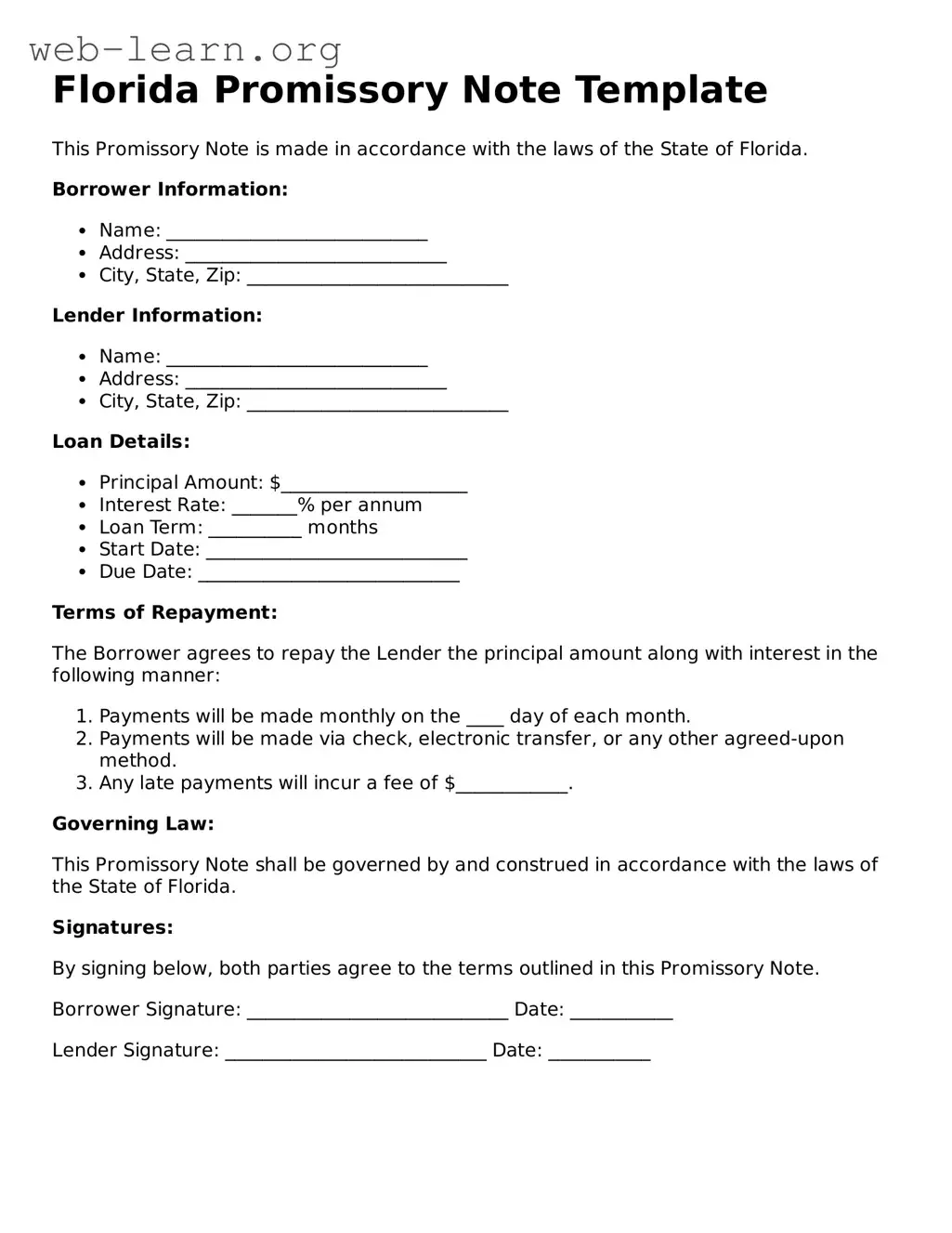
Florida Promissory Note Template

This Promissory Note is made in accordance with the laws of the State of Florida.

Borrower Information:

  • Name: ____________________________
  • Address: ____________________________
  • City, State, Zip: ____________________________

Lender Information:

  • Name: ____________________________
  • Address: ____________________________
  • City, State, Zip: ____________________________

Loan Details:

  • Principal Amount: $____________________
  • Interest Rate: _______% per annum
  • Loan Term: __________ months
  • Start Date: ____________________________
  • Due Date: ____________________________

Terms of Repayment:

The Borrower agrees to repay the Lender the principal amount along with interest in the following manner:

  1. Payments will be made monthly on the ____ day of each month.
  2. Payments will be made via check, electronic transfer, or any other agreed-upon method.
  3. Any late payments will incur a fee of $____________.

Governing Law:

This Promissory Note shall be governed by and construed in accordance with the laws of the State of Florida.

Signatures:

By signing below, both parties agree to the terms outlined in this Promissory Note.

Borrower Signature: ____________________________ Date: ___________

Lender Signature: ____________________________ Date: ___________

File Characteristics

Fact Name Description
Definition A promissory note is a written promise to pay a specified amount of money to a designated person or entity at a defined future date or on demand.
Governing Law The Florida Promissory Note is governed by the Florida Uniform Commercial Code (UCC), specifically under Chapter 673.
Parties Involved The note typically involves two parties: the borrower (maker) who promises to pay, and the lender (payee) who is entitled to receive the payment.
Interest Rate Interest can be specified in the note, and it must comply with Florida's usury laws to ensure it is not excessively high.
Payment Terms Payment terms should clearly outline the schedule, whether it's a lump sum, installments, or on demand.
Default Clause A default clause may be included, detailing the consequences if the borrower fails to make payments as agreed.
Signatures Both parties must sign the note for it to be legally binding. In some cases, notarization is recommended.
Transferability Promissory notes can be transferred to another party unless restricted by the terms of the note itself.
Enforcement If the borrower defaults, the lender has the right to pursue legal action to enforce the terms of the note.

Detailed Guide for Filling Out Florida Promissory Note

After obtaining the Florida Promissory Note form, you will need to fill it out accurately. This document is essential for establishing the terms of a loan agreement between the lender and the borrower. Follow these steps to complete the form correctly.

  1. Identify the parties: Fill in the names and addresses of both the lender and the borrower at the top of the form.
  2. Loan amount: Clearly state the total amount of money being borrowed.
  3. Interest rate: Specify the interest rate applicable to the loan. If there is no interest, indicate that as well.
  4. Payment terms: Outline the repayment schedule, including the frequency of payments (e.g., monthly, quarterly) and the due date for each payment.
  5. Maturity date: Indicate the date by which the loan must be fully repaid.
  6. Late fees: If applicable, mention any late fees that will be charged if payments are not made on time.
  7. Signatures: Both the lender and borrower must sign and date the form to validate the agreement.

Obtain Answers on Florida Promissory Note

  1. What is a Florida Promissory Note?

    A Florida Promissory Note is a legal document that outlines a borrower's promise to repay a loan to a lender. This document specifies the amount borrowed, the interest rate, repayment schedule, and any other terms agreed upon by both parties. It serves as a written record of the debt and can be enforced in court if necessary.

  2. What are the key components of a Florida Promissory Note?

    Key components typically include:

    • Principal Amount: The total amount of money being borrowed.
    • Interest Rate: The percentage charged on the principal amount, which can be fixed or variable.
    • Repayment Terms: Details about when and how the borrower will repay the loan, including due dates and payment methods.
    • Default Terms: Conditions under which the borrower would be considered in default, and the lender's rights in that situation.
    • Signatures: Both parties must sign the document to indicate their agreement to the terms.
  3. Is a Florida Promissory Note legally binding?

    Yes, a properly executed Florida Promissory Note is legally binding. It creates an enforceable obligation for the borrower to repay the loan according to the terms outlined in the document. If the borrower fails to meet these obligations, the lender has the right to take legal action to recover the owed amount.

  4. Do I need a lawyer to create a Florida Promissory Note?

    While it is not legally required to have a lawyer draft a Florida Promissory Note, it is often advisable. A legal professional can ensure that the document meets all state requirements and adequately protects the interests of both parties. If the loan amount is significant or if there are complex terms involved, seeking legal assistance can help prevent future disputes.

Common mistakes

Filling out a Florida Promissory Note form requires careful attention to detail. One common mistake people make is leaving out essential information. Failing to include the names of both the borrower and lender can lead to confusion and potential legal issues. It is crucial to ensure that all parties involved are clearly identified.

Another frequent error is not specifying the loan amount. Without a clearly stated sum, the note may be deemed incomplete. This omission can complicate the repayment process and create disputes later on. Always double-check that the amount is clearly written and easy to read.

People often neglect to include the interest rate, which is a vital component of any promissory note. If the interest rate is omitted, it can lead to misunderstandings about the terms of repayment. It is advisable to clearly state whether the interest is fixed or variable and to specify the exact percentage.

Dates are another area where mistakes commonly occur. Failing to indicate the date the note is signed or the repayment due date can create ambiguity. Accurate dating helps establish a timeline for repayment and can be critical in case of default.

Some individuals make the mistake of not outlining the repayment schedule. A vague repayment plan can lead to confusion about when payments are due. Clearly detailing the payment frequency—whether monthly, quarterly, or otherwise—can help prevent misunderstandings.

Another common error is not including a default clause. This clause outlines the consequences if the borrower fails to make payments. Without this provision, lenders may find it difficult to enforce their rights in case of non-payment.

People sometimes forget to sign the document. A promissory note without signatures from both parties is not legally binding. Ensure that all required signatures are present to validate the agreement.

Lastly, many overlook the importance of having the note witnessed or notarized. While not always required, having a witness or notary can add an extra layer of protection and legitimacy to the document. This step can be especially important in disputes or if the note needs to be enforced in court.

Documents used along the form

When entering into a loan agreement in Florida, a Promissory Note is often accompanied by various other documents. Each of these documents serves a specific purpose and helps to clarify the terms of the agreement, protect the interests of both parties, and ensure compliance with state laws. Below is a list of common forms and documents that are typically used alongside a Florida Promissory Note.

  • Loan Agreement: This document outlines the terms and conditions of the loan, including the amount borrowed, interest rates, repayment schedule, and any collateral involved.
  • Security Agreement: If the loan is secured by collateral, this agreement details the specific assets that back the loan and the rights of the lender in case of default.
  • Personal Guarantee: A personal guarantee is often required from the borrower or a third party, ensuring that they will be personally responsible for the loan if the primary borrower defaults.
  • Disclosure Statement: This document provides important information about the loan terms, including fees, interest rates, and the total cost of borrowing, helping borrowers make informed decisions.
  • Amortization Schedule: An amortization schedule breaks down the repayment of the loan into manageable installments, showing how much of each payment goes toward interest and principal.
  • UCC Financing Statement: This form is filed to give public notice of the lender's interest in the collateral, ensuring that the lender's rights are protected in the event of the borrower's bankruptcy.
  • Loan Payment Receipts: These receipts serve as proof of payment for each installment made by the borrower, helping to maintain accurate records of the loan repayment.
  • Default Notice: If the borrower fails to meet the loan obligations, this notice informs them of the default and outlines the lender's rights and potential actions.
  • Release of Lien: Once the loan is fully repaid, this document is issued to remove the lender's claim on the collateral, officially releasing the borrower from the obligation.

Understanding these documents can help both borrowers and lenders navigate the complexities of loan agreements more effectively. Each form plays a critical role in ensuring that the terms of the Promissory Note are clear, enforceable, and protect the interests of all parties involved.

Similar forms

  • Loan Agreement: This document outlines the terms of a loan between a lender and a borrower. Like a promissory note, it specifies the amount borrowed, interest rates, and repayment terms.
  • IOU (I Owe You): An informal acknowledgment of a debt. An IOU states the amount owed but may not include detailed repayment terms, unlike a promissory note.
  • Security Agreement: This document provides the lender with rights to specific assets if the borrower defaults. It is similar to a promissory note in that it involves a loan but adds collateral for security.
  • Mortgage: A mortgage is a type of loan specifically for purchasing real estate. It includes a promissory note and uses the property as collateral, similar to how a promissory note secures a loan.
  • Lease Agreement: This document outlines the terms for renting property. While it primarily focuses on rental payments, it also includes payment obligations similar to those in a promissory note.
  • Installment Agreement: This document details a plan for paying off a debt in regular installments. It shares similarities with a promissory note in its focus on repayment terms and schedules.
  • Debt Settlement Agreement: This document outlines a settlement between a debtor and a creditor. It specifies how much will be paid and when, much like the repayment terms in a promissory note.

Dos and Don'ts

When filling out the Florida Promissory Note form, it is essential to approach the task with care and attention to detail. Here are some important dos and don'ts to keep in mind:

  • Do read the entire form carefully before starting to fill it out.
  • Do provide accurate and complete information, including names, addresses, and loan amounts.
  • Do sign and date the form in the designated areas to make it legally binding.
  • Do keep a copy of the completed form for your records.
  • Do consult a legal expert if you have questions about any terms or conditions.
  • Don't leave any sections blank; every part of the form should be filled out.
  • Don't use unclear or ambiguous language when describing the terms of the loan.
  • Don't forget to review the form for any errors before submitting it.
  • Don't sign the form without fully understanding your obligations.
  • Don't ignore the importance of keeping all parties informed about the loan agreement.

Misconceptions

Understanding the Florida Promissory Note form is essential for anyone involved in lending or borrowing money in the state. However, several misconceptions can lead to confusion. Here are ten common misunderstandings:

  1. All promissory notes must be notarized. While notarization can add an extra layer of security, it is not a legal requirement for a promissory note to be valid in Florida.
  2. A promissory note is the same as a loan agreement. Although they are related, a promissory note is a promise to pay, while a loan agreement includes the terms and conditions of the loan.
  3. Only banks can issue promissory notes. Individuals and businesses can also create promissory notes for personal loans or transactions.
  4. A verbal promise to pay is sufficient. A written promissory note is strongly recommended to provide clear evidence of the terms and obligations.
  5. Interest rates on promissory notes are unrestricted. Florida law imposes limits on interest rates, so it’s crucial to comply with state usury laws.
  6. Promissory notes are only for large amounts of money. They can be used for any amount, making them versatile for various financial situations.
  7. Once signed, a promissory note cannot be changed. Parties can amend the note if both agree to the changes, provided they document the amendments properly.
  8. Defaulting on a promissory note has no consequences. Defaulting can lead to legal action, including lawsuits and damage to credit ratings.
  9. Promissory notes do not require a repayment schedule. Including a repayment schedule clarifies expectations and helps avoid misunderstandings.
  10. All promissory notes are enforceable in court. While most are, certain conditions, such as illegal terms or lack of consideration, can render them unenforceable.

Being aware of these misconceptions can help individuals navigate the complexities of promissory notes more effectively. Understanding the correct information is key to protecting your rights and ensuring a smooth lending process.

Key takeaways

When filling out and using the Florida Promissory Note form, it is essential to understand several key aspects. Below are important takeaways to consider:

  • Identify the Parties: Clearly state the names and addresses of both the borrower and the lender to avoid confusion.
  • Loan Amount: Specify the exact amount being borrowed. This figure should be clearly indicated to prevent disputes.
  • Interest Rate: Include the interest rate, if applicable. Be sure to specify whether it is fixed or variable.
  • Payment Schedule: Outline the payment terms, including due dates and the frequency of payments (e.g., monthly, quarterly).
  • Maturity Date: Indicate the date by which the loan must be fully repaid. This is crucial for both parties.
  • Default Terms: Clearly define what constitutes a default and the consequences that will follow.
  • Governing Law: Specify that the note is governed by Florida law, which helps in resolving any legal issues that may arise.
  • Signatures: Ensure that both parties sign the document. This step is vital for the note to be legally binding.

Understanding these components will help ensure that the Promissory Note is properly executed and enforceable in Florida.