Homepage Blank Florida Petition Emancipation Form
Outline

Emancipation in Florida allows minors to gain the rights and responsibilities typically reserved for adults. This process is initiated through the Florida Petition Emancipation form, which serves as a formal request to the court. The form requires the minor's name, age, and residence, as well as details about their parents or guardians. To begin, the minor must be at least 16 years old and the petition must be signed in front of a notary public or deputy clerk. Filing the completed petition with the Clerk of the Circuit Court is essential, and the correct location varies by county. In Leon County, for instance, submissions are made in the Family Law Division at the courthouse. Filing fees apply, but those facing financial hardship can apply for a waiver. After filing, a case manager will review the petition, and within about four weeks, a court date may be scheduled. During the court hearing, if the judge finds emancipation to be in the minor's best interest, an order will be granted, allowing the minor to act as an adult. It’s important to keep track of all necessary documents and copies of the final judgment, as various institutions will require proof of emancipation. This form is a crucial step toward independence for minors ready to take on adult responsibilities.


Sample - Florida Petition Emancipation Form

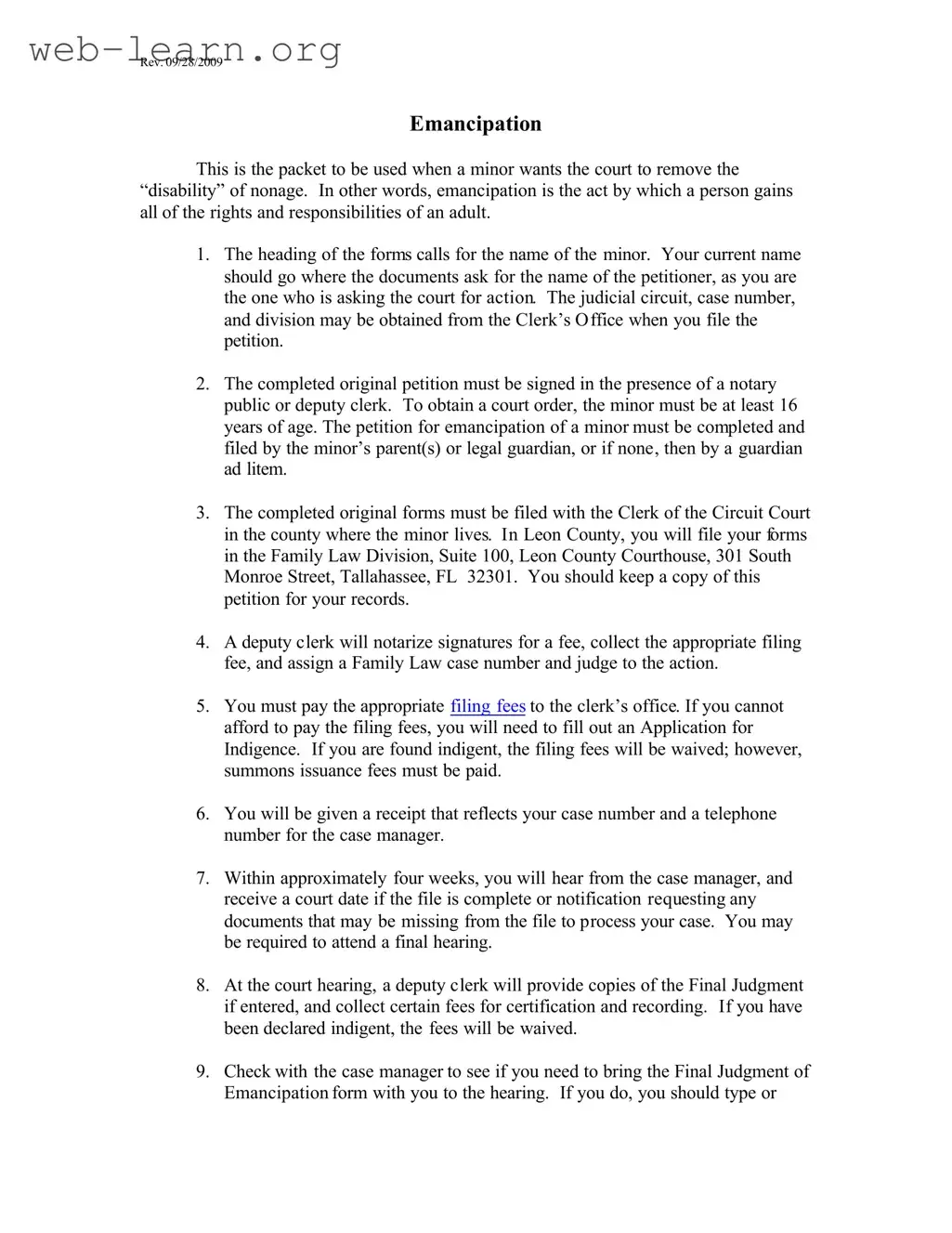
Rev. 09/28/2009
Emancipation
This is the packet to be used when a minor wants the court to remove the
“disability” of nonage. In other words, emancipation is the act by which a person gains
all of the rights and responsibilities of an adult.
1. The heading of the forms calls for the name of the minor. Your current name
should go where the documents ask for the name of the petitioner, as you are
the one who is asking the court for action. The judicial circuit, case number,
and division may be obtained from the Clerk’s Office when you file the
petition.
2. The completed original petition must be signed in the presence of a notary
public or deputy clerk. To obtain a court order, the minor must be at least 16
years of age. The petition for emancipation of a minor must be completed and
filed by the minor’s parent(s) or legal guardian, or if none, then by a guardian
ad litem.
3. The completed original forms must be filed with the Clerk of the Circuit Court
in the county where the minor lives. In Leon County, you will file your forms
in the Family Law Division, Suite 100, Leon County Courthouse, 301 South
Monroe Street, Tallahassee, FL 32301. You should keep a copy of this
petition for your records.
4. A deputy clerk will notarize signatures for a fee, collect the appropriate filing
fee, and assign a Family Law case number and judge to the action.
5. You must pay the appropriate filing fees to the clerk’s office. If you cannot
afford to pay the filing fees, you will need to fill out an Application for
Indigence. If you are found indigent, the filing fees will be waived; however,
summons issuance fees must be paid.
6. You will be given a receipt that reflects your case number and a telephone
number for the case manager.
7. Within approximately four weeks, you will hear from the case manager, and
receive a court date if the file is complete or notification requesting any
documents that may be missing from the file to process your case. You may
be required to attend a final hearing.
8. At the court hearing, a deputy clerk will provide copies of the Final Judgment
if entered, and collect certain fees for certification and recording. If you have
been declared indigent, the fees will be waived.
9. Check with the case manager to see if you need to bring the Final Judgment of
Emancipation form with you to the hearing. If you do, you should type or
print the heading, including the circuit, county, case number, division, and the
parties’ names, and leave the rest blank for the judge to complete at your
hearing or trial.
10. If the court is satisfied that emancipation is in the minor’s best interest, it will
enter an order removing the disabilities of nonage and authorize the minor to
perform all acts that the minor could do if he or she were 18 years of age. The
order will be recorded in the public records of the county where the action is
filed. The minor will need to obtain certified copies of the order to show proof
of his or her emancipation.
11. It may be helpful to compile a list of all of the people and/or places that will
need a copy of your final judgment. This list may include the driver’s license
office, social security office, banks, schools, etc. A list will help you know
how many copies of your order you should get from the clerk's office after
your hearing.
IN THE CIRCUIT COURT OF THE SECOND JUDICIAL CIRCUIT
IN AND FOR LEON COUNTY, STATE OF FLORIDA
IN RE: EMANCIPATION OF:
________________________________, Case #: _______________________
a minor.
PETITION FOR EMANCIPATION OF A MINOR
1. Petitioner, ______________________________, whose address is
_____________________________________________________________________,
and whose relationship to the above minor is _________________________________,
petitions this Court to remove the disabilities of nonage of the above minor.
2. The minor, ______________________________, is 16 years of age or older. The
minor’s date of birth is ________________.
3. The minor currently resides at ______________________________________,
and has a mailing address of ________________________________________.
4. The minor is a resident of ____________________ County, Florida.
5. The parents of the above minor are ___________________________, Father,
whose residence is ______________________________________________ and
whose mailing address is: _________________________________________________,
and _____________________________, Mother, whose residence is ______________
________________________ and whose mailing address is: _____________________
_____________________________.
6. The name, date of birth, custody and location of any children born to the minor
are as follows:
Name: ___________________________________________________
Date of Birth: _____________________________________________
Custody and location: _______________________________________
(Attach extra sheet if there are additional children.)
7. The minor’s character, habits, education, income, and mental capacity for
business are as follows:
8. The minor’s needs with respect to food, shelter, clothing, medical care, and
other necessities will be met as follows:
9. With respect to whether the minor is a party to or subject of a pending judicial
proceeding in this State or any other jurisdiction or the subject of a judicial order
of any description issued in connection with such judicial proceeding, such as a child
support order, custody or visitation order or guardianship: (check only one)
____ The minor is not a party or subject to pending judicial proceedings.
____ The minor is a party to or subject to a pending judicial proceeding,
namely, _________________________________________________________________
________________________________________________________________________
________________________________________________________________________
(note the nature of proceedings, case number, court/jurisdiction where case is pending,
and names and address of parties).
10. The disabilities of nonage should be removed from the minor for the following
reason:
11. The above minor has joined in this petition and consents to the Court granting
an Order of Emancipation as indicated and evidenced by the minor’s signature on this
petition.
WHEREFORE, the Petitioner and the Minor request that this Court enter an
Order of Emancipation removing the disabilities of nonage of said Minor.
Signed this ______ day of _______________, 20___.
___________________________________
Signature of Petitioner
___________________________________
Printed name of Petitioner
___________________________________
Street Address of Petitioner
___________________________________
City/State/Zip of Petitioner
STATE OF FLORIDA,
COUNTY OF _________________.
BEFORE ME, the undersigned authority, personally appeared _______________
___________________________, who has acknowledged before me that he/she is the
Petitioner in the above Petition for Emancipation of a Minor and executed the same, and
said person is ___ personally known to me OR ___ produced identification: _________
____________________________________.
Witness my hand and official seal this _____ day of ______________, 20___.
____________________________________
Notary Public/Deputy Clerk
CONSENT BY MINOR
I, ___________________________, the above named minor, consent to the entry
by this Court of an Order of Emancipation and I am fully ready to assume my
responsibilities as an adult.
Signed this ______ day of ____________, 20___.
____________________________________
Minor’s signature
____________________________________
Minor’s printed name
____________________________________
Minor’s street address
____________________________________
Minor’s City/State/Zip
STATE OF FLORIDA
COUNTY OF _________________
BEFORE ME, the undersigned authority, personally appeared _______________
_________________________, who has acknowledged before me that he/she is the
Minor that is the subject of the Petition for Emancipation of a Minor and that he/she
executed the foregoing Consent, and said person is ___ personally known OR ___
produced identification: ___________________________________________________.
Witness my hand and official seal this ______ day of _____________, 20___.
___________________________________
Notary Public/Deputy Clerk
IN THE CIRCUIT COURT OF THE SECOND JUDICIAL CIRCUIT
IN AND FOR LEON COUNTY, STATE OF FLORIDA
IN RE: EMANCIPATION OF:
________________________________, Case #: _______________________
a minor.
FINAL JUDGMENT OF EMANCIPATION
THIS CAUSE was heard on the Petition for Emancipation of a Minor filed by the
Petitioner. The Court, having jurisdiction over the subject matter, and being fully advised
in the premises, finds as follows:
1. The minor is capable of being an adult, bearing the responsibilities and
privileges of being an adult.
2. The minor has demonstrated the maturity of managing her own affairs,
without the supervision of a parent or legal guardian.
3. The minor and the parent or legal guardian have agreed for the parent or legal
guardian to relinquish his/her rights to control of the minor child.
It is, therefore, ORDERED AND ADJUDGED:
The minor child is adjudged to be emancipated upon this Final Judgment
becoming final. The minor child will be emancipated and enjoy the privileges and
responsibilities of being an adult as defined by Florida Statute.
DONE AND ORDERED this _____ day of _______________________,
20_____, in Tallahassee, Leon County, Florida.
______________________________
Circuit Judge
Copies to:
Petitioner
Respondent
Minor

Form Information

Fact Name Details
Purpose of Emancipation This form allows a minor to request the court to remove the legal limitations of being underage.
Eligibility Age The minor must be at least 16 years old to file for emancipation.
Filing Location The petition must be filed with the Clerk of the Circuit Court in the county where the minor resides.
Signature Requirement The original petition must be signed in the presence of a notary public or deputy clerk.
Filing Fees Filing fees are required. If unable to pay, an Application for Indigence may be submitted to waive fees.
Case Manager Contact A receipt will be provided with the case number and contact information for the case manager.
Court Hearing A hearing will be scheduled, and attendance may be necessary for the minor.
Final Judgment If granted, the court will issue a Final Judgment, which must be recorded and certified copies obtained.

Detailed Guide for Filling Out Florida Petition Emancipation

To fill out the Florida Petition for Emancipation form, follow these steps carefully. Once you have completed the form, you will need to file it with the appropriate court. The process involves several steps, including gathering necessary information, signing the petition, and attending a court hearing.

  1. Write your name in the heading of the form where it asks for the name of the petitioner. This is your current name.
  2. Obtain the judicial circuit, case number, and division from the Clerk’s Office when you file the petition.
  3. Ensure you are at least 16 years old, as this is a requirement for emancipation.
  4. Have the completed original petition signed in the presence of a notary public or deputy clerk.
  5. File the completed original forms with the Clerk of the Circuit Court in your county. In Leon County, go to the Family Law Division, Suite 100, Leon County Courthouse, 301 South Monroe Street, Tallahassee, FL 32301.
  6. Keep a copy of the petition for your records.
  7. Pay the appropriate filing fees at the clerk’s office. If you cannot afford these fees, fill out an Application for Indigence.
  8. If found indigent, the filing fees will be waived, but you must still pay for summons issuance fees.
  9. Receive a receipt that includes your case number and a telephone number for the case manager.
  10. Wait approximately four weeks for the case manager to contact you. You will either receive a court date or a notification about any missing documents.
  11. Attend the court hearing. A deputy clerk will provide copies of the Final Judgment if entered and collect fees for certification and recording.
  12. If you are declared indigent, the fees for certification and recording will be waived.
  13. Check with the case manager to see if you need to bring the Final Judgment of Emancipation form to the hearing. If required, fill in the heading and leave the rest blank for the judge.
  14. If the court agrees that emancipation is in your best interest, it will issue an order removing the disabilities of nonage.
  15. Obtain certified copies of the order to prove your emancipation.
  16. Compile a list of individuals and organizations that will need a copy of your final judgment, such as the driver’s license office, social security office, banks, and schools.

Obtain Answers on Florida Petition Emancipation

  1. What is the purpose of the Florida Petition for Emancipation form?

    The Florida Petition for Emancipation form is designed for minors who wish to gain the rights and responsibilities of an adult. Emancipation allows a minor to be legally recognized as an adult, thereby removing the “disability” of nonage. This means they can make decisions regarding their lives without needing parental consent.

  2. Who can file the petition for emancipation?

    The petition must be filed by the minor, who needs to be at least 16 years old. If the minor does not have parents or legal guardians, a guardian ad litem can file on their behalf. The minor's current name should be used as the petitioner in the documents.

  3. Where do I file the completed petition?

    The completed original forms should be filed with the Clerk of the Circuit Court in the county where the minor resides. For instance, in Leon County, you would file in the Family Law Division at the Leon County Courthouse, located at 301 South Monroe Street, Tallahassee, FL 32301. Remember to keep a copy of the petition for your records.

  4. Are there any fees associated with filing the petition?

    Yes, there are filing fees that must be paid to the Clerk's Office. If you cannot afford these fees, you can fill out an Application for Indigence. If approved, the filing fees will be waived, although you will still need to pay any summons issuance fees.

  5. What happens after I file the petition?

    Once the petition is filed, you will receive a receipt containing your case number and a contact number for the case manager. Typically, within four weeks, the case manager will reach out to you. They will either provide a court date if everything is in order or request any missing documents necessary to process your case.

  6. What should I expect during the court hearing?

    At the court hearing, you may need to present the Final Judgment of Emancipation form, so it’s wise to check with the case manager beforehand. If the court agrees that emancipation is in your best interest, it will issue an order removing the disabilities of nonage. You will receive copies of this order, which you may need to show as proof of your emancipation.

  7. How can I ensure that I have enough copies of the Final Judgment?

    It is advisable to create a list of all the entities that will require a copy of your Final Judgment. This list may include places like the driver’s license office, social security office, banks, and schools. Having this list will help you determine how many certified copies you should request from the Clerk's Office after your hearing.

Common mistakes

Filling out the Florida Petition for Emancipation can be a straightforward process, but mistakes can lead to delays or even denials. One common error occurs when individuals do not correctly fill in the name of the minor in the heading. It is essential to ensure that the name of the minor appears where the document requests the name of the petitioner. This minor is the one seeking emancipation, and clarity in this section is crucial.

Another frequent mistake is failing to sign the completed original petition in the presence of a notary public or deputy clerk. The law requires that the petition be signed in front of an authorized individual. Additionally, minors must be at least 16 years old to file for emancipation. Neglecting this requirement can result in the petition being rejected.

Some individuals mistakenly file the petition in the wrong location. The completed forms must be submitted to the Clerk of the Circuit Court in the county where the minor resides. For those living in Leon County, it is vital to go to the Family Law Division at the designated courthouse. Keeping a copy of the petition for personal records is also often overlooked.

Not paying the appropriate filing fees is another mistake that can hinder the process. The clerk’s office requires these fees to process the petition. If a person cannot afford the fees, they must fill out an Application for Indigence. Failing to do so may lead to the petition being stalled until payment is made.

Some petitioners forget to obtain a receipt after filing. This receipt is important as it contains the case number and contact information for the case manager. Without this information, it may be challenging to track the progress of the petition.

Another oversight occurs when individuals do not follow up with the case manager. After filing, it typically takes about four weeks to hear back. If the file is incomplete, the case manager will request missing documents. Ignoring this step can prolong the process unnecessarily.

During the court hearing, some petitioners arrive without the necessary documentation, such as the Final Judgment of Emancipation form. It is advisable to check with the case manager beforehand to confirm what documents are needed. Bringing the correct paperwork can facilitate a smoother hearing.

Lastly, a lack of preparation regarding the final judgment can create complications. After emancipation, the minor will need certified copies of the order to prove their status. Compiling a list of entities that require a copy, such as schools and banks, will help ensure that the minor has all necessary documentation for future needs.

Documents used along the form

When pursuing emancipation in Florida, several additional forms and documents may be necessary to support the petition. Each of these documents serves a specific purpose in the process, ensuring that the court has all the information needed to make an informed decision. Below is a list of commonly used forms alongside the Florida Petition for Emancipation.

  • Application for Indigence: This form is required if the petitioner cannot afford the filing fees. Completing it allows the court to determine whether the fees can be waived based on the petitioner's financial situation.
  • Final Judgment of Emancipation: After the court hearing, this document serves as proof of the minor's emancipation. It outlines the court's decision and must be obtained in certified copies for various institutions.
  • Notice of Hearing: This document informs all relevant parties about the scheduled court hearing. It is essential for ensuring that everyone involved is aware of the date and time of the proceedings.
  • Affidavit of Consent: If the minor has children, this affidavit may be needed to confirm that all parties involved consent to the emancipation. It provides clarity regarding the minor's responsibilities toward their children.
  • Character References: Letters from individuals who can attest to the minor's character, maturity, and ability to live independently may be submitted. These references can support the case for emancipation.
  • Proof of Residency: Documentation proving the minor's residency in the county where the petition is filed may be required. This can include utility bills, lease agreements, or school records.
  • Financial Disclosure Statement: This form outlines the minor's financial situation, including income and expenses. It helps the court assess whether the minor can support themselves independently.
  • Parental Consent Form: If applicable, this form may need to be signed by the minor's parents or legal guardians, indicating their approval of the emancipation petition.

Each of these documents plays a crucial role in the emancipation process. It is important to gather and prepare them carefully to ensure that the petition is complete and that the court has all necessary information to make a fair determination. Proper preparation can significantly influence the outcome of the emancipation request.

Similar forms

The Florida Petition for Emancipation form shares similarities with several other legal documents that serve different purposes but have comparable structural and procedural elements. Here are eight documents that reflect these similarities:

  • Application for Indigence: Like the emancipation petition, this document requires the applicant to provide personal information and financial details to demonstrate their inability to pay court fees. Both forms must be submitted to the Clerk’s Office for processing.
  • Petition for Guardianship: This petition also requires the petitioner to provide specific information about the individual needing guardianship, similar to how the emancipation form outlines details about the minor. Both documents involve court review and approval.
  • Petition for Child Support Modification: This document involves a request for changes to existing child support agreements. Like the emancipation petition, it necessitates the inclusion of personal details and relevant circumstances that justify the request.
  • Petition for Adoption: In this document, the petitioner must provide comprehensive information about the child and the adopting parents. The structure resembles that of the emancipation petition, with sections dedicated to personal details and justifications.
  • Final Judgment of Dissolution of Marriage: Similar to the emancipation form, this judgment requires specific information about the parties involved and outlines the court's decisions. Both documents culminate in a court order that affects the legal status of individuals.
  • Request for Restraining Order: This request requires detailed information about the petitioner and the circumstances necessitating the order. Like the emancipation form, it must be filed with the court and often involves a hearing.
  • Petition for Name Change: This document requires the petitioner to provide personal information and the reason for the name change, mirroring the structure of the emancipation petition. Both petitions require court approval and may involve a hearing.
  • Motion to Modify Custody: Similar to the emancipation petition, this motion requires detailed information about the current custody arrangement and reasons for the proposed changes. Both documents are submitted to the court for review and decision-making.

Understanding these similarities can provide clarity on the procedural aspects of the Florida Petition for Emancipation and other related legal documents. Each document serves a unique purpose but follows a similar format and requires specific information to facilitate the court's review and decision-making process.

Dos and Don'ts

When filling out the Florida Petition for Emancipation form, it’s important to follow certain guidelines to ensure a smooth process. Here’s a list of what you should and shouldn’t do:

  • Do make sure you are at least 16 years old before filing the petition.
  • Do fill in your current name as the petitioner in the designated area.
  • Do sign the completed original petition in front of a notary public or deputy clerk.
  • Do file the petition with the Clerk of the Circuit Court in your county.
  • Do keep a copy of the petition for your records.
  • Don’t forget to pay the appropriate filing fees unless you qualify as indigent.
  • Don’t leave any sections of the form blank that require your information.

Following these guidelines can help streamline your emancipation process. It’s always wise to double-check your work before submission to avoid any delays.

Misconceptions

Understanding the Florida Petition Emancipation form can be challenging, and there are several misconceptions that often arise. Here are ten common misunderstandings:

  1. Only parents can file the petition. Many believe that only a parent can file for emancipation. However, a legal guardian or guardian ad litem can also file on behalf of the minor.
  2. The minor must be 18 to be emancipated. Some think that emancipation is only for those 18 and older. In fact, a minor can petition for emancipation at the age of 16.
  3. All forms must be completed perfectly. While it is important to fill out the forms accurately, minor mistakes can sometimes be corrected during the process. The court may provide guidance on what needs to be fixed.
  4. Emancipation is automatic once the petition is filed. It is a common belief that filing the petition guarantees emancipation. The court must review the case and determine if it is in the minor's best interest.
  5. You don’t need to attend a hearing. Some minors think they can simply submit their paperwork without appearing in court. A hearing is typically required to finalize the emancipation process.
  6. The court always approves emancipation requests. It is a misconception that all petitions are granted. The court evaluates each case individually and may deny the request if it does not meet specific criteria.
  7. Emancipation means complete freedom from parents. While emancipation grants many adult rights, it does not mean that the minor is free from all parental responsibilities or obligations.
  8. Filing fees are always required. Some believe that fees must be paid regardless of financial situation. If a minor cannot afford the fees, they can apply for a waiver based on indigence.
  9. Once emancipated, a minor can make any decision independently. Although emancipation grants many rights, some decisions, such as medical treatment, may still require parental consent depending on the situation.
  10. Emancipation is the same as moving out. Many confuse emancipation with simply leaving home. Emancipation is a legal process that grants specific rights and responsibilities, whereas moving out does not automatically confer those rights.

By understanding these misconceptions, minors and their families can navigate the emancipation process more effectively and with greater clarity.

Key takeaways

Filling out the Florida Petition for Emancipation form is an important step for minors seeking legal independence. Here are some key takeaways to keep in mind:

  • Eligibility Requirements: The minor must be at least 16 years old to file for emancipation. The petition can be completed by the minor's parent(s), legal guardian, or a guardian ad litem if no parent or guardian is available.
  • Filing Location: Submit the completed forms to the Clerk of the Circuit Court in the county where the minor resides. In Leon County, this is the Family Law Division at the Leon County Courthouse.
  • Notarization: The original petition must be signed in front of a notary public or deputy clerk. Be prepared to pay any associated fees for notarization and filing.
  • Filing Fees: There are fees required to file the petition. If you cannot afford these fees, you can fill out an Application for Indigence to potentially have the fees waived, though some fees may still apply.
  • Follow-Up: After filing, expect to hear from a case manager within about four weeks. They will inform you of your court date or request any missing documents necessary for processing your case.

By understanding these key points, you can navigate the emancipation process more effectively and ensure that you meet all necessary requirements. Keep these guidelines in mind as you prepare your petition.