Homepage Blank Florida Order Form
Outline

The Florida Order Form, specifically Form 12.996(a), serves as an essential tool in family law cases involving income deduction for support payments. This form is utilized in non-Title IV-D cases, where a court mandates that an obligor, the individual responsible for making support payments, have their payments deducted directly from their income. The form requires specific information, including the effective date of the order, the amount and frequency of support payments, and any arrears that may be owed. It also outlines the responsibilities of employers or payors in making these deductions and directs them to forward payments to the State Disbursement Unit. Additionally, the form includes a schedule for child support obligations, detailing when payments will terminate based on the age of the children involved. For the order to take effect, it must be signed by a judge, and proper procedures must be followed for notifying the other party and their attorney, if applicable. This comprehensive approach ensures that support payments are managed efficiently and transparently, adhering to legal requirements while safeguarding the rights of both the obligor and the obligee.

Sample - Florida Order Form

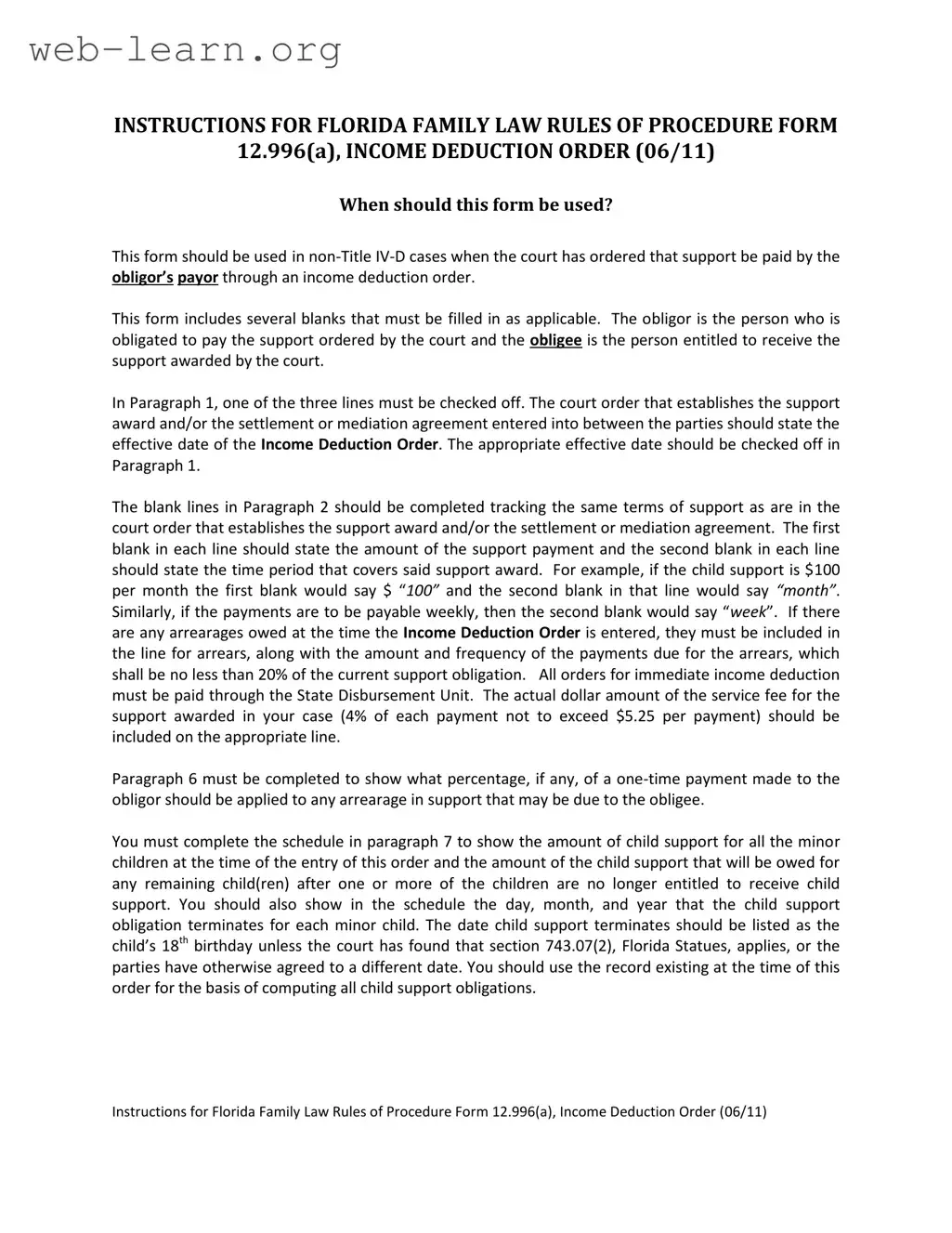
INSTRUCTIONS FOR FLORIDA FAMILY LAW RULES OF PROCEDURE FORM
12.996(a), INCOME DEDUCTION ORDER (06/11)
When should this form be used?
This form should be used in non-Title IV-D cases when the court has ordered that support be paid by the
oligor’s payor through an income deduction order.
This form includes several blanks that must be filled in as applicable. The obligor is the person who is
obligated to pay the support ordered by the court and the obligee is the person entitled to receive the
support awarded by the court.
In Paragraph 1, one of the three lines must be checked off. The court order that establishes the support
award and/or the settlement or mediation agreement entered into between the parties should state the
effective date of the Income Deduction Order. The appropriate effective date should be checked off in
Paragraph 1.
The blank lines in Paragraph 2 should be completed tracking the same terms of support as are in the
court order that establishes the support award and/or the settlement or mediation agreement. The first
blank in each line should state the amount of the support payment and the second blank in each line
should state the time period that covers said support award. For example, if the child support is $100
per month the first blank would say $ 100 and the second blank in that line would say oth.
~iilal,#if#the#paets#ae#to#e#paale#weekl,#the#the#seod#lak#would#sa#week.# Of#thee#
are any arrearages owed at the time the Income Deduction Order is entered, they must be included in
the line for arrears, along with the amount and frequency of the payments due for the arrears, which
shall be no less than 20% of the current support obligation. All orders for immediate income deduction
must be paid through the State Disbursement Unit. The actual dollar amount of the service fee for the
support awarded in your case (4% of each payment not to exceed $5.25 per payment) should be
included on the appropriate line.
Paragraph 6 must be completed to show what percentage, if any, of a one-time payment made to the
obligor should be applied to any arrearage in support that may be due to the obligee.
You must complete the schedule in paragraph 7 to show the amount of child support for all the minor
children at the time of the entry of this order and the amount of the child support that will be owed for
any remaining child(ren) after one or more of the children are no longer entitled to receive child
support. You should also show in the schedule the day, month, and year that the child support
obligation terminates for each minor child. The date child support terminates should be listed as the
hild’s#18
th
birthday unless the court has found that section 743.07(2), Florida Statues, applies, or the
parties have otherwise agreed to a different date. You should use the record existing at the time of this
order for the basis of computing all child support obligations.
Instructions for Florida Family Law Rules of Procedure Form 12.996(a), Income Deduction Order (06/11)
What should I do next?
For this order to be effective, it must be signed by the judge. This form should be typed or printed in
black ink. After completing this form, you must first send a copy to the other party or his or her
attorney, if he or she is represented by an attorney, for approval or objection to the form before you
send it to the judge assigned to your case. If the opposing party or his or her attorney, if represented,
approves the form order, you may send the original proposed order and two copies to the judge
assigned to your case with a letter telling the judge that you have first sent a copy of this proposed order
to the opposing counsel or party, if unrepresented, and that they have no objection to the judge signing
this order. If the other party or his or her attorney, if represented, has an objection to the proposed
order as completed by you, you must tell the judge that you have sent a copy of this proposed order to
the opposing party or his or her counsel, if represented, and that they specifically object to the entry of
the proposed form Income Deduction Order. You must also send stamped self-addressed envelopes to
the judge addressed to you and the opposing party or his or her attorney, if represented. You should
keep a copy for your own records. If the judge signs the Income Deduction Order, the judge will mail
you and the opposing party (or their attorney) copies of the signed order in the envelopes you provide
to the court.
Where can I look for more information?
1efore proeedig,#you should read Geeral Oforatio for elf-zepreseted ^itigats#foud at#the
beginning of these forms. The words that are in bold underline in these instructions are defined
there. For further information see section 61.1301, Florida Statutes.
Special Instructions...
When the Income Deduction Order becomes effective (either immediately or delayed until arrearage),
you must then also send a copy of the Income Deduction Order to the oligo’s#eploe#alog#with#a#
Notice to Payor, Florida Family Law Rules of Procedure Form 12.996(b), for the Income Deduction
Order to take effect.
It is your responsibility to determine what extra steps and/or forms, if any, must be taken, supplied,
and/or filed to insure the Income Deduction Order is implemented.
Remember, a person who is NOT an attorney is called a nonlawyer. If a nonlawyer helps you fill out
these forms, that person must give you a copy of a Disclosure from Nonlawyer, Florida Family Law Rules
of Procedure Form 12.900(a), before he or she helps you. A nonlawyer helping you fill out these forms
also must put his or her name, address, and telephone number on the bottom of the last page of every
form he or she helps you complete.
Instructions for Florida Family Law Rules of Procedure Form 12.996(a), Income Deduction Order (06/11)
IN THE CIRCUIT COURT OF THE _____________________ JUDICIAL CIRCUIT,
IN AND FOR ______________________________ COUNTY, FLORIDA
Case No: ________________________
Division: ________________________
_________________________________,
Petitioner,
and
_________________________________,
Respondent.
INCOME DEDUCTION ORDER (Non-Title IV-D Case)
TO: ANY PRESENT OR SUBSEQUENT EMPLOYERS/PAYORS OF OBLIGOR
{name} ________________________________________________________
YOU ARE HEREBY ORDERED to make regular deductions from all income due and payable to the
above-named obligor in accordance with the terms of this order as follows:
1. This Income Deduction Order shall be effective
[Choose only one]
immediately.
upon a delinquency in the amount of $___________ ut#ot#to#eeed#oe#oth’s#paet,#
pursuant to the order establishing, enforcing, or modifying the obligation.
beginning {date} __________________.
2. You shall deduct:
$ per __ for child support. Child support shall be automatically reduced or terminated
consistent with the schedule in paragraph 7.
$ per for permanent alimony
$ per for rehabilitative alimony
$ per for arrears totaling $
The deduction for arrears shall be no less than 20% of the current support obligation. After the full
amount of any arrears is paid, you shall deduct for attorneys’#fees and costs owed until the full amount
is paid.
$ per for attorneys’#fees and costs totaling $
$ per for State of Florida Disbursement Unit fee
(4% of each payment not to exceed $5.25 per payment)
$ Total amount of income to be deducted each pay period
Florida Family Law Rules of Procedure Form 12.996(a), Income Deduction Order (06/11)
3. コou#shall#pa#the#deduted#aout#to#the#~tate#of#Floida#8isuseet#ィit,#ad#ail#it#to#the#
State of Florida Disbursement Unit P.O. Box 8500, Tallahassee, FL 32314-8500, (tel.) (877) 769-0251.
All payments must include the oligo’s#ae#last,#iddle,#fist,#oligo’s#soial#seuit#ue,
oligee’s#ae#last,#iddle, first), name of county where court order originated, and case number.
$ll#paets#ust#e#ade##hek,#oe#ode,#ashie’s#hek,#etified#hek,#o#though#the#
Internet with access provided by the State of Florida
www.floridasdu.com. No credit will be given for
any payments made directly to the obligee without a court order permitting direct payments.
4. If a delinquency accrues after the order establishing, modifying, or enforcing the obligation has been
entered and there is no order for repayment of the delinquency or a preexisting arrearage, a payor
shall deduct an additional 20 percent of the current support obligation or other amount agreed to
by the parties until the delinquency and any attorneys’#fees and costs are paid in full. No deduction
may be applied to attorneys’#fees and costs until the delinquency is paid in full.
5. You shall not deduct in excess of the amounts allowed under the Consumer Credit Protection Act, 15
U.S.C. 1673(b), as amended.
6. You shall deduct ( Choose only one) ( ) the full amount, ( ) _____%, or ( ) none of the income
which is payable to the obligor in the form of a bonus or other similar one-time payment, up to the
amount of arrearage reported in the Income Deduction Order or the remaining balance thereof, and
forward the payment to the State of Florida Disbursement Unit. For purposes of this subparagraph,
ous#means a payment in addition to an obligor's usual compensation and which is in addition to
any amounts contracted for or otherwise legally due and shall not include any commission
payments due an obligor.
7. Child Support Reduction/Termination Schedule. Child support shall be automatically reduced or
terminated as set forth in the following schedule:
Please list
children
by initials
from eldest to
youngest
Insert in this
column the
day, month,
and year the
child support
obligation
terminates for
each
designated
child (see
instructions)
Insert in
this column
the amount
of child
support for
all minor
children
remaining
(including
designated
child).
Child 1 From the effective child support for Child 1 and
(Eldest) date of this Income all other younger child(ren)
Initials & year Deduction Order should be paid in the
of birth: until the following
date:
following monthly amount:
Florida Family Law Rules of Procedure Form 12.996(a), Income Deduction Order (06/11)
Child 2
After the date set
child support for Child 2 and
Initials & year
forth in the row
all other younger child(ren)
of birth:
above until the
following date:
should be paid in the
following monthly amount:
Child 3
After the date set
child support for Child 3 and
Initials & year
forth in the row
all other younger child(ren)
of birth:
above until the
following date:
should be paid in the
following monthly amount:
Child 4
After the date set
child support for Child 4 and
Initials & year
forth in the row
all other younger child(ren)
of birth:
above until the
following date:
should be paid in the
following monthly amount:
Child 5
After the date set
child support for Child 5 and
Initials & year
forth in the row
all other younger child(ren)
of birth:
above until the
following date:
should be paid in the
following monthly amount:
(Continue on additional pages for additional children)
8. This Income Deduction Order shall remain in effect so long as the underlying order of support is
effective or until further order of the court.
~、$、<d<e、#kF#k1^OGkz’~#zOGL、~,#z<d<8O<~,#$e8#8ィ、O<~
9. The obligor is required to pay all amounts and fees specified within this Income Deduction Order.
10. The amounts deducted may not be in excess of that allowed under the Consumer Credit Protection
Act, 15 U.S.C. §1673(b) as amended.
11. This income deduction order applies to all of the oligo’s#uet#ad#suseuet#paos#ad#
periods of employment.
12. A copy of the Income Deduction Order will be served upon the oligo’s#payor or payors.
13. Enforcement of the Income Deduction Order may only be contested on the ground of mistake of
fact regarding the amount owed pursuant to the order establishing, enforcing, or modifying the
obligation, the arrearages, or the identity of the obligor, the payor, or the obligee.
14. The obligor is required to notify the obligee and, when the obligee is receiving IV-D services, the IV-D
agency, within 7 days of any changes in the obligo’s#addess,#payors, and the addresses of the
oligo’s#paos.#
Florida Family Law Rules of Procedure Form 12.996(a), Income Deduction Order (06/11)
____________________________________
15. In a Title IV-D case, if an obligation to pay current support is reduced or terminated due to
emancipation of a child and the obligor owes an arrearage, retroactive support, delinquency, or
costs, income deduction continues at the rate in effect immediately prior to emancipation until all
arrearages, retroactive support, delinquencies, and costs are paid in full or until the amount of
withholding is modified.
ORDERED on_____________________________.
CIRCUIT JUDGE
COPIES TO:
Obligee
Obligor
Other: ____________________________________
Florida Family Law Rules of Procedure Form 12.996(a), Income Deduction Order (06/11)

Form Information

Fact Name Details
Usage This form is utilized in non-Title IV-D cases when a court has mandated that support be paid through an income deduction order.
Obligor and Obligee The obligor is the individual required to pay support, while the obligee is the person entitled to receive it.
Effective Date The form requires an effective date to be checked in Paragraph 1, which should align with the court order or agreement regarding support.
Arrears Inclusion If there are arrears owed at the time the order is entered, they must be included, specifying the amount and payment frequency.
Governing Law This form is governed by the Florida Family Law Rules of Procedure and is specifically referenced in section 61.1301 of the Florida Statutes.

Detailed Guide for Filling Out Florida Order

Completing the Florida Order form requires careful attention to detail. Each section must be filled out accurately to ensure the order is effective and enforceable. Follow the steps below to fill out the form correctly.

  1. Begin by entering the name of the judicial circuit and the county at the top of the form.
  2. Fill in the case number and division number as applicable.
  3. Identify the petitioner and respondent by entering their names in the designated fields.
  4. In Paragraph 1, check the appropriate box to indicate when the Income Deduction Order will become effective.
  5. In Paragraph 2, complete the blanks with the amount of child support, alimony, and any arrears, including the frequency of payments.
  6. In Paragraph 3, specify the total amount to be deducted from each pay period and ensure it includes all necessary fees.
  7. In Paragraph 6, indicate the percentage of any one-time payments that should be applied to arrears.
  8. Complete the schedule in Paragraph 7, detailing child support amounts and termination dates for each minor child.
  9. Ensure all entries are typed or printed in black ink for clarity.
  10. Review the completed form for accuracy and completeness before proceeding.

After filling out the form, it is essential to send a copy to the other party or their attorney for approval. If there are no objections, you can then submit the original form to the judge for signature. Remember to keep a copy for your records, as it is crucial for future reference.

Obtain Answers on Florida Order

  1. What is the purpose of the Florida Income Deduction Order form?

    This form is used to ensure that support payments, such as child support or alimony, are deducted directly from the obligor's income. It applies in non-Title IV-D cases when a court has ordered support payments. The obligor is the person required to pay support, while the obligee is the person receiving it. By using this form, the court can enforce regular deductions to ensure timely payments.

  2. How do I fill out the form correctly?

    To fill out the form, you need to provide specific information regarding the support payments. Start by checking the appropriate effective date in Paragraph 1. Then, in Paragraph 2, fill in the amounts and frequency of payments for child support, alimony, and any arrears. Make sure to include the service fee for the State Disbursement Unit. Additionally, Paragraph 6 requires you to specify how any one-time payments to the obligor will be applied to arrears. Finally, complete Paragraph 7 with a schedule detailing the child support obligations for each minor child.

  3. What steps should I take after completing the form?

    Once you have completed the Income Deduction Order form, you must send a copy to the other party or their attorney for approval. If they approve, you can submit the original form and two copies to the judge, along with a letter explaining the approval. If there is an objection, you must inform the judge and provide details about the objection. Remember to include self-addressed stamped envelopes for the judge to return signed copies to both parties.

  4. Where can I find more information about the Income Deduction Order?

    For more information, it's recommended to read the General Information for Self-Represented Litigants at the beginning of the forms. Additionally, you can refer to section 61.1301 of the Florida Statutes for further details. If you need help filling out the form, ensure that any nonlawyer assisting you provides a Disclosure from Nonlawyer form.

Common mistakes

Filling out the Florida Income Deduction Order form can be a straightforward process, but several common mistakes can complicate matters. One frequent error is failing to check the appropriate effective date in Paragraph 1. This section requires the selection of one of three options, and neglecting to do so can delay the order's implementation. It's crucial to ensure that the correct effective date aligns with the court order or agreement.

Another common mistake involves inaccuracies in Paragraph 2, where support amounts and payment frequencies must be clearly stated. Many individuals mistakenly enter incorrect figures or fail to specify the time period for payments. For instance, if child support is set at $100 per month, it should be clearly indicated as such, along with the correct frequency, such as "monthly." This clarity is essential for proper enforcement of the order.

Omitting arrears in the appropriate section is another mistake that can have significant repercussions. If there are any overdue payments when the Income Deduction Order is issued, these must be included in the arrears line. The amount and frequency of payments for arrears should also be specified, typically at a minimum of 20% of the current support obligation. Failing to include this information can lead to complications in collecting owed amounts.

Paragraph 6 requires attention as well. Individuals often overlook this section, which pertains to one-time payments made to the obligor. It is essential to indicate what percentage of such payments, if any, should be applied to any arrearage. This oversight can lead to confusion about how payments are allocated and may affect the overall support obligations.

Completing the schedule in Paragraph 7 is another area where mistakes frequently occur. This section requires detailed information about all minor children and their respective support obligations. It is important to accurately list the names, birthdates, and termination dates for child support. Misunderstanding or miscalculating these details can result in disputes later on.

Finally, many people forget to send copies of the completed form to the other party or their attorney for approval before submitting it to the judge. This step is crucial to ensure that the proposed order is not contested later. Additionally, not including stamped self-addressed envelopes for the judge can lead to delays in receiving the signed order. Taking these extra steps can help facilitate a smoother process and avoid unnecessary complications.

Documents used along the form

When dealing with family law in Florida, several forms and documents often accompany the Florida Order form. Each of these documents serves a specific purpose in ensuring that legal processes are followed correctly. Below is a list of common forms that you may encounter.

  • Notice to Payor, Florida Family Law Rules of Procedure Form 12.996(b): This form notifies the obligor's employer or payor about the income deduction order. It ensures that the employer knows to withhold the specified amounts from the obligor's income.
  • Disclosure from Nonlawyer, Florida Family Law Rules of Procedure Form 12.900(a): This document is required when a nonlawyer assists you with filling out forms. It ensures transparency about who is helping you and their qualifications.
  • Child Support Guidelines Worksheet, Florida Family Law Rules of Procedure Form 12.902(e): This worksheet helps calculate the appropriate amount of child support based on both parents' incomes and other factors. It is often used in conjunction with the income deduction order.
  • Petition for Modification of Child Support, Florida Family Law Rules of Procedure Form 12.905(b): If circumstances change, this form allows either parent to request a modification of the existing child support order.
  • Order of Support, Florida Family Law Rules of Procedure Form 12.995(a): This is the official court order that establishes the obligation for child support. It is crucial for the enforcement of payments.
  • Affidavit of Compliance, Florida Family Law Rules of Procedure Form 12.902(j): This document is used to confirm that the obligor has complied with the support order. It may be required by the court during enforcement proceedings.
  • Request for Hearing, Florida Family Law Rules of Procedure Form 12.923: If there are disputes regarding the income deduction order or any related issues, this form can be used to request a court hearing.
  • Income Deduction Order Acknowledgment, Florida Family Law Rules of Procedure Form 12.996(c): This form confirms that the payor has received the income deduction order and understands their responsibilities under it.
  • Final Judgment of Dissolution of Marriage, Florida Family Law Rules of Procedure Form 12.901(b): This document finalizes the divorce process and often includes provisions for child support and alimony.

Understanding these forms can help you navigate the legal landscape more effectively. Each document plays a vital role in ensuring that family law matters are handled fairly and in accordance with Florida law.

Similar forms

The Florida Order form, specifically the Income Deduction Order, shares similarities with several other legal documents. Understanding these similarities can provide clarity on how they function within the legal framework. Here’s a breakdown:

  • Child Support Order: This document outlines the obligations of a parent to provide financial support for their child. Like the Income Deduction Order, it specifies the amount and frequency of payments, ensuring that the child's needs are met.
  • Alimony Order: Similar to the Income Deduction Order, an alimony order mandates one spouse to provide financial support to the other after separation or divorce. Both documents detail payment amounts and schedules, ensuring compliance.
  • Judgment for Arrears: This document addresses overdue payments, much like the Income Deduction Order which includes provisions for arrears. Both emphasize the importance of timely payments and outline consequences for non-compliance.
  • Notice to Payor: This form is used to inform an employer or payor about the obligations to deduct payments from an obligor’s income. It complements the Income Deduction Order by ensuring that the payor understands their responsibilities.
  • Modification of Support Order: When circumstances change, a modification order adjusts the terms of support. This is similar to the Income Deduction Order, which can also be modified based on changes in financial situations or needs.
  • Enforcement Order: This document is used to enforce compliance with existing support obligations. Like the Income Deduction Order, it provides mechanisms for ensuring that payments are made as ordered by the court.

Each of these documents plays a crucial role in family law, ensuring that financial responsibilities are clearly defined and enforced. Understanding their similarities can help individuals navigate the complexities of legal obligations more effectively.

Dos and Don'ts

When filling out the Florida Order form, it’s important to follow specific guidelines to ensure accuracy and compliance. Here’s a list of things you should and shouldn't do:

  • Do: Carefully read all instructions before starting to fill out the form. Understanding the requirements will help you avoid mistakes.
  • Do: Double-check that all amounts entered match those specified in the court order or agreement. Consistency is key.
  • Do: Use black ink or type the form to ensure clarity. This makes it easier for the court to read your submission.
  • Do: Send a copy of the completed form to the other party for approval before submitting it to the judge. This step can prevent objections later on.
  • Don't: Leave any required fields blank. Incomplete forms can delay the process.
  • Don't: Submit the form without ensuring that it has been signed by the judge. An unsigned order is not valid.
  • Don't: Forget to include the service fee when calculating the total amount to be deducted. This fee is part of the order.
  • Don't: Ignore the need for stamped, self-addressed envelopes when sending the order to the judge. This ensures you receive copies of the signed order.

Misconceptions

Misconceptions about the Florida Order form can lead to confusion and delays. Here are seven common misunderstandings:

  • This form can be used in any case. The Florida Order form is specifically for non-Title IV-D cases where the court has ordered support payments through an income deduction order.
  • Only the obligor needs to fill out the form. Both parties should be aware of the contents. The obligee must also review the order before it is submitted to the judge.
  • The effective date is optional. The effective date of the Income Deduction Order must be clearly stated in Paragraph 1. It cannot be left blank.
  • Arrearages do not need to be included. If there are any arrears owed, they must be documented in the order, along with the payment frequency.
  • The judge’s signature is not necessary. For the order to be valid, it must be signed by the judge. Without this, the order cannot be enforced.
  • Payments can be sent directly to the obligee. All payments must go through the State Disbursement Unit. Direct payments to the obligee are not recognized unless there is a court order allowing it.
  • Nonlawyers can assist without restrictions. If a nonlawyer helps complete the forms, they must provide a Disclosure from Nonlawyer. This ensures transparency and compliance with regulations.

Understanding these points is crucial for ensuring the proper processing of the Income Deduction Order. Take action to clarify any uncertainties before proceeding.

Key takeaways

Key Takeaways for Using the Florida Order Form

  • This form is specifically for non-Title IV-D cases where the court has mandated support payments through an income deduction order.
  • Ensure that all relevant sections are filled out accurately, particularly the amounts and time periods for support payments and any arrears.
  • After completing the form, it must be sent to the other party for approval before submission to the judge. This step is crucial to avoid objections later.
  • Once signed by the judge, copies of the order must be sent to the obligor's employer along with a Notice to Payor to ensure the order is enforced.