In the vibrant landscape of Florida's business environment, the Operating Agreement form plays a crucial role for Limited Liability Companies (LLCs). This document serves as the foundational framework that outlines the management structure, operational guidelines, and financial arrangements among members. It addresses key aspects such as the distribution of profits and losses, decision-making processes, and the procedures for adding or removing members. By clearly delineating the rights and responsibilities of each member, the Operating Agreement helps to prevent misunderstandings and disputes, fostering a cooperative atmosphere. Furthermore, it can include provisions for handling various scenarios, such as the dissolution of the company or the transfer of ownership interests. Understanding the significance of this form is essential for anyone looking to establish a successful LLC in Florida, as it not only ensures compliance with state laws but also provides a roadmap for the company's future operations.
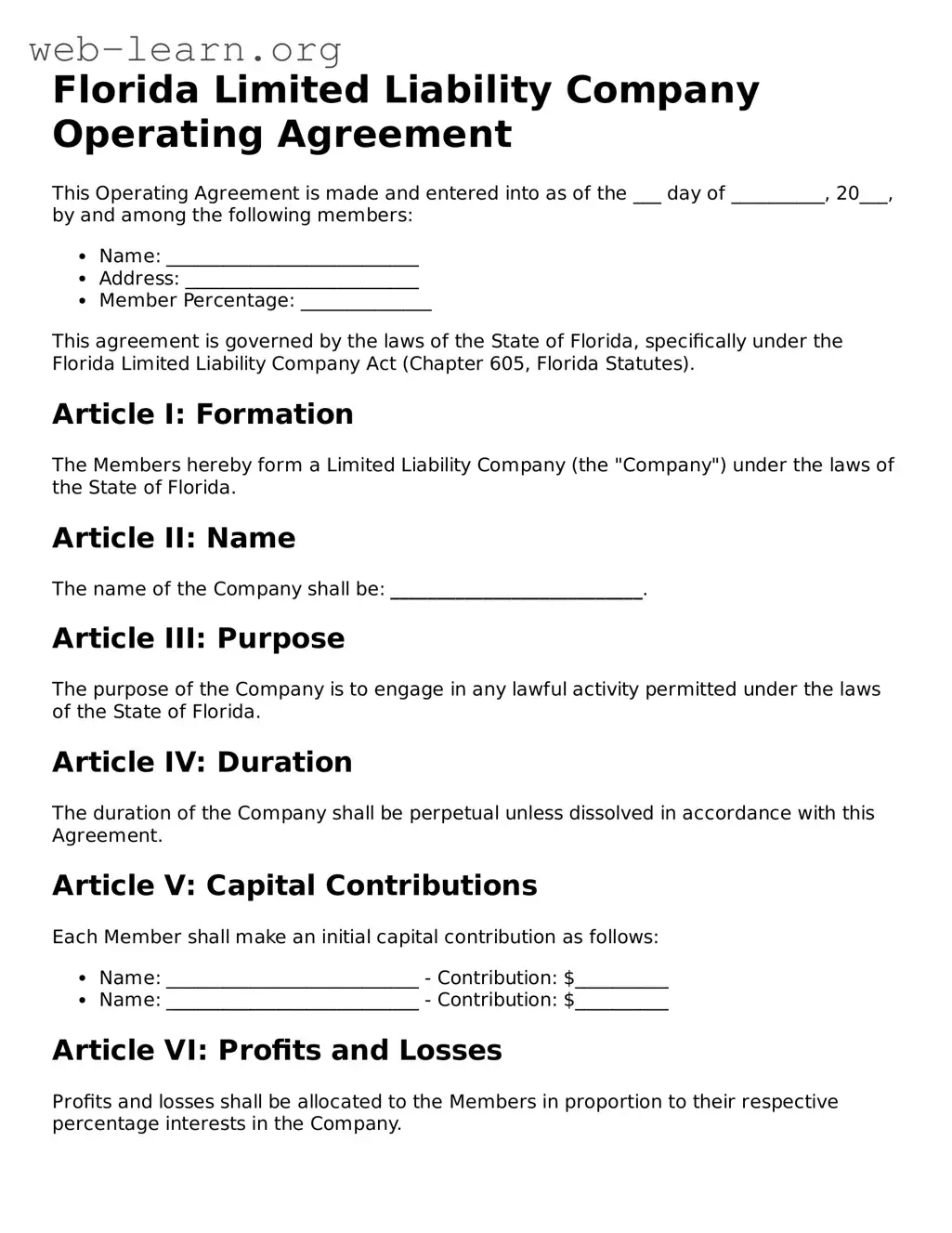
Florida Limited Liability Company Operating Agreement
This Operating Agreement is made and entered into as of the ___ day of __________, 20___, by and among the following members:
This agreement is governed by the laws of the State of Florida, specifically under the Florida Limited Liability Company Act (Chapter 605, Florida Statutes).
Article I: Formation
The Members hereby form a Limited Liability Company (the "Company") under the laws of the State of Florida.
Article II: Name
The name of the Company shall be: ___________________________.
Article III: Purpose
The purpose of the Company is to engage in any lawful activity permitted under the laws of the State of Florida.
Article IV: Duration
The duration of the Company shall be perpetual unless dissolved in accordance with this Agreement.
Article V: Capital Contributions
Each Member shall make an initial capital contribution as follows:
Article VI: Profits and Losses
Profits and losses shall be allocated to the Members in proportion to their respective percentage interests in the Company.
Article VII: Management
The management of the Company shall be vested in the Members. Decisions shall be made by a majority vote of the Members.
Article VIII: Indemnification
The Company shall indemnify any Member or Manager for actions taken on behalf of the Company, except in cases of willful misconduct or gross negligence.
Article IX: Amendments
This Operating Agreement may be amended only by a written agreement signed by all Members.
Article X: Miscellaneous
IN WITNESS WHEREOF, the Members have executed this Operating Agreement as of the date first above written.
_____________________________ _____________________________
Member Name Member Name
_____________________________ _____________________________
Member Signature Member Signature
| Fact Name | Description |
|---|---|
| Governing Law | The Florida Operating Agreement is governed by the Florida Limited Liability Company Act. |
| Purpose | This agreement outlines the management structure and operating procedures of a limited liability company (LLC) in Florida. |
| Members | All members of the LLC should be included in the agreement, detailing their rights and responsibilities. |
| Flexibility | Florida law allows for significant flexibility in how the operating agreement is structured and what it includes. |
| Amendments | The agreement can be amended as needed, provided that all members agree to the changes. |
| Dispute Resolution | Many operating agreements include provisions for resolving disputes among members, such as mediation or arbitration. |
| Not Mandatory | While not required by law, having an operating agreement is highly recommended for LLCs in Florida. |
Completing the Florida Operating Agreement form is an essential step for those looking to establish a limited liability company (LLC) in Florida. This document will outline the management structure, responsibilities, and operational guidelines for your LLC. Following these steps will ensure that you fill out the form accurately and effectively.
What is a Florida Operating Agreement?
A Florida Operating Agreement is a legal document that outlines the management structure and operational procedures of a Limited Liability Company (LLC) in Florida. It serves as a roadmap for how the company will be run, detailing the rights and responsibilities of its members, how profits and losses will be distributed, and how decisions will be made.
Is an Operating Agreement required in Florida?
While Florida law does not mandate that LLCs have an Operating Agreement, it is highly recommended. Having one helps prevent misunderstandings among members and provides clarity on how the business should operate. If disputes arise, a well-drafted Operating Agreement can serve as a crucial reference point.
Who should draft the Operating Agreement?
Members of the LLC can draft the Operating Agreement themselves, but it’s advisable to consult with a legal professional. An attorney can ensure that the document complies with Florida laws and addresses specific needs and concerns of the business. This can save time and potential legal issues down the line.
What should be included in the Operating Agreement?
Key elements of an Operating Agreement typically include:
Can the Operating Agreement be amended?
Yes, the Operating Agreement can be amended. It’s important to include a provision in the document that outlines the process for making amendments. Typically, this requires a vote from the members. Keeping the Operating Agreement up to date ensures that it reflects the current operations and agreements of the LLC.
How does the Operating Agreement affect liability protection?
The Operating Agreement plays a crucial role in maintaining the liability protection that an LLC provides. By clearly defining the roles and responsibilities of members and how the business operates, it helps demonstrate that the LLC is a separate entity. This separation is key to protecting personal assets from business liabilities.
Where should the Operating Agreement be kept?
The Operating Agreement should be kept in a safe place, such as a secure file or a digital storage system. All members should have access to it. It’s also a good practice to keep copies of any amendments or updates made to the document, as these will be important for future reference.
When individuals set out to fill out the Florida Operating Agreement form, they often overlook critical details that can lead to complications down the line. One common mistake is failing to clearly define the roles and responsibilities of each member. Without this clarity, misunderstandings can arise, leading to conflicts that could have been easily avoided.
Another frequent error is neglecting to specify the percentage of ownership for each member. This omission can create confusion about profit distribution and decision-making authority. Each member should understand their stake in the business, which helps prevent disputes later on.
Some individuals mistakenly assume that a verbal agreement is sufficient. However, the Operating Agreement serves as a formal document that outlines the rules and regulations governing the business. Relying solely on verbal agreements can lead to significant legal challenges if disagreements occur.
Additionally, many people fail to include provisions for resolving disputes. Without a clear process in place, conflicts can escalate, potentially harming relationships and the business itself. Establishing a method for conflict resolution is essential for maintaining harmony among members.
Another mistake involves not updating the Operating Agreement as changes occur. Life events, such as the addition of new members or changes in ownership percentages, should prompt a review and revision of the agreement. Ignoring this can result in outdated terms that no longer reflect the current structure of the business.
Some individuals also overlook the importance of including a buy-sell agreement. This provision outlines the process for members to buy out a departing member’s share. Without it, the remaining members may face challenges in managing ownership transitions smoothly.
Moreover, failing to consult with legal or financial professionals is a mistake that can have long-term consequences. While the form may seem straightforward, expert advice can help ensure that all necessary provisions are included and that the document complies with state laws.
Another common error is not considering tax implications. The Operating Agreement can influence how the business is taxed, and neglecting this aspect can lead to unexpected financial burdens. Understanding these implications is crucial for effective financial planning.
Finally, many people do not take the time to review the completed form thoroughly. Errors in spelling, grammar, or missing information can undermine the document's validity. A careful review can prevent these mistakes, ensuring that the agreement serves its intended purpose effectively.
When forming a Limited Liability Company (LLC) in Florida, the Operating Agreement is a crucial document that outlines the management structure and operational procedures. However, several other forms and documents are often used in conjunction with the Operating Agreement to ensure compliance with state laws and to facilitate smooth business operations. Here are some of the key documents:
Using these documents alongside the Florida Operating Agreement helps create a solid foundation for your LLC. Proper documentation not only ensures compliance with state regulations but also promotes transparency and clarity among members, ultimately contributing to the success of your business.
When filling out the Florida Operating Agreement form, it is important to follow certain guidelines to ensure accuracy and compliance. Below are key dos and don'ts to consider.
When it comes to the Florida Operating Agreement form, there are several misconceptions that can lead to confusion. Understanding these can help you navigate the process more smoothly. Here’s a list of common misunderstandings:
By addressing these misconceptions, you can better understand the importance of the Florida Operating Agreement form and how it serves your business needs.
When filling out and using the Florida Operating Agreement form, consider the following key takeaways:
Creating an Operating Agreement - It can clarify the rights of members regarding access to company records.
Operating Agreement Llc California Template - An Operating Agreement can outline the process for dissolution of the LLC.
Indiana Llc Operating Agreement - The Operating Agreement helps prevent misunderstandings among members.