In Florida, when a landlord needs a tenant to vacate a rental property, the process begins with a crucial document known as the Notice to Quit. This form serves as a formal request for tenants to leave the premises, and it is a vital step in the eviction process. The Notice to Quit outlines the reasons for the eviction, whether it be for non-payment of rent, lease violations, or the expiration of a rental agreement. It specifies a deadline by which the tenant must vacate, ensuring that they have a clear timeframe to respond. Understanding the requirements and implications of this form is essential for both landlords and tenants, as it sets the stage for any potential legal actions that may follow. Properly completing and serving this notice can help landlords protect their rights while also giving tenants the opportunity to address the issues at hand. The significance of this document cannot be overstated, as it establishes the groundwork for a smooth transition, whether it leads to an amicable resolution or further legal proceedings.
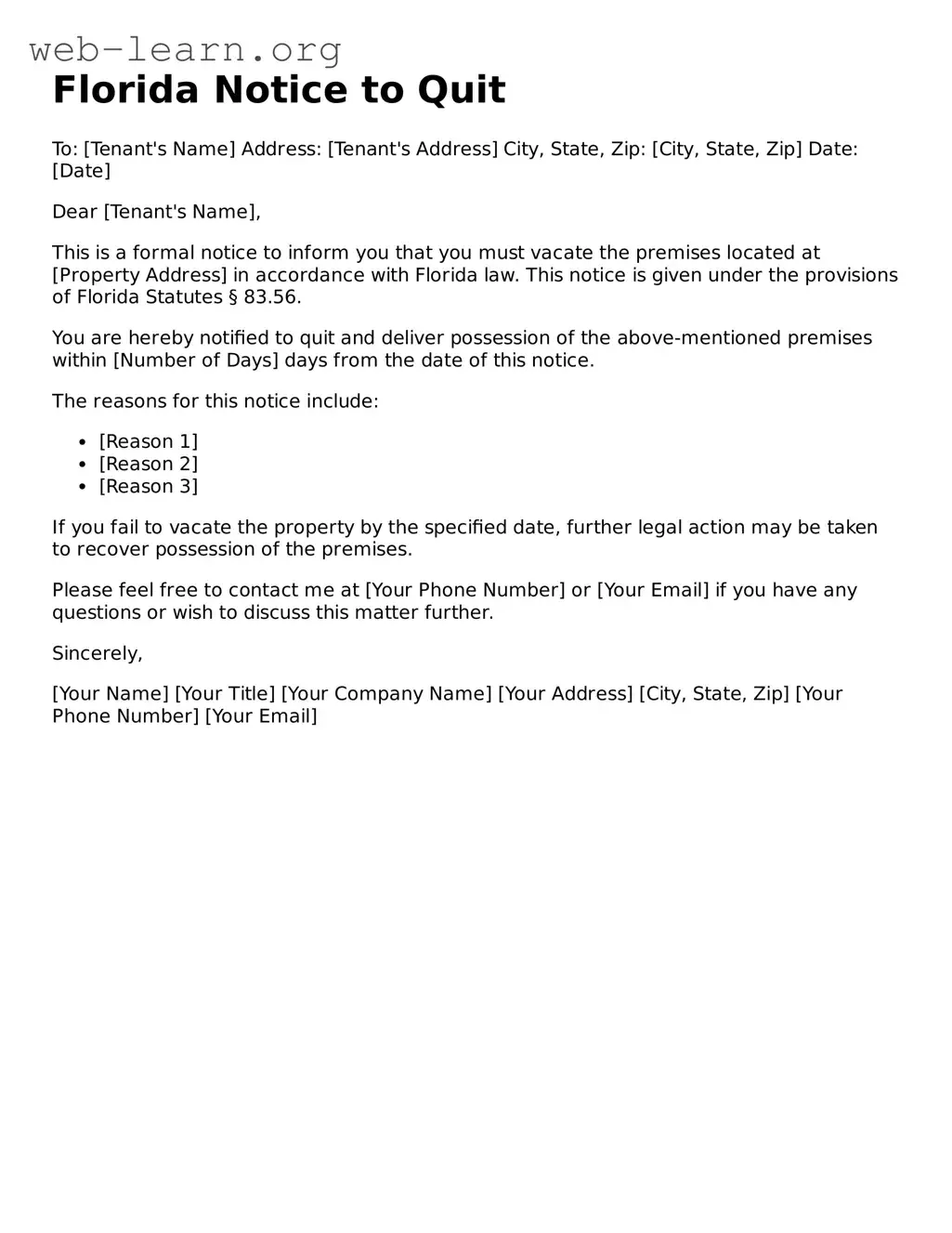
Florida Notice to Quit
To: [Tenant's Name] Address: [Tenant's Address] City, State, Zip: [City, State, Zip] Date: [Date]
Dear [Tenant's Name],
This is a formal notice to inform you that you must vacate the premises located at [Property Address] in accordance with Florida law. This notice is given under the provisions of Florida Statutes § 83.56.
You are hereby notified to quit and deliver possession of the above-mentioned premises within [Number of Days] days from the date of this notice.
The reasons for this notice include:
If you fail to vacate the property by the specified date, further legal action may be taken to recover possession of the premises.
Please feel free to contact me at [Your Phone Number] or [Your Email] if you have any questions or wish to discuss this matter further.
Sincerely,
[Your Name] [Your Title] [Your Company Name] [Your Address] [City, State, Zip] [Your Phone Number] [Your Email]
| Fact Name | Description |
|---|---|
| Purpose | The Florida Notice to Quit form is used by landlords to inform tenants of their intention to terminate the lease agreement. |
| Governing Law | This form is governed by Florida Statutes, specifically Chapter 83, which outlines residential landlord-tenant law. |
| Delivery Methods | The notice can be delivered in person, by mail, or by posting on the rental property. |
| Notice Period | Depending on the reason for termination, the notice period may vary. Typically, it is at least 3 days for non-payment of rent. |
| Tenant Rights | Tenants have the right to respond to the notice and may contest the eviction in court. |
| Form Requirements | The notice must include specific information, such as the date, reason for termination, and the tenant's name. |
| Legal Consequences | If a tenant does not comply with the notice, the landlord may proceed with eviction proceedings. |
| Variations | Different types of notices exist, such as for lease violations or non-renewal, each with its own requirements. |
| Documentation | Landlords should keep a copy of the notice for their records, as it may be needed in court. |
Once you have the Florida Notice to Quit form in hand, it’s time to fill it out accurately. This form is essential in communicating your intentions clearly and formally. Follow these steps to ensure you complete the form correctly.
After filling out the form, make sure to deliver it to the tenant in accordance with Florida law. Proper delivery methods include personal delivery, certified mail, or posting it on the property. Keeping a copy for your records is also a good practice.
What is a Florida Notice to Quit form?
The Florida Notice to Quit form is a legal document used by landlords to inform tenants that they must vacate the rental property. This notice is typically given when a tenant has violated the terms of their lease or rental agreement, such as failing to pay rent or causing damage to the property.
When should a landlord use a Notice to Quit?
A landlord should use a Notice to Quit when they want to terminate a lease agreement due to specific reasons. Common reasons include:
It's important to follow the proper legal procedures when issuing this notice to ensure compliance with Florida law.
How much notice must be given?
The amount of notice required depends on the reason for the eviction. Generally, a landlord must provide:
Always check the specific circumstances and consult local laws to confirm the required notice period.
What happens if the tenant does not leave?
If the tenant does not vacate the property by the date specified in the Notice to Quit, the landlord may proceed with filing an eviction lawsuit. This process is known as an unlawful detainer action, and it requires the landlord to go through the court system to regain possession of the property.
Can a tenant contest a Notice to Quit?
Yes, a tenant can contest a Notice to Quit. If they believe the notice was issued unfairly or if they have a valid defense, they can respond to the eviction lawsuit in court. It's advisable for tenants to seek legal advice to understand their rights and options.
Is the Notice to Quit the same as an eviction notice?
No, a Notice to Quit is not the same as an eviction notice. The Notice to Quit is a preliminary step that informs the tenant of the need to vacate. An eviction notice is issued after the tenant fails to leave following the Notice to Quit, leading to legal proceedings to remove them from the property.
Can a landlord change the terms of the Notice to Quit?
Once a Notice to Quit has been issued, the landlord cannot change its terms. If the landlord wishes to alter the notice or extend the time frame, they must issue a new Notice to Quit. This new notice must comply with all legal requirements.
Do I need a lawyer to prepare a Notice to Quit?
While it is not legally required to have a lawyer prepare a Notice to Quit, it is often beneficial to consult with one. A legal professional can ensure that the notice complies with all relevant laws and regulations, helping to avoid potential issues down the line.
Where can I find a template for a Florida Notice to Quit?
Templates for a Florida Notice to Quit can be found online through various legal aid websites or legal document preparation services. Make sure to use a reputable source to ensure the template meets all state requirements.
When filling out the Florida Notice to Quit form, individuals often overlook important details that can lead to complications. One common mistake is failing to provide accurate tenant information. It is crucial to include the full name of the tenant as it appears on the lease agreement. Missing or incorrect names can create confusion and potentially invalidate the notice.
Another frequent error involves the lack of a clear statement regarding the reason for eviction. The form must specify the grounds for the eviction, whether it is for non-payment of rent or violation of lease terms. Vague or ambiguous language can undermine the effectiveness of the notice and may lead to disputes later in the process.
Many people also neglect to include the correct date of the notice. The date is significant because it establishes the timeline for the tenant to vacate the property. If the date is incorrect or omitted, it could result in a longer notice period than required, complicating the eviction process.
Additionally, some individuals fail to sign and date the form. A signature is essential as it indicates that the landlord or property owner is formally initiating the eviction process. Without a signature, the notice may be deemed incomplete and unenforceable.
Another mistake is not providing a copy of the notice to the tenant in a proper manner. Simply posting the notice on the door may not suffice. Florida law often requires that the notice be delivered in a specific way, such as by certified mail or personal delivery, to ensure that the tenant receives it.
Lastly, individuals sometimes overlook the importance of keeping a copy of the filled-out Notice to Quit form for their records. Retaining a copy can be invaluable if disputes arise later. It serves as proof that the notice was properly issued and can assist in any future legal proceedings.
When dealing with rental agreements and tenant issues in Florida, the Notice to Quit form is just one of several important documents. Understanding these forms can help landlords and tenants navigate the legal landscape more effectively. Here’s a list of other commonly used forms and documents that often accompany the Florida Notice to Quit.
Each of these documents plays a crucial role in the landlord-tenant relationship. Being familiar with them can help ensure that both parties understand their rights and responsibilities, ultimately leading to smoother interactions and fewer disputes.
The Notice to Quit form is a crucial document in the landlord-tenant relationship. It serves as a formal communication indicating that a tenant must vacate the rental property. Several other documents share similarities with the Notice to Quit form in terms of purpose and function. Here’s a list of those documents:
When filling out the Florida Notice to Quit form, it is crucial to follow specific guidelines to ensure clarity and compliance with the law. Here are six important do's and don'ts:
There are several misconceptions about the Florida Notice to Quit form that can lead to confusion. Understanding these myths can help tenants and landlords navigate the eviction process more effectively.
Many people think that a Notice to Quit is the same as an eviction notice. In reality, it is a formal request for a tenant to vacate the property, but it does not mean that eviction is guaranteed.
Some believe that landlords can issue a Notice to Quit for any reason. However, it must be based on specific grounds, such as non-payment of rent or lease violations.
Receiving a Notice to Quit does not strip tenants of their rights. They still have the opportunity to respond and address the issues raised in the notice.
While personal delivery is one option, a Notice to Quit can also be sent via certified mail or posted on the property, as long as it follows Florida law.
Some assume that once a Notice to Quit is issued, the eviction is imminent. However, there are several steps that must be taken before a landlord can legally evict a tenant.
It is a common belief that tenants have no recourse after receiving a Notice to Quit. In fact, tenants can contest the notice in court if they believe it is unjustified.
When dealing with the Florida Notice to Quit form, it’s essential to understand its purpose and how to use it effectively. Here are some key takeaways to guide you:
By following these guidelines, you can navigate the process of issuing a Notice to Quit in Florida with greater confidence and clarity.
Georgia Tenant at Will 60 Day Notice - Landlords should be clear and concise in the Notice to Quit to avoid confusion or disputes later on.
Three Day Notice to Quit - The notice can also include options for the tenant to remedy the situation.
3 Day Notice to Pay or Quit California 2023 - Can be issued for reasons beyond non-payment, such as damage.