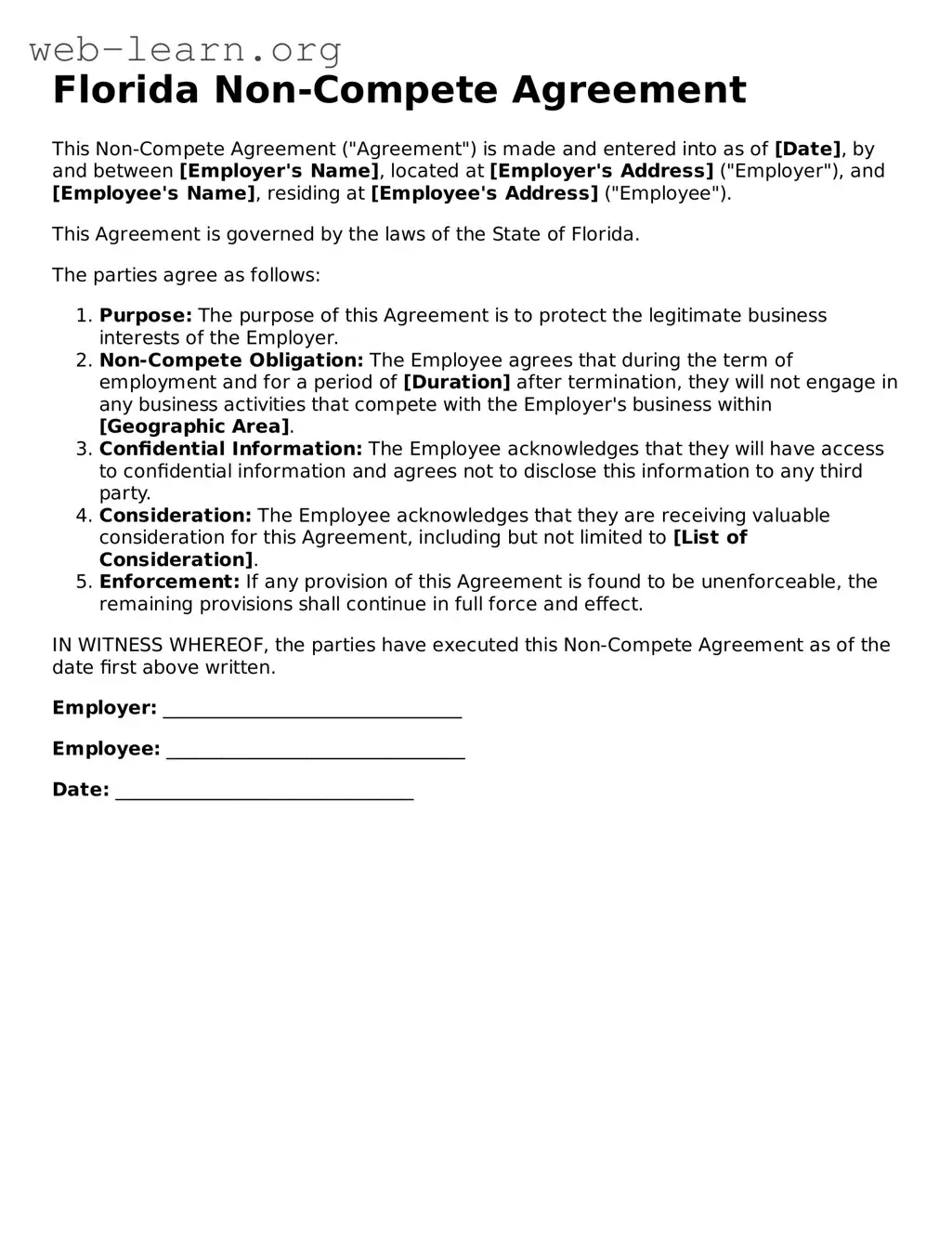
In the competitive landscape of Florida's job market, protecting business interests is crucial. A Non-compete Agreement serves as a vital tool for employers to safeguard their proprietary information and maintain their competitive edge. This legally binding document outlines the restrictions placed on employees regarding their ability to work for competing businesses after leaving their current employer. The Florida Non-compete Agreement form typically includes essential elements such as the duration of the non-compete period, the geographic scope of the restriction, and the specific types of activities that are prohibited. Employers must ensure that the terms are reasonable and enforceable under Florida law, which requires a legitimate business interest to justify the restrictions. Understanding the nuances of this agreement is essential for both employers and employees, as it can significantly impact future employment opportunities and business operations.
Florida Non-Compete Agreement
This Non-Compete Agreement ("Agreement") is made and entered into as of [Date], by and between [Employer's Name], located at [Employer's Address] ("Employer"), and [Employee's Name], residing at [Employee's Address] ("Employee").
This Agreement is governed by the laws of the State of Florida.
The parties agree as follows:
IN WITNESS WHEREOF, the parties have executed this Non-Compete Agreement as of the date first above written.
Employer: ________________________________
Employee: ________________________________
Date: ________________________________
| Fact Name | Description |
|---|---|
| Definition | A non-compete agreement is a contract that restricts an employee from working for competitors after leaving a job. |
| Governing Law | Florida Statutes Chapter 542 governs non-compete agreements in Florida. |
| Enforceability | In Florida, a non-compete agreement is enforceable if it is reasonable in time, area, and line of business. |
| Time Limit | Typically, a non-compete can last up to two years, but this can vary based on the nature of the business. |
| Geographic Scope | The agreement must specify a geographic area where the employee cannot compete, which should be reasonable. |
| Consideration | To be valid, a non-compete agreement must be supported by adequate consideration, such as a job offer or training. |
| Employee Rights | Employees have the right to review the terms of the agreement and seek legal advice before signing. |
| Judicial Review | Courts in Florida will review non-compete agreements to ensure they do not impose an undue hardship on the employee. |
| Exceptions | There are exceptions to enforcement, especially if the employer is found to have acted in bad faith. |
| Modification | Non-compete agreements can be modified by mutual consent, but both parties must agree to the changes in writing. |
After obtaining the Florida Non-compete Agreement form, you will need to fill it out carefully to ensure all necessary information is provided. This process involves several steps, which, when followed correctly, will help you complete the form accurately.
Once you have completed these steps, review the form for accuracy before submitting it. This will help prevent any misunderstandings or legal issues in the future.
What is a Florida Non-compete Agreement?
A Florida Non-compete Agreement is a legal document that restricts an employee from engaging in business activities that compete with their employer after leaving the company. This agreement aims to protect the employer's business interests, trade secrets, and customer relationships.
What are the requirements for a Non-compete Agreement in Florida?
In Florida, a Non-compete Agreement must be reasonable in scope, duration, and geographic area. The agreement must protect legitimate business interests and cannot impose undue hardship on the employee. Specific requirements include:
How long can a Non-compete Agreement last in Florida?
The duration of a Non-compete Agreement in Florida can vary, but it typically ranges from six months to two years. Courts will evaluate the reasonableness of the duration based on the nature of the business and the employee's role. Longer durations may be scrutinized more closely.
What happens if I violate a Non-compete Agreement?
If an employee violates a Non-compete Agreement, the employer may seek legal remedies. This can include injunctions to prevent the employee from continuing the competing activities and potential monetary damages for losses incurred due to the violation. Legal action can be costly and time-consuming.
Can a Non-compete Agreement be enforced if I did not sign it?
Generally, a Non-compete Agreement is only enforceable if it has been signed by the employee. However, if the employee continues to work under the terms of the agreement or accepts benefits from the employer, a court may find that the employee has implicitly agreed to the terms.
Are there any exceptions to Non-compete Agreements in Florida?
Yes, certain exceptions exist. For example, Florida law prohibits Non-compete Agreements for employees who are terminated without cause or laid off. Additionally, non-compete clauses cannot be enforced against employees who are part-time workers or independent contractors in some cases.
How can I contest a Non-compete Agreement?
If you believe a Non-compete Agreement is unfair or unreasonable, you can contest it in court. Common defenses include arguing that the agreement is overly broad, lacks a legitimate business interest, or imposes an undue hardship. Consulting with a legal professional is advisable to assess your options.
Do I need a lawyer to draft a Non-compete Agreement?
While it is possible to draft a Non-compete Agreement without legal assistance, it is highly recommended to consult with a lawyer. A legal professional can ensure that the agreement complies with Florida law, protects your interests, and is enforceable in court.
When filling out the Florida Non-compete Agreement form, many individuals overlook important details that can lead to complications down the line. One common mistake is failing to specify the geographic area covered by the agreement. Without clearly defining the locations where the non-compete applies, the terms may be considered too broad or vague, which can weaken the enforceability of the agreement.
Another frequent error is not including a reasonable duration for the non-compete clause. A period that is excessively long may be deemed unreasonable by a court, while a duration that is too short may not adequately protect the employer’s interests. It is essential to strike a balance that serves both parties.
Many people also neglect to consider the specific activities that the non-compete agreement restricts. Failing to clearly outline which types of employment or business activities are prohibited can lead to confusion and potential legal disputes. It’s crucial to be precise about what is and isn’t allowed.
In addition, individuals sometimes overlook the importance of mutual consideration. A valid non-compete agreement requires that both parties receive something of value. If one party does not provide consideration, the agreement may be unenforceable. This can happen if the employee does not receive a promotion, raise, or other benefits in exchange for signing the agreement.
People may also forget to review the agreement with legal counsel before signing. While it may seem unnecessary, having a lawyer review the document can help identify potential issues and ensure that the agreement is fair and reasonable. This step can save time and money in the future.
Another mistake involves not keeping a copy of the signed agreement. After signing, it is important to retain a copy for personal records. Without it, individuals may struggle to recall the terms or may be unable to prove what was agreed upon if a dispute arises.
Lastly, individuals often fail to understand the implications of the non-compete agreement on their future employment opportunities. They may not realize how signing such an agreement could limit their job prospects in their field. It’s vital to consider how the agreement could impact career choices before agreeing to its terms.
When entering into a Florida Non-compete Agreement, several additional forms and documents may be necessary to ensure clarity and legal compliance. Each of these documents serves a specific purpose, helping both parties understand their rights and obligations. Below is a list of common documents often used in conjunction with a Non-compete Agreement.
Understanding these documents can help both employers and employees navigate the complexities of employment relationships. By ensuring that all relevant agreements are in place, parties can protect their interests while fostering a professional and respectful work environment.
A Non-compete Agreement is a legal document designed to restrict an individual's ability to engage in certain activities that may compete with a business. Several other documents share similarities with a Non-compete Agreement, each serving a specific purpose in protecting business interests or outlining obligations. Here are eight such documents:
When filling out the Florida Non-compete Agreement form, there are several important considerations to keep in mind. Below is a list of things you should and shouldn't do:
Non-compete agreements are often misunderstood. Below is a list of common misconceptions about the Florida Non-compete Agreement form, along with clarifications for each.
In Florida, non-compete agreements must meet specific criteria to be enforceable. They must protect legitimate business interests and be reasonable in scope and duration.
Not all employees are required to sign a non-compete agreement. The necessity often depends on the employee's role and access to sensitive information.
While both agreements aim to protect business interests, non-compete agreements restrict employment opportunities, whereas non-disclosure agreements protect confidential information.
A non-compete agreement may limit where and how you can work, but it does not necessarily prevent you from working in your field altogether. The restrictions are typically limited to specific geographic areas and timeframes.
Non-compete agreements can apply to various levels of employees, not just executives. Any employee with access to proprietary information may be subject to such agreements.
Employees can challenge the enforceability of a non-compete agreement in court if they believe it is overly restrictive or not justified by legitimate business interests.
Each state has its own laws regarding non-compete agreements. Florida has specific regulations that differ from those in other states, affecting their enforceability.
Employers must act within a reasonable timeframe to enforce a non-compete agreement. Delays in enforcement may weaken their case.
While some businesses may benefit from non-compete agreements to protect trade secrets and customer relationships, others may not find them necessary or appropriate.
When considering a Florida Non-compete Agreement, it’s important to understand the nuances of the form and its implications. Here are key takeaways to keep in mind:
Understanding these elements can help individuals and businesses navigate the complexities of non-compete agreements effectively.
Nys Non Compete - Employees should seek legal advice if they have concerns about a Non-compete Agreement.
How to Beat a Non Compete in Pa - Signing a Non-compete Agreement may be a condition of employment.