The Florida Motor Vehicle Power of Attorney form is an essential document for anyone needing to delegate authority regarding their vehicle. This form allows an individual, known as the principal, to appoint another person, referred to as the agent, to handle specific tasks related to their motor vehicle. Key responsibilities can include signing titles, registering vehicles, and obtaining or transferring vehicle ownership. By utilizing this form, the principal can ensure that their vehicle-related matters are managed efficiently, especially in situations where they are unable to do so themselves. The form is straightforward, requiring basic information about both the principal and the agent, as well as details about the vehicle in question. Proper completion and notarization of the form are crucial to make it legally binding, providing peace of mind that the agent can act on behalf of the principal without complications.
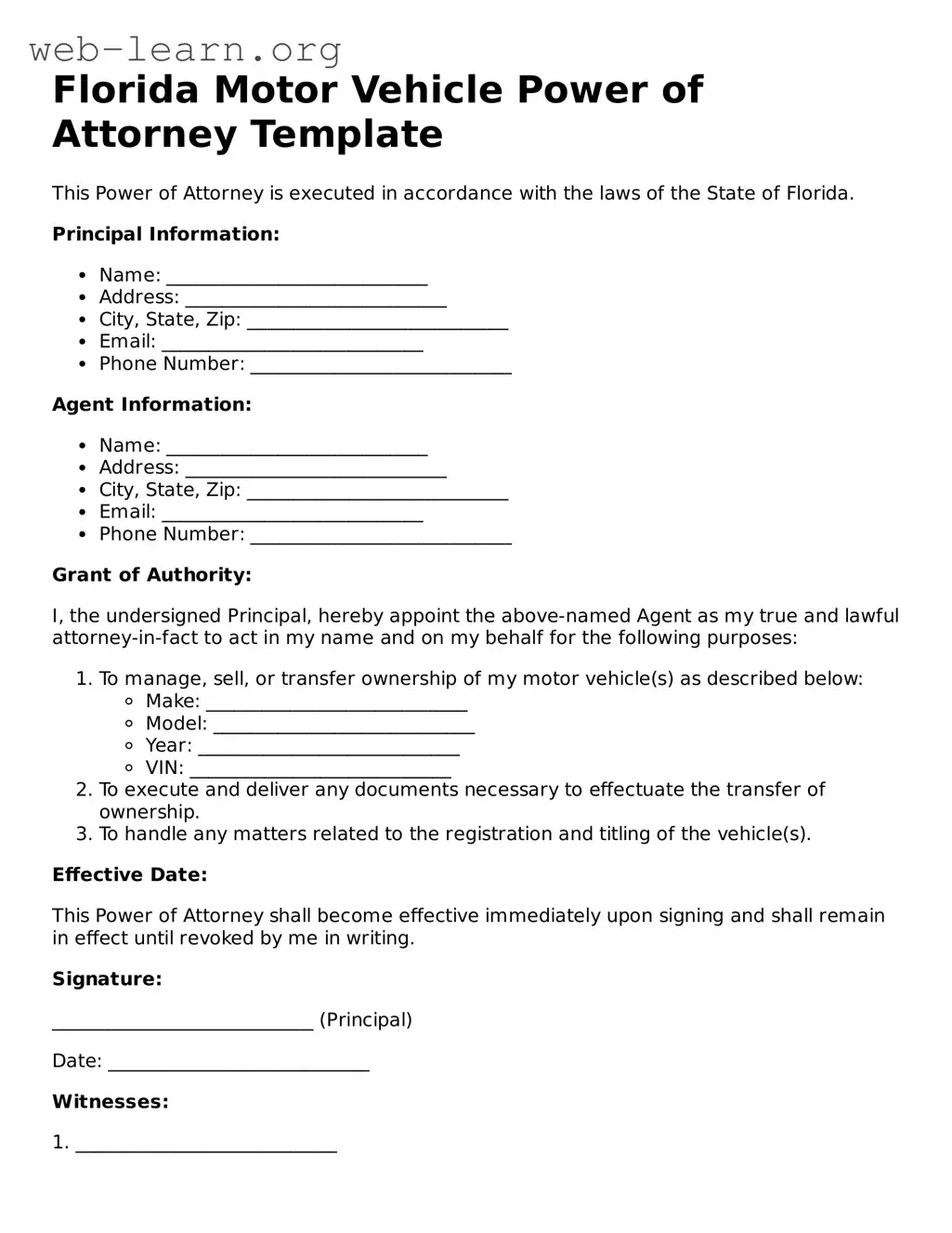
Florida Motor Vehicle Power of Attorney Template
This Power of Attorney is executed in accordance with the laws of the State of Florida.
Principal Information:
Agent Information:
Grant of Authority:
I, the undersigned Principal, hereby appoint the above-named Agent as my true and lawful attorney-in-fact to act in my name and on my behalf for the following purposes:
Effective Date:
This Power of Attorney shall become effective immediately upon signing and shall remain in effect until revoked by me in writing.
Signature:
____________________________ (Principal)
Date: ____________________________
Witnesses:
1. ____________________________
2. ____________________________
Notary Public:
State of Florida
County of ____________________________
Subscribed and sworn to before me this ____ day of __________, 20__.
____________________________ (Notary Public)
My Commission Expires: ____________________________
| Fact Name | Description |
|---|---|
| Purpose | The Florida Motor Vehicle Power of Attorney form allows an individual to appoint someone else to handle motor vehicle transactions on their behalf. |
| Governing Law | This form is governed by Florida Statutes, specifically Chapter 709, which covers powers of attorney. |
| Eligibility | Any adult resident of Florida can create this power of attorney, as long as they are of sound mind. |
| Signature Requirement | The principal must sign the form in the presence of a notary public or two witnesses. |
| Duration | The power of attorney remains effective until revoked by the principal or until the principal's death. |
| Revocation | The principal can revoke the power of attorney at any time by notifying the agent in writing. |
| Agent's Authority | The agent can perform tasks such as signing titles, registering vehicles, and handling other motor vehicle-related matters. |
| Limitations | The form may not grant authority for all legal matters; it is specific to motor vehicle transactions. |
| Filing | While the form does not need to be filed with any government agency, it should be kept in a safe place for reference. |
Filling out the Florida Motor Vehicle Power of Attorney form is a straightforward process. After completing the form, you will need to ensure that it is signed and dated appropriately. This document will allow another person to act on your behalf regarding motor vehicle matters.
What is a Florida Motor Vehicle Power of Attorney form?
The Florida Motor Vehicle Power of Attorney form is a legal document that allows an individual, known as the principal, to appoint another person, called the agent, to handle specific tasks related to motor vehicles on their behalf. This can include signing documents for vehicle registration, title transfers, or other transactions with the Florida Department of Highway Safety and Motor Vehicles.
Who can serve as an agent in this form?
Any competent adult can serve as an agent. This means the person must be at least 18 years old and capable of understanding the responsibilities involved. It is common for individuals to choose a trusted family member, friend, or attorney to act as their agent. The selected agent should be someone who is reliable and can be trusted to handle the principal's affairs responsibly.
How do I complete the Florida Motor Vehicle Power of Attorney form?
To complete the form, follow these steps:
Once completed, keep a copy for your records and provide a copy to your agent.
Is the Florida Motor Vehicle Power of Attorney form revocable?
Yes, the Florida Motor Vehicle Power of Attorney form is revocable. As the principal, you have the right to revoke the power of attorney at any time, as long as you are competent. To revoke the document, you should provide written notice to your agent and any relevant parties, such as the Florida Department of Highway Safety and Motor Vehicles. It is advisable to complete a formal revocation form to ensure clarity and legal standing.
Filling out the Florida Motor Vehicle Power of Attorney form can seem straightforward, but many individuals make common mistakes that can lead to complications. One frequent error is failing to provide complete information about the principal and the agent. Both parties must be clearly identified, including their full names and addresses. Omitting this information can render the document invalid.
Another mistake is neglecting to specify the powers granted to the agent. The form allows for a range of powers related to motor vehicle transactions, such as selling, transferring, or registering a vehicle. If these powers are not clearly outlined, the agent may not have the authority needed to act on behalf of the principal.
Many people also overlook the importance of signing the form in the appropriate places. The principal must sign the document, and in some cases, a witness may also be required. Failing to sign or having an incorrect signature can lead to disputes or rejection of the form by the Department of Motor Vehicles.
Not dating the form is another common oversight. A date is essential to establish when the powers take effect. Without a date, it may be unclear whether the authority is current or outdated, which can complicate transactions.
Some individuals mistakenly assume that the Power of Attorney is effective indefinitely. However, it is crucial to indicate if the authority is limited to a specific time frame or a particular transaction. This clarity helps prevent misunderstandings and protects both the principal and the agent.
Another frequent error involves using outdated forms. Laws and requirements can change, so it is important to ensure that the most current version of the Florida Motor Vehicle Power of Attorney form is being used. Using an outdated form may lead to issues with acceptance.
Additionally, people often forget to keep copies of the completed form. It is wise to retain a copy for personal records and provide one to the agent. This ensures that both parties have access to the same information and can refer to it when needed.
Lastly, many individuals fail to consult with a knowledgeable person before completing the form. Seeking advice from someone experienced in legal documents can help avoid pitfalls and ensure that the form is filled out correctly. Taking this step can save time and prevent future complications.
When dealing with vehicle transactions in Florida, the Motor Vehicle Power of Attorney form is often accompanied by several other important documents. These forms ensure that the process is smooth and legally compliant. Below are some commonly used forms that you may encounter alongside the Power of Attorney.
Understanding these documents can significantly ease the process of vehicle transactions in Florida. Each form plays a vital role in ensuring that ownership is transferred legally and efficiently. Always ensure that you have the necessary paperwork completed to avoid any complications down the road.
When filling out the Florida Motor Vehicle Power of Attorney form, it is essential to approach the task with care. This document grants another person the authority to act on your behalf regarding motor vehicle matters. To ensure the process goes smoothly, consider the following guidelines.
Following these guidelines will help you navigate the process more effectively and avoid potential pitfalls. Properly executed, this form can provide the necessary authority to handle your motor vehicle needs seamlessly.
Understanding the Florida Motor Vehicle Power of Attorney form can be challenging. Here are eight common misconceptions that people often have about this document:
Many believe that the Power of Attorney is solely for the sale of a vehicle. In reality, it can also be used for other tasks such as registering a vehicle, transferring titles, and handling any related paperwork.
While you can appoint a trusted individual, not everyone is eligible. The person you choose must be at least 18 years old and capable of handling the responsibilities assigned to them.
Some people think that notarization is optional. However, in Florida, notarization is typically required for the Power of Attorney to be valid, ensuring that the document is legally binding.
Many assume that once a Power of Attorney is created, it lasts indefinitely. In fact, it can be revoked or expire under certain conditions, such as when the principal becomes incapacitated.
Some individuals believe that a single Power of Attorney form can be used for multiple vehicles. Each vehicle may require its own form to ensure clarity and legality in transactions.
While the Florida Motor Vehicle Power of Attorney is specific to Florida, it can be used for transactions involving vehicles registered in other states, provided it meets the legal requirements of those states.
People often overlook potential fees. Depending on where you file or use the Power of Attorney, there may be associated costs, such as notarization or filing fees.
Some believe that the Power of Attorney is set in stone. However, it can be modified or revoked at any time by the principal, as long as they are mentally competent.
By clarifying these misconceptions, individuals can better understand the purpose and function of the Florida Motor Vehicle Power of Attorney form, ensuring they use it effectively and responsibly.
Filling out and using the Florida Motor Vehicle Power of Attorney form can be a straightforward process if you keep a few key points in mind. Here are some essential takeaways to consider:
By following these guidelines, you can ensure that your Power of Attorney is set up correctly and serves your needs effectively.
Poa Dmv - A Motor Vehicle Power of Attorney can be a simple yet effective way to manage vehicle transactions.
Louisiana Dmv Power of Attorney - It allows for the appointment of an agent who can act in your best interest regarding your vehicle.
Appointment of Agent Form Michigan - This form simplifies vehicle transactions by allowing another person to act for you.