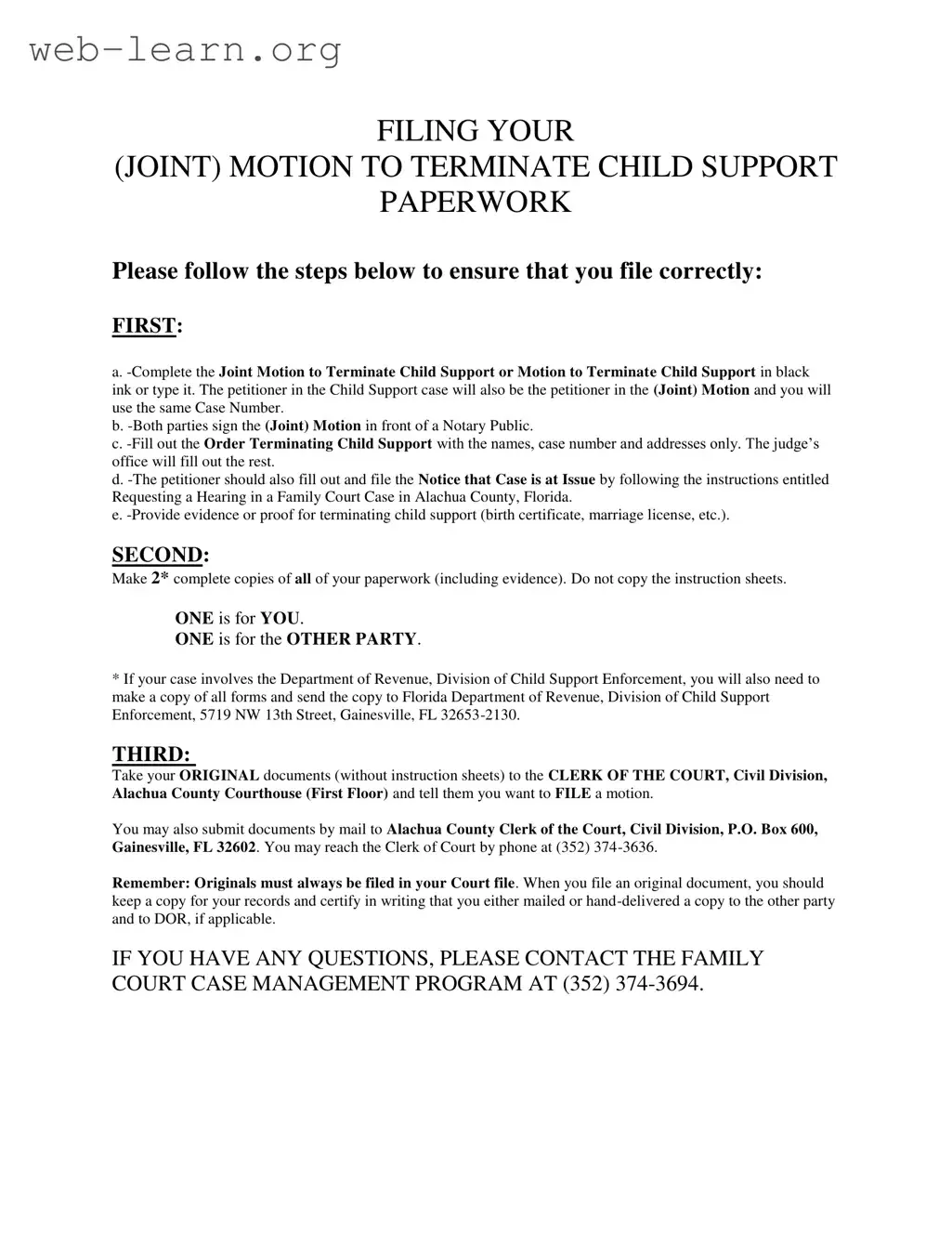
The Florida Motion to Terminate Income Deduction Order form plays a crucial role in the process of modifying or terminating income deductions related to child support or alimony. This form is typically utilized by individuals who seek to stop automatic deductions from their wages, which may have been previously established through court orders. It is essential to understand that the completion of this form requires accurate information, including details about the original income deduction order, the reasons for the termination request, and any supporting documentation that may substantiate the claim. The form must be filed with the appropriate court, and it is advisable to follow specific procedural guidelines to ensure proper handling. Additionally, parties involved should be aware of the potential implications of terminating an income deduction order, as it may affect ongoing financial responsibilities. Understanding these aspects can help individuals navigate the process more effectively and ensure compliance with legal requirements.



| Fact Name | Description |
|---|---|
| Purpose | The Florida Motion to Terminate Income Deduction Order form is used to request the termination of income deduction for child support or alimony payments. |
| Governing Law | This form is governed by Florida Statutes, specifically Section 61.1301, which addresses income deduction orders. |
| Eligibility | Individuals who have been ordered to make child support or alimony payments may file this motion if they believe the obligation has ended. |
| Filing Location | The completed form must be filed with the Clerk of Court in the county where the original support order was issued. |
| Required Information | Filers must provide personal information, including names, case numbers, and details regarding the income deduction order. |
| Response Time | Once filed, the other party typically has a specific period, usually 20 days, to respond to the motion. |
| Hearing Requirement | A hearing may be scheduled to review the motion, allowing both parties to present their case before a judge. |
| Legal Representation | While individuals can represent themselves, it is advisable to seek legal counsel to navigate the complexities of family law. |
| Consequences of Denial | If the motion is denied, the income deduction order remains in effect, and the individual must continue making payments as ordered. |
After gathering the necessary information and documents, you can begin filling out the Florida Motion Terminate Income Deduction Order form. This process involves providing specific details about your case and ensuring that all information is accurate and complete. Once you have filled out the form, you will need to submit it to the appropriate court for review.
What is the Florida Motion to Terminate Income Deduction Order?
The Florida Motion to Terminate Income Deduction Order is a legal document used to request the court to end an existing income deduction order. This order typically involves the withholding of a portion of an individual's income to satisfy child support obligations. If circumstances change, such as a change in employment or a modification of the support order, a motion can be filed to terminate this deduction.
Who can file this motion?
Either parent or guardian involved in the child support arrangement can file the motion. If you are the parent who is having income deducted, you may request to terminate the order. However, it is essential to ensure that the reasons for termination are valid and supported by evidence.
What reasons are valid for filing this motion?
Common reasons for filing the motion include:
How do I file the motion?
To file the motion, you will need to complete the appropriate form, which can usually be obtained from the local courthouse or online. Once completed, submit the form to the court along with any required supporting documents. Make sure to follow your local court's specific filing procedures.
Is there a fee to file this motion?
Yes, there may be a filing fee associated with submitting the motion. The amount can vary by county, so it is advisable to check with your local court for the exact fee. If you cannot afford the fee, you may be able to request a fee waiver.
What happens after I file the motion?
After filing, the court will schedule a hearing. You will receive a notice regarding the date and time of the hearing. It is crucial to attend this hearing, as it provides an opportunity to present your case and explain why the income deduction order should be terminated.
Do I need an attorney to file this motion?
While it is not mandatory to have an attorney, it is highly recommended. An attorney can provide valuable guidance, help prepare your documents, and represent you during the hearing. If you choose to proceed without an attorney, ensure that you understand the process and requirements thoroughly.
What if the court denies my motion?
If the court denies your motion, you will receive a written order explaining the reasons for the denial. Depending on the situation, you may have the option to appeal the decision or file a new motion in the future if circumstances change.
How can I prepare for the hearing?
Preparation is key for a successful hearing. Gather all relevant documents, including proof of income, employment status, and any other evidence supporting your request to terminate the income deduction. Practice presenting your case clearly and confidently, as this will help the judge understand your situation better.
Where can I find more information?
For more information, you can visit your local courthouse's website or consult with a legal aid organization. They often provide resources and assistance for individuals navigating the court system. Additionally, many counties offer self-help centers that can guide you through the process.
Filling out the Florida Motion to Terminate Income Deduction Order form can be a daunting task, and many people make mistakes that can complicate the process. One common error is failing to provide accurate personal information. It's essential to double-check names, addresses, and other identifying details. A simple typo can lead to delays or even a rejection of the motion.
Another frequent mistake involves the omission of required documentation. The form often requires supporting documents to substantiate the request. If these documents are not included, the court may not consider the motion, leading to frustration and wasted time.
Inaccurate financial information is also a prevalent issue. When detailing income and expenses, individuals sometimes provide outdated figures or fail to include all relevant sources of income. This can create a misleading picture of financial circumstances, which may affect the court's decision.
Some people neglect to sign and date the form properly. Without a signature, the motion is incomplete. Additionally, dating the form is crucial, as it establishes when the request was made. An unsigned or undated form can lead to further complications.
Another mistake is not following the specific instructions outlined for the motion. Each court may have its own rules regarding formatting and submission. Ignoring these guidelines can result in the motion being dismissed or delayed.
People often forget to keep copies of the submitted documents. This oversight can be problematic if there are questions or issues later on. Having a record of what was submitted is vital for tracking the progress of the motion.
Additionally, failing to serve the motion to the appropriate parties is a common pitfall. It’s crucial to ensure that all relevant parties receive a copy of the motion, as this is often a legal requirement. Not doing so can lead to further legal complications.
Some individuals also underestimate the importance of a clear and concise explanation of their request. A vague or poorly articulated motion can confuse the court and hinder the chances of approval. Providing a straightforward rationale is key to a successful motion.
Lastly, many people overlook the deadlines associated with filing the motion. Each court has specific timelines that must be adhered to. Missing these deadlines can result in the motion being dismissed outright, requiring individuals to start the process over.
By being aware of these common mistakes, individuals can improve their chances of successfully completing the Florida Motion to Terminate Income Deduction Order form. Attention to detail and a thorough understanding of the requirements are crucial for a smooth process.
The Florida Motion to Terminate Income Deduction Order form is often accompanied by several other important documents. Each of these documents serves a specific purpose in the legal process. Understanding them can help streamline the proceedings and clarify the situation for all parties involved.
Familiarity with these documents can facilitate a smoother legal process. Each plays a vital role in ensuring that the motion to terminate an income deduction order is handled fairly and efficiently.
When filling out the Florida Motion Terminate Income Deduction Order form, keep the following tips in mind:
Understanding the Florida Motion Terminate Income Deduction Order form is crucial for individuals navigating child support and income deductions. However, several misconceptions can lead to confusion. Here are four common misconceptions:
Clarifying these misconceptions can help individuals better navigate the legal process and ensure their rights are protected.
Ensure that all required information is accurately filled out on the Florida Motion Terminate Income Deduction Order form. Incomplete or incorrect information can lead to delays in processing.
Submit the completed form to the appropriate court or agency as specified in the instructions. This step is crucial for the termination of the income deduction order.
Keep a copy of the submitted form for your records. This documentation may be needed for future reference or in case of any disputes.
Follow up with the court or agency after submission to confirm that the motion has been processed. Timely follow-up can prevent any potential issues or misunderstandings.