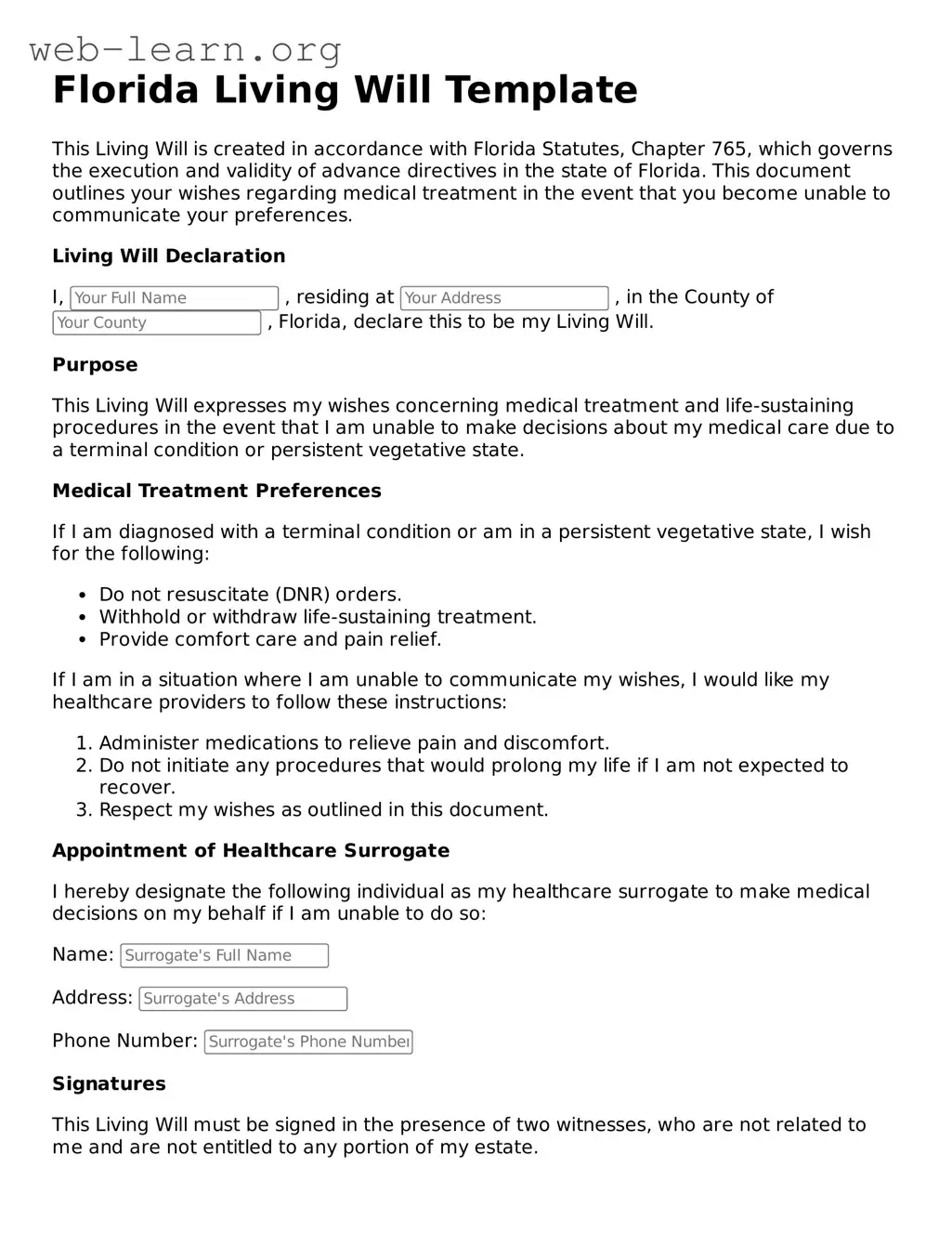
In Florida, the Living Will form plays a crucial role in ensuring that individuals can express their wishes regarding medical treatment in the event they become incapacitated. This legal document allows you to outline your preferences for life-sustaining measures, such as resuscitation, artificial nutrition, and hydration. By completing a Living Will, you provide guidance to your healthcare providers and loved ones during difficult times, helping them make informed decisions that align with your values. The form must be signed in the presence of two witnesses or a notary public to be valid, ensuring that your intentions are clear and legally recognized. Understanding the key components of the Florida Living Will form is essential for anyone looking to take control of their healthcare decisions and ensure their voice is heard, even when they can no longer speak for themselves.
Florida Living Will Template
This Living Will is created in accordance with Florida Statutes, Chapter 765, which governs the execution and validity of advance directives in the state of Florida. This document outlines your wishes regarding medical treatment in the event that you become unable to communicate your preferences.
Living Will Declaration
I, , residing at , in the County of , Florida, declare this to be my Living Will.
Purpose
This Living Will expresses my wishes concerning medical treatment and life-sustaining procedures in the event that I am unable to make decisions about my medical care due to a terminal condition or persistent vegetative state.
Medical Treatment Preferences
If I am diagnosed with a terminal condition or am in a persistent vegetative state, I wish for the following:
If I am in a situation where I am unable to communicate my wishes, I would like my healthcare providers to follow these instructions:
Appointment of Healthcare Surrogate
I hereby designate the following individual as my healthcare surrogate to make medical decisions on my behalf if I am unable to do so:
Name:
Address:
Phone Number:
Signatures
This Living Will must be signed in the presence of two witnesses, who are not related to me and are not entitled to any portion of my estate.
Signature: ___________________________ Date: _______________
Witness 1: ___________________________ Date: _______________
Witness 2: ___________________________ Date: _______________
Notarization (optional)
State of Florida, County of _____________
Subscribed and sworn to before me this _____ day of ____________, 20__.
Notary Public: ___________________________
My Commission Expires: _______________
| Fact Name | Description |
|---|---|
| Purpose | A Florida Living Will outlines a person's wishes regarding medical treatment in case they become unable to communicate their decisions. |
| Governing Law | The Florida Living Will is governed by Chapter 765 of the Florida Statutes. |
| Requirements | The form must be signed by the individual and witnessed by two adults who are not related to the individual. |
| Revocation | Individuals can revoke their Living Will at any time, verbally or in writing, as long as they are competent. |
| Healthcare Proxy | A Living Will can be used alongside a Healthcare Proxy, which designates someone to make healthcare decisions on behalf of the individual. |
Filling out the Florida Living Will form is an important step in ensuring your healthcare wishes are known and respected. Once you have completed the form, it will need to be signed and witnessed to be valid. Here’s how to fill it out step by step.
Once you have completed these steps, your Living Will will be ready to guide your healthcare decisions when you cannot speak for yourself. Make sure to review it periodically, especially if your preferences change.
What is a Florida Living Will?
A Florida Living Will is a legal document that outlines a person's preferences regarding medical treatment in the event they become unable to communicate their wishes due to a terminal illness or incapacitation. It specifies the types of medical interventions a person does or does not want, particularly concerning life-sustaining treatments.
Who should consider creating a Living Will?
Any adult residing in Florida should consider creating a Living Will. This includes individuals who wish to ensure their healthcare preferences are known and respected. It is particularly important for those with serious health conditions, chronic illnesses, or anyone who wants to plan for the future.
How do I create a Florida Living Will?
To create a Florida Living Will, you must complete a written document that meets state requirements. The form must be signed by you and witnessed by two individuals who are not related to you and who will not benefit from your estate. Alternatively, you can have the document notarized.
Can I change or revoke my Living Will?
Yes, you can change or revoke your Living Will at any time, as long as you are mentally competent. To revoke it, simply destroy the document or create a new one that explicitly states your current wishes. Inform your healthcare providers and loved ones of any changes you make.
What happens if I do not have a Living Will?
If you do not have a Living Will and become incapacitated, medical decisions will be made by your family members or legal representatives. This can lead to disagreements or decisions that may not align with your personal wishes. Having a Living Will helps avoid such situations.
What types of decisions can I make in a Living Will?
You can specify your preferences regarding various medical treatments, such as:
These choices help ensure that your healthcare aligns with your values and desires.
Is a Living Will the same as a Durable Power of Attorney for Healthcare?
No, a Living Will and a Durable Power of Attorney for Healthcare are different documents. A Living Will outlines your specific medical treatment preferences, while a Durable Power of Attorney designates someone to make healthcare decisions on your behalf if you cannot do so. Both documents can work together to provide comprehensive healthcare planning.
Where should I keep my Living Will?
Store your Living Will in a safe place, such as a locked file cabinet. It is important to provide copies to your healthcare provider, family members, and anyone who may be involved in your medical care. Ensure that those individuals are aware of its existence and your wishes as outlined in the document.
Filling out a Florida Living Will form can be a crucial step in ensuring that your healthcare wishes are honored in the event of a medical emergency. However, many individuals make common mistakes that can lead to confusion or even invalidate their intentions. Understanding these pitfalls can help ensure that your Living Will accurately reflects your desires.
One frequent mistake is failing to provide clear and specific instructions regarding medical treatments. A vague statement can lead to uncertainty among healthcare providers and loved ones. For example, simply stating that you do not want "extraordinary measures" can leave room for interpretation. It is essential to specify what types of treatments you do or do not want, such as resuscitation, mechanical ventilation, or tube feeding.
Another common error involves not signing the document properly. In Florida, a Living Will must be signed by the individual creating it and witnessed by two adults who are not related to the individual and who will not benefit from the estate. Neglecting to secure the necessary signatures can render the document ineffective.
Some individuals also overlook the importance of updating their Living Will. Life circumstances change, and so do personal preferences regarding medical care. Failing to revise the document after significant life events, such as marriage, divorce, or the birth of a child, can lead to outdated wishes being followed.
People often forget to communicate their wishes to family members and healthcare providers. Even if the Living Will is filled out correctly, if loved ones are unaware of its existence or content, they may struggle to make decisions that align with the individual's desires. Open discussions about end-of-life care can alleviate confusion and provide peace of mind.
Another mistake is assuming that a Living Will covers all aspects of healthcare decisions. While it addresses specific medical treatments, it does not appoint a healthcare proxy or durable power of attorney. Individuals should consider designating someone to make decisions on their behalf in situations not explicitly covered in the Living Will.
Some people may also fail to consider the implications of their choices. For instance, opting for no life-sustaining treatments can have profound effects on family members. It is crucial to think through the emotional and ethical dimensions of these decisions, as they can impact loved ones significantly.
Finally, individuals sometimes neglect to keep the Living Will in a safe yet accessible location. Storing the document in a safe deposit box may protect it from loss, but it also makes it difficult for healthcare providers to access when needed. Keeping a copy in a readily available place and informing family members of its location is vital.
By avoiding these common mistakes, individuals can ensure that their Florida Living Will accurately reflects their healthcare wishes and provides guidance to their loved ones and medical professionals during critical times.
When preparing a Florida Living Will, it's important to consider other related documents that can complement your end-of-life planning. These documents can help ensure that your wishes are honored and provide guidance to your loved ones and healthcare providers. Here are five important forms to consider:
Incorporating these documents into your planning can provide peace of mind. They help ensure that your healthcare preferences are clear and respected, making a challenging time a little easier for your loved ones.
A Living Will is an important document that outlines your preferences for medical treatment in case you become unable to communicate your wishes. There are several other documents that serve similar purposes, helping individuals express their healthcare preferences. Here’s a look at six documents similar to a Living Will:
When filling out the Florida Living Will form, it's important to approach the process with care. Here are some dos and don'ts to consider:
When it comes to Florida's Living Will form, many people have misconceptions that can lead to confusion and misinformed decisions. Here are ten common misunderstandings:
Many believe that only older individuals need a Living Will. In reality, anyone over the age of 18 can benefit from having one. Accidents or sudden illnesses can happen at any age.
These two documents serve very different purposes. A Living Will outlines your wishes regarding medical treatment if you become incapacitated, while a Last Will and Testament deals with the distribution of your assets after death.
This is false. You can modify or revoke your Living Will at any time, as long as you are mentally competent. It’s important to keep your documents up to date with your current wishes.
While they are often associated with terminal conditions, a Living Will can apply to any situation where you are unable to communicate your wishes, including severe accidents or comas.
While healthcare providers are generally required to honor your Living Will, there may be exceptions based on specific circumstances or state laws. It’s essential to discuss your wishes with your medical team.
This is a common fear. A Living Will does not automatically mean you forgo all medical treatment. You can specify the types of treatment you do or do not want in various situations.
Living Wills can be relevant in any healthcare setting, including nursing homes, rehabilitation centers, and even during emergency situations.
While a Power of Attorney allows someone to make decisions on your behalf, it does not specify your medical treatment preferences. A Living Will complements this by detailing your specific wishes.
It’s crucial to communicate your wishes with family members and healthcare providers. This ensures everyone understands your preferences and can advocate for them if necessary.
Living Wills are not tied to any particular religion. They are a personal choice that everyone can make, regardless of their beliefs, to ensure their medical wishes are respected.
Understanding these misconceptions can empower individuals to make informed decisions about their healthcare preferences. A Living Will is an important tool in ensuring that your wishes are known and respected, no matter your age or health status.
Here are some important points to remember when filling out and using the Florida Living Will form:
Advance Directive - A Living Will can specify your preferences for pain management and comfort care during serious illness.
Can I Write My Own Will in New York State - A Living Will can be an important part of discussions about aging, illness, and the types of medical interventions you may or may not want.
Free Living Will Georgia - A Living Will should be shared with family members and healthcare providers.