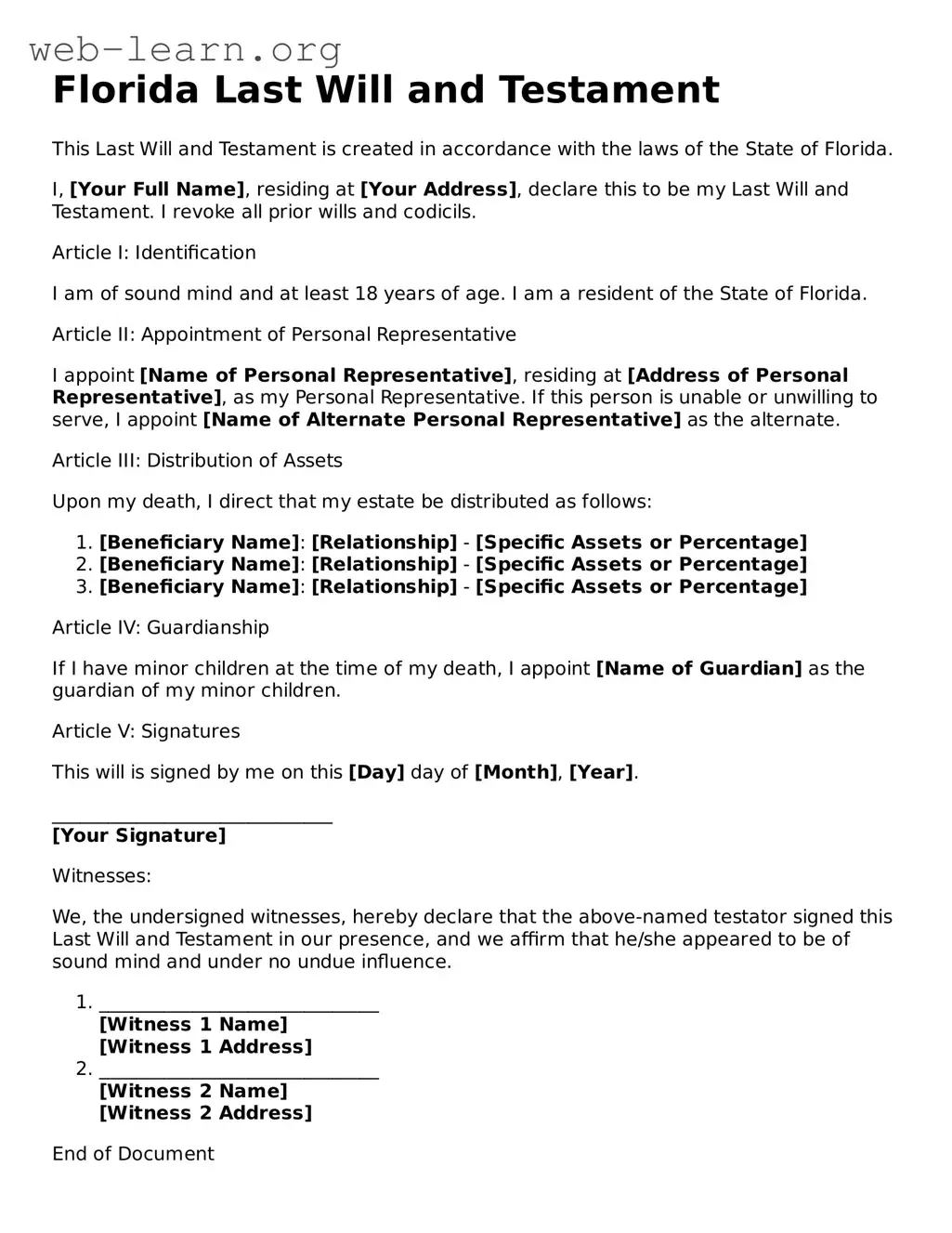
Creating a Last Will and Testament is an essential step in ensuring that your wishes are honored after your passing. In Florida, this legal document serves several critical functions, including the distribution of assets, the appointment of guardians for minor children, and the designation of an executor to oversee the estate. The Florida Last Will and Testament form must meet specific requirements to be considered valid, such as being in writing, signed by the testator, and witnessed by at least two individuals who are not beneficiaries. This form allows individuals to specify how their property will be divided, which can help prevent disputes among family members. Additionally, it provides an opportunity to express personal wishes regarding funeral arrangements and other matters. Understanding these key components can empower individuals to make informed decisions about their estate planning, ensuring that their intentions are clear and legally enforceable.
Florida Last Will and Testament
This Last Will and Testament is created in accordance with the laws of the State of Florida.
I, [Your Full Name], residing at [Your Address], declare this to be my Last Will and Testament. I revoke all prior wills and codicils.
Article I: Identification
I am of sound mind and at least 18 years of age. I am a resident of the State of Florida.
Article II: Appointment of Personal Representative
I appoint [Name of Personal Representative], residing at [Address of Personal Representative], as my Personal Representative. If this person is unable or unwilling to serve, I appoint [Name of Alternate Personal Representative] as the alternate.
Article III: Distribution of Assets
Upon my death, I direct that my estate be distributed as follows:
Article IV: Guardianship
If I have minor children at the time of my death, I appoint [Name of Guardian] as the guardian of my minor children.
Article V: Signatures
This will is signed by me on this [Day] day of [Month], [Year].
______________________________
[Your Signature]
Witnesses:
We, the undersigned witnesses, hereby declare that the above-named testator signed this Last Will and Testament in our presence, and we affirm that he/she appeared to be of sound mind and under no undue influence.
End of Document
| Fact Name | Description |
|---|---|
| Governing Law | The Florida Last Will and Testament is governed by Florida Statutes, Chapter 732. |
| Age Requirement | In Florida, individuals must be at least 18 years old to create a valid will. |
| Witness Requirement | A will in Florida must be signed by at least two witnesses who are present at the same time. |
| Revocation | A Florida will can be revoked by creating a new will or by physically destroying the original document. |
| Self-Proving Will | Florida allows for self-proving wills, which can simplify the probate process by including a notarized affidavit. |
| Holographic Wills | Florida recognizes holographic wills, which are handwritten and signed by the testator, but they must meet specific criteria. |
After completing the Florida Last Will and Testament form, you will need to ensure that it is signed and witnessed according to state requirements. This will help to validate your wishes regarding the distribution of your assets.
Once the form is completed and signed, store it in a safe place and inform your executor and beneficiaries of its location.
What is a Last Will and Testament in Florida?
A Last Will and Testament is a legal document that outlines how a person wishes to distribute their assets after they pass away. In Florida, this document can also name guardians for minor children, appoint an executor to manage the estate, and specify funeral arrangements. It serves as a crucial tool for ensuring that your wishes are honored and can help avoid disputes among family members.
Who can create a Last Will and Testament in Florida?
In Florida, any person who is at least 18 years old and of sound mind can create a Last Will and Testament. This means you should be able to understand the nature of the document and its implications. If you are a minor or deemed incapacitated, you may need to wait until you meet these criteria or seek assistance from a legal guardian.
What are the requirements for a valid will in Florida?
For a will to be considered valid in Florida, it must meet several criteria:
Can I change my will after it has been created?
Yes, you can change your will at any time while you are alive and of sound mind. This is often done through a legal document called a codicil, which amends specific parts of the original will. Alternatively, you can create a new will that revokes the previous one. It’s important to ensure that any changes are made in compliance with Florida law to maintain the validity of your wishes.
What happens if I die without a will in Florida?
If you pass away without a will, Florida’s intestacy laws will determine how your assets are distributed. Generally, this means that your property will be divided among your closest relatives, which may not align with your personal wishes. Dying without a will can lead to complications and disputes among family members, making it even more important to have a will in place.
Can I name guardians for my children in my will?
Yes, one of the significant benefits of having a Last Will and Testament is the ability to name guardians for your minor children. This ensures that your children will be cared for by someone you trust in the event of your passing. It’s essential to discuss this decision with the person you wish to appoint, as it is a significant responsibility.
How should I store my will?
After creating your will, it’s vital to store it in a safe and accessible location. You might consider keeping it in a fireproof safe at home or with a trusted attorney. Inform your loved ones about where to find the document, as they will need it after your passing. Additionally, avoid storing it in a bank safety deposit box without informing someone, as accessing it may require legal steps after your death.
Is it necessary to hire an attorney to create a will in Florida?
While it is not legally required to hire an attorney to create a will in Florida, doing so can be beneficial. An attorney can help ensure that your will complies with state laws, effectively addresses your wishes, and minimizes the risk of disputes. If your estate is complex or you have specific concerns, consulting with a legal professional is advisable.
Creating a Last Will and Testament in Florida is an important step in ensuring that your wishes are honored after your passing. However, many individuals make mistakes when filling out the form, which can lead to confusion or even legal disputes. Understanding these common pitfalls can help you navigate the process more smoothly.
One frequent mistake is not clearly identifying the beneficiaries. It's crucial to specify who will inherit your assets. Vague terms like "my children" without naming them can create ambiguity. If circumstances change, such as the birth of a new child or the death of a beneficiary, these details should be updated promptly to avoid complications.
Another common error is failing to properly date the will. The date is essential because it establishes the will's validity. If multiple versions exist, the most recent one is typically honored, but only if it is clearly dated. Without a date, it can be challenging to determine which document reflects your current wishes.
People often overlook the importance of signatures. In Florida, a will must be signed by the testator (the person making the will) and witnessed by at least two individuals. If the required signatures are missing, the will may be deemed invalid. Additionally, witnesses should not be beneficiaries themselves, as this could lead to conflicts of interest.
Not considering the choice of executor is another mistake. The executor is responsible for managing your estate after your passing. Selecting someone who is trustworthy, organized, and capable of handling financial matters is vital. Failing to name an executor or choosing someone who is unwilling or unable to serve can create unnecessary challenges for your loved ones.
Another oversight involves the distribution of specific assets. While you may intend for certain items to go to specific people, failing to list these items clearly can lead to disputes among family members. Consider including a personal property memorandum that outlines who gets what to avoid misunderstandings.
Lastly, many individuals forget to review and update their wills regularly. Life changes such as marriage, divorce, or the birth of children can significantly impact your estate plan. It’s wise to revisit your will every few years or after major life events to ensure it accurately reflects your current wishes.
By being aware of these common mistakes, you can create a Last Will and Testament that better serves your intentions and protects your loved ones. Taking the time to carefully complete the form can prevent future complications and ensure that your wishes are honored.
When preparing a Last Will and Testament in Florida, several other documents may also be beneficial to ensure that your estate is managed according to your wishes. These documents can address various aspects of estate planning and can help streamline the process for your loved ones after your passing.
Incorporating these documents into your estate planning can provide clarity and peace of mind. Each serves a specific purpose and can work in conjunction with your Last Will and Testament to ensure that your wishes are honored and your loved ones are supported during a challenging time.
When filling out the Florida Last Will and Testament form, it’s important to follow certain guidelines to ensure your wishes are clearly expressed. Here’s a list of things you should and shouldn’t do:
By following these guidelines, you can help ensure that your Last Will and Testament is valid and reflects your wishes accurately.
Understanding the Florida Last Will and Testament form is crucial for anyone looking to create a legally binding document to outline their wishes after passing. However, several misconceptions exist that can lead to confusion. Here are eight common misconceptions:
By debunking these misconceptions, individuals can make informed decisions about their estate planning needs and ensure their wishes are clearly communicated and legally upheld.
When considering the Florida Last Will and Testament form, several important aspects come into play. Understanding these can help ensure that your wishes are honored after your passing.
These key points can help guide you through the process of creating a valid and effective will in Florida.
Living Will Vs Last Will and Testament - Can include charitable donations as part of the estate plan.
California Holographic Will - Allows individuals to appoint guardians for minor children.
Does an Attorney Have to Prepare a Will - Ensures that all wishes regarding property are legally recognized.