Homepage Blank Florida Landlord Tenant Act Form
Outline

The Florida Landlord Tenant Act is a comprehensive piece of legislation that outlines the rights and responsibilities of both landlords and tenants in residential rental agreements. This law is designed to create a balanced framework for rental relationships, ensuring that both parties understand their obligations. Key components of the Act include regulations on rental agreements, the handling of security deposits, and the maintenance obligations of landlords. It specifies the necessary disclosures that landlords must provide to tenants, such as their identity and the conditions of the rental property. Additionally, the Act prohibits certain unfair practices in rental agreements and establishes guidelines for the termination of tenancies. It emphasizes the importance of good faith in all dealings and provides remedies for both landlords and tenants in case of disputes. By detailing these aspects, the Florida Landlord Tenant Act aims to promote fair housing practices and protect the interests of all involved in the rental process.

Sample - Florida Landlord Tenant Act Form

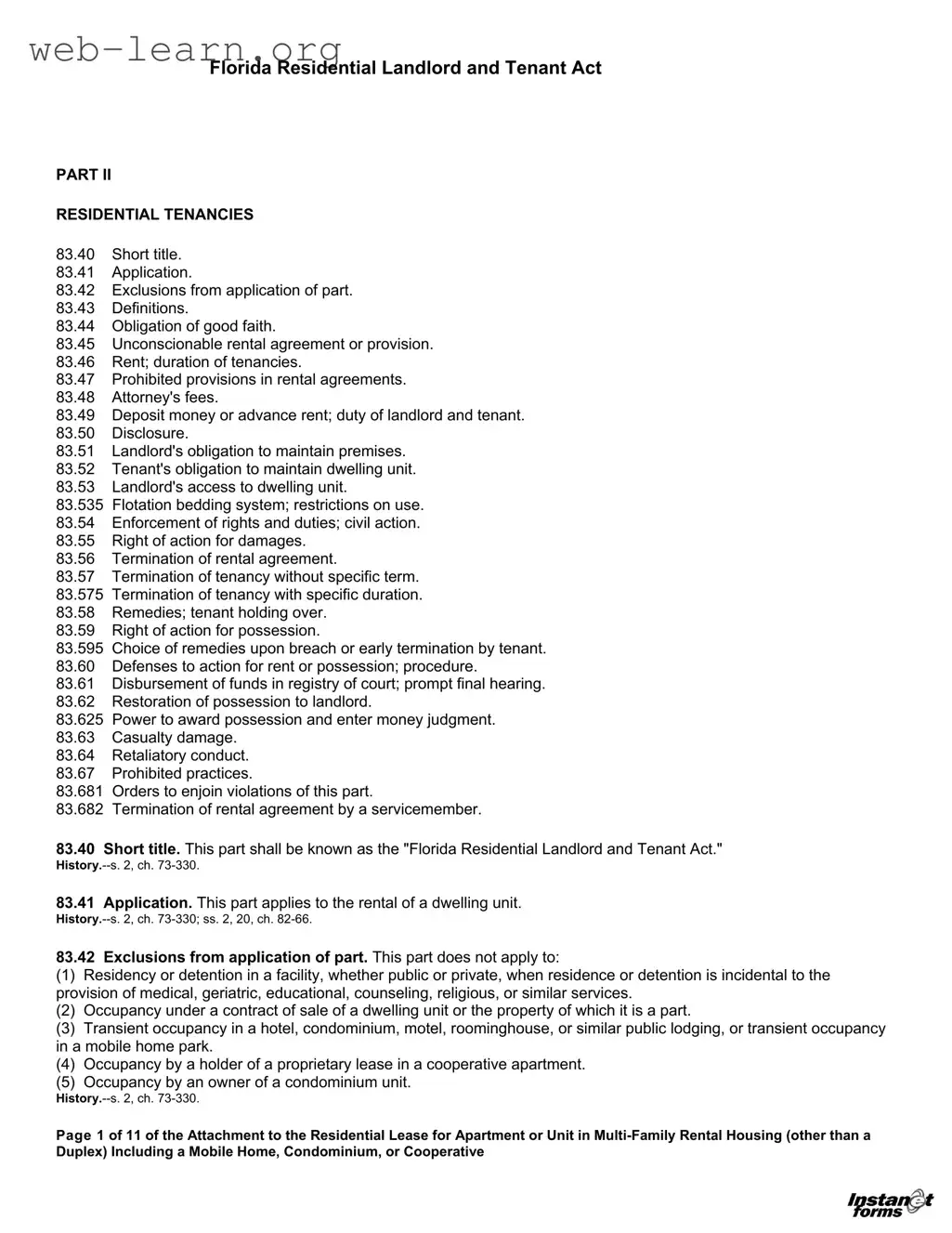
Florida Residential Landlord and Tenant Act
PART II
RESIDENTIAL TENANCIES
83.40 Short title.
83.41 Application.
83.42 Exclusions from application of part.
83.43 Definitions.
83.44 Obligation of good faith.
83.45 Unconscionable rental agreement or provision.
83.46 Rent; duration of tenancies.
83.47 Prohibited provisions in rental agreements.
83.48 Attorney's fees.
83.49 Deposit money or advance rent; duty of landlord and tenant.
83.50 Disclosure.
83.51 Landlord's obligation to maintain premises.
83.52 Tenant's obligation to maintain dwelling unit.
83.53 Landlord's access to dwelling unit.
83.535 Flotation bedding system; restrictions on use.
83.54 Enforcement of rights and duties; civil action.
83.55 Right of action for damages.
83.56 Termination of rental agreement.
83.57 Termination of tenancy without specific term.
83.575 Termination of tenancy with specific duration.
83.58 Remedies; tenant holding over.
83.59 Right of action for possession.
83.595 Choice of remedies upon breach or early termination by tenant.
83.60 Defenses to action for rent or possession; procedure.
83.61 Disbursement of funds in registry of court; prompt final hearing.
83.62 Restoration of possession to landlord.
83.625 Power to award possession and enter money judgment.
83.63 Casualty damage.
83.64 Retaliatory conduct.
83.67 Prohibited practices.
83.681 Orders to enjoin violations of this part.
83.682 Termination of rental agreement by a servicemember.
83.40 Short title. This part shall be known as the "Florida Residential Landlord and Tenant Act."
History.--s. 2, ch. 73-330.
83.41 Application. This part applies to the rental of a dwelling unit.
History.--s. 2, ch. 73-330; ss. 2, 20, ch. 82-66.
83.42 Exclusions from application of part. This part does not apply to:
(1) Residency or detention in a facility, whether public or private, when residence or detention is incidental to the
provision of medical, geriatric, educational, counseling, religious, or similar services.
(2) Occupancy under a contract of sale of a dwelling unit or the property of which it is a part.
(3) Transient occupancy in a hotel, condominium, motel, roominghouse, or similar public lodging, or transient occupancy
in a mobile home park.
(4) Occupancy by a holder of a proprietary lease in a cooperative apartment.
(5) Occupancy by an owner of a condominium unit.
History.--s. 2, ch. 73-330.
Page 1 of 11 of the Attachment to the Residential Lease for Apartment or Unit in Multi-Family Rental Housing (other than a
Duplex) Including a Mobile Home, Condominium, or Cooperative
83.43 Definitions. As used in this part, the following words and terms shall have the following meanings unless some
other meaning is plainly indicated:
(1) "Building, housing, and health codes" means any law, ordinance, or governmental regulation concerning health,
safety, sanitation or fitness for habitation, or the construction, maintenance, operation, occupancy, use, or appearance, of
any dwelling unit.
(2) "Dwelling unit" means:
(a) A structure or part of a structure that is rented for use as a home, residence, or sleeping place by one person or by
two or more persons who maintain a common household.
(b) A mobile home rented by a tenant.
(c) A structure or part of a structure that is furnished, with or without rent, as an incident of employment for use as a
home, residence, or sleeping place by one or more persons.
(3) "Landlord" means the owner or lessor of a dwelling unit.
(4) "Tenant" means any person entitled to occupy a dwelling unit under a rental agreement.
(5) "Premises" means a dwelling unit and the structure of which it is a part and a mobile home lot and the appurtenant
facilities and grounds, areas, facilities, and property held out for the use of tenants generally.
(6) "Rent" means the periodic payments due the landlord from the tenant for occupancy under a rental agreement and
any other payments due the landlord from the tenant as may be designated as rent in a written rental agreement.
(7) "Rental agreement" means any written agreement, including amendments or addenda, or oral agreement for a
duration of less than 1 year, providing for use and occupancy of premises.
(8) "Good faith" means honesty in fact in the conduct or transaction concerned.
(9) "Advance rent" means moneys paid to the landlord to be applied to future rent payment periods, but does not include
rent paid in advance for a current rent payment period.
(10) "Transient occupancy" means occupancy when it is the intention of the parties that the occupancy will be temporary.
(11) "Deposit money" means any money held by the landlord on behalf of the tenant, including, but not limited to, damage
deposits, security deposits, advance rent deposit, pet deposit, or any contractual deposit agreed to between landlord and
tenant either in writing or orally.
(12) "Security deposits" means any moneys held by the landlord as security for the performance of the rental agreement,
including, but not limited to, monetary damage to the landlord caused by the tenant's breach of lease prior to the
expiration thereof.
(13) "Legal holiday" means holidays observed by the clerk of the court.
(14) "Servicemember" shall have the same meaning as provided in s. 250.01.
(15) "Active duty" shall have the same meaning as provided in s. 250.01.
(16) "State active duty" shall have the same meaning as provided in s. 250.01.
(17) "Early termination fee" means any charge, fee, or forfeiture that is provided for in a written rental agreement and is
assessed to a tenant when a tenant elects to terminate the rental agreement, as provided in the agreement, and vacates
a dwelling unit before the end of the rental agreement. An early termination fee does not include:
(a) Unpaid rent and other accrued charges through the end of the month in which the landlord retakes possession of the
dwelling unit.
(b) Charges for damages to the dwelling unit.
(c) Charges associated with a rental agreement settlement, release, buy-out, or accord and satisfaction agreement.
History.--s. 2, ch. 73-330; s. 1, ch. 74-143; s. 1, ch. 81-190; s. 3, ch. 83-151; s. 17, ch. 94-170; s. 2, ch. 2003-72; s. 1, ch. 2008-131.
83.44 Obligation of good faith. Every rental agreement or duty within this part imposes an obligation of good faith in its
performance or enforcement.
History.--s. 2, ch. 73-330.
83.45 Unconscionable rental agreement or provision.
(1) If the court as a matter of law finds a rental agreement or any provision of a rental agreement to have been
unconscionable at the time it was made, the court may refuse to enforce the rental agreement, enforce the remainder of
the rental agreement without the unconscionable provision, or so limit the application of any unconscionable provision as
to avoid any unconscionable result.
(2) When it is claimed or appears to the court that the rental agreement or any provision thereof may be unconscionable,
the parties shall be afforded a reasonable opportunity to present evidence as to meaning, relationship of the parties,
purpose, and effect to aid the court in making the determination.
History.--s. 2, ch. 73-330.
83.46 Rent; duration of tenancies.
(1) Unless otherwise agreed, rent is payable without demand or notice; periodic rent is payable at the beginning of each
rent payment period; and rent is uniformly apportionable from day to day.
(2) If the rental agreement contains no provision as to duration of the tenancy, the duration is determined by the periods
Page 2 of 11 of the Attachment to the Residential Lease for Apartment or Unit in Multi-Family Rental Housing (other than a
Duplex) Including a Mobile Home, Condominium, or Cooperative
for which the rent is payable. If the rent is payable weekly, then the tenancy is from week to week; if payable monthly,
tenancy is from month to month; if payable quarterly, tenancy is from quarter to quarter; if payable yearly, tenancy is from
year to year.
(3) If the dwelling unit is furnished without rent as an incident of employment and there is no agreement as to the duration
of the tenancy, the duration is determined by the periods for which wages are payable. If wages are payable weekly or
more frequently, then the tenancy is from week to week; and if wages are payable monthly or no wages are payable, then
the tenancy is from month to month. In the event that the employee ceases employment, the employer shall be entitled to
rent for the period from the day after the employee ceases employment until the day that the dwelling unit is vacated at a
rate equivalent to the rate charged for similarly situated residences in the area. This subsection shall not apply to an
employee or a resident manager of an apartment house or an apartment complex when there is a written agreement to
the contrary.
History.--s. 2, ch. 73-330; s. 2, ch. 81-190; s. 2, ch. 87-195; s. 2, ch. 90-133; s. 1, ch. 93-255.
83.47 Prohibited provisions in rental agreements.
(1) A provision in a rental agreement is void and unenforceable to the extent that it:
(a) Purports to waive or preclude the rights, remedies, or requirements set forth in this part.
(b) Purports to limit or preclude any liability of the landlord to the tenant or of the tenant to the landlord, arising under law.
(2) If such a void and unenforceable provision is included in a rental agreement entered into, extended, or renewed after
the effective date of this part and either party suffers actual damages as a result of the inclusion, the aggrieved party may
recover those damages sustained after the effective date of this part.
History.--s. 2, ch. 73-330.
83.48 Attorney's fees.--In any civil action brought to enforce the provisions of the rental agreement or this part, the party
in whose favor a judgment or decree has been rendered may recover reasonable court costs, including attorney's fees,
from the nonprevailing party.
History.--s. 2, ch. 73-330; s. 4, ch. 83-151.
83.49 Deposit money or advance rent; duty of landlord and tenant.
(1) Whenever money is deposited or advanced by a tenant on a rental agreement as security for performance of the
rental agreement or as advance rent for other than the next immediate rental period, the landlord or the landlord's agent
shall either:
(a) Hold the total amount of such money in a separate non-interest-bearing account in a Florida banking institution for the
benefit of the tenant or tenants. The landlord shall not commingle such moneys with any other funds of the landlord or
hypothecate, pledge, or in any other way make use of such moneys until such moneys are actually due the landlord;
(b) Hold the total amount of such money in a separate interest-bearing account in a Florida banking institution for the
benefit of the tenant or tenants, in which case the tenant shall receive and collect interest in an amount of at least 75
percent of the annualized average interest rate payable on such account or interest at the rate of 5 percent per year,
simple interest, whichever the landlord elects. The landlord shall not commingle such moneys with any other funds of the
landlord or hypothecate, pledge, or in any other way make use of such moneys until such moneys are actually due the
landlord; or
(c) Post a surety bond, executed by the landlord as principal and a surety company authorized and licensed to do
business in the state as surety, with the clerk of the circuit court in the county in which the dwelling unit is located in the
total amount of the security deposits and advance rent he or she holds on behalf of the tenants or $50,000, whichever is
less. The bond shall be conditioned upon the faithful compliance of the landlord with the provisions of this section and
shall run to the Governor for the benefit of any tenant injured by the landlord's violation of the provisions of this section. In
addition to posting the surety bond, the landlord shall pay to the tenant interest at the rate of 5 percent per year, simple
interest. A landlord, or the landlord's agent, engaged in the renting of dwelling units in five or more counties, who holds
deposit moneys or advance rent and who is otherwise subject to the provisions of this section, may, in lieu of posting a
surety bond in each county, elect to post a surety bond in the form and manner provided in this paragraph with the office
of the Secretary of State. The bond shall be in the total amount of the security deposit or advance rent held on behalf of
tenants or in the amount of $250,000, whichever is less. The bond shall be conditioned upon the faithful compliance of the
landlord with the provisions of this section and shall run to the Governor for the benefit of any tenant injured by the
landlord's violation of this section. In addition to posting a surety bond, the landlord shall pay to the tenant interest on the
security deposit or advance rent held on behalf of that tenant at the rate of 5 percent per year simple interest.
(2) The landlord shall, within 30 days of receipt of advance rent or a security deposit, notify the tenant in writing of the
manner in which the landlord is holding the advance rent or security deposit and the rate of interest, if any, which the
tenant is to receive and the time of interest payments to the tenant. Such written notice shall:
(a) Be given in person or by mail to the tenant.
(b) State the name and address of the depository where the advance rent or security deposit is being held, whether the
advance rent or security deposit is being held in a separate account for the benefit of the tenant or is commingled with
Page 3 of 11 of the Attachment to the Residential Lease for Apartment or Unit in Multi-Family Rental Housing (other than a
Duplex) Including a Mobile Home, Condominium, or Cooperative
other funds of the landlord, and, if commingled, whether such funds are deposited in an interest-bearing account in a
Florida banking institution.
(c) Include a copy of the provisions of subsection (3).
Subsequent to providing such notice, if the landlord changes the manner or location in which he or she is holding the
advance rent or security deposit, he or she shall notify the tenant within 30 days of the change according to the provisions
herein set forth. This subsection does not apply to any landlord who rents fewer than five individual dwelling units. Failure
to provide this notice shall not be a defense to the payment of rent when due.
(3)(a) Upon the vacating of the premises for termination of the lease, if the landlord does not intend to impose a claim on
the security deposit, the landlord shall have 15 days to return the security deposit together with interest if otherwise
required, or the landlord shall have 30 days to give the tenant written notice by certified mail to the tenant's last known
mailing address of his or her intention to impose a claim on the deposit and the reason for imposing the claim. The notice
shall contain a statement in substantially the following form:
This is a notice of my intention to impose a claim for damages in the amount of _____ upon your security deposit, due to
_____. It is sent to you as required by s. 83.49(3), Florida Statutes. You are hereby notified that you must object in writing
to this deduction from your security deposit within 15 days from the time you receive this notice or I will be authorized to
deduct my claim from your security deposit. Your objection must be sent to (landlord's address) .
If the landlord fails to give the required notice within the 30-day period, he or she forfeits the right to impose a claim upon
the security deposit.
(b) Unless the tenant objects to the imposition of the landlord's claim or the amount thereof within 15 days after receipt of
the landlord's notice of intention to impose a claim, the landlord may then deduct the amount of his or her claim and shall
remit the balance of the deposit to the tenant within 30 days after the date of the notice of intention to impose a claim for
damages.
(c) If either party institutes an action in a court of competent jurisdiction to adjudicate the party's right to the security
deposit, the prevailing party is entitled to receive his or her court costs plus a reasonable fee for his or her attorney. The
court shall advance the cause on the calendar.
(d) Compliance with this section by an individual or business entity authorized to conduct business in this state, including
Florida-licensed real estate brokers and sales associates, shall constitute compliance with all other relevant Florida
Statutes pertaining to security deposits held pursuant to a rental agreement or other landlord-tenant relationship.
Enforcement personnel shall look solely to this section to determine compliance. This section prevails over any conflicting
provisions in chapter 475 and in other sections of the Florida Statutes, and shall operate to permit licensed real estate
brokers to disburse security deposits and deposit money without having to comply with the notice and settlement
procedures contained in s. 475.25(1)(d).
(4) The provisions of this section do not apply to transient rentals by hotels or motels as defined in chapter 509; nor do
they apply in those instances in which the amount of rent or deposit, or both, is regulated by law or by rules or regulations
of a public body, including public housing authorities and federally administered or regulated housing programs including
s. 202, s. 221(d)(3) and (4), s. 236, or s. 8 of the National Housing Act, as amended, other than for rent stabilization. With
the exception of subsections (3), (5), and (6), this section is not applicable to housing authorities or public housing
agencies created pursuant to chapter 421 or other statutes.
(5) Except when otherwise provided by the terms of a written lease, any tenant who vacates or abandons the premises
prior to the expiration of the term specified in the written lease, or any tenant who vacates or abandons premises which
are the subject of a tenancy from week to week, month to month, quarter to quarter, or year to year, shall give at least 7
days' written notice by certified mail or personal delivery to the landlord prior to vacating or abandoning the premises
which notice shall include the address where the tenant may be reached. Failure to give such notice shall relieve the
landlord of the notice requirement of paragraph (3)(a) but shall not waive any right the tenant may have to the security
deposit or any part of it.
(6) For the purposes of this part, a renewal of an existing rental agreement shall be considered a new rental agreement,
and any security deposit carried forward shall be considered a new security deposit.
(7) Upon the sale or transfer of title of the rental property from one owner to another, or upon a change in the designated
rental agent, any and all security deposits or advance rents being held for the benefit of the tenants shall be transferred to
the new owner or agent, together with any earned interest and with an accurate accounting showing the amounts to be
credited to each tenant account. Upon the transfer of such funds and records as stated herein, and upon transmittal of a
written receipt therefor, the transferor shall be free from the obligation imposed in subsection (1) to hold such moneys on
behalf of the tenant. However, nothing herein shall excuse the landlord or agent for a violation of the provisions of this
section while in possession of such deposits.
(8) Any person licensed under the provisions of s. 509.241, unless excluded by the provisions of this part, who fails to
comply with the provisions of this part shall be subject to a fine or to the suspension or revocation of his or her license by
the Division of Hotels and Restaurants of the Department of Business and Professional Regulation in the manner
provided in s. 509.261.
(9) In those cases in which interest is required to be paid to the tenant, the landlord shall pay directly to the tenant, or
credit against the current month's rent, the interest due to the tenant at least once annually. However, no interest shall be
Page 4 of 11 of the Attachment to the Residential Lease for Apartment or Unit in Multi-Family Rental Housing (other than a
Duplex) Including a Mobile Home, Condominium, or Cooperative
due a tenant who wrongfully terminates his or her tenancy prior to the end of the rental term.
History.--s. 1, ch. 69-282; s. 3, ch. 70-360; s. 1, ch. 72-19; s. 1, ch. 72-43; s. 5, ch. 73-330; s. 1, ch. 74-93; s. 3, ch. 74-146; ss. 1, 2, ch. 75-133; s. 1, ch.
76-15; s. 1, ch. 77-445; s. 20, ch. 79-400; s. 21, ch. 82-66; s. 5, ch. 83-151; s. 13, ch. 83-217; s. 3, ch. 87-195; s. 1, ch. 87-369; s. 3, ch. 88-379; s. 2, ch.
93-255; s. 5, ch. 94-218; s. 1372, ch. 95-147; s. 1, ch. 96-146; s. 1, ch. 2001-179; s. 53, ch. 2003-164.
Note.--Former s. 83.261.
83.50 Disclosure.
(1) The landlord, or a person authorized to enter into a rental agreement on the landlord's behalf, shall disclose in writing
to the tenant, at or before the commencement of the tenancy, the name and address of the landlord or a person
authorized to receive notices and demands in the landlord's behalf. The person so authorized to receive notices and
demands retains authority until the tenant is notified otherwise. All notices of such names and addresses or changes
thereto shall be delivered to the tenant's residence or, if specified in writing by the tenant, to any other address.
(2) The landlord or the landlord's authorized representative, upon completion of construction of a building exceeding
three stories in height and containing dwelling units, shall disclose to the tenants initially moving into the building the
availability or lack of availability of fire protection.
History.--s. 2, ch. 73-330; s. 443, ch. 95-147.
83.51 Landlord's obligation to maintain premises.
(1) The landlord at all times during the tenancy shall:
(a) Comply with the requirements of applicable building, housing, and health codes; or
(b) Where there are no applicable building, housing, or health codes, maintain the roofs, windows, screens, doors, floors,
steps, porches, exterior walls, foundations, and all other structural components in good repair and capable of resisting
normal forces and loads and the plumbing in reasonable working condition. However, the landlord shall not be required to
maintain a mobile home or other structure owned by the tenant.
The landlord's obligations under this subsection may be altered or modified in writing with respect to a single-family home
or duplex.
(2)(a) Unless otherwise agreed in writing, in addition to the requirements of subsection (1), the landlord of a dwelling unit
other than a single-family home or duplex shall, at all times during the tenancy, make reasonable provisions for:
1. The extermination of rats, mice, roaches, ants, wood-destroying organisms, and bedbugs. When vacation of the
premises is required for such extermination, the landlord shall not be liable for damages but shall abate the rent. The
tenant shall be required to temporarily vacate the premises for a period of time not to exceed 4 days, on 7 days' written
notice, if necessary, for extermination pursuant to this subparagraph.
2. Locks and keys.
3. The clean and safe condition of common areas.
4. Garbage removal and outside receptacles therefor.
5. Functioning facilities for heat during winter, running water, and hot water.
(b) Unless otherwise agreed in writing, at the commencement of the tenancy of a single-family home or duplex, the
landlord shall install working smoke detection devices. As used in this paragraph, the term "smoke detection device"
means an electrical or battery-operated device which detects visible or invisible particles of combustion and which is listed
by Underwriters Laboratories, Inc., Factory Mutual Laboratories, Inc., or any other nationally recognized testing laboratory
using nationally accepted testing standards.
(c) Nothing in this part authorizes the tenant to raise a noncompliance by the landlord with this subsection as a defense to
an action for possession under s. 83.59.
(d) This subsection shall not apply to a mobile home owned by a tenant.
(e) Nothing contained in this subsection prohibits the landlord from providing in the rental agreement that the tenant is
obligated to pay costs or charges for garbage removal, water, fuel, or utilities.
(3) If the duty imposed by subsection (1) is the same or greater than any duty imposed by subsection (2), the landlord's
duty is determined by subsection (1).
(4) The landlord is not responsible to the tenant under this section for conditions created or caused by the negligent or
wrongful act or omission of the tenant, a member of the tenant's family, or other person on the premises with the tenant's
consent.
History.--s. 2, ch. 73-330; s. 22, ch. 82-66; s. 4, ch. 87-195; s. 1, ch. 90-133; s. 3, ch. 93-255; s. 444, ch. 95-147; s. 8, ch. 97-95.
83.52 Tenant's obligation to maintain dwelling unit. The tenant at all times during the tenancy shall:
(1) Comply with all obligations imposed upon tenants by applicable provisions of building, housing, and health codes.
(2) Keep that part of the premises which he or she occupies and uses clean and sanitary.
(3) Remove from the tenant's dwelling unit all garbage in a clean and sanitary manner.
(4) Keep all plumbing fixtures in the dwelling unit or used by the tenant clean and sanitary and in repair.
(5) Use and operate in a reasonable manner all electrical, plumbing, sanitary, heating, ventilating, air-conditioning and
other facilities and appliances, including elevators.
Page 5 of 11 of the Attachment to the Residential Lease for Apartment or Unit in Multi-Family Rental Housing (other than a
Duplex) Including a Mobile Home, Condominium, or Cooperative
(6) Not destroy, deface, damage, impair, or remove any part of the premises or property therein belonging to the landlord
nor permit any person to do so.
(7) Conduct himself or herself, and require other persons on the premises with his or her consent to conduct themselves,
in a manner that does not unreasonably disturb the tenant's neighbors or constitute a breach of the peace.
History.--s. 2, ch. 73-330; s. 445, ch. 95-147.
83.53 Landlord's access to dwelling unit
(1) The tenant shall not unreasonably withhold consent to the landlord to enter the dwelling unit from time to time in order
to inspect the premises; make necessary or agreed repairs, decorations, alterations, or improvements; supply agreed
services; or exhibit the dwelling unit to prospective or actual purchasers, mortgagees, tenants, workers, or contractors.
(2) The landlord may enter the dwelling unit at any time for the protection or preservation of the premises. The landlord
may enter the dwelling unit upon reasonable notice to the tenant and at a reasonable time for the purpose of repair of the
premises. "Reasonable notice" for the purpose of repair is notice given at least 12 hours prior to the entry, and reasonable
time for the purpose of repair shall be between the hours of 7:30 a.m. and 8:00 p.m. The landlord may enter the dwelling
unit when necessary for the further purposes set forth in subsection (1) under any of the following circumstances:
(a) With the consent of the tenant;
(b) In case of emergency;
(c) When the tenant unreasonably withholds consent; or
(d) If the tenant is absent from the premises for a period of time equal to one-half the time for periodic rental payments. If
the rent is current and the tenant notifies the landlord of an intended absence, then the landlord may enter only with the
consent of the tenant or for the protection or preservation of the premises.
(3) The landlord shall not abuse the right of access nor use it to harass the tenant.
History.--s. 2, ch. 73-330; s. 5, ch. 87-195; s. 4, ch. 93-255; s. 446, ch. 95-147.
83.535 Flotation bedding system; restrictions on use. No landlord may prohibit a tenant from using a flotation bedding
system in a dwelling unit, provided the flotation bedding system does not violate applicable building codes. The tenant
shall be required to carry in the tenant's name flotation insurance as is standard in the industry in an amount deemed
reasonable to protect the tenant and owner against personal injury and property damage to the dwelling units. In any
case, the policy shall carry a loss payable clause to the owner of the building.
History.--s. 7, ch. 82-66; s. 5, ch. 93-255.
83.54 Enforcement of rights and duties; civil action. Any right or duty declared in this part is enforceable by civil
action.
History.--s. 2, ch. 73-330.
83.55 Right of action for damages. If either the landlord or the tenant fails to comply with the requirements of the rental
agreement or this part, the aggrieved party may recover the damages caused by the noncompliance.
History.--s. 2, ch. 73-330.
83.56 Termination of rental agreement.
(1) If the landlord materially fails to comply with s. 83.51(1) or material provisions of the rental agreement within 7 days
after delivery of written notice by the tenant specifying the noncompliance and indicating the intention of the tenant to
terminate the rental agreement by reason thereof, the tenant may terminate the rental agreement. If the failure to comply
with s. 83.51(1) or material provisions of the rental agreement is due to causes beyond the control of the landlord and the
landlord has made and continues to make every reasonable effort to correct the failure to comply, the rental agreement
may be terminated or altered by the parties, as follows:
(a) If the landlord's failure to comply renders the dwelling unit untenantable and the tenant vacates, the tenant shall not
be liable for rent during the period the dwelling unit remains uninhabitable.
(b) If the landlord's failure to comply does not render the dwelling unit untenantable and the tenant remains in occupancy,
the rent for the period of noncompliance shall be reduced by an amount in proportion to the loss of rental value caused by
the noncompliance.
(2) If the tenant materially fails to comply with s. 83.52 or material provisions of the rental agreement, other than a failure
to pay rent, or reasonable rules or regulations, the landlord may:
(a) If such noncompliance is of a nature that the tenant should not be given an opportunity to cure it or if the
noncompliance constitutes a subsequent or continuing noncompliance within 12 months of a written warning by the
landlord of a similar violation, deliver a written notice to the tenant specifying the noncompliance and the landlord's intent
to terminate the rental agreement by reason thereof. Examples of noncompliance which are of a nature that the tenant
should not be given an opportunity to cure include, but are not limited to, destruction, damage, or misuse of the landlord's
or other tenants' property by intentional act or a subsequent or continued unreasonable disturbance. In such event, the
landlord may terminate the rental agreement, and the tenant shall have 7 days from the date that the notice is delivered to
vacate the premises. The notice shall be adequate if it is in substantially the following form:
Page 6 of 11 of the Attachment to the Residential Lease for Apartment or Unit in Multi-Family Rental Housing (other than a
Duplex) Including a Mobile Home, Condominium, or Cooperative
You are advised that your lease is terminated effective immediately. You shall have 7 days from the delivery of this letter
to vacate the premises. This action is taken because (cite the noncompliance)
.
(b) If such noncompliance is of a nature that the tenant should be given an opportunity to cure it, deliver a written notice
to the tenant specifying the noncompliance, including a notice that, if the noncompliance is not corrected within 7 days
from the date the written notice is delivered, the landlord shall terminate the rental agreement by reason thereof.
Examples of such noncompliance include, but are not limited to, activities in contravention of the lease or this act such as
having or permitting unauthorized pets, guests, or vehicles; parking in an unauthorized manner or permitting such parking;
or failing to keep the premises clean and sanitary. The notice shall be adequate if it is in substantially the following form:
You are hereby notified that (cite the noncompliance)
. Demand is hereby made that you remedy the noncompliance within 7
days of receipt of this notice or your lease shall be deemed terminated and you shall vacate the premises upon such
termination. If this same conduct or conduct of a similar nature is repeated within 12 months, your tenancy is subject to
termination without your being given an opportunity to cure the noncompliance.
(3) If the tenant fails to pay rent when due and the default continues for 3 days, excluding Saturday, Sunday, and legal
holidays, after delivery of written demand by the landlord for payment of the rent or possession of the premises, the
landlord may terminate the rental agreement. Legal holidays for the purpose of this section shall be court-observed
holidays only. The 3-day notice shall contain a statement in substantially the following form:
You are hereby notified that you are indebted to me in the sum of _____ dollars for the rent and use of the premises
(address of leased premises, including county)
, Florida, now occupied by you and that I demand payment of the rent or possession
of the premises within 3 days (excluding Saturday, Sunday, and legal holidays) from the date of delivery of this notice, to
wit: on or before the _________ day of ______________, ____ .
(landlord's name, address and phone number)
(4) The delivery of the written notices required by subsections (1), (2), and (3) shall be by mailing or delivery of a true
copy thereof or, if the tenant is absent from the premises, by leaving a copy thereof at the residence.
(5) If the landlord accepts rent with actual knowledge of a noncompliance by the tenant or accepts performance by the
tenant of any other provision of the rental agreement that is at variance with its provisions, or if the tenant pays rent with
actual knowledge of a noncompliance by the landlord or accepts performance by the landlord of any other provision of the
rental agreement that is at variance with its provisions, the landlord or tenant waives his or her right to terminate the rental
agreement or to bring a civil action for that noncompliance, but not for any subsequent or continuing noncompliance. Any
tenant who wishes to defend against an action by the landlord for possession of the unit for noncompliance of the rental
agreement or of relevant statutes shall comply with the provisions in s. 83.60(2). The court may not set a date for
mediation or trial unless the provisions of s. 83.60(2) have been met, but shall enter a default judgment for removal of the
tenant with a writ of possession to issue immediately if the tenant fails to comply with s. 83.60(2). This subsection does
not apply to that portion of rent subsidies received from a local, state, or national government or an agency of local, state,
or national government; however, waiver will occur if an action has not been instituted within 45 days of the
noncompliance.
(6) If the rental agreement is terminated, the landlord shall comply with s. 83.49(3).
History.--s. 2, ch. 73-330; s. 23, ch. 82-66; s. 6, ch. 83-151; s. 14, ch. 83-217; s. 6, ch. 87-195; s. 6, ch. 93-255; s. 6, ch. 94-170; s. 1373, ch. 95-147; s.
5, ch. 99-6.
83.57 Termination of tenancy without specific term. A tenancy without a specific duration, as defined in s. 83.46(2) or
(3), may be terminated by either party giving written notice in the manner provided in s. 83.56(4), as follows:
(1) When the tenancy is from year to year, by giving not less than 60 days' notice prior to the end of any annual period;
(2) When the tenancy is from quarter to quarter, by giving not less than 30 days' notice prior to the end of any quarterly
period;
(3) When the tenancy is from month to month, by giving not less than 15 days' notice prior to the end of any monthly
period; and
(4) When the tenancy is from week to week, by giving not less than 7 days' notice prior to the end of any weekly period.
History.--s. 2, ch. 73-330; s. 3, ch. 81-190; s. 15, ch. 83-217.
83.575 Termination of tenancy with specific duration.
(1) A rental agreement with a specific duration may contain a provision requiring the tenant to notify the landlord before
vacating the premises at the end of the rental agreement; however, a rental agreement may not require more than 60
days' notice before vacating the premises.
(2) A rental agreement with a specific duration may provide that if a tenant fails to give the required notice before vacating
the premises at the end of the rental agreement, the tenant may be liable for liquidated damages as specified in the rental
agreement if the landlord provides written notice to the tenant specifying the tenant's obligations under the notification
provision contained in the lease and the date the rental agreement is terminated. The landlord must provide such written
Page 7 of 11 of the Attachment to the Residential Lease for Apartment or Unit in Multi-Family Rental Housing (other than a
Duplex) Including a Mobile Home, Condominium, or Cooperative
notice to the tenant within 15 days before the start of the notification period contained in the lease. The written notice shall
list all fees, penalties, and other charges applicable to the tenant under this subsection.
(3) If the tenant remains on the premises with the permission of the landlord after the rental agreement has terminated
and fails to give notice required under s. 83.57(3), the tenant is liable to the landlord for an additional 1 month's rent.
History.--s. 3, ch. 2003-30; s. 1, ch. 2004-375.
83.58 Remedies; tenant holding over. If the tenant holds over and continues in possession of the dwelling unit or any
part thereof after the expiration of the rental agreement without the permission of the landlord, the landlord may recover
possession of the dwelling unit in the manner provided for in s. 83.59 [F.S. 1973]. The landlord may also recover double
the amount of rent due on the dwelling unit, or any part thereof, for the period during which the tenant refuses to surrender
possession.
History.--s. 2, ch. 73-330
83.59 Right of action for possession.
(1) If the rental agreement is terminated and the tenant does not vacate the premises, the landlord may recover
possession of the dwelling unit as provided in this section.
(2) A landlord, the landlord's attorney, or the landlord's agent, applying for the removal of a tenant shall file in the county
court of the county where the premises are situated a complaint describing the dwelling unit and stating the facts that
authorize its recovery. A landlord's agent is not permitted to take any action other than the initial filing of the complaint,
unless the landlord's agent is an attorney. The landlord is entitled to the summary procedure provided in s. 51.011 [F.S.
1971], and the court shall advance the cause on the calendar.
(3) The landlord shall not recover possession of a dwelling unit except:
(a) In an action for possession under subsection (2) or other civil action in which the issue of right of possession is
determined;
(b) When the tenant has surrendered possession of the dwelling unit to the landlord;
(c) When the tenant has abandoned the dwelling unit. In the absence of actual knowledge of abandonment, it shall be
presumed that the tenant has abandoned the dwelling unit if he or she is absent from the premises for a period of time
equal to one-half the time for periodic rental payments. However, this presumption does not apply if the rent is current or
the tenant has notified the landlord, in writing, of an intended absence; or
(d) When the last remaining tenant of a dwelling unit is deceased, personal property remains on the premises, rent is
unpaid, at least 60 days have elapsed following the date of death, and the landlord has not been notified in writing of the
existence of a probate estate or of the name and address of a personal representative. This paragraph does not apply to
a dwelling unit used in connection with a federally administered or regulated housing program, including programs under
s. 202, s. 221(d)(3) and (4), s. 236, or s. 8 of the National Housing Act, as amended.
(4) The prevailing party is entitled to have judgment for costs and execution therefor.
History.--s. 2, ch. 73-330; s. 1, ch. 74-146; s. 24, ch. 82-66; s. 1, ch. 92-36; s. 447, ch. 95-147; s. 1, ch. 2007-136.
83.595 Choice of remedies upon breach or early termination by tenant. If the tenant breaches the rental agreement
for the dwelling unit and the landlord has obtained a writ of possession, or the tenant has surrendered possession of the
dwelling unit to the landlord, or the tenant has abandoned the dwelling unit, the landlord may:
(1) Treat the rental agreement as terminated and retake possession for his or her own account, thereby terminating any
further liability of the tenant;
(2) Retake possession of the dwelling unit for the account of the tenant, holding the tenant liable for the difference
between the rent stipulated to be paid under the rental agreement and what the landlord is able to recover from a reletting.
If the landlord retakes possession, the landlord has a duty to exercise good faith in attempting to relet the premises, and
any rent received by the landlord as a result of the reletting must be deducted from the balance of rent due from the
tenant. For purposes of this subsection, the term "good faith in attempting to relet the premises" means that the landlord
uses at least the same efforts to relet the premises as were used in the initial rental or at least the same efforts as the
landlord uses in attempting to rent other similar rental units but does not require the landlord to give a preference in
renting the premises over other vacant dwelling units that the landlord owns or has the responsibility to rent;
(3) Stand by and do nothing, holding the lessee liable for the rent as it comes due; or
(4) Charge liquidated damages, as provided in the rental agreement, or an early termination fee to the tenant if the
landlord and tenant have agreed to liquidated damages or an early termination fee, if the amount does not exceed 2
months' rent, and if, in the case of an early termination fee, the tenant is required to give no more than 60 days' notice, as
provided in the rental agreement, prior to the proposed date of early termination. This remedy is available only if the
tenant and the landlord, at the time the rental agreement was made, indicated acceptance of liquidated damages or an
early termination fee. The tenant must indicate acceptance of liquidated damages or an early termination fee by signing a
separate addendum to the rental agreement containing a provision in substantially the following form:
Page 8 of 11 of the Attachment to the Residential Lease for Apartment or Unit in Multi-Family Rental Housing (other than a
Duplex) Including a Mobile Home, Condominium, or Cooperative
[ ] I agree, as provided in the rental agreement, to pay $_________ (an amount that does not exceed 2 months' rent) as
liquidated damages or an early termination fee if I elect to terminate the rental agreement, and the landlord waives the
right to seek additional rent beyond the month in which the landlord retakes possession.
[ ] I do not agree to liquidated damages or an early termination fee, and I acknowledge that the landlord may seek
damages as provided by law.
(a) In addition to liquidated damages or an early termination fee, the landlord is entitled to the rent and other charges
accrued through the end of the month in which the landlord retakes possession of the dwelling unit and charges for
damages to the dwelling unit.
(b) This subsection does not apply if the breach is failure to give notice as provided in s. 83.575.
History.--s. 2, ch. 87-369; s. 4, ch. 88-379; s. 448, ch. 95-147; s. 2, ch. 2008-131.
83.60 Defenses to action for rent or possession; procedure.
(1) In an action by the landlord for possession of a dwelling unit based upon nonpayment of rent or in an action by the
landlord under s. 83.55 seeking to recover unpaid rent, the tenant may defend upon the ground of a material
noncompliance with s. 83.51(1) [F.S. 1973], or may raise any other defense, whether legal or equitable, that he or she
may have, including the defense of retaliatory conduct in accordance with s. 83.64. The defense of a material
noncompliance with s. 83.51(1) [F.S. 1973] may be raised by the tenant if 7 days have elapsed after the delivery of written
notice by the tenant to the landlord, specifying the noncompliance and indicating the intention of the tenant not to pay rent
by reason thereof. Such notice by the tenant may be given to the landlord, the landlord's representative as designated
pursuant to s. 83.50(1), a resident manager, or the person or entity who collects the rent on behalf of the landlord. A
material noncompliance with s. 83.51(1) [F.S. 1973] by the landlord is a complete defense to an action for possession
based upon nonpayment of rent, and, upon hearing, the court or the jury, as the case may be, shall determine the
amount, if any, by which the rent is to be reduced to reflect the diminution in value of the dwelling unit during the period of
noncompliance with s. 83.51(1) [F.S. 1973]. After consideration of all other relevant issues, the court shall enter
appropriate judgment.
(2) In an action by the landlord for possession of a dwelling unit, if the tenant interposes any defense other than payment,
the tenant shall pay into the registry of the court the accrued rent as alleged in the complaint or as determined by the court
and the rent which accrues during the pendency of the proceeding, when due. The clerk shall notify the tenant of such
requirement in the summons. Failure of the tenant to pay the rent into the registry of the court or to file a motion to
determine the amount of rent to be paid into the registry within 5 days, excluding Saturdays, Sundays, and legal holidays,
after the date of service of process constitutes an absolute waiver of the tenant's defenses other than payment, and the
landlord is entitled to an immediate default judgment for removal of the tenant with a writ of possession to issue without
further notice or hearing thereon. In the event a motion to determine rent is filed, documentation in support of the
allegation that the rent as alleged in the complaint is in error is required. Public housing tenants or tenants receiving rent
subsidies shall be required to deposit only that portion of the full rent for which the tenant is responsible pursuant to
federal, state, or local program in which they are participating.
History.--s. 2, ch. 73-330; s. 7, ch. 83-151; s. 7, ch. 87-195; s. 7, ch. 93-255; s. 7, ch. 94-170; s. 1374, ch. 95-147.
83.61 Disbursement of funds in registry of court; prompt final hearing. When the tenant has deposited funds into
the registry of the court in accordance with the provisions of s. 83.60(2) and the landlord is in actual danger of loss of the
premises or other personal hardship resulting from the loss of rental income from the premises, the landlord may apply to
the court for disbursement of all or part of the funds or for prompt final hearing. The court shall advance the cause on the
calendar. The court, after preliminary hearing, may award all or any portion of the funds on deposit to the landlord or may
proceed immediately to a final resolution of the cause.
History.--s. 2, ch. 73-330; s. 2, ch. 74-146.
83.62 Restoration of possession to landlord.
(1) In an action for possession, after entry of judgment in favor of the landlord, the clerk shall issue a writ to the sheriff
describing the premises and commanding the sheriff to put the landlord in possession after 24 hours' notice conspicuously
posted on the premise
(2) At the time the sheriff executes the writ of possession or at any time thereafter, the landlord or the landlord's agent
may remove any personal property found on the premises to or near the property line. Subsequent to executing the writ of
possession, the landlord may request the sheriff to stand by to keep the peace while the landlord changes the locks and
removes the personal property from the premises. When such a request is made, the sheriff may charge a reasonable
hourly rate, and the person requesting the sheriff to stand by to keep the peace shall be responsible for paying the
reasonable hourly rate set by the sheriff. Neither the sheriff nor the landlord or the landlord's agent shall be liable to the
tenant or any other party for the loss, destruction, or damage to the property after it has been removed.
History.--s. 2, ch. 73-330; s. 3, ch. 82-66; s. 5, ch. 88-379; s. 8, ch. 94-170; s. 1375, ch. 95-147; s. 2, ch. 96-146.
Page 9 of 11 of the Attachment to the Residential Lease for Apartment or Unit in Multi-Family Rental Housing (other than a
Duplex) Including a Mobile Home, Condominium, or Cooperative
83.625 Power to award possession and enter money judgment. In an action by the landlord for possession of a
dwelling unit based upon nonpayment of rent, if the court finds the rent is due, owing, and unpaid and by reason thereof
the landlord is entitled to possession of the premises, the court, in addition to awarding possession of the premises to the
landlord, shall direct, in an amount which is within its jurisdictional limitations, the entry of a money judgment with costs in
favor of the landlord and against the tenant for the amount of money found due, owing, and unpaid by the tenant to the
landlord. However, no money judgment shall be entered unless service of process has been effected by personal service
or, where authorized by law, by certified or registered mail, return receipt, or in any other manner prescribed by law or the
rules of the court; and no money judgment may be entered except in compliance with the Florida Rules of Civil Procedure.
The prevailing party in the action may also be awarded attorney's fees and costs.
History.--s. 1, ch. 75-147; s. 8, ch. 87-195; s. 6, ch. 88-379.
83.63 Casualty damage. If the premises are damaged or destroyed other than by the wrongful or negligent acts of the
tenant so that the enjoyment of the premises is substantially impaired, the tenant may terminate the rental agreement and
immediately vacate the premises. The tenant may vacate the part of the premises rendered unusable by the casualty, in
which case the tenant's liability for rent shall be reduced by the fair rental value of that part of the premises damaged or
destroyed. If the rental agreement is terminated, the landlord shall comply with s. 83.49(3) [F.S. 1973].
History.--s. 2, ch. 73-330; s. 449, ch. 95-147.
83.64 Retaliatory conduct
(1) It is unlawful for a landlord to discriminatorily increase a tenant's rent or decrease services to a tenant, or to bring or
threaten to bring an action for possession or other civil action, primarily because the landlord is retaliating against the
tenant. In order for the tenant to raise the defense of retaliatory conduct, the tenant must have acted in good faith.
Examples of conduct for which the landlord may not retaliate include, but are not limited to, situations where:
(a) The tenant has complained to a governmental agency charged with responsibility for enforcement of a building,
housing, or health code of a suspected violation applicable to the premises;
(b) The tenant has organized, encouraged, or participated in a tenants' organization;
(c) The tenant has complained to the landlord pursuant to s. 83.56(1); or
(d) The tenant is a servicemember who has terminated a rental agreement pursuant to s. 83.682.
(2) Evidence of retaliatory conduct may be raised by the tenant as a defense in any action brought against him or her for
possession.
(3) In any event, this section does not apply if the landlord proves that the eviction is for good cause. Examples of good
cause include, but are not limited to, good faith actions for nonpayment of rent, violation of the rental agreement or of
reasonable rules, or violation of the terms of this chapter.
(4) "Discrimination" under this section means that a tenant is being treated differently as to the rent charged, the services
rendered, or the action being taken by the landlord, which shall be a prerequisite to a finding of retaliatory conduct.
History.--s. 8, ch. 83-151; s. 450, ch. 95-147; s. 3, ch. 2003-72.
83.67 Prohibited practices.
(1) A landlord of any dwelling unit governed by this part shall not cause, directly or indirectly, the termination or
interruption of any utility service furnished the tenant, including, but not limited to, water, heat, light, electricity, gas,
elevator, garbage collection, or refrigeration, whether or not the utility service is under the control of, or payment is made
by, the landlord.
(2) A landlord of any dwelling unit governed by this part shall not prevent the tenant from gaining reasonable access to
the dwelling unit by any means, including, but not limited to, changing the locks or using any bootlock or similar device.
(3) A landlord of any dwelling unit governed by this part shall not discriminate against a servicemember in offering a
dwelling unit for rent or in any of the terms of the rental agreement.
(4) A landlord shall not prohibit a tenant from displaying one portable, removable, cloth or plastic United States flag, not
larger than 4 and
1
/
2
feet by 6 feet, in a respectful manner in or on the dwelling unit regardless of any provision in the
rental agreement dealing with flags or decorations. The United States flag shall be displayed in accordance with s.
83.52(6). The landlord is not liable for damages caused by a United States flag displayed by a tenant. Any United States
flag may not infringe upon the space rented by any other tenant.
(5) A landlord of any dwelling unit governed by this part shall not remove the outside doors, locks, roof, walls, or windows
of the unit except for purposes of maintenance, repair, or replacement; and the landlord shall not remove the tenant's
personal property from the dwelling unit unless such action is taken after surrender, abandonment, recovery of
possession of the dwelling unit due to the death of the last remaining tenant in accordance with s. 83.59(3)(d), or a lawful
eviction. If provided in the rental agreement or a written agreement separate from the rental agreement, upon surrender or
abandonment by the tenant, the landlord is not required to comply with s. 715.104 and is not liable or responsible for
storage or disposition of the tenant's personal property; if provided in the rental agreement, there must be printed or
clearly stamped on such rental agreement a legend in substantially the following form:
Page 10 of 11 of the Attachment to the Residential Lease for Apartment or Unit in Multi-Family Rental Housing (other than a
Duplex) Including a Mobile Home, Condominium, or Cooperative

Form Information

Fact Name Description
Short Title The Florida Residential Landlord and Tenant Act is officially referred to as "Part II Residential Tenancies." This title helps identify the legal framework governing residential rental agreements in Florida.
Application Scope This act applies specifically to the rental of dwelling units. It outlines the rights and responsibilities of both landlords and tenants in residential rental agreements.
Exclusions The act does not apply to various types of occupancy, including transient rentals in hotels or motels, residency in facilities providing medical or educational services, and certain types of cooperative housing.
Landlord's Obligations Landlords must maintain their properties in compliance with applicable building, housing, and health codes. They are responsible for keeping the premises in good repair and ensuring essential services are functioning.

Detailed Guide for Filling Out Florida Landlord Tenant Act

Completing the Florida Landlord Tenant Act form is essential for ensuring a clear understanding of the rights and responsibilities of both landlords and tenants. This form will guide you through the necessary information to include, ensuring compliance with Florida law.

  1. Obtain the Form: Download the Florida Landlord Tenant Act form from a reliable source or request a hard copy from your local housing authority.
  2. Fill in the Landlord's Information: Provide the name and address of the landlord or the authorized representative. This should be accurate and up-to-date.
  3. Complete Tenant Information: Enter the name and address of the tenant(s) involved in the rental agreement.
  4. Specify the Rental Property: Clearly describe the rental property, including the address and any specific unit number, if applicable.
  5. Indicate the Rental Terms: State the duration of the tenancy, including start and end dates, and the amount of rent due.
  6. Detail Security Deposits: Mention any security deposits or advance rent received, including the amount and how it will be held.
  7. Outline Maintenance Responsibilities: Specify the obligations of both the landlord and tenant regarding property maintenance.
  8. Review for Accuracy: Double-check all entries for accuracy and completeness to avoid any misunderstandings later.
  9. Sign and Date the Form: Both parties should sign and date the form to indicate agreement and understanding of the terms.
  10. Distribute Copies: Provide copies of the signed form to all parties involved for their records.

Once the form is completed and signed, both parties should keep their copies in a safe place. This documentation will serve as a reference in case any disputes arise during the tenancy. It is advisable to familiarize oneself with the Florida Residential Landlord and Tenant Act to ensure compliance with all relevant regulations.

Obtain Answers on Florida Landlord Tenant Act

  1. What is the Florida Landlord Tenant Act?

    The Florida Landlord Tenant Act governs the rental of residential properties in Florida. It outlines the rights and responsibilities of both landlords and tenants, ensuring fair treatment and clear expectations for both parties. This law provides a framework for rental agreements, maintenance obligations, security deposits, and termination procedures.

  2. Who does the Act apply to?

    The Act applies primarily to residential tenancies, meaning it governs the rental of dwelling units. However, it does not cover certain situations, such as transient occupancy in hotels, occupancy under contracts of sale, or residency in facilities providing medical or educational services. Understanding these exclusions is crucial for both landlords and tenants.

  3. What are the obligations of landlords under the Act?

    Landlords have several key responsibilities, including:

    • Maintaining the property in compliance with building, housing, and health codes.
    • Keeping the premises in good repair and ensuring that plumbing and structural components are functioning properly.
    • Providing reasonable provisions for pest control and maintaining common areas.

    Failure to meet these obligations can lead to legal consequences and affect the landlord's ability to enforce rental agreements.

  4. What are tenants’ responsibilities?

    Tenants also have specific duties, including:

    • Keeping their living space clean and sanitary.
    • Properly disposing of garbage and maintaining plumbing fixtures.
    • Using appliances and facilities in a reasonable manner.

    By adhering to these obligations, tenants help ensure a safe and pleasant living environment.

  5. How are security deposits handled?

    Landlords must manage security deposits according to the Act. They can either hold the deposit in a non-interest-bearing account, an interest-bearing account, or post a surety bond. Landlords must inform tenants in writing about how their deposits are being held within 30 days of receipt. If a claim is made against the deposit, landlords must notify tenants within 30 days of their intention to impose a claim.

  6. What happens if a rental agreement is terminated?

    Termination of a rental agreement can occur under various circumstances. If a tenant wishes to terminate a tenancy, they must provide written notice, typically at least seven days in advance. Landlords must return security deposits within 15 days if no claims are made, or provide written notice of claims within 30 days. Understanding these processes helps avoid disputes and ensures compliance with the law.

  7. Can landlords and tenants seek legal remedies?

    Yes, both parties have the right to seek legal remedies for violations of the Act. If a landlord or tenant believes the other party has failed to uphold their responsibilities, they can pursue civil action. The Act allows for the recovery of attorney's fees and court costs for the prevailing party, making it essential for both sides to understand their rights and obligations.

Common mistakes

Filling out the Florida Landlord Tenant Act form can be a straightforward process, but there are several common mistakes that individuals often make. Recognizing these errors can help ensure that the form is completed correctly and that both landlords and tenants understand their rights and responsibilities.

One frequent mistake is incomplete information. Many individuals fail to provide all necessary details, such as the full names of the landlord and tenant, the address of the rental property, or specific terms of the rental agreement. Omitting this information can lead to misunderstandings and disputes later on.

Another common error involves misunderstanding the terms of the rental agreement. Individuals may not fully grasp the implications of certain clauses, such as those related to security deposits or termination of the lease. This lack of understanding can result in agreements that do not accurately reflect the intentions of both parties.

Additionally, some people overlook the importance of dates and timelines. Failing to specify when rent is due, the duration of the tenancy, or deadlines for notices can create confusion. It is crucial to clearly outline these elements to avoid potential legal issues.

In some cases, individuals mistakenly believe that verbal agreements are sufficient. However, the Florida Landlord Tenant Act emphasizes the necessity of having a written rental agreement. Relying solely on verbal agreements can lead to disputes and difficulties in enforcement.

Furthermore, many individuals neglect to review the entire form before submission. Skimming through the document can result in overlooked errors or missing signatures. A thorough review can help catch mistakes that could otherwise complicate the rental relationship.

Another mistake is failing to provide proper disclosures. Landlords are required to inform tenants about important aspects of the property, such as the name and address of the landlord or authorized agent. Not adhering to these disclosure requirements can lead to legal repercussions.

Lastly, individuals sometimes do not keep copies of the completed form. Failing to retain a copy for personal records can lead to difficulties if disputes arise later. It is essential for both landlords and tenants to have access to the original agreement for reference.

By being aware of these common mistakes and taking steps to avoid them, both landlords and tenants can foster a smoother rental experience and reduce the likelihood of conflicts.

Documents used along the form

The Florida Landlord Tenant Act is a crucial document that outlines the rights and responsibilities of both landlords and tenants in the state of Florida. However, it is often accompanied by various other forms and documents that help clarify specific aspects of the rental relationship. Below is a list of these additional forms and documents, each serving a unique purpose in the landlord-tenant dynamic.

  • Rental Agreement: This is a written contract between the landlord and tenant that outlines the terms of the rental arrangement, including rent amount, duration of the lease, and rules regarding the use of the property.
  • Security Deposit Agreement: This document details the amount of the security deposit, the conditions under which it may be withheld, and the process for its return after the lease ends.
  • Move-In/Move-Out Checklist: This checklist is used to document the condition of the rental unit at the beginning and end of the tenancy. It helps prevent disputes over damages and the return of the security deposit.
  • Notice of Rent Increase: This notice informs the tenant of an upcoming increase in rent. It must comply with the notice requirements set forth in the Florida Landlord Tenant Act.
  • Notice to Cure or Quit: This document is used when a tenant is in violation of the lease agreement. It provides a specified time frame for the tenant to correct the issue or face eviction.
  • Eviction Notice: This legal document formally notifies a tenant that they must vacate the property, usually due to non-payment of rent or violation of lease terms.
  • Tenant’s Rights Pamphlet: This pamphlet provides tenants with information about their rights under Florida law, including how to report issues and seek help.
  • Landlord’s Disclosure Statement: This statement informs tenants about important details related to the property, such as the landlord's contact information and any known issues that could affect the tenant’s living conditions.
  • Lease Renewal Agreement: This document is used when a landlord and tenant agree to extend the terms of the existing lease. It may include changes to rent or other conditions.

These documents play an essential role in ensuring that both landlords and tenants understand their rights and obligations. By utilizing these forms, both parties can foster a more transparent and harmonious rental relationship, minimizing the potential for misunderstandings and disputes.

Similar forms

  • Lease Agreement: Similar to the Florida Landlord Tenant Act form, a lease agreement outlines the terms and conditions between a landlord and tenant. It specifies the rights and responsibilities of both parties, including payment terms, duration, and maintenance obligations.
  • Rental Application: This document collects essential information from potential tenants, such as employment history and credit checks. It serves as a preliminary assessment tool for landlords, similar to how the Florida Landlord Tenant Act establishes criteria for tenant qualifications.
  • Security Deposit Agreement: Like the provisions in the Florida Landlord Tenant Act regarding security deposits, this document details the amount, conditions for return, and any deductions that may apply when a tenant vacates the property.
  • Notice of Rent Increase: This document is akin to the Florida Landlord Tenant Act's stipulations regarding rent. It formally informs tenants of changes in rent amounts and the effective date, ensuring compliance with local regulations.
  • Termination Notice: Similar to the termination provisions in the Florida Landlord Tenant Act, this document notifies tenants of the end of their lease or rental agreement, outlining the necessary steps for vacating the property.
  • Maintenance Request Form: This form allows tenants to formally request repairs or maintenance, paralleling the obligations outlined in the Florida Landlord Tenant Act regarding landlords' responsibilities for maintaining the premises.
  • Pet Agreement: This document specifies rules and conditions for pet ownership within rental properties. It relates to the Florida Landlord Tenant Act by addressing tenant obligations and landlord rights concerning pets on the premises.
  • Lease Renewal Agreement: This document extends the terms of an existing lease. It shares similarities with the Florida Landlord Tenant Act, which discusses the continuation of rental agreements and tenant rights during renewals.
  • Eviction Notice: This document informs tenants of the landlord's intent to terminate the lease due to violations, mirroring the enforcement rights outlined in the Florida Landlord Tenant Act.
  • Move-In/Move-Out Checklist: This checklist documents the condition of the rental unit at the start and end of a lease. It complements the Florida Landlord Tenant Act by providing a clear record of the premises' state, aiding in the resolution of disputes over security deposits.

Dos and Don'ts

When filling out the Florida Landlord Tenant Act form, it is essential to approach the task with care and attention. Here are six important dos and don’ts to keep in mind:

  • Do read the entire form thoroughly before starting. Understanding each section will help you provide accurate information.
  • Do use clear and legible handwriting or type your responses. This will ensure that your information is easily readable.
  • Do double-check all information for accuracy, including names, addresses, and dates. Mistakes can lead to misunderstandings later.
  • Do keep a copy of the completed form for your records. This will be useful for future reference or disputes.
  • Don’t leave any required fields blank. If a question does not apply, indicate that clearly rather than omitting it.
  • Don’t rush through the process. Take your time to ensure that all details are correct and complete.

Misconceptions

  • Misconception 1: The Florida Landlord Tenant Act applies to all types of rental agreements.
  • This is not true. The Act specifically excludes certain types of occupancy, such as transient rentals in hotels or motels, and residency in facilities where medical or educational services are provided.

  • Misconception 2: Tenants can withhold rent if the landlord fails to make repairs.
  • While tenants have rights regarding maintenance, withholding rent is not a guaranteed action. It is essential to follow the proper legal procedures for addressing maintenance issues before considering withholding rent.

  • Misconception 3: A verbal agreement is sufficient for a rental contract.
  • Although verbal agreements can be legally binding, it is highly recommended to have a written rental agreement. This helps clarify the terms and protects both parties in case of disputes.

  • Misconception 4: Landlords can keep security deposits for any reason.
  • Landlords must follow specific guidelines regarding security deposits. They are required to provide written notice if they intend to impose a claim on the deposit, and they cannot keep it without justification.

  • Misconception 5: All rental agreements must be for a minimum duration of one year.
  • This is incorrect. The Florida Landlord Tenant Act allows for rental agreements of less than one year. Agreements can be month-to-month, week-to-week, or for any other specified duration.

  • Misconception 6: The landlord can enter the rental unit whenever they want.
  • Landlords must provide reasonable notice before entering a tenant's unit, except in emergencies. This helps protect the tenant's right to privacy and quiet enjoyment of their home.

Key takeaways

  • Understand the Scope: The Florida Residential Landlord and Tenant Act applies specifically to the rental of dwelling units, outlining the rights and responsibilities of both landlords and tenants.
  • Know the Exclusions: Certain types of occupancy, such as transient rentals in hotels or medical facilities, are excluded from the Act. Familiarize yourself with these exclusions to determine if the Act applies to your situation.
  • Obligations of Good Faith: Both landlords and tenants are required to act in good faith when fulfilling their obligations under the rental agreement. This means honesty and fairness should guide all interactions.
  • Security Deposits: Landlords must manage security deposits responsibly, either by holding them in a separate account or posting a surety bond. They are also required to inform tenants about how their deposits are being handled.
  • Maintenance Responsibilities: Landlords are obligated to maintain the premises in a safe and habitable condition. This includes complying with health and safety codes, while tenants must keep their units clean and sanitary.
  • Legal Protections: If disputes arise, both parties have legal recourse. The Act allows for civil actions to enforce rights and provides a mechanism for recovering attorney's fees in certain situations.