Homepage Attorney-Approved Independent Contractor Agreement Template Attorney-Approved Independent Contractor Agreement Document for the State of Florida
Outline

In the vibrant landscape of Florida's economy, independent contractors play a crucial role, providing flexibility and specialized skills across various industries. The Florida Independent Contractor Agreement form serves as a vital tool for both contractors and businesses, outlining the expectations and responsibilities of each party involved. This agreement typically addresses key elements such as the scope of work, payment terms, and deadlines, ensuring that both parties have a clear understanding of their obligations. Additionally, it often includes clauses related to confidentiality, intellectual property rights, and dispute resolution, which help protect the interests of both the contractor and the hiring entity. By establishing these parameters, the form not only fosters a professional relationship but also minimizes the potential for misunderstandings and legal disputes down the line. Understanding the intricacies of this agreement is essential for anyone looking to navigate the independent contracting landscape in Florida effectively.

Sample - Florida Independent Contractor Agreement Form

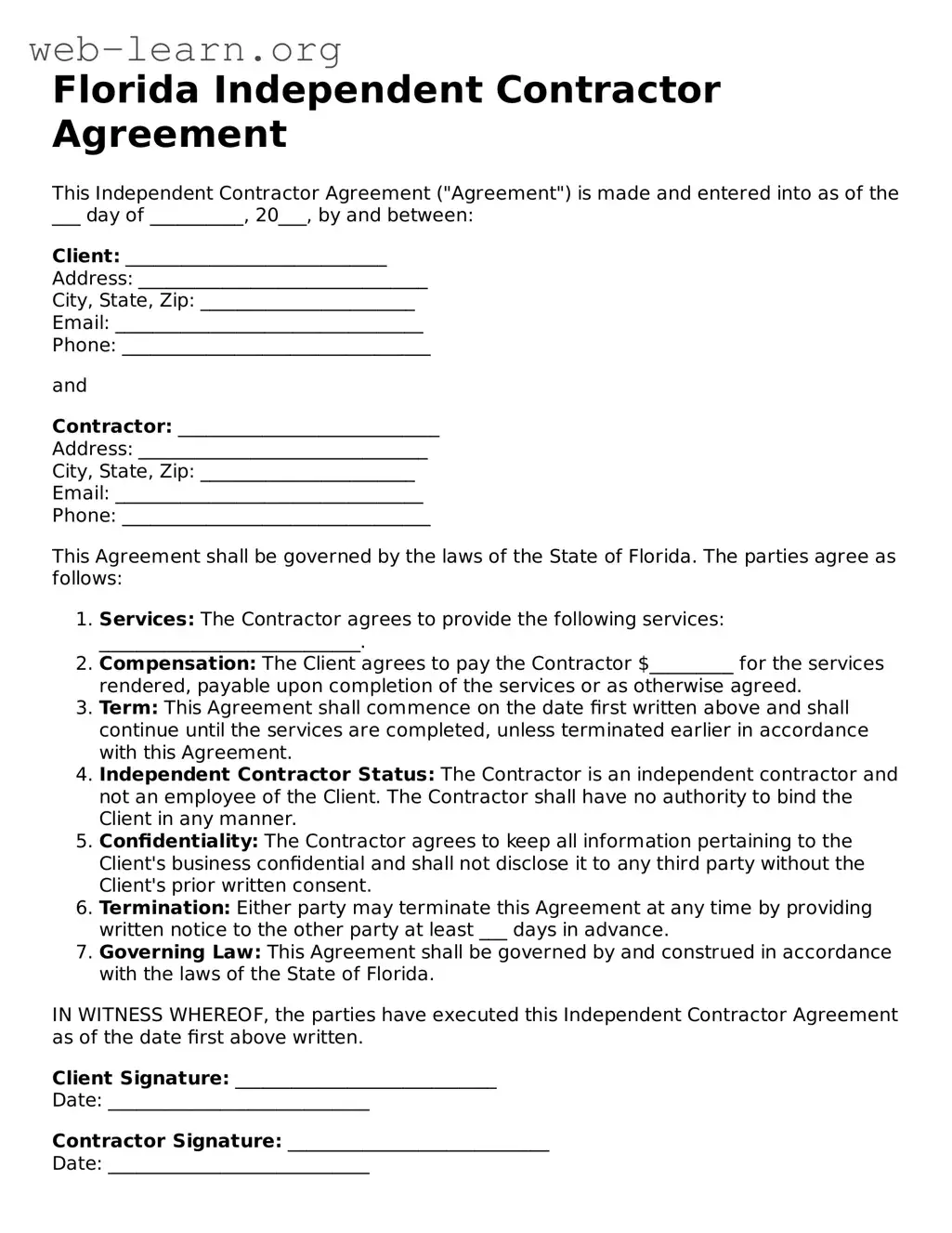
Florida Independent Contractor Agreement

This Independent Contractor Agreement ("Agreement") is made and entered into as of the ___ day of __________, 20___, by and between:

Client: ____________________________
Address: _______________________________
City, State, Zip: _______________________
Email: _________________________________
Phone: _________________________________

and

Contractor: ____________________________
Address: _______________________________
City, State, Zip: _______________________
Email: _________________________________
Phone: _________________________________

This Agreement shall be governed by the laws of the State of Florida. The parties agree as follows:

  1. Services: The Contractor agrees to provide the following services: ____________________________.
  2. Compensation: The Client agrees to pay the Contractor $_________ for the services rendered, payable upon completion of the services or as otherwise agreed.
  3. Term: This Agreement shall commence on the date first written above and shall continue until the services are completed, unless terminated earlier in accordance with this Agreement.
  4. Independent Contractor Status: The Contractor is an independent contractor and not an employee of the Client. The Contractor shall have no authority to bind the Client in any manner.
  5. Confidentiality: The Contractor agrees to keep all information pertaining to the Client's business confidential and shall not disclose it to any third party without the Client's prior written consent.
  6. Termination: Either party may terminate this Agreement at any time by providing written notice to the other party at least ___ days in advance.
  7. Governing Law: This Agreement shall be governed by and construed in accordance with the laws of the State of Florida.

IN WITNESS WHEREOF, the parties have executed this Independent Contractor Agreement as of the date first above written.

Client Signature: ____________________________
Date: ____________________________

Contractor Signature: ____________________________
Date: ____________________________

File Characteristics

Fact Name Description
Purpose The Florida Independent Contractor Agreement is designed to outline the terms of engagement between a contractor and a client.
Governing Law This agreement is governed by the laws of the State of Florida.
Independent Status The agreement clarifies that the contractor operates as an independent entity, not an employee of the client.
Compensation Details regarding payment terms, including rates and payment schedules, are specified in the agreement.
Duration The agreement should state the duration of the contract, including start and end dates, if applicable.
Confidentiality Provisions for confidentiality may be included to protect sensitive information shared during the contract.
Termination Clause The agreement typically includes terms under which either party can terminate the contract.

Detailed Guide for Filling Out Florida Independent Contractor Agreement

Once you have the Florida Independent Contractor Agreement form in front of you, it’s time to fill it out. This process is straightforward, and following these steps will help ensure you complete the form correctly.

  1. Start by entering the date at the top of the form. This should be the date you are filling out the agreement.
  2. Fill in the name of the contractor. Make sure to include their full legal name.
  3. Next, provide the contractor’s address. This includes the street address, city, state, and ZIP code.
  4. Enter the name of the company or individual hiring the contractor. This should also be the full legal name.
  5. Provide the hiring party's address, including the street address, city, state, and ZIP code.
  6. Clearly describe the services that the contractor will provide. Be specific to avoid any confusion later.
  7. Indicate the payment terms. Specify how much the contractor will be paid and when payments will be made.
  8. Include the duration of the agreement. State when the work will start and when it is expected to be completed.
  9. Both parties need to sign and date the form at the bottom. Make sure each signature is legible.

After completing these steps, review the form to ensure all information is accurate. This will help prevent any issues down the line. Once everything looks good, you can proceed with the next steps as needed.

Obtain Answers on Florida Independent Contractor Agreement

  1. What is a Florida Independent Contractor Agreement?

    A Florida Independent Contractor Agreement is a legal document that outlines the terms and conditions between a business and an independent contractor. This agreement clarifies the nature of the working relationship, including the services to be provided, payment terms, and other important details. It helps protect both parties by setting clear expectations.

  2. Who should use this agreement?

    This agreement is suitable for any business or individual that hires independent contractors in Florida. It is especially useful for freelancers, consultants, and service providers who work on a project basis rather than as employees. Using this agreement can help ensure that both parties understand their rights and responsibilities.

  3. What are the key components of the agreement?

    The key components typically include:

    • Identification of the parties involved
    • Description of the services to be provided
    • Payment terms, including rates and payment schedule
    • Duration of the agreement
    • Confidentiality clauses, if applicable
    • Termination conditions

    Including these components helps ensure that both parties are on the same page and reduces the risk of misunderstandings.

  4. Is the agreement legally binding?

    Yes, when properly signed by both parties, the Florida Independent Contractor Agreement is legally binding. This means that both the business and the contractor are obligated to adhere to the terms outlined in the agreement. It is important for both parties to read and understand the agreement before signing.

  5. Can the agreement be modified?

    Yes, the agreement can be modified if both parties agree to the changes. It is advisable to document any modifications in writing and have both parties sign the updated agreement. This helps maintain clarity and ensures that all parties are aware of the new terms.

  6. What happens if there is a dispute?

    If a dispute arises, the first step is usually to refer to the terms of the agreement. Many agreements include a dispute resolution clause that outlines how conflicts should be handled, such as mediation or arbitration. If the issue cannot be resolved amicably, legal action may be considered as a last resort.

  7. Where can I obtain a Florida Independent Contractor Agreement form?

    Florida Independent Contractor Agreement forms can be obtained from various sources. Many legal websites offer templates that can be customized to fit specific needs. Additionally, consulting with a legal professional can provide guidance on drafting an agreement that meets all legal requirements.

Common mistakes

Filling out the Florida Independent Contractor Agreement form can be straightforward, but many people make common mistakes that can lead to complications later. One frequent error is failing to clearly define the scope of work. This section should detail the specific tasks and responsibilities of the contractor. Without clarity, misunderstandings may arise, leading to disputes over what was expected.

Another common mistake is not including the payment terms. It's crucial to specify how and when the contractor will be paid. This includes the payment amount, frequency, and method. Omitting these details can create confusion and result in payment delays, which can strain the working relationship.

People also often neglect to address the duration of the contract. It is important to state the start date and, if applicable, the end date of the agreement. Without this information, both parties may have different expectations about how long the contractor will be engaged, leading to potential conflicts.

Lastly, many individuals overlook the importance of signatures. Both parties must sign the agreement for it to be legally binding. Failing to secure signatures can render the contract unenforceable, leaving both parties without legal protection. Always ensure that the agreement is signed and dated by all involved parties.

Documents used along the form

When engaging an independent contractor in Florida, several additional forms and documents may be necessary to ensure clarity and compliance. These documents help define the working relationship, protect both parties, and outline expectations. Below is a list of commonly used forms alongside the Florida Independent Contractor Agreement.

  • W-9 Form: This form is used to collect the contractor's taxpayer identification number. It is essential for tax reporting purposes, particularly for issuing 1099 forms at the end of the year.
  • 1099-MISC Form: This tax form is issued to report payments made to independent contractors. It must be provided to the contractor and filed with the IRS if payments exceed a certain threshold.
  • Scope of Work Document: This document outlines the specific tasks and responsibilities expected from the contractor. It provides clarity on deliverables and deadlines.
  • Non-Disclosure Agreement (NDA): An NDA protects confidential information shared between the contractor and the hiring party. It prevents the contractor from disclosing sensitive business information.
  • Non-Compete Agreement: This agreement restricts the contractor from engaging in similar business activities that compete with the hiring party for a specified period after the contract ends.
  • Insurance Certificates: Contractors may need to provide proof of insurance coverage. This ensures that both parties are protected in case of accidents or damages related to the work performed.
  • Invoicing Document: This document is used by the contractor to request payment for services rendered. It typically includes details such as hours worked, services provided, and payment terms.
  • Termination Letter: If either party decides to end the contract, a termination letter formalizes the decision. It outlines the reasons for termination and any final obligations.
  • Payment Agreement: This document specifies the payment terms, including rates, payment schedule, and methods. It ensures both parties agree on financial arrangements.

Utilizing these forms and documents can help establish a clear and professional relationship between the hiring party and the independent contractor. Each document serves a specific purpose, contributing to a smoother working arrangement and minimizing potential disputes.

Similar forms

  • Consulting Agreement: This document outlines the terms between a consultant and a client, similar to how an Independent Contractor Agreement defines the relationship between the contractor and the hiring party.
  • Freelance Agreement: A freelance agreement specifies the scope of work and payment terms for freelancers, paralleling the structure and purpose of an Independent Contractor Agreement.
  • Service Agreement: This document governs the provision of services between two parties, much like an Independent Contractor Agreement, detailing responsibilities and compensation.
  • Project Agreement: A project agreement focuses on a specific project, outlining deliverables and timelines, similar to how an Independent Contractor Agreement addresses specific tasks or projects.
  • Non-Disclosure Agreement (NDA): While primarily focused on confidentiality, an NDA often accompanies an Independent Contractor Agreement to protect sensitive information shared during the contract period.
  • Work for Hire Agreement: This document specifies that the work produced by the contractor is owned by the client, akin to the ownership clauses in an Independent Contractor Agreement.
  • Partnership Agreement: Although it involves a different relationship, a partnership agreement shares similarities in outlining roles, responsibilities, and profit-sharing, much like an Independent Contractor Agreement.
  • Employment Agreement: While distinct from independent contractor arrangements, both documents define the terms of engagement and expectations, albeit for different types of work relationships.
  • Subcontractor Agreement: This agreement details the relationship between a contractor and a subcontractor, similar to the relationship defined in an Independent Contractor Agreement.
  • Retainer Agreement: This document establishes a long-term relationship where a client pays for ongoing services, similar to how an Independent Contractor Agreement may set terms for ongoing work.

Dos and Don'ts

When filling out the Florida Independent Contractor Agreement form, it's important to be thorough and accurate. Here are seven things you should and shouldn't do:

  • Do read the entire agreement carefully before filling it out.
  • Do provide accurate and complete information about yourself and the services you will provide.
  • Do clarify any terms or conditions you do not understand before signing.
  • Do keep a copy of the signed agreement for your records.
  • Don't leave any sections blank unless instructed to do so.
  • Don't rush through the form; take your time to ensure everything is correct.
  • Don't sign the agreement if you feel pressured or unsure about any terms.

Misconceptions

Understanding the Florida Independent Contractor Agreement is essential for both contractors and businesses. However, several misconceptions often arise regarding this important document. Here are six common misconceptions explained:

  • Independent contractors have no rights. Many people believe that independent contractors are not entitled to any rights or protections. In reality, they have rights under various laws, including the right to receive payment for services rendered and protection against discrimination.
  • All independent contractor agreements are the same. Some assume that one agreement fits all situations. However, each agreement should be tailored to the specific needs and circumstances of the parties involved, addressing unique terms and conditions.
  • Independent contractors cannot work for multiple clients. This is a common misunderstanding. Independent contractors often have the freedom to work for multiple clients simultaneously, as long as it does not violate any agreements they have in place.
  • Signing an agreement means you are an employee. Many think that signing an independent contractor agreement makes them an employee. In fact, the agreement is meant to clarify the contractor's status as an independent worker, not an employee.
  • Independent contractors are responsible for all taxes. While independent contractors do handle their own taxes, businesses may still have obligations, such as reporting payments made to contractors. Understanding tax responsibilities is crucial for both parties.
  • Once signed, the agreement cannot be changed. Some believe that an independent contractor agreement is set in stone after signing. In truth, both parties can negotiate changes and amendments to the agreement if necessary, as long as both agree.

Being aware of these misconceptions can help both independent contractors and businesses navigate their agreements more effectively, ensuring a smoother working relationship.

Key takeaways

When filling out and using the Florida Independent Contractor Agreement form, consider the following key takeaways:

  1. Identify the Parties: Clearly state the names and addresses of both the contractor and the hiring party.
  2. Define the Scope of Work: Specify the services the contractor will provide. This should be detailed to avoid misunderstandings.
  3. Payment Terms: Outline how and when the contractor will be paid. Include rates, payment methods, and any milestones.
  4. Duration of Agreement: Indicate the start date and end date of the contract, or specify if it is ongoing until terminated.
  5. Confidentiality Clause: If applicable, include a section that protects sensitive information shared during the contract.
  6. Termination Conditions: State how either party can terminate the agreement and the notice required.
  7. Independent Contractor Status: Clearly affirm that the contractor is not an employee, which affects tax and liability issues.
  8. Dispute Resolution: Consider including a method for resolving disputes, such as mediation or arbitration.
  9. Compliance with Laws: Ensure that both parties agree to adhere to relevant local, state, and federal laws.
  10. Signatures: Both parties must sign the agreement to make it legally binding. Include date lines for signatures.

These elements help create a clear and effective Independent Contractor Agreement in Florida.