Homepage Attorney-Approved Bill of Sale Template Attorney-Approved Horse Bill of Sale Template Attorney-Approved Horse Bill of Sale Document for the State of Florida
Outline

When buying or selling a horse in Florida, having a well-structured Horse Bill of Sale form is essential for both parties involved. This document serves as a legal record of the transaction, ensuring that all necessary details are clearly outlined. Key aspects typically included in the form are the names and contact information of both the buyer and seller, a detailed description of the horse—including its breed, age, color, and any unique identifiers like registration numbers—and the sale price. Additionally, the form often addresses the terms of the sale, such as whether the horse is sold "as is" or if any warranties are provided. It may also include provisions regarding the transfer of ownership and any specific agreements related to the horse's care or health records. By utilizing this form, both buyers and sellers can protect their interests and create a transparent and accountable transaction process.

Sample - Florida Horse Bill of Sale Form

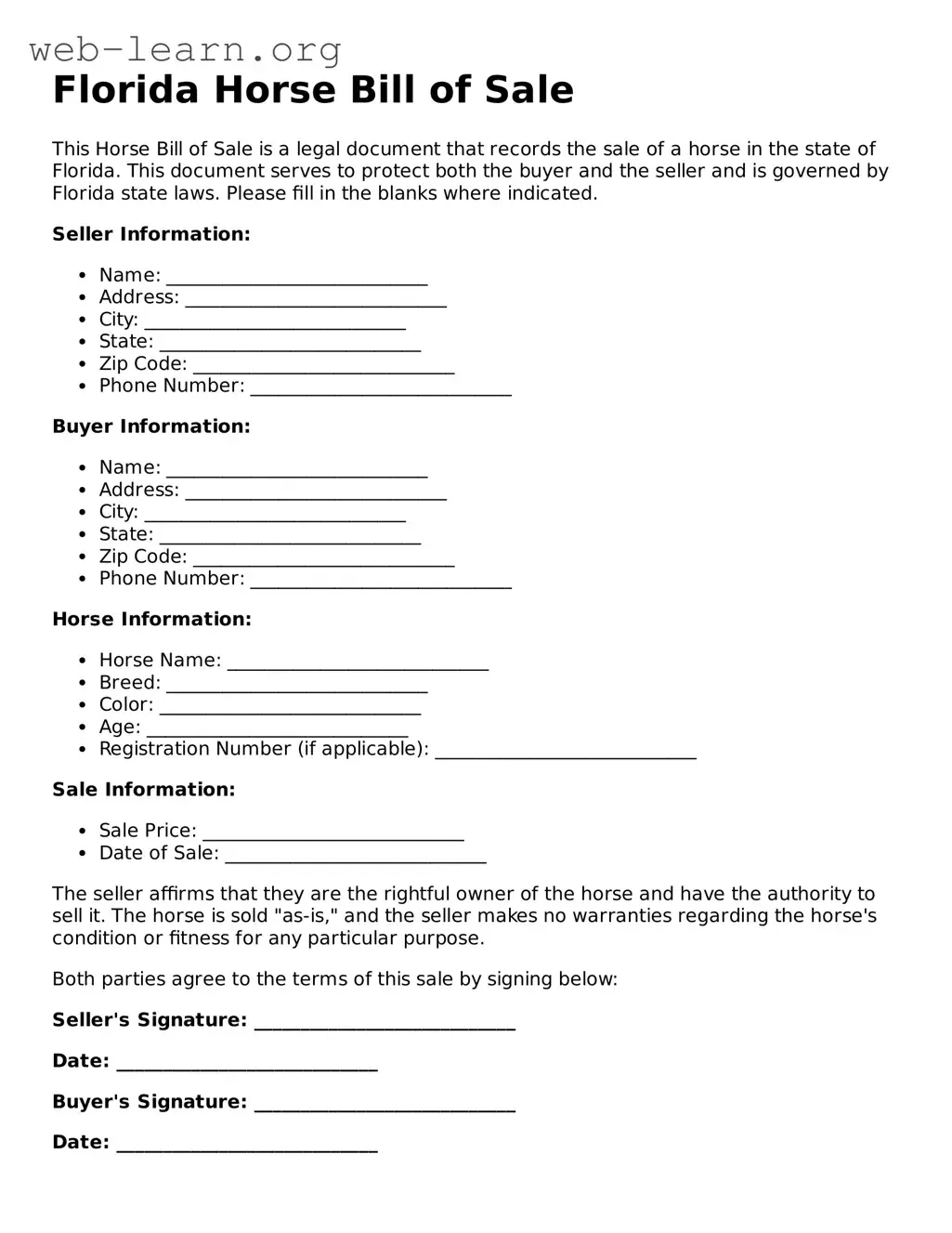
Florida Horse Bill of Sale

This Horse Bill of Sale is a legal document that records the sale of a horse in the state of Florida. This document serves to protect both the buyer and the seller and is governed by Florida state laws. Please fill in the blanks where indicated.

Seller Information:

  • Name: ____________________________
  • Address: ____________________________
  • City: ____________________________
  • State: ____________________________
  • Zip Code: ____________________________
  • Phone Number: ____________________________

Buyer Information:

  • Name: ____________________________
  • Address: ____________________________
  • City: ____________________________
  • State: ____________________________
  • Zip Code: ____________________________
  • Phone Number: ____________________________

Horse Information:

  • Horse Name: ____________________________
  • Breed: ____________________________
  • Color: ____________________________
  • Age: ____________________________
  • Registration Number (if applicable): ____________________________

Sale Information:

  • Sale Price: ____________________________
  • Date of Sale: ____________________________

The seller affirms that they are the rightful owner of the horse and have the authority to sell it. The horse is sold "as-is," and the seller makes no warranties regarding the horse's condition or fitness for any particular purpose.

Both parties agree to the terms of this sale by signing below:

Seller's Signature: ____________________________

Date: ____________________________

Buyer's Signature: ____________________________

Date: ____________________________

By signing this document, both the buyer and seller acknowledge that they have read and understood the terms of this Bill of Sale.

File Characteristics

Fact Name Description
Purpose The Florida Horse Bill of Sale form is used to document the sale of a horse, ensuring both parties have a record of the transaction.
Governing Law This form is governed by Florida Statutes, specifically under Title XXXII, Chapter 828, which pertains to animal laws.
Parties Involved The form requires the names and addresses of both the seller and the buyer to establish clear ownership transfer.
Horse Description A detailed description of the horse must be included, covering aspects such as breed, age, color, and any identifying marks.
Purchase Price The agreed-upon purchase price must be clearly stated to avoid any future disputes regarding the transaction.
As-Is Clause Typically, the form includes an "as-is" clause, indicating that the buyer accepts the horse in its current condition without warranties.
Signatures Both the seller and buyer must sign the form to validate the sale and confirm their agreement to the terms outlined.

Detailed Guide for Filling Out Florida Horse Bill of Sale

Filling out the Florida Horse Bill of Sale form is a straightforward process that ensures both the buyer and seller have a clear understanding of the transaction. Once the form is completed, it can serve as a legal record of the sale, providing essential details about the horse and the terms of the sale.

  1. Begin by entering the date of the sale at the top of the form.
  2. Provide the full name and address of the seller. Ensure that the information is accurate and up-to-date.
  3. Next, enter the buyer's full name and address in the designated section.
  4. Clearly describe the horse being sold. Include details such as the horse's name, breed, age, color, and any identifying markings.
  5. Specify the sale price of the horse. This should be a clear and agreed-upon amount between both parties.
  6. Include any terms and conditions of the sale, if applicable. This might cover aspects like payment methods or any warranties offered.
  7. Both the seller and buyer should sign and date the form to validate the transaction.
  8. Finally, ensure that each party receives a copy of the completed bill of sale for their records.

Obtain Answers on Florida Horse Bill of Sale

  1. What is a Florida Horse Bill of Sale?

    A Florida Horse Bill of Sale is a legal document that records the sale and transfer of ownership of a horse. This form provides essential information about the horse, the seller, and the buyer. It serves as proof of the transaction and can be used for various purposes, such as registration or insurance.

  2. What information is included in the Horse Bill of Sale?

    The form typically includes the following details:

    • The names and addresses of the buyer and seller
    • A description of the horse, including breed, age, color, and any identifying marks
    • The sale price and payment terms
    • The date of the sale
    • Any warranties or guarantees provided by the seller
  3. Is the Horse Bill of Sale required in Florida?

    While a Horse Bill of Sale is not legally required in Florida, it is highly recommended. Having a written record of the sale protects both the buyer and seller. It provides evidence of ownership and can help resolve any disputes that may arise in the future.

  4. How should the Horse Bill of Sale be completed?

    The form should be filled out completely and accurately. Both parties should review the information to ensure it is correct. After completion, both the buyer and seller should sign and date the document. It is advisable to keep copies for personal records.

  5. Can the Horse Bill of Sale be modified after signing?

    Once signed, modifications to the Horse Bill of Sale should be avoided unless both parties agree to the changes. If changes are necessary, it is best to create a new document that reflects the updated terms and have both parties sign it.

  6. Where can I obtain a Florida Horse Bill of Sale form?

    Florida Horse Bill of Sale forms can be obtained from various sources, including online legal document services, local equestrian organizations, or legal offices. It is important to ensure that the form meets Florida's requirements and includes all necessary information.

Common mistakes

When filling out the Florida Horse Bill of Sale form, one common mistake is failing to provide accurate descriptions of the horse. Buyers and sellers must include essential details such as the horse's breed, age, color, and any identifying marks. Omitting this information can lead to disputes later on, as it may create ambiguity regarding the horse's identity. A clear and precise description helps protect both parties involved in the transaction.

Another frequent error is neglecting to include the purchase price. This detail is crucial for establishing the terms of the sale. Without a stated price, it may be challenging to prove the value of the transaction for tax purposes or in case of a dispute. Both parties should agree on the amount and ensure it is clearly written on the form to avoid any misunderstandings.

People often overlook the necessity of signatures. Both the buyer and seller must sign the bill of sale to validate the transaction. Without signatures, the document may not hold legal weight. It is important to ensure that both parties sign and date the form at the time of sale, confirming their agreement to the terms outlined.

Finally, many individuals fail to keep a copy of the completed bill of sale. After the transaction, it is essential for both the buyer and seller to retain a copy for their records. This documentation serves as proof of ownership and can be vital in case of future disputes or inquiries regarding the horse. Keeping a copy ensures that both parties have access to the same information should any questions arise later.

Documents used along the form

When purchasing or selling a horse in Florida, the Horse Bill of Sale form is an essential document that outlines the transaction details. However, several other forms and documents are often used in conjunction with the Horse Bill of Sale to ensure a smooth and legally sound process. Below are some commonly used documents that may accompany the Horse Bill of Sale.

  • Equine Liability Release Form: This document protects the seller from liability in case of accidents or injuries that occur while the buyer is handling or riding the horse. It typically requires the buyer to acknowledge the inherent risks involved in horse-related activities.
  • Health Certificate: A health certificate is issued by a veterinarian and confirms that the horse is free from disease and fit for travel. This document is often required if the horse is being transported across state lines.
  • Coggins Test Result: This is a blood test that checks for Equine Infectious Anemia (EIA). A negative Coggins test is usually required for horses being sold or transported, ensuring that the horse is not a health risk to others.
  • Registration Papers: If the horse is registered with a breed association, the registration papers provide proof of the horse's pedigree and ownership. These papers can affect the horse's value and are important for buyers interested in showing or breeding.
  • Purchase Agreement: This document outlines the terms of the sale, including price, payment method, and any conditions that must be met before the sale is finalized. It serves as a more detailed contract between the buyer and seller.
  • Transfer of Ownership Form: This form is often required by breed registries or associations to officially transfer ownership of the horse from the seller to the buyer. It helps maintain accurate records within the registry.

Using these additional documents alongside the Horse Bill of Sale can help ensure that both parties are protected and that the transaction is handled properly. It is always wise to consult with a legal expert or a knowledgeable professional in the equine industry to ensure that all necessary paperwork is in order before completing the sale.

Similar forms

  • Vehicle Bill of Sale: This document serves as proof of the sale of a vehicle. Like the Horse Bill of Sale, it includes details about the buyer, seller, and the item being sold, ensuring both parties have a record of the transaction.
  • Real Estate Purchase Agreement: This agreement outlines the terms of a property sale. Similar to the Horse Bill of Sale, it details the buyer and seller information, property description, and purchase price, providing legal protection for both parties.
  • Boat Bill of Sale: This document is used when transferring ownership of a boat. Much like the Horse Bill of Sale, it includes essential information about the boat, buyer, and seller, confirming the sale and protecting the interests of both parties.
  • Equipment Bill of Sale: This form is used for the sale of various types of equipment. It shares similarities with the Horse Bill of Sale by detailing the equipment being sold, along with buyer and seller information, thus documenting the transaction.
  • Pet Bill of Sale: This document is used when transferring ownership of a pet. Similar to the Horse Bill of Sale, it includes details about the pet, buyer, and seller, ensuring that the transaction is clear and legally recognized.

Dos and Don'ts

When filling out the Florida Horse Bill of Sale form, it's important to follow certain guidelines to ensure the process goes smoothly. Here are six key dos and don'ts:

  • Do provide accurate information about the horse, including breed, age, and any identifying marks.
  • Do include the names and contact information of both the buyer and seller.
  • Do clearly state the purchase price and payment terms.
  • Do sign and date the document to make it legally binding.
  • Don't leave any sections blank; incomplete forms can cause issues later.
  • Don't forget to keep a copy of the signed bill of sale for your records.

Misconceptions

The Florida Horse Bill of Sale form is essential for anyone buying or selling a horse in Florida. However, several misconceptions surround this document. Here are eight common misunderstandings:

  • It is not legally required. Many believe that a bill of sale is optional. In reality, it provides legal protection for both the buyer and seller.
  • All sales must be notarized. While notarization can add an extra layer of security, it is not mandatory for a bill of sale to be valid in Florida.
  • It only protects the seller. This is false. The bill of sale protects both parties by documenting the transaction details.
  • Verbal agreements are sufficient. Relying on verbal agreements can lead to misunderstandings. A written bill of sale is always more reliable.
  • It does not need to include specific details. Omitting details can cause issues later. A thorough bill of sale should include information such as the horse's age, breed, and any health issues.
  • It is only for horses. While the form is designed for horse sales, it can also be adapted for other livestock transactions.
  • Once signed, it cannot be changed. Amendments can be made if both parties agree. It is essential to document any changes in writing.
  • It is a one-size-fits-all document. Each transaction is unique. Customize the bill of sale to reflect the specifics of the sale.

Understanding these misconceptions can help ensure a smoother transaction when buying or selling a horse in Florida.

Key takeaways

When filling out and using the Florida Horse Bill of Sale form, it is important to keep several key points in mind. These takeaways will help ensure a smooth transaction and provide necessary documentation for both parties involved.

  • Accurate Information: Ensure that all information regarding the horse, including its breed, age, and identification details, is accurate and complete.
  • Seller and Buyer Details: Include full names and contact information for both the seller and the buyer to facilitate future communication.
  • Purchase Price: Clearly state the agreed-upon purchase price for the horse to avoid any misunderstandings.
  • Payment Terms: Specify the payment method and any payment terms, such as deposits or payment plans, if applicable.
  • Condition of Sale: Describe the condition of the horse at the time of sale, including any known health issues or special considerations.
  • Transfer of Ownership: The bill of sale serves as a legal document that transfers ownership from the seller to the buyer, so both parties should retain a copy.
  • Signatures Required: Both the seller and the buyer must sign the document to validate the sale and acknowledge agreement to the terms.
  • Witness or Notary: While not always necessary, having a witness or notary public can add an extra layer of legitimacy to the transaction.
  • Legal Compliance: Ensure compliance with any local or state regulations regarding horse sales, which may vary by jurisdiction.
  • Record Keeping: Keep a copy of the bill of sale for personal records, as it may be needed for future reference, such as registration or insurance purposes.