Homepage Blank Florida F 706 Form
Outline

The Florida F 706 form serves as a crucial document for managing estate tax obligations in the state of Florida. This form is necessary for estates that are subject to federal estate tax filing requirements and must be filed by the personal representative of the decedent. The form collects essential information, including the decedent's name, social security number, and residence at the time of death. It also requires details about the personal representative and any attorneys involved in the estate. The F 706 is divided into three parts, catering to Florida residents, nonresidents, and nonresident aliens, each addressing specific tax credits and calculations based on the estate's value. Additionally, the form outlines the due dates for submission and payment, which is typically within nine months following the decedent's death. Failure to comply with these requirements can result in penalties and interest on unpaid taxes. To ensure accurate processing, the personal representative must also attach a signed copy of the federal estate tax return, either Form 706 or 706-NA. Understanding the intricacies of the F 706 form is essential for fulfilling legal obligations and managing the estate effectively.

Sample - Florida F 706 Form

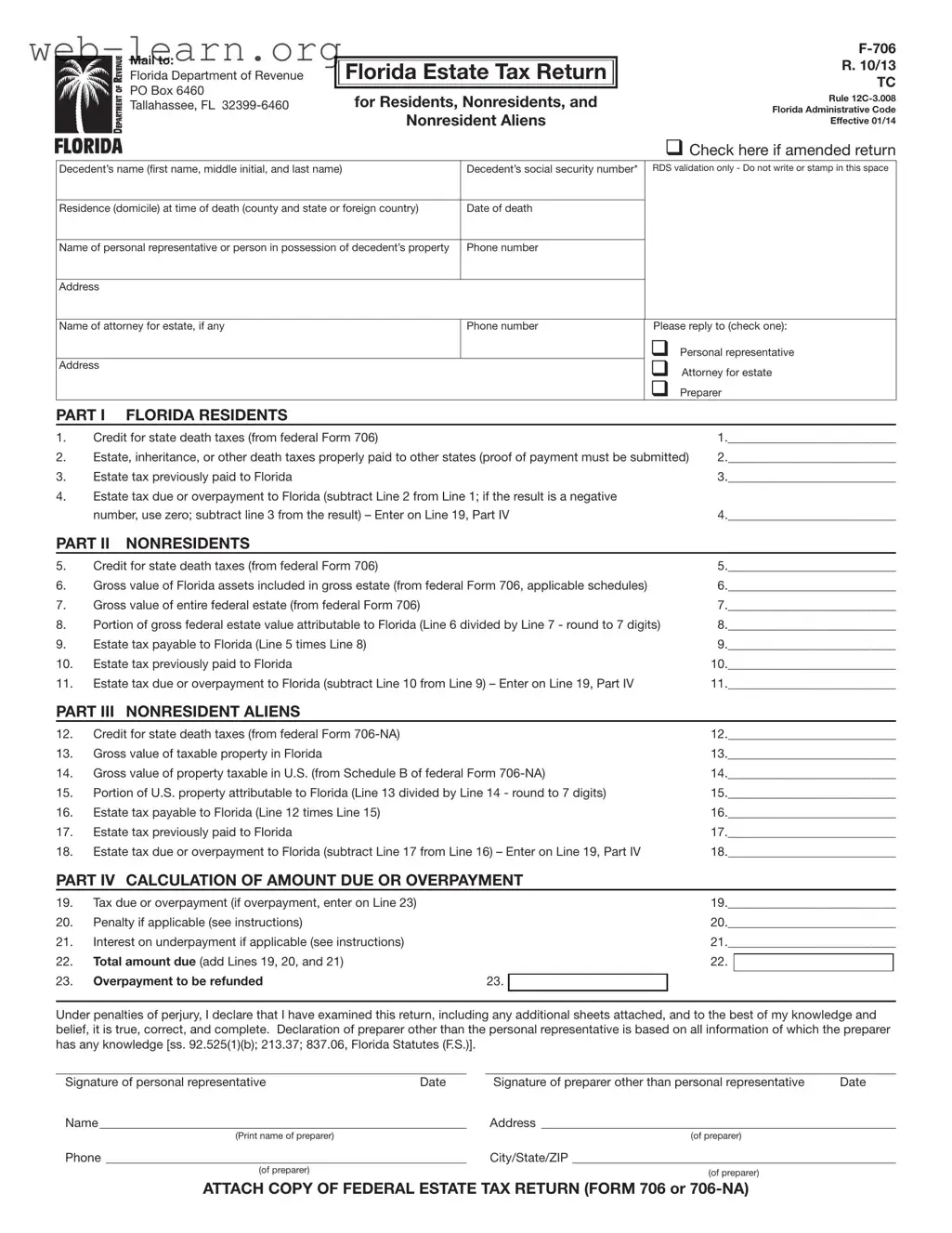
Decedent’s name (rst name, middle initial, and last name) Decedent’s social security number*
Residence (domicile) at time of death (county and state or foreign country) Date of death
Name of personal representative or person in possession of decedent’s property Phone number
Address
Name of attorney for estate, if any Phone number Please reply to (check one):
Address
Florida Estate Tax Return
for Residents, Nonresidents, and
Nonresident Aliens
Mail to:
Florida Department of Revenue
PO Box 6460
Tallahassee, FL 32399-6460
q Check here if amended return
ATTACH COPY OF FEDERAL ESTATE TAX RETURN (FORM 706 or 706-NA)
PART I FLORIDA RESIDENTS
1. Credit for state death taxes (from federal Form 706) 1.___________________________
2. Estate, inheritance, or other death taxes properly paid to other states (proof of payment must be submitted) 2.___________________________
3. Estate tax previously paid to Florida 3.___________________________
4. Estate tax due or overpayment to Florida (subtract Line 2 from Line 1; if the result is a negative
number, use zero; subtract line 3 from the result) – Enter on Line 19, Part IV 4.___________________________
PART II NONRESIDENTS
5. Credit for state death taxes (from federal Form 706) 5.___________________________
6. Gross value of Florida assets included in gross estate (from federal Form 706, applicable schedules) 6.___________________________
7. Gross value of entire federal estate (from federal Form 706) 7.___________________________
8. Portion of gross federal estate value attributable to Florida (Line 6 divided by Line 7 - round to 7 digits) 8.___________________________
9. Estate tax payable to Florida (Line 5 times Line 8) 9.___________________________
10. Estate tax previously paid to Florida 10.___________________________
11. Estate tax due or overpayment to Florida (subtract Line 10 from Line 9) – Enter on Line 19, Part IV 11.___________________________
PART III NONRESIDENT ALIENS
12. Credit for state death taxes (from federal Form 706-NA) 12.___________________________
13. Gross value of taxable property in Florida 13.___________________________
14. Gross value of property taxable in U.S. (from Schedule B of federal Form 706-NA) 14.___________________________
15. Portion of U.S. property attributable to Florida (Line 13 divided by Line 14 - round to 7 digits) 15.___________________________
16. Estate tax payable to Florida (Line 12 times Line 15) 16.___________________________
17. Estate tax previously paid to Florida 17.___________________________
18. Estate tax due or overpayment to Florida (subtract Line 17 from Line 16) – Enter on Line 19, Part IV 18.___________________________
PART IV CALCULATION OF AMOUNT DUE OR OVERPAYMENT
19. Tax due or overpayment (if overpayment, enter on Line 23) 19.___________________________
20. Penalty if applicable (see instructions) 20.___________________________
21. Interest on underpayment if applicable (see instructions) 21.___________________________
22. Total amount due (add Lines 19, 20, and 21) 22.
23. Overpayment to be refunded 23.
Under penalties of perjury, I declare that I have examined this return, including any additional sheets attached, and to the best of my knowledge and
belief, it is true, correct, and complete. Declaration of preparer other than the personal representative is based on all information of which the preparer
has any knowledge [ss. 92.525(1)(b); 213.37; 837.06, Florida Statutes (F.S.)].
__________________________________________________________________ __________________________________________________________________
Signature of personal representative Date Signature of preparer other than personal representative Date
Name ___________________________________________________________ Address _________________________________________________________
Phone __________________________________________________________ City/State/ZIP ____________________________________________________
RDS validation only - Do not write or stamp in this space
(of preparer)(Print name of preparer)
(of preparer)
(of preparer)
q Personal representative
q Attorney for estate
q Preparer
F-706
R. 10/13
TC
Rule 12C-3.008
Florida Administrative Code
Effective 01/14
General Information
Florida’s estate tax is based on the allowable federal credit
for state death taxes. Florida tax is imposed only on those
estates subject to federal estate tax ling requirements and
entitled to a credit for state death taxes (Chapter 198, F.S.).
Estate tax is not due if a federal estate tax return (Form 706
or 706-NA) is not required to be led. (When estate tax is not
due because there is no federal estate tax ling requirement,
you should use Florida Form DR-312, Afdavit of No Florida
Estate Tax Due, to remove the Florida estate tax lien on the
property.) If a nontaxable certicate is requested, you must
pay a $5.00 fee for it.
Form F-706 Filing Requirements
The requirement to le Form F-706 depends upon the date
of death.
Date of Death F-706 Required?
On or before December 31, 2004 Yes**
On or after January 1, 2005 No
**If required, Form F-706 must be led for the estate of
every Florida resident, nonresident, and nonresident alien
with Florida property that is required to le a federal estate
tax return (Form 706 or Form 706-NA). The personal
representative must attach a signed copy of federal Form
706 or 706-NA to the Florida estate tax return.
Due Dates and Extensions of Time
Form F-706 and payment is due within 9 months after the
decedent’s death (when the federal estate tax return is
due). If you need an extension of time to le or pay, you
must send your request to the Internal Revenue Service
(IRS). Florida does not have a separate extension form.
We will grant the same extension to pay or le that the
IRS does; however, you must send copies of both the
extension request and approved federal extension to
us within 30 days of mailing the request and 30 days of
receiving the federal approval. An extension of time to le
does not extend the time to pay. Interest accrues on the
Florida tax due from the original due date until paid.
Tax Paid to Other States
For Florida residents: if estate, inheritance, or other death
taxes were properly paid to other states, proof of payment
must be submitted to the Florida Department of Revenue.
(Proof of payment means the nal certicate of payment
showing the specic amounts of tax, penalty, or interest
assessed and paid.)
*Social Security Numbers
Social security numbers (SSNs) are used by the Florida
Department of Revenue as unique identiers for the
administration of Florida’s taxes. SSNs obtained for tax
administration purposes are condential under sections
213.053 and 119.071, Florida Statutes, and not subject
to disclosure as public records. Collection of your SSN is
authorized under state and federal law. Visit our Internet
INSTRUCTIONS FOR FORM F-706
site at floridarevenue.com and select “Privacy
Notice” for more information regarding the state and
federal law governing the collection, use, or release of
SSNs, including authorized exceptions.
Where to File
Mail your completed F-706 and payment to:
Florida Department of Revenue
PO Box 6460
Tallahassee, FL 32399-6460
If you are requesting a nontaxable certicate, include the
$5.00 fee.
Signature
The personal representative must sign the return
declaration under penalties of perjury. If someone else
prepares the return, the preparer must also sign the return.
Amending Form F-706
If you must change a return that has already been led,
you must complete another Form F-706 and check
the amended return box on the form. If the amended
return is caused by a change in your federal Form 706
or 706-NA, you must attach a statement describing the
reasons and all documents related to the change, including
correspondence received from the IRS and/or the amended
federal Form 706 or 706-NA.
Penalties and Interest
Penalties – If tax is not paid by the due date (or approved
extension date) a late payment penalty of 10% of the
unpaid tax is due. After 30 days, the late penalty increases
to 20%. An added penalty of 10% per month up to a
maximum of 50% of the tax due is imposed if the unpaid
tax is due to negligence or intentional disregard. A fraud
penalty of 100% of the tax due is imposed if the unpaid tax
is due to willful intent to defraud. However, the Department
of Revenue is authorized to compromise or settle these
penalties pursuant to section 213.21, F.S.
Interest – Interest is due on late payments from the due
date until paid. Interest rates are updated January 1 and
July 1 of each year. To obtain current interest rates,
visit our website at floridarevenue.com.
Need Assistance?
Information and forms are available on our Internet site at
floridarevenue.com.
If you have any questions, you may contact Taxpayer
Services at 850-488-6800, Monday through Friday,
excluding holidays.
For a written reply to your tax questions, write:
Taxpayer Services MS 3-2000
Florida Department of Revenue
5050 W Tennessee St
Tallahassee, FL 32399-0112
For federal estate tax information or forms, visit the IRS
website at www.irs.gov.
F-706
R. 10/13
Page 2

Form Information

Fact Name Description
Form Title The official name of the form is the Florida Estate Tax Return, designated as F-706.
Governing Laws This form is governed by Chapter 198 of the Florida Statutes.
Filing Requirement Form F-706 must be filed for estates subject to federal estate tax filing requirements.
Filing Deadline The form and payment are due within 9 months after the decedent’s death.
Amended Returns If changes are necessary, an amended return can be filed by checking the appropriate box.
Penalties for Late Payment A late payment penalty starts at 10% of the unpaid tax if not paid by the due date.
Interest on Late Payments Interest accrues on any unpaid tax from the original due date until it is paid in full.
Non-Residents and Aliens Special provisions exist for non-residents and non-resident aliens filing this form.
Where to File The completed form should be mailed to the Florida Department of Revenue in Tallahassee.

Detailed Guide for Filling Out Florida F 706

Filling out the Florida F 706 form is a crucial step in managing estate tax obligations. This process requires careful attention to detail to ensure compliance with state regulations. Once the form is completed, it should be submitted to the Florida Department of Revenue, along with any necessary documentation.

  1. Begin by obtaining the Florida F 706 form from the Florida Department of Revenue website or other official sources.
  2. In the designated area, check the box if you are submitting an amended return.
  3. Fill in the decedent's name, including the first name, middle initial, and last name.
  4. Provide the decedent’s social security number in the appropriate field.
  5. Indicate the residence (county and state or foreign country) where the decedent lived at the time of death.
  6. Enter the date of death.
  7. List the name of the personal representative or the person in possession of the decedent’s property.
  8. Include the phone number and address of the personal representative.
  9. If applicable, provide the name and phone number of the attorney for the estate.
  10. Check the box for the preferred reply method (personal representative, attorney for estate, or preparer) and provide the relevant address.
  11. Complete Part I if the decedent was a Florida resident by filling in lines 1 through 4, which require information about state death taxes and any overpayment or due amounts.
  12. For nonresidents, complete Part II by filling in lines 5 through 11, detailing the estate tax credits and values related to Florida assets.
  13. For nonresident aliens, complete Part III by filling in lines 12 through 18, providing information on property values and estate tax calculations.
  14. In Part IV, calculate the total amount due or overpayment by filling in lines 19 through 23.
  15. Sign and date the form as the personal representative. If someone else prepared the return, they must also sign and date it.
  16. Attach a copy of the federal estate tax return (Form 706 or 706-NA) to the F 706 form.
  17. Mail the completed form and any payment to the Florida Department of Revenue at the specified address.

Obtain Answers on Florida F 706

  1. What is the Florida F-706 form?

    The Florida F-706 form is the Florida Estate Tax Return. It is required for estates that are subject to federal estate tax filing requirements. This form is used to report the estate tax due to the Florida Department of Revenue, and it is applicable to residents, nonresidents, and nonresident aliens who have property in Florida. The form must be filed within nine months after the decedent's death if a federal estate tax return is required.

  2. Who needs to file the F-706 form?

    Filing the F-706 form is necessary for the estates of individuals who died on or before December 31, 2004. For those who passed away on or after January 1, 2005, the form is generally not required unless the estate is subject to federal estate tax. This includes Florida residents, nonresidents, and nonresident aliens with Florida property that necessitates filing a federal estate tax return.

  3. What are the penalties for not filing the F-706 form on time?

    If the F-706 form is not filed by the due date, which is nine months after the decedent's death, penalties may apply. A late payment penalty of 10% of the unpaid tax will be assessed initially. If the payment remains overdue for more than 30 days, this penalty increases to 20%. Additional penalties can be imposed for negligence or intentional disregard of tax laws, with a maximum penalty of 50% for unpaid tax due to negligence. Furthermore, interest accrues on any unpaid tax from the due date until it is paid.

  4. How do I amend a previously filed F-706 form?

    To amend a previously filed F-706 form, you must complete a new F-706 form and check the box indicating that it is an amended return. If the amendment is due to changes in the federal Form 706 or 706-NA, you should attach a statement explaining the reasons for the amendment, along with any relevant documents, such as correspondence from the IRS or the amended federal forms.

  5. Where should I mail the completed F-706 form?

    The completed F-706 form, along with any payment, should be mailed to the Florida Department of Revenue at the following address:

    • Florida Department of Revenue
    • PO Box 6460
    • Tallahassee, FL 32399-6460

    If you are requesting a nontaxable certificate, do not forget to include the $5.00 fee along with your submission.

  6. What should I do if I have questions about the F-706 form?

    If you have questions regarding the F-706 form or the estate tax process, you can visit the Florida Department of Revenue's website at floridarevenue.com for more information and resources. Additionally, you can contact Taxpayer Services at 850-488-6800 during regular business hours. For written inquiries, you may send your questions to:

    • Taxpayer Services
    • MS 3-2000
    • Florida Department of Revenue
    • 5050 W Tennessee St
    • Tallahassee, FL 32399-0112

Common mistakes

Filling out the Florida F 706 form can be a daunting task, and many people make common mistakes that can lead to delays or complications. One frequent error is failing to include the decedent's complete name. It’s essential to write the full name, including the first name, middle initial, and last name. Omitting any part of the name can create confusion and may result in processing issues.

Another mistake is neglecting to provide the decedent’s social security number. This number is crucial for identification purposes and must be accurately recorded. Skipping this step can lead to unnecessary delays in processing the return.

Additionally, many individuals forget to check the appropriate box if they are submitting an amended return. If changes have been made to the original filing, indicating that it’s an amendment is vital. Failing to do so can lead to complications in the review process.

People often overlook the requirement to submit proof of any estate, inheritance, or other death taxes paid to other states. This documentation must accompany the return. Without it, the Florida Department of Revenue may reject the claim for a credit, resulting in a higher tax liability.

Another common error is incorrectly calculating the estate tax due or overpayment. This calculation is critical and involves several lines of the form. Miscalculating can lead to either underpayment or overpayment, both of which can have financial repercussions.

Many filers also fail to sign the form. The personal representative must sign the return declaration under penalties of perjury. If someone else prepares the return, that individual must also sign. A missing signature can halt the processing of the return.

People sometimes forget to attach a copy of the federal estate tax return (Form 706 or 706-NA). This attachment is not just a formality; it’s a requirement that supports the information provided on the Florida F 706 form. Without it, the return may be considered incomplete.

Another mistake is not paying attention to the due dates. The F 706 form and payment are due within nine months after the decedent’s death. If you miss this deadline, penalties and interest can accrue, complicating the situation further.

Finally, failing to check for any updates or changes in the form’s instructions can lead to errors. Tax laws can change, and staying informed is crucial for ensuring compliance and accuracy. By avoiding these common pitfalls, you can help ensure a smoother process when filing the Florida F 706 form.

Documents used along the form

When dealing with the Florida F 706 form, there are several other forms and documents that may be necessary to ensure a smooth process. Each of these documents serves a specific purpose and plays a vital role in estate tax proceedings. Here’s a brief overview of some commonly used forms alongside the Florida F 706.

  • Federal Form 706: This is the United States Estate (and Generation-Skipping Transfer) Tax Return. It must be filed by the estate of a deceased person when the gross estate exceeds a certain threshold. This form is essential for calculating federal estate taxes and must be attached to the Florida F 706.
  • Federal Form 706-NA: Similar to Form 706, this form is specifically for nonresident aliens. It is used to report the estate tax liability for individuals who are not U.S. citizens and who have property in the U.S. This form is crucial for nonresident estates and must also be included with the Florida F 706 if applicable.
  • Form DR-312: This is the Affidavit of No Florida Estate Tax Due. If the estate does not meet the federal filing requirements, this form can be used to remove any estate tax liens on the property, providing a clear path for the estate's administration.
  • Form F-706X: This is the Amended Florida Estate Tax Return. If there are changes to the original F 706 submission, this form is necessary to correct any errors or omissions. It allows the estate to adjust its tax liability accordingly.
  • Proof of Payment Documentation: If estate taxes were paid to other states, documentation proving those payments must be submitted. This proof is essential for claiming credits on the Florida estate tax return.
  • Death Certificate: A certified copy of the decedent's death certificate is often required to validate the date of death and other pertinent information. This document is fundamental in establishing the estate's legal standing.
  • Power of Attorney: If someone other than the personal representative is handling the filing, a Power of Attorney document may be required. This legal document authorizes another individual to act on behalf of the personal representative in tax matters.

Understanding these forms and their purposes can greatly simplify the estate tax filing process in Florida. Being prepared with the necessary documentation not only helps in compliance but also ensures that the estate is settled efficiently and correctly.

Similar forms

The Florida F 706 form, which is the Florida Estate Tax Return, shares similarities with several other documents related to estate and tax matters. Below are six documents that are comparable to the Florida F 706, along with explanations of their similarities:

  • Federal Form 706: This is the U.S. Estate (and Generation-Skipping Transfer) Tax Return. Like the Florida F 706, it is used to report the value of a decedent's estate and calculate any estate tax owed to the federal government. Both forms require detailed information about the decedent's assets and liabilities.
  • Federal Form 706-NA: This form is for nonresident aliens and serves a similar purpose as the Federal Form 706. It is used to report the estate tax obligations for nonresidents, just as the Florida F 706 includes provisions for nonresident aliens with Florida property.
  • Florida Form DR-312: This form is the Affidavit of No Florida Estate Tax Due. While the Florida F 706 is used when estate tax is applicable, Form DR-312 is filed when no estate tax is due, providing a mechanism to clear the estate tax lien on property.
  • IRS Form 1041: The U.S. Income Tax Return for Estates and Trusts is similar in that it deals with the financial aspects of an estate. While Form 706 focuses on estate taxes, Form 1041 addresses income generated by the estate after the decedent's death.
  • State Inheritance Tax Returns: Similar to the Florida F 706, some states require inheritance tax returns to be filed. These forms report assets inherited by beneficiaries and calculate any taxes owed to the state, paralleling the process of reporting and taxation found in the Florida F 706.
  • Form 706-CE: This is the Certificate of Payment of Estate Tax. It is used to certify that estate tax has been paid, similar to how the Florida F 706 calculates and reports estate tax obligations. Both forms are essential for ensuring compliance with tax obligations related to an estate.

Dos and Don'ts

When filling out the Florida F-706 form, it's essential to approach the task with care. Here are some key do's and don'ts to keep in mind:

  • Do ensure that you have the decedent’s full name, Social Security number, and date of death ready before starting the form.
  • Do attach a copy of the federal estate tax return (Form 706 or 706-NA) to your submission.
  • Do double-check all calculations, especially when determining the estate tax due or overpayment.
  • Do file the form within nine months of the decedent’s death to avoid penalties.
  • Don't forget to provide proof of any estate taxes paid to other states if applicable.
  • Don't leave any sections of the form blank; ensure all required fields are filled out completely.
  • Don't attempt to amend the form without checking the amended return box and providing necessary documentation.
  • Don't neglect to sign the form; both the personal representative and preparer must sign where indicated.

Following these guidelines can help ensure a smoother filing process and reduce the risk of errors or penalties.

Misconceptions

  • Misconception 1: The F 706 form is only for Florida residents.
  • This form is required for residents, nonresidents, and nonresident aliens with Florida property, as long as they meet federal estate tax filing requirements.

  • Misconception 2: You only need to file the F 706 form if the estate is taxable.
  • The F 706 form must be filed if a federal estate tax return is required, regardless of whether any Florida estate tax is due.

  • Misconception 3: Filing the F 706 form is optional.
  • Filing is mandatory for estates that fall under specific criteria, particularly if they are required to file a federal estate tax return.

  • Misconception 4: There is no penalty for late filing.
  • There are penalties for late payment and filing, which can increase significantly over time. It’s important to file on time to avoid these penalties.

  • Misconception 5: You don’t need to attach any documents to the F 706 form.
  • A signed copy of the federal estate tax return (Form 706 or 706-NA) must be attached when filing the F 706 form.

  • Misconception 6: The F 706 form can be filed at any time after the decedent's death.
  • The form must be filed within nine months of the decedent’s death, aligning with the due date for the federal estate tax return.

  • Misconception 7: All estates owe Florida estate tax.
  • Florida estate tax is only imposed on estates that are required to file a federal estate tax return and are entitled to a credit for state death taxes.

Key takeaways

When dealing with the Florida F-706 form, there are several important points to keep in mind. Understanding these can help ensure that the process goes smoothly and that all necessary requirements are met.

  • Filing Requirements: The F-706 form must be filed if the decedent died on or before December 31, 2004, and a federal estate tax return is required. For those who died on or after January 1, 2005, filing the form is not necessary.
  • Due Dates: The completed form and any payment are due within nine months following the decedent's death. If an extension is needed, it must be requested from the IRS, and copies of the extension must be sent to the Florida Department of Revenue.
  • Proof of Payment: If estate taxes were paid to other states, proof of these payments must be included with the F-706 form submission. This ensures that the Florida Department of Revenue can accurately assess any credits due.
  • Amended Returns: If changes are necessary after filing, a new F-706 must be completed, and the amended return box should be checked. It is essential to attach any relevant documents that support the changes made.