Homepage Blank Florida Energy Form
Outline

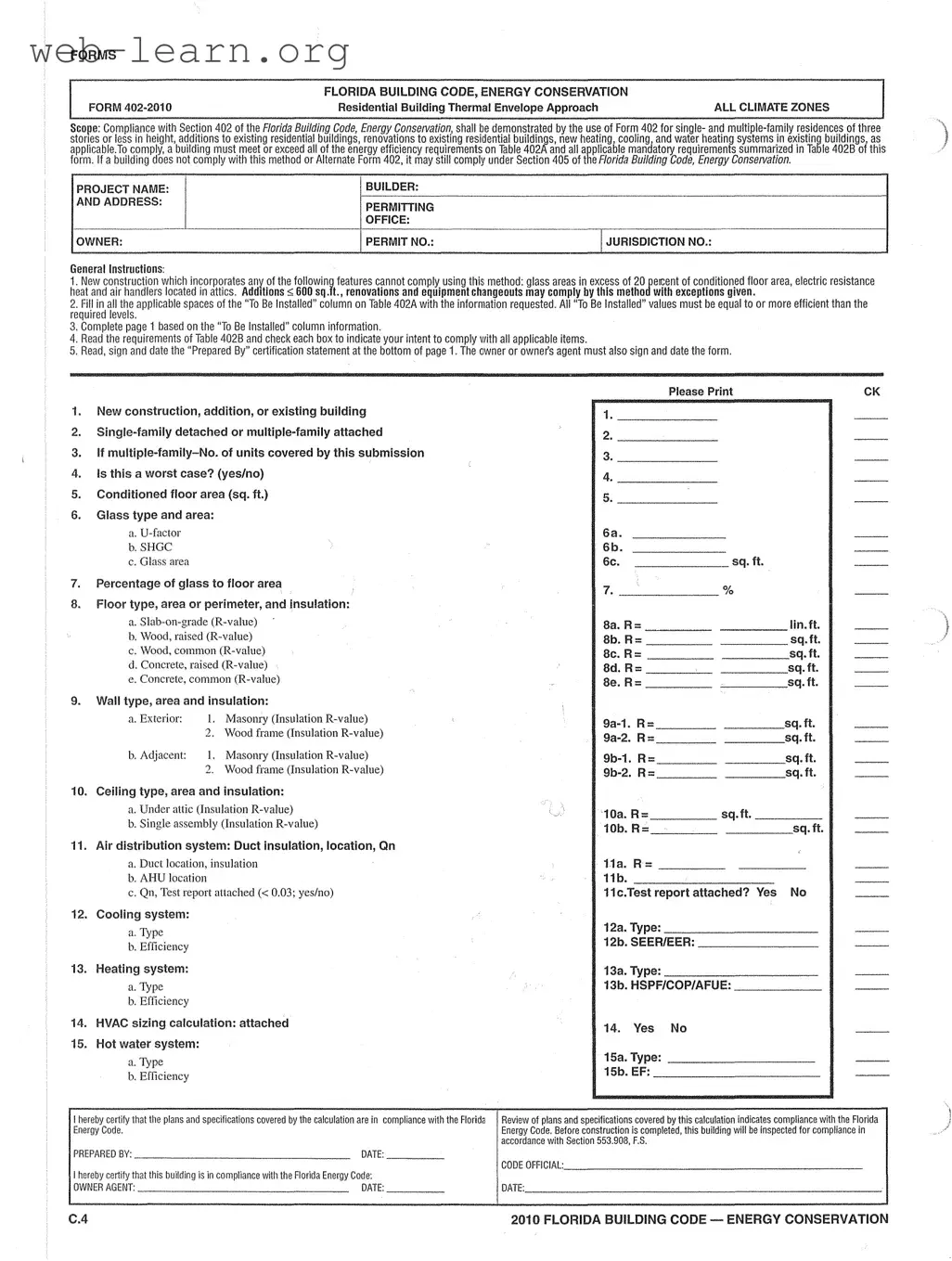
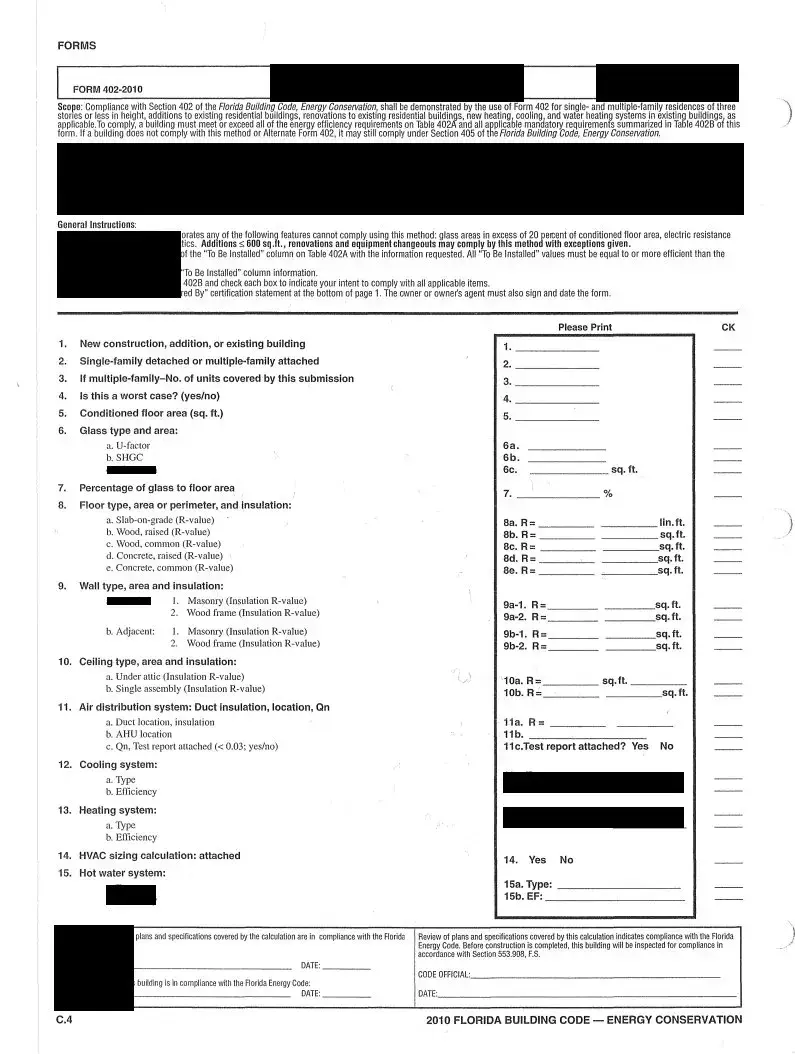
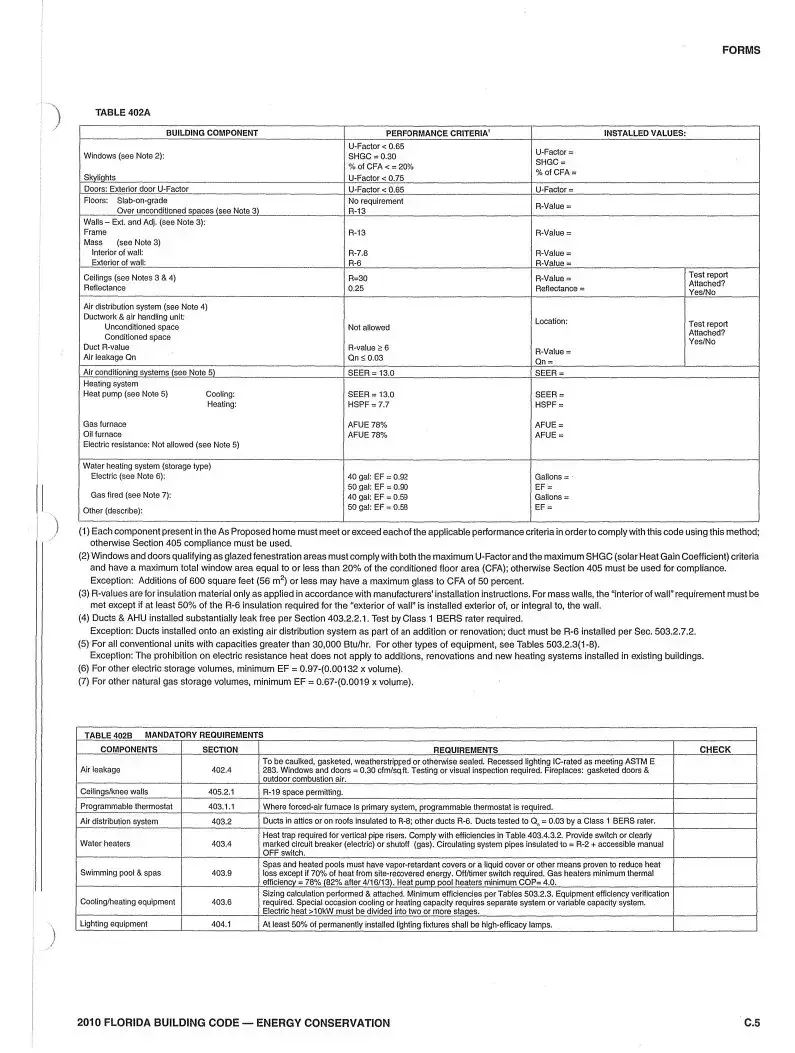
The Florida Energy Form is a crucial document that ensures compliance with the energy conservation standards set forth in Section 402 of the Florida Building Code. This form applies to various types of residential buildings, including single-family homes and multi-family residences up to three stories in height. It covers new constructions, additions, renovations, and the installation of new heating, cooling, and water heating systems in existing buildings. To meet the energy efficiency requirements, the building must adhere to the standards outlined in Table 402A, which details the performance criteria for various building components, such as windows, walls, and HVAC systems. Additionally, Table 402B summarizes mandatory requirements that must be checked for compliance. Notably, specific features, such as excessive glass areas or electric resistance heating in attics, disqualify a project from using this method for compliance. The form also requires detailed information about the building's characteristics, including conditioned floor area, insulation values, and system efficiencies, ensuring that all components meet or exceed established benchmarks. Owners or their agents must sign the form, confirming their commitment to adhere to the energy conservation measures outlined in the Florida Building Code.
Sample - Florida Energy Form

FORMS
Scope:
Compliance
with
Section
402
of
the
Florida
Building
Code,
Energy
Conservation,
shall
be
demonstrated
by
the
use
of
Form
402
for
single-
and
multiple-family
residences
of
three
stones
or
less
in
height,
additions
to
existing
residential
buildings,
renovations
to
existing
residential
buildings,
new
heatingbcoolingJ
and
water
heating
systems
in
existing
buildings,
as
applicable.
To
comply,
a
building
must
meet
or
exceed
all
of
the
energy
efficiency
requirements
on
Table
402A
and
all
applica
le
manoatory
requirements
summarized
in
Table
402B
of
this
form.
If
a
building
does
not
comply
with
this
method
or
Alternate
Form
402,
it
may
still
comply
under
Section
405
of
the
Florida
Building
Code,
Energy
Conservation.
General
Instructions:
constrLJcti.<m
which
incorporates
any
of
the
following
features
cannot
comply
using
this
method:
glass
areas
in
excess
of
20
pen:::ent
of
conditioned
floor
area,
electric
resistance
located
in
attics.
Additions:::;
600
sq
.ft.,
renovations
and
equipment
change
outs
may
comply
by
this
method
with
exceptions
given.
applicable
spaces
of
the
"To
Be
Installed"
column
on
Table
402A
with
the
information
requested.
All
"To
Be
Installed"
values
must
be
equal
to
or
more
efficient
than
the
"To
Be
Installed"
column
information.
402B
and
check
each
box
to
indicate
your
intent
to
comply
with
all
applicable
items.
"Prepared
By"
certification
statement
at
the
bottom
of
page
1.
The
owner
or
owner's
agent
must
also
sign
and
date
the
form.
1.
New construction, addition,
or
existing building
2.
Single-family detached
or
multiple-family attached
3.
If
multiple-family-No.
of
units covered by this submission
4.
Is
this
a worst case? (yes/no)
5. Conditioned floor area (sq. ft.)
6.
Glass type and area:
U-factor
b.
SHGC
7. Percentage
of
glass
to
floor
area
8.
Floor type, area
or
perimeter, and insulation:
Slab-on-grade (R-value)
b.
Wood, raised (R-value)
Wood, common (R-value)
d. Concrete, raised (R-value)
common (R-value)
9. Wall type, area and insulation:
b.
Adjacent:
l.
Masonry (Insulation R-value)
Wood frame (Insulation R-value)
1.
Masonry (Insulation R-value)
Wood frame (Insulation R-value)
10.
Ceiling type, area and insulation:
Under attic (Insulation R-value)
Single assembly (Insulation R-value)
11. Air distribution system: Duct insulation, location,
Qn
Duct location, insulation
b.
AHU location
Qn, Test report
attached(<
0.03; yes/no)
12. Cooling system:
Type
b.
Efficiency
13. Heating system:
Type
b.
Efficiency
14.
HVAC
sizing calculation: attached
15. Hot water system:
Please
Print
1.
2.
3.
4.
5.
6a.
6b.
6c.
sq. ft.
7. %
Sa.
R:::
lin. ft.
8b.
R:::
sq. ft.
ac.
R=
sq. ft.
8d.
R:::::
sq. ft.
ae.
A=
sq. ft.
9a-i.
A=
sq. ft.
9a-2.
R=
sq. ft.
9b-1.
R::::
sq. ft.
9b-2.
R::::
sq. ft.
10a.
R=
sq. ft.
10b.
R-
sq. ft.
11a.
R::::
___
_
11b.
----------------
11
c. Test report attached?
Yes
No
14. Yes No
15a.
15b.
CK
plans
and
specifications
covered
by
the
calculation
are
in
compliance
with
the
Florida
Review
of
plans
and
specifications
covered
by
this
calculation
indicates
compliance
with
the
Florida
Energy
Code.
Before
construction
is
completed,
this
building
will
be
inspected
for
compliance
in
accordance
with
Section
553.908,
F.S.
DATE:
___
_
CODE
OFFICIAL:
___________________
.
rnrtiht
エィセエエィゥッ@
building
is
in
compliance
with
the
Florida
Energy
Code:
DATE:
___
_
C.4
2010 FLORIDA BUILDING
CODE-
ENERGY CONSERVATION
FORMS
TABLE402A
BUILDING COMPONENT
PERFORMANCE CRITERIA'
INSTALLED VALUES:
U-Factor < 0.65
U-Factor=
Windows (see Note 2):
SHGC=0.30
SHGC=
%of
CFA <:::
20%
Skvliahts
U-Factor < 0.75
%of
CFA=
セイウZ@
Exterior door U-Factor
U-Factor < 0.65
U-Factor=
Floors: Slab-on-grade
No requirement
R-Value =
Over unconditioned spaces (see Note 3)
R-13
Walls-
Ext. and Adj. (see Note 3):
Frame
R-13
A-Value
Mass
(see Note 3)
Interior of wall:
R-7.8
A-Value=
Exterior of wall:
R-6
A-Value-
Ceilings (see Notes 3 & 4)
R=30
A-Value=
Test report
Attached?
Reflectance
0.25
Reflectance =
Yes/No
Air distribution system (see Note 4)
Ductwork
& air handling unit:
Location:
Test report
Unconditioned space
Not
allowed
Attached?
Conditioned space
Yes/No
Duct A-value
A-value<:
6
R-Value
Air leakage On
On
セPNPS@
On=
Air conditionina svstems (see Note
5)
SEER=
13.0
SEER=
Heating system
Heat pump (see Note 5)
Cooling:
SEER 13.0
SEER=
Heating:
HSPF = 7.7
HSPF=
Gas furnace
AFUE78%
AFUE=
Oil furnace
AFUE78%
AFUE=
Electric resistance: Not allowed (see Note 5)
Water heating system (storage type)
Electric (see Note
40 gal: EF = 0.92
Gallons
50 gal:
EF = 0.90
EF=
Gas fired (see Note 7):
40 gal: EF =
0.59
Gallons=
Other (describe):
50 gal: EF
0.58
EF=
(1) Each component present in the As Proposed home must meet
or
exceed each of the applicable performance criteria in order to comply with this code using this method;
otherwise Section
405 compliance must be used.
(2) Windows and doors qualifying as glazed fenestration areas must comply with both the maximum U-Factor and the maximum SHGC (solar Heat Gain Coefficient) criteria
and have a maximum total window area equal to
or
less than 20% of the conditioned floor area (CFA); otherwise Section 405 must be used for compliance.
Exception: Additions
of
600 square feet (56 m
2
)
or
less may have a maximum glass to CFA of 50 percent.
(3)
A-values are for insulation material only as applied in accordance with manufacturers' installation instructions. For mass walls, the "interior of wall" requirement must be
met except if at least
50% of the R-6 insulation required for the "exterior of wall" is installed exterior of,
or
integral to, the wall.
(4) Ducts
& AHU installed substantially leak free
per
Section 403.2.2.1. Test by Class 1
BERS
rater required.
Exception: Ducts
installed onto an existing air distribution system as part of
an
addition
or
renovation; duct must be R-6 installed
per
Sec. 503.2.7.2.
(5) For
all conventional units with capacities greater than 30,000 Btu/hr. For other types
of
equipment, see Tables 503.2.3(1-8).
Exception: The prohibition on electric resistance heat does not apply to additions, renovations and new heating systems
installed in existing buildings.
(6) For other electric storage volumes, minimum EF = 0.97-(0.00132 x volume).
(7) For other natural gas storage volumes, minimum EF = 0.67-(0.0019 x volume).
TABLE
4028
MANDATORY REQUIREMENTS
COMPONENTS
SECTION
REQUIREMENTS
I
CHECK
To
be caulked, gasketed,
キ・。エィ・イウエイゥーセ・、@
or
otherwise sealed. Recessed lighting !C-rated as meeting ASTM E
Air leakage
402.4
283. Windows and
doors=
0.30 cfm/sq.ft. Testing or visual inspection required. Fireplaces: gasketed doors &
outdoor combustion air.
Ceilings/knee
walls
405.2.1
R-19 space permitting.
Programmable thermostat
403.1.1
Where forced-air furnace is primary system, programmable thermostat is required.
Air distribution system
403.2
Ducts in attics
or
on roofs insulated to
R-8;
other ducts R-6. Ducts tested to
a.
= 0.03 by a Class 1 BERS rater.
Water heaters
403.4
Heat trap required for vertical pipe risers. Comply with efficiencies in Table 403.4.3.2. Provide switch
or
clearly
marked circuit breaker (electric) or shutoff (gas). Circulating system pipes insulated
to=
R-2 +accessible manual
OFF switch.
Spas and heated pools must have vapor-retardant covers or a liquid cover
or
other means proven to reduce heat
Swimming pool & spas
403.9
loss except if 70%
of
heat from site-recovered energy. Off/timer switch required. Gas heaters minimum thermal
efficiency-
78% (82% after 4/16/13). Heat pump pool heaters minimum
COP-
4.0.
Sizing calculation performed & attached. Minimum efficiencies per Tables 503.2.3. Equipment efficiency verification
Cooling/heating equipment
403.6
required.
Special occasion cooling or heating capacity requires separate system or variable capacity system.
Electric heat
>10kW must be divided into two or more stages.
Lighting equipment
404.1
At least 50% of permanently installed lighting fixtures shall be high-efficacy lamps.
2010 FLORIDA BUILDING
CODE-
ENERGY CONSERVATION
C.5

Form Information

Fact Name Description
Governing Law This form is governed by Section 402 of the Florida Building Code, Energy Conservation.
Scope of Use Form 402 is used for compliance in single- and multiple-family residences up to three stories, as well as for renovations and new systems in existing buildings.
Energy Efficiency Requirements Buildings must meet or exceed the energy efficiency criteria outlined in Table 402A and the mandatory requirements in Table 402B.
Non-Compliance Options If a building does not meet the requirements of Form 402, compliance may be achieved under Section 405 of the Florida Building Code.
Certification Requirements The form must be signed and dated by the owner or their agent, along with a "Prepared By" certification statement.

Detailed Guide for Filling Out Florida Energy

Filling out the Florida Energy form is essential for ensuring compliance with energy efficiency standards. To complete the form accurately, follow the steps outlined below. Each section requires specific information about the building's characteristics and energy systems. Make sure to gather all necessary data before you start.

  1. Determine if the project involves new construction, an addition, or an existing building.
  2. Identify whether the building is a single-family detached or multiple-family attached structure.
  3. If it's a multiple-family building, specify the number of units covered by this submission.
  4. Indicate if this is a worst-case scenario by selecting yes or no.
  5. Input the conditioned floor area in square feet.
  6. Provide details about the glass type and area, including U-factor and solar heat gain coefficient (SHGC).
  7. Calculate the percentage of glass relative to the floor area.
  8. Detail the floor type, area, or perimeter, and insulation values for each type of floor present.
  9. List the wall type, area, and insulation values for both exterior and adjacent walls.
  10. Specify the ceiling type, area, and insulation values.
  11. Describe the air distribution system, including duct insulation and location.
  12. Provide information about the cooling system type and its efficiency rating.
  13. Detail the heating system type and its efficiency rating.
  14. Attach any required test reports, including HVAC sizing calculations.
  15. Complete the "Prepared By" certification statement at the bottom of page 1.
  16. Ensure that the owner or owner's agent signs and dates the form.

Obtain Answers on Florida Energy

  1. What is the purpose of the Florida Energy form?

    The Florida Energy form is designed to ensure compliance with Section 402 of the Florida Building Code, specifically focusing on energy conservation. This form must be used for single-family and multiple-family residences that are three stories or less, as well as for additions, renovations, and new heating or cooling systems in existing buildings. By using this form, builders can demonstrate that their projects meet or exceed the required energy efficiency standards outlined in the code.

  2. Who is required to fill out the Florida Energy form?

    The owner of the property or their designated agent is responsible for completing the Florida Energy form. This includes providing all necessary information about the building's construction, such as the type of materials used, insulation values, and energy systems installed. Both the preparer and the owner must sign and date the form to certify its accuracy.

  3. What types of buildings require this form?

    The Florida Energy form is applicable to:

    • New construction of single-family detached homes.
    • New construction of multiple-family attached residences.
    • Additions to existing residential buildings.
    • Renovations of existing residential buildings.
    • Installation of new heating, cooling, and water heating systems in existing buildings.
  4. What are the energy efficiency requirements?

    To comply with the Florida Energy form, a building must meet or exceed the energy efficiency standards outlined in Table 402A. This includes specific performance criteria for various building components, such as windows, walls, ceilings, and HVAC systems. Additionally, all mandatory requirements summarized in Table 402B must be checked to indicate compliance.

  5. What happens if a building does not meet the requirements of the Florida Energy form?

    If a building does not comply with the standards set forth in the Florida Energy form, it may still achieve compliance under Section 405 of the Florida Building Code. This alternative method allows for different compliance pathways, but it may involve additional steps or requirements.

  6. Are there any exceptions to the compliance requirements?

    Yes, there are exceptions for certain situations. For example, if a building has glass areas that exceed 20% of the conditioned floor area, it cannot comply using this method. However, for additions of 600 square feet or less, a maximum glass-to-floor area ratio of 50% may apply. Additionally, electric resistance heating is not allowed in attics, but may be permitted for new heating systems in existing buildings.

  7. How is compliance verified?

    Compliance with the Florida Energy form will be verified through inspections conducted before construction is completed. The building will be checked to ensure it meets the requirements of the Florida Energy Code as outlined in Section 553.908, F.S. It's crucial for builders to ensure that all components and systems installed are in accordance with the energy efficiency standards to avoid any compliance issues.

Common mistakes

Filling out the Florida Energy form can be a straightforward process, but there are common mistakes that people often make. Understanding these pitfalls can help ensure compliance with the Florida Building Code, Energy Conservation. Here are seven common errors to avoid.

One frequent mistake is failing to accurately report the conditioned floor area. This area is crucial for determining energy efficiency requirements. People sometimes miscalculate or misinterpret what constitutes conditioned space, leading to incorrect submissions. Ensure that you measure correctly and include only the areas that are heated or cooled.

Another common error involves the glass area percentage. Many individuals overlook the requirement that the total glass area should not exceed 20% of the conditioned floor area. If the glass area is too large, the building will not meet energy efficiency standards. Double-check your measurements and calculations to avoid this issue.

In addition, many people neglect to verify the U-factor and SHGC values for windows and doors. These values are essential for compliance, and using incorrect figures can lead to non-compliance. Always refer to the most recent specifications and ensure that the installed values meet or exceed the required criteria.

Another mistake is not completing the "To Be Installed" column accurately. All entries must be equal to or more efficient than the values listed in the form. Incomplete or incorrect entries can lead to compliance issues. Take your time to fill this section out thoroughly.

People often forget to check all applicable boxes in the mandatory requirements section. This part is essential for demonstrating compliance with various energy efficiency measures. Missing a box can indicate non-compliance, so be diligent in reviewing this section.

Additionally, signatures can be a point of confusion. The form requires the owner or their agent to sign and date it. Failing to provide this certification can result in delays or rejections. Make sure that all necessary signatures are present before submission.

Lastly, many individuals do not attach the required supporting documents, such as HVAC sizing calculations or test reports. These documents are crucial for demonstrating compliance with the Florida Energy Code. Ensure that all necessary paperwork accompanies the form to avoid complications.

By being aware of these common mistakes, you can help ensure that your Florida Energy form is filled out correctly and efficiently. Taking the time to double-check your work can save you from potential compliance issues down the line.

Documents used along the form

When dealing with the Florida Energy form, it's important to understand that several other documents and forms often accompany it. These documents help ensure compliance with the Florida Building Code and facilitate the overall process of energy conservation in residential buildings. Below is a list of commonly used forms and documents that may be required alongside the Florida Energy form.

  • Building Permit Application: This document is necessary for obtaining permission to begin construction or renovation. It outlines the scope of work and ensures that the project complies with local building codes.
  • Energy Compliance Certificate: This certificate confirms that a building meets the energy efficiency standards set forth in the Florida Building Code. It is often issued after a thorough inspection and review of the energy calculations.
  • HVAC Sizing Calculation: This calculation provides detailed information on the heating, ventilation, and air conditioning system's requirements for a building. It ensures that the system is appropriately sized for the space it serves, promoting energy efficiency.
  • Plans and Specifications: These documents outline the design and technical details of the construction project. They must be submitted for review to ensure compliance with the energy code and other regulations.
  • Insulation Inspection Report: This report verifies that insulation materials have been installed according to code requirements. It is crucial for ensuring that the building meets energy efficiency standards.
  • Test Reports for Duct Leakage: These reports confirm that duct systems are sealed and insulated properly, minimizing energy loss. They are essential for compliance with energy conservation measures.
  • Final Inspection Report: After construction is completed, this report is generated to confirm that the building meets all applicable codes and standards. It is a critical step before occupancy can be granted.

Understanding these documents and their roles in the compliance process is vital for any construction or renovation project in Florida. Ensuring that all necessary forms are completed and submitted can help avoid delays and complications, ultimately leading to a smoother project experience.

Similar forms

The Florida Energy form is essential for demonstrating compliance with energy efficiency standards in building projects. Several other documents share similarities with this form, each serving a specific purpose in ensuring energy conservation. Below are six documents that are comparable to the Florida Energy form, along with explanations of their similarities.

  • REScheck: This form is used nationwide to show compliance with energy codes for residential buildings. Like the Florida Energy form, REScheck requires detailed information about building components, insulation, and energy systems to ensure they meet energy efficiency standards.
  • COMcheck: Similar to REScheck, COMcheck is designed for commercial buildings. It assesses energy compliance through a checklist format, much like the Florida Energy form, focusing on insulation, lighting, and HVAC systems to verify adherence to energy codes.
  • Energy Star Certification: This program requires documentation that demonstrates a building's energy efficiency. The process involves detailed assessments of energy systems and components, paralleling the requirements of the Florida Energy form for documenting compliance with energy conservation measures.
  • HERS Index: The Home Energy Rating System (HERS) Index evaluates a home's energy efficiency. The assessment involves a comprehensive analysis of the building's energy features, similar to the detailed requirements outlined in the Florida Energy form.
  • LEED Certification: Leadership in Energy and Environmental Design (LEED) certification requires extensive documentation of a building's energy efficiency. This process shares similarities with the Florida Energy form, as both require detailed information about various building components and systems to achieve compliance with energy efficiency standards.
  • ASHRAE Standards: The American Society of Heating, Refrigerating and Air-Conditioning Engineers (ASHRAE) sets guidelines for energy efficiency in buildings. Compliance with these standards often necessitates similar documentation and assessments as required by the Florida Energy form, focusing on energy performance and efficiency metrics.

Understanding these similarities can help streamline the compliance process for energy efficiency in building projects. Each document serves a unique purpose but ultimately aims to promote sustainable practices and energy conservation.

Dos and Don'ts

When filling out the Florida Energy form, it's essential to approach the task with care. Here are some important dos and don'ts to keep in mind:

  • Do ensure all information is accurate and complete.
  • Do verify that the building meets or exceeds the energy efficiency requirements outlined in Table 402A.
  • Do check each box in Table 402B to indicate compliance with all applicable items.
  • Do have the form signed and dated by the owner or their agent.
  • Don't ignore the mandatory requirements listed in Table 402B.
  • Don't forget to include any necessary supporting documents, such as test reports.
  • Don't leave out the "Prepared By" certification statement at the bottom of page 1.
  • Don't submit the form without double-checking for any errors or omissions.

By following these guidelines, you can help ensure that the submission process goes smoothly and that your building complies with the Florida Energy Code.

Misconceptions

Misconceptions about the Florida Energy form can lead to confusion regarding compliance and requirements. Here are four common misconceptions:

  • The Florida Energy form is only for new constructions. This is incorrect. The form applies to new constructions, additions to existing buildings, and renovations. Even existing buildings that undergo changes must comply with the requirements outlined in the form.
  • All buildings must meet the same energy efficiency standards. Not true. The standards vary based on the type of building and its specific characteristics. For example, single-family homes and multiple-family residences have different criteria, and certain exceptions apply to smaller additions.
  • If a building fails to comply with the form, it cannot be approved. This is a misconception. A building can still comply with the Florida Building Code under Section 405, even if it does not meet the requirements of Form 402. Alternative methods exist for compliance.
  • Only the builder or contractor needs to sign the form. This is misleading. The owner or the owner's agent must also sign and date the form. This ensures that all parties are aware of and agree to the compliance requirements.

Key takeaways

When filling out and using the Florida Energy form, keep these key points in mind:

  • Purpose: The form ensures compliance with the Florida Building Code, specifically Section 402 related to energy conservation.
  • Applicability: It applies to single-family and multiple-family residences up to three stories, along with certain renovations and additions.
  • Energy Efficiency: Buildings must meet or exceed the energy efficiency requirements outlined in Table 402A and comply with mandatory requirements in Table 402B.
  • Glass Area Limitations: Structures cannot have glass areas exceeding 20% of the conditioned floor area unless they meet specific exceptions.
  • Signatures Required: The form must be signed and dated by the owner or the owner's agent to validate the information provided.
  • Information Accuracy: All values in the "To Be Installed" column must be equal to or more efficient than the specified requirements.
  • Compliance Options: If compliance is not achieved through this method, alternative compliance options are available under Section 405 of the Florida Building Code.
  • Inspection Requirement: The building will be inspected for compliance before construction is completed, ensuring adherence to the Florida Energy Code.